In the predawn darkness of December 11, 1899, the kilted soldiers of the Highland Brigade advanced in parade-ground formation, their lines kept straight by ropes held in the inky black. They were marching straight into a deadly ambush. Within minutes, the African sky would light up with the flashes of Mauser rifles, and the British Army would suffer one of its most humiliating defeats of the Victorian era.
The Battle of Magersfontein was a catastrophe that stunned the British Empire. It was the centerpiece of ‘Black Week,’ a five-day period in which the British Army was defeated three times by the Boer forces. The Highland Brigade—including the legendary Black Watch—lost over 700 men in the opening minutes. Among the dead was their commander, Major General Andrew Wauchope. This is the story of how arrogance, outdated tactics, and a brilliantly concealed trench turned a Scottish charge into a slaughter.
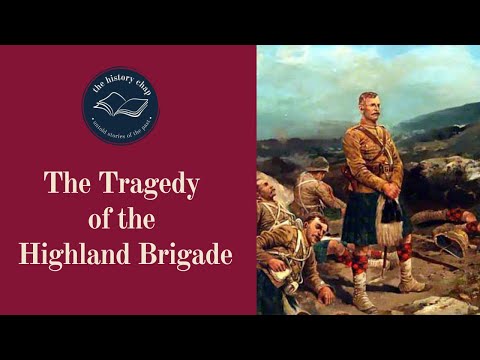
As the first streaks of dawn appeared, the Highlanders found themselves tangled in barbed wire, the jangling tin cans alerting the Boers. Then, from just 400 yards ahead—not from the hillside they expected—a single shot rang out. It was the signal for a storm of rifle fire from Boers lying low in a concealed trench at the foot of the hill. The British, trained to fight massed native armies, were cut down before they could even see their enemy.
The Boers, under the command of General Koos de la Rey, had crafted a masterful defense. De la Rey, a seasoned guerrilla fighter, had ordered a 1,000-yard trench dug on the level ground, hidden by barbed wire and scrub. It was the last place the British would expect them. The British commander, Lord Methuen, had not scouted properly; he assumed the Boers were entrenched on the hilltop. His plan was a simple dawn assault—the same tactic that had failed disastrously at Stormberg just hours earlier.
As the sun rose, the Highlanders were pinned down under the baking African sun, unable to move forward or retreat. Sir Arthur Conan Doyle later wrote that 700 Highlanders were hit in the first seven minutes. The Black Watch, the Seaforth Highlanders, the Argyll and Sutherland Highlanders—all were trapped in the killing zone. The British artillery tried to shell the Boer positions, but the Boers simply took cover in their trenches. Small groups of Highlanders made desperate runs for safety, but many never made it.
By late afternoon, with his center collapsing, Methuen ordered a full retreat. The British suffered 970 casualties, the bulk of them from the Highland Brigade. It was the worst loss in a single day’s fighting since the Crimean War. The Boers lost only about 250 men. Kimberley remained besieged, and Methuen’s career was effectively ruined. Yet, in a strange twist of fate, he would be captured by De la Rey a month before the war ended—and released on parole.
The Highland Brigade fought on under the legendary General Hector MacDonald, but the scars of Magersfontein would never fully heal. The battle exposed the British Army’s outdated tactics and its underestimation of the Boer farmer-soldiers. It was a lesson that would be learned again and again in the brutal guerrilla war that followed.
But Black Week was not yet finished with the British Empire. Even as the survivors of Magersfontein stumbled back toward the Modder River camp, news arrived from the far side of the theatre that would turn shock into something closer to panic. On December 15, barely four days after the Highland Brigade’s slaughter, General Redvers Buller himself would march into his own catastrophe at Colenso.
Buller had spent weeks creeping up the railway line toward Ladysmith, where General White’s garrison was slowly starving behind the Boer siege lines. Unlike Methuen, Buller was no aristocratic amateur—he was a Zulu War veteran with a Victoria Cross, a man the troops called ‘the Bull’ for his blunt, thundering manner. He was expected to be the one British commander who understood the Boers.
Yet he too was marching with the same assumptions. His plan called for a crossing of the Tugela River, a frontal push toward the hills beyond, and the relief of Ladysmith within days. What he did not know was that Louis Botha, a young, energetic Boer commander barely thirty-seven years old, had spent the same weeks preparing a trap every bit as cunning as De la Rey’s.
Botha had positioned his men not in the obvious spots, but in the folds and hollows of the riverbank—places where British reconnaissance could not see them. He had even ordered his men to dig trenches and then cover them with brush so that, from a distance, the ground looked empty. The British would have to cross the open riverbed under fire from an enemy they could not locate.
On the morning of December 15, Buller’s brigades advanced. The result was eerily familiar. British artillery fired at empty hills. Infantry crossed the river and walked into a curtain of Mauser fire from concealed positions. Within hours, the attack had collapsed. Ten British guns were abandoned in the riverbed, and over 1,100 men were killed, wounded, or captured. Buller, stunned and shaken, ordered a retreat.
The news reached London the same day. Three defeats in five days—Stormberg, Magersfontein, Colenso—had shattered the myth of British invincibility. Queen Victoria was said to be deeply distressed. The press, which had cheered the war’s outbreak, now demanded answers. Black Week had become a national humiliation.
Yet even as the British reeled, the Boer leaders faced a dilemma of their own. They had won stunning defensive victories, but they had not driven the British into the sea. Buller’s army, though bloodied, remained in the field. Methuen’s force still threatened Kimberley. And far to the west, another British column was already on the move.
Botha, De la Rey, and Cronjé had proven that farmer-soldiers with modern rifles could humble a professional army. But the British Empire had reserves of men and money that the tiny Boer republics could never match. The question hanging over the veld in that bleak December was simple: how long could the Boers keep winning before the weight of the Empire crushed them?
The answer would not come quickly. Within weeks, the British would call up their largest expeditionary force since the Napoleonic Wars. New commanders would arrive. The war would drag on for two more bitter years, shifting from set-piece battles to a grinding guerrilla struggle that would scar South Africa for generations.
Field Marshal Lord Roberts, the hero of Kandahar and one of the most celebrated soldiers of the age, was dispatched to take overall command, bringing with him his chief of staff, the hard-driving Major General Lord Kitchener. Together they would assemble an army of nearly 200,000 men—a force so vast that the Boer republics could never hope to match it in the field.
The strategy changed with them. No more frontal charges into concealed trenches. Roberts would use the sheer weight of numbers to turn the Boer flanks, to march around their defenses rather than through them. Kimberley would be relieved by a sweeping cavalry ride, and Cronjé himself would be surrounded and forced to surrender at Paardeberg. The Boer capitals of Bloemfontein and Pretoria would fall, and the war would appear, for a moment, to be won.
But it was not won. The Boers simply refused to accept defeat. When their armies could no longer stand and fight, they melted away into the vastness of the veld, splitting into small, fast-moving commandos that struck at railway lines, supply columns, and isolated garrisons. De la Rey, Botha, and the brilliant young Christiaan de Wet became ghosts, appearing without warning and vanishing before the British could respond.
In response, Kitchener turned to harsher methods. He built a vast network of blockhouses, strung barbed wire across the plains, and ordered the burning of Boer farms. Thousands of Boer women and children were herded into concentration camps, where disease and starvation would eventually claim more than twenty thousand lives. The war had become something far uglier than the set-piece battles of Black Week.
Back in Britain, the public that had cheered the war’s outbreak now grew weary and divided. Some spoke of the camps with horror; others demanded that the Boers be crushed without mercy. The war dragged on through 1901 and into 1902, a grinding, bitter struggle that neither side could decisively win.
It was the Peace of Vereeniging, signed in May 1902, that finally ended the fighting. The Boer republics would be absorbed into the British Empire, but the terms were generous—a recognition that the Boers could not be treated as a conquered people forever. Yet the scars of the war would linger long after the guns fell silent.
For the British Army, Black Week had been a brutal education. The tactics of Omdurman and Tel el-Kebir, of massed volleys and bayonet charges, had been proven obsolete against an enemy with modern rifles and the wit to use cover. Magdalfonstein and Colenso were not merely defeats; they were lessons written in blood, lessons that would shape British military thinking for a generation.
And for the Boers, the victories of Black Week became a source of enduring pride—proof that a handful of determined farmer-soldiers could stand against the mightiest empire on earth. The names of De la Rey, Botha, and De Wet would be remembered as heroes of a lost cause.
The war that began with such confidence in October 1899 had become, by its end, a cautionary tale about the limits of imperial power. The British Empire had won, but it had been humbled, and the world had seen that its armies were not invincible.
In the decades that followed, as the empire faced new challenges and new enemies, the ghosts of Magersfontein and Colenso would return to haunt its generals. The lessons of Black Week—about reconnaissance, about adaptability, about the deadly cost of underestimating one’s enemy—would echo through the trenches of the First World War and beyond.
Yet even as the British learned and adapted, the Boers could not reverse the tide. By 1902, their commandos were exhausted, their farms burned, their families interned. The Peace of Vereeniging was a bitter pill, but it was survival.
For the British, Black Week remained a scar on the national psyche. The red-coated soldiers who had charged at Magersfontein and Colenso became symbols of a vanished age, their bravery undoubted but their tactics fatally flawed. The empire would never again send its sons into battle with such blithe confidence.
And for the Boers, the victories of that dark December were both a triumph and a tragedy. They had proven that a handful of determined farmers could humble a superpower—but they had also learned that courage alone could not hold back the weight of an empire. The war had forged a new South African identity, one that would shape the country for a century to come.
As the sun set over the veld, the ghosts of Black Week lingered—a reminder that in war, the price of arrogance is always paid in blood. What do you think was the most important lesson the British Army learned from Black Week? Share your thoughts in the comments below.
Report this article
Select a reason for reporting:






