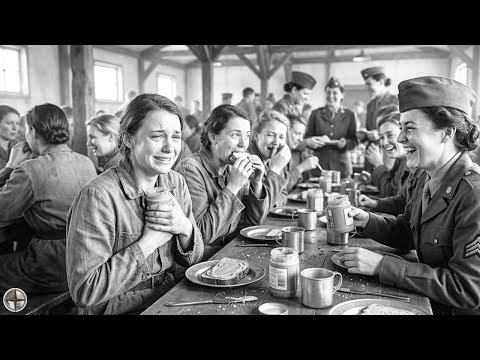
November 1944, Camp Aliceville, Alabama. Helga Brandt stared at the jar in her hands, her fingers trembling—not from fear, but from a confusion so deep it felt like vertigo. She had survived Rommel’s Africa Corps. She had pulled shrapnel from screaming soldiers and eaten rations so moldy they turned her stomach. She thought she had seen everything war could throw at her. Then America gave her peanut butter.
The brown paste inside the glass jar looked like axle grease. It smelled strange—nutty, sweet, completely alien. Across the table, 33 other German women, prisoners of war, stared at identical jars with identical bewilderment. An American guard walked by, scooped a spoonful straight from the jar, and ate it with a smile. “Best thing in the world,” she said. “You’ll love it.”
The German women thought it was a joke. Feed the prisoners machine grease and watch them suffer. But then Helga noticed something that made her blood run cold: the American guards weren’t eating different food. They were eating the exact same thing—same bread, same soup, same mysterious brown paste. Officers, cooks, guards—everyone ate it. Some even fought over it.
These Americans actually loved this stuff. And that’s when Helga realized something terrifying: everything she’d been told about America might be a lie.
Back in Germany, the newspapers said Americans were starving. The radio said their economy had collapsed. The propaganda films showed breadlines and poverty and weakness. But starving people don’t make butter out of peanuts.
What happened next changed 34 women forever. Within three days, Helga would be sneaking extra jars back to her bunk, trading her mother’s silver earrings for four spoonfuls, lying awake at night wondering what else the Reich had lied about. Within two weeks, the camp would run out of peanut butter because German prisoners consumed three times the expected supply. Within a month, a complete underground economy would form where peanut butter became more valuable than cigarettes, more precious than gold, more powerful than any propaganda.
And by the time these women returned to a destroyed Germany in 1947, they would carry something more dangerous than any weapon: the truth.
But that was all to come. For now, Helga just stared at the jar, her mind racing. The train had stopped with a loud screech of metal against metal, echoing through the Alabama countryside. It was November 1944. The air was cool but humid—different from the dry heat of North Africa where these women had been captured. Thirty-four German women stepped off the train at Camp Aliceville, their boots hitting American soil for the first time.
They were not soldiers in the traditional sense. They were Wehrmacht auxiliaries—nurses who had bandaged wounds in field hospitals, signals operators who had sent messages across battle lines, secretaries who had typed orders for generals. Women who had served the Reich in ways that did not require pulling triggers. Now they were prisoners of war in a country they had been taught to hate.
Helga Brandt was 26 years old. She had been a nurse in Rommel’s Africa Corps. She had seen men die in the desert sand. She had been captured when Allied forces overran her medical station. For three months, she had moved through processing camps—first in Algeria, then Morocco, then onto a ship crossing the Atlantic. She expected the worst from Americans.
But Camp Aliceville did not look like suffering.
The camp had been built in 1942 to hold captured enemy soldiers. At its peak, it held over 6,000 German prisoners. The women’s section was smaller, separated by fences, but built to the same standard: wooden barracks with real beds, showers with hot water, a medical clinic, a recreation area. Helga looked around. This is a prison? she thought.
The guards led them to the mess hall for their first meal. The building was large and clean. Long wooden tables stretched across the room. The smell hit them immediately—bread, meat, something cooking on stoves. And underneath it all, a strange nutty smell that none of them recognized.
They sat down on benches. American kitchen staff, some of them women, brought out plates: soup with vegetables, white bread—soft and fresh—canned peaches in sweet syrup, meat that was actually identifiable as meat. And on every table sat glass jars filled with brown paste.
Helga stared at hers. The substance inside was thick. It clung to the sides of the jar like grease. The color reminded her of mud, or maybe machine oil. A paper label said two words in English: Peanut Butter.
“What is this?” asked Ingrid, the woman next to her. Ingrid was 22, a signals operator from Hamburg. She picked up the jar and turned it in her hand. Nobody knew.
They watched the American staff. A young woman in a kitchen apron walked by with her own sandwich. She had spread the brown paste thickly on bread. She took a big bite and chewed happily, like it was the most normal thing in the world.
A guard named Betty noticed their confusion. She walked over with a smile. “Peanut butter,” she said slowly, pointing at the jar. “You eat it. It’s good.” She opened a jar, took a spoon, scooped out a large portion, and ate it directly. No bread, just peanut butter on a spoon. She closed her eyes like she was enjoying something wonderful.
The German women watched in complete confusion. “Americans eat this,” Helga whispered in German, “like this every day.”
Another guard, an older woman named Ruth, overheard through a translator. She laughed kindly. “Honey, I’ve eaten peanut butter every day since I was five years old. My kids eat it. My husband takes it to work. Every family in America has a jar in their kitchen.”
Helga did the math in her head. Every family. There were over 130 million Americans. If every family had peanut butter, that meant millions of jars. Millions and millions. But they told us Americans were starving.
That first meal, the German women ate the bread. They ate the soup. They ate the peaches. But the jars of peanut butter sat untouched. Too strange. Too suspicious. Perhaps it was some kind of trick.
“It looks like axle grease,” one woman muttered. Others laughed nervously.
But Helga noticed something. The American staff did not eat different food. They ate the same things. Same bread, same soup, same peanut butter. Guards and prisoners shared the same meals. In German camps, that would never happen. Prisoners ate scraps. Guards ate well. The difference showed who had power. But here, the lines blurred in ways that made no sense.
That night, lying in her bunk, Helga could not sleep. Not because of fear, not because of discomfort—the bed was actually soft, the blanket warm. She could not sleep because of those jars. Why did Americans love that strange brown paste so much? Why did they eat it with such joy? And why did they give it to prisoners like it was nothing special?
She had no answers. But tomorrow she would watch more carefully. She would learn. And if the Americans kept eating it like that, maybe she would try it herself—just one small taste, just to understand.
What she did not know was that one taste would change everything. Not just for her, but for every woman in that barracks.
The next morning came with gray skies and the smell of coffee drifting through the camp. Helga woke early. She had not slept well. Her mind kept returning to those jars, the brown paste, the way Americans ate it like treasure. She told herself it was just curiosity, nothing more.
At breakfast, the mess hall filled quickly. The German women took their seats. Same tables as yesterday. Same white bread, same strange jars sitting in the center like a test nobody wanted to take. Helga watched the American kitchen workers. A young woman named Dorothy was preparing sandwiches for the guards. She spread peanut butter on one slice of bread, then opened another jar and spread something red on the second slice. Strawberry jam. She pressed the slices together and wrapped it in paper.
“PB&J,” Dorothy said to another worker. “Best lunch there is—peanut butter and jam.”
Helga filed this information away. For fifteen minutes, the German women ate everything except the peanut butter. The bread disappeared. The eggs disappeared. The coffee was drunk to the last drop. But the jars remained sealed.
Then Ingrid spoke. “I cannot stand this anymore,” she said quietly. “I must know why they love it so much.”
She reached for a jar. The women at her table went silent. Ingrid twisted the lid. It popped open with a soft sound. The smell rose immediately—rich, nutty, a little sweet, unlike anything from German kitchens. Not unpleasant, but deeply foreign, like smelling a spice from a country you had never visited.
Ingrid took a knife and spread a thin layer on bread—very thin, almost invisible. She lifted the bread to her mouth. Everyone watched. She took the smallest possible bite. She chewed slowly. Her face showed nothing at first. Then her eyebrows rose. She chewed more, swallowed, looked at the bread in her hand like it had betrayed her.
“Well?” Helga asked. “Is it terrible?”
Ingrid shook her head slowly. “No.”
“Is it good?”
Ingrid took another bite, a bigger one this time. She chewed with her eyes closed. “It is very good,” she finally said. “It is salty and sweet at the same time. It sticks to your mouth. It fills you up. It tastes like…” She struggled for words. “It tastes like energy. Like strength.”
Helga felt something shift in the room. Other women leaned forward. Hands reached for jars. Lids twisted open one by one. The nutty smell spread across the entire table. One woman tried it and nodded. Another tried it and smiled for the first time since capture. A third woman, a nurse named Britta who had barely spoken in weeks, tasted it and whispered, “Mein Gott.”
Within ten minutes, Helga’s table had emptied two jars completely. She finally tried it herself. The texture was strange—thick and sticky. It clung to the roof of her mouth. But the flavor was remarkable: rich and deep, salty enough to satisfy, sweet enough to comfort. Her body responded instantly. After months of poor rations, her starving cells recognized real nutrition—protein, fat, calories. Her body knew what her mind did not. This food could keep you alive.
She took another bite, then another.
By the end of breakfast, something extraordinary had happened. Every jar on every table was empty. Forty-seven jars consumed in a single morning. American kitchen staff stood watching with wide eyes.
“Yesterday they wouldn’t touch it,” one cook said. “Today they ate everything we had.”
Dorothy laughed and shook her head. “Peanut butter does that. It converts everyone eventually.”
A supply sergeant checked his inventory later that morning. The women’s section had consumed nearly three times the expected amount. He wrote a confused note in his report: German female prisoners have developed extreme preference for peanut butter. Requesting increased supply. The camp’s records, now held in the National Archives, show that peanut butter consumption in the women’s section jumped 340% in the first week—a statistic so unusual that administrators in Washington requested confirmation.
That afternoon, the mess hall made an announcement through a translator. Due to high demand, peanut butter would be rationed: one jar per table, per meal. No exceptions.
The German women protested immediately. “One jar is not enough,” Ingrid said through the translator. “We need more.”
The American officer looked confused. “Yesterday you refused to eat it.”
“Yesterday we did not understand,” Ingrid replied. “Today we understand. We want more.”
Helga sat quietly, thinking about what had just happened. Thirty-four women who had been taught to distrust everything American had just begged for more peanut butter—not because they were forced, but because they wanted it. In Germany, such desire would be seen as weakness. But here, the Americans seemed pleased. They smiled. They nodded. They promised to request additional supplies.
That night, Helga wrote in a small notebook she kept hidden: The brown paste is called peanut butter. Americans eat it every day. They make it from peanuts, which are cheap and common here. They have so many peanuts that they turn them into butter. We were told America had no food. This was a lie.
She paused, her pencil hovering over the paper. What else was a lie?
She did not write more, but the question burned in her mind. And she knew she was not the only one asking it, because as the women returned to their barracks that night, clutching their rationed portions, something had changed beyond their taste buds. A small crack had appeared in the wall of beliefs they had carried across the ocean. And cracks, once started, tend to spread.
By early 1945, the brown gold economy had reshaped everything. Helga traded her mother’s silver earrings for four jars and felt no shame—only a strange, giddy freedom. Maria wrote in her diary: “When I eat it, I feel human again.” The guards noticed, and some traded too.
But the real change was quieter. Women began asking questions—about peanuts, about America, about everything. “We were told they were starving,” Ingrid said one night. “Yet they feed their enemies butter from surplus nuts.” The crack in their beliefs widened into a chasm.
When Germany surrendered in May 1945, the women wept—some for the Reich, most for relief. “To peace,” Guard Betty toasted, raising a jar. Helga lifted her spoon. “To plenty,” she answered in careful English.
She returned to a ruined Stuttgart in 1947, carrying four jars and a recipe card. Her mother tasted the paste and whispered, “We were told they had nothing.” Helga nodded. “Everything was backwards.”
Years later, her grandson asked what she learned. “Truth tastes different than propaganda,” she said. “It’s thick and rich and fills you up. Once you taste it, you can’t go back.”
Peanut butter won no battles. But for 34 women, it destroyed a lie—one sticky spoonful at a time. What would you have believed if you were Helga?
Report this article
Select a reason for reporting:






