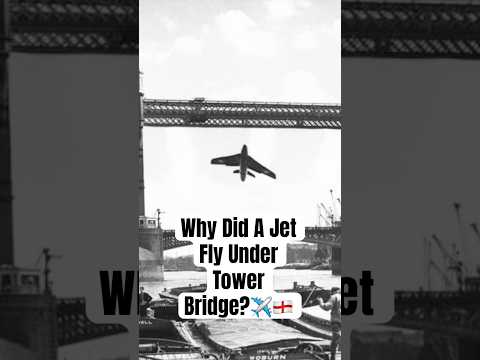
The roar of a Hawker Hunter’s engine shattered the quiet London morning. Office workers looked up from their desks. Pedestrians stopped mid-stride. And then, in a heartbeat, the impossible happened: a jet aircraft dove toward the Thames, threading the narrow gap between the towers of Tower Bridge.
It was April 8th, 1968. The pilot was Flight Lieutenant Alan Pollock, a Royal Air Force officer with a spotless record and a growing sense of injustice. In that single, audacious act, he would become one of only five people to ever fly an aircraft under the bridge—and the only one to do it as a protest.
The RAF was celebrating its 50th anniversary that year. But Pollock saw no grand celebrations, no official recognition. Instead, he watched as defense budgets were slashed and the military’s role was diminished. The government had recently announced deep cuts, and the RAF felt the sting. Pollock, a decorated pilot, was furious.
“I was fed up with the government’s attitude towards the RAF,” he later recalled. “I wanted to draw attention to the situation.”
So he devised a plan. He would fly his Hawker Hunter—a sleek, single-seat fighter—under Tower Bridge, the iconic symbol of London. It would be a stunt so bold, so dangerous, that no one could ignore it.
On that fateful morning, Pollock took off from RAF Tangmere. He flew toward London, his heart pounding. The weather was clear, the visibility perfect. As he approached the bridge, he dipped the jet’s nose and descended. The towers loomed on either side. The gap was just wide enough for his wingspan.
“I had to line up perfectly,” he said. “There was no room for error.”
He shot through the gap at over 400 miles per hour, the jet’s exhaust echoing off the water. Onlookers gasped. Some cheered. Others stared in disbelief. Pollock pulled up, climbed into the sky, and returned to base.
But his act of defiance didn’t go unnoticed. Upon landing, he was immediately arrested. The RAF was furious. The government was embarrassed. Pollock had made his point, but at a cost.
He was later dismissed from the RAF on medical grounds—a convenient way to avoid a court-martial. But Pollock’s story didn’t end there. His protest became a symbol of resistance, a reminder that sometimes, the most powerful statements are made not with words, but with actions.
As Pollock walked away from the RAF, he knew he had changed the conversation. But what happened next would surprise even him.
The public reaction was immediate and electric. Newspapers splashed the story across their front pages, some branding him a reckless fool, others a daring hero. Letters poured into the Air Ministry by the sackful—half demanding his head, half demanding a medal. In the pubs of London, men raised their glasses to the mad pilot who had the nerve to do what they all secretly dreamed of.
“He flew under Tower Bridge?” people asked, disbelief giving way to laughter. “Bloody brilliant.”
But behind the headlines, the machinery of the establishment was grinding. The Air Force had a problem on its hands. Pollock had broken nearly every rule in the book—low flying, flying over a built-up area, endangering the public—yet he had also done something extraordinary. A court-martial would mean weeks of embarrassing testimony, the government’s defense cuts laid bare for all to see. The last thing anyone wanted was Pollock in a courtroom, explaining his motives to a sympathetic public.
So they found another way. Medical grounds. A quiet, bureaucratic exit. Pollock was out of the RAF before the dust had even settled, spared the spectacle of a trial but stripped of the career he loved.
He didn’t fight it. In fact, he seemed almost relieved. “I’d made my point,” he said years later. “That was what mattered.”
But the story refused to die. Aviation enthusiasts began to study his flight, poring over maps and measurements. How wide was the gap? How fast was he going? Could it even be done? The more they looked, the more remarkable it seemed. The clearance on either side of his wings was measured in feet, not meters. One small error—a gust of wind, a moment’s hesitation—and he would have been a smear on the Thames.
Yet Pollock had done it without a scratch. He had threaded the needle of one of the world’s most famous landmarks, and he had done it sober, deliberate, and utterly in control.
As the weeks passed, something unexpected began to happen. Young pilots, inspired by his audacity, started to speak up about their own frustrations. The defense cuts became a talking point in Parliament. Questions were asked. Debates were held. And slowly, quietly, the RAF’s anniversary began to receive the recognition it had been denied.
Pollock had flown for only a few seconds under that bridge. But those seconds echoed for years.
But the full truth of that morning was stranger than the newspapers ever printed. Pollock had not acted alone. A small circle of confidants—two ground crewmen and a fellow pilot—had helped him plan the flight in secret, poring over tide tables and timing the run to coincide with a slack current. They knew the bridge’s bascules were up for a scheduled test that morning, and they knew the exact window when the gap would be widest and the river traffic thinnest.
“We checked it a hundred times,” one of the ground crew later admitted. “If the timing had slipped by even thirty seconds, he’d have been through the machinery instead of the gap.”
The secrecy held for years. The men who helped him kept their silence, partly out of loyalty and partly out of fear. But in the 1980s, as the story resurfaced in aviation magazines, one of them finally spoke. The revelation added a new layer to the legend: Pollock was not merely a lone daredevil, but a man who had inspired quiet, careful loyalty in others.
Meanwhile, the Air Ministry’s internal files—released decades later under the thirty-year rule—told their own story. The paperwork revealed a frantic scramble in the hours after the flight. Senior officers debated whether to charge him, whether to praise him, whether to bury the whole thing. One memo, scribbled in obvious frustration, read simply: “The man has made us look both foolish and magnificent. What does one do with that?”
What one did, it turned out, was nothing. The medical discharge was quietly processed, and Pollock slipped into civilian life. He took a job in civil aviation, kept his head down, and rarely spoke of the bridge. But the silence never quite held. Every few years, a journalist would track him down, and every few years, he would offer the same modest shrug.
“I was young and angry,” he told one interviewer. “I’d probably do it again.”
And yet, there was one detail he never discussed. In the cockpit that morning, as the towers rushed past on either side, he had felt something he could never quite put into words. Not fear, exactly. Something closer to peace. For those few seconds, everything in his life had narrowed to a single, perfect line—the gap, the river, the roar of the engine—and nothing else in the world had mattered.
It was the purest moment of his life. And he knew, even as he pulled up and climbed away, that nothing would ever match it again.
Years later, a young documentary filmmaker tracked Pollock to a quiet cottage in the countryside. She asked him the question no one had ever asked: not why he did it, but how it felt to know he could never do it again.
Pollock was silent for a long moment. Then he smiled, that same modest smile the cameras always caught. “You spend your whole life looking for one moment that’s truly yours,” he said. “I found mine at four hundred miles an hour. Most men never find theirs at all.”
The filmmaker asked if he regretted the career it cost him. He shook his head slowly. “They took my wings. They couldn’t take the morning.”
He died in 2001, largely unknown to the public that had once cheered him. But at his funeral, a handful of old pilots stood in silence as a lone Hawker Hunter—flown by a young RAF officer who had never met him—swept low over the churchyard and climbed into the grey sky. No one had ordered it. No one had asked. It simply happened, the way legends tend to.
The bridge still stands. The gap is still narrow. And somewhere in the archives, that frustrated memo gathers dust, asking its unanswerable question.
What does one do with a man who makes you look both foolish and magnificent?
Perhaps the answer is simpler than the Air Ministry ever imagined: you remember him. You tell his story. You let the echo of those few seconds carry on, long after the engine has gone quiet.
Because some acts of defiance aren’t really about anger at all. They’re about love—for a service, for a craft, for a single perfect moment that no rulebook could ever contain.
So here’s a question for you, reader: if you had one chance to thread the needle, to risk everything for something you believed in—would you dive, or would you climb away?
Report this article
Select a reason for reporting:






