What if the faces we fell in love with on the silver screen weren’t entirely real? Behind the glamour of Hollywood’s golden age lay a world of quiet scalpels, whispered procedures, and studio-mandated transformations. The stars we idolized weren’t just born beautiful—they were meticulously crafted, sometimes under the surgeon’s knife, to fit an impossible mold.
In this documentary, we uncover the secret surgeries that shaped the stars and the hidden costs of perfection. These aren’t just beauty tweaks. They’re the untold stories behind Hollywood’s most legendary faces.
Marilyn Monroe. Few transformations in Hollywood history are as iconic—or as surgically assisted—as Marilyn Monroe’s. Born Norma Jeane Mortenson, her evolution into Marilyn wasn’t just about hair dye and lipstick. In the late 1940s, studio insiders and doctors alike witnessed subtle but strategic changes. Confidential medical records, later leaked in the 1990s, confirmed that Monroe underwent a minor rhinoplasty to refine the tip of her nose and a chin augmentation to give her jawline a more classic contour. Dr. Michael Gurdin, a Los Angeles plastic surgeon, noted in a 1950s report that she had cartilage inserted in her chin. This was corroborated by X-rays sold at auction in 2010, which fetched over $25,000.
These quiet interventions helped eliminate the last traces of her girl-next-door looks, solidifying the facial symmetry that would make her one of the most photographed women of the 20th century. Marilyn’s appearance became the gold standard for blonde bombshells for decades, but few fans ever suspected her beauty was quite literally sculpted. The changes were so well done and so early in her career that they became invisible, woven into the myth of Marilyn itself.
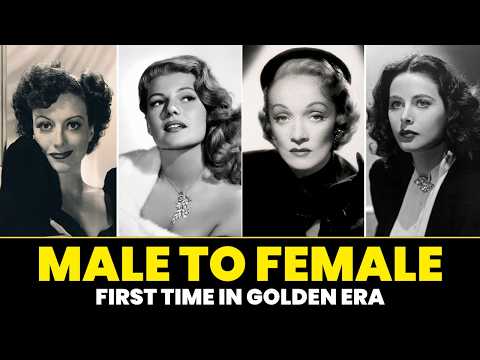
Rita Hayworth. Rita Hayworth’s metamorphosis was more than dramatic. It was radical. Born Margarita Carmen Cansino, the daughter of Spanish dancer Eduardo Cansino, her naturally low hairline and jet-black hair marked her as too ethnic for 1930s Hollywood. At the insistence of Columbia Pictures boss Harry Cohn, Rita underwent a painful process of electrolysis to raise her hairline and reshape her image. It took over two years of repeated treatments to erase what studios deemed a foreign look. She also underwent extensive hair bleaching and restyling, transforming from a raven-haired flamenco dancer into the flame-haired femme fatale of the silver screen.
Her new look debuted in the 1941 film Blood and Sand, and the transformation stunned critics. She became America’s favorite pinup during World War II with her photo pasted in the lockers of thousands of soldiers. The physical changes were so central to her stardom that she once famously said, “Men go to bed with Gilda, but they wake up with me.” The cosmetic overhaul did more than boost her appeal. It made her a quintessential Hollywood product, crafted and curated from root to tip.
Marlene Dietrich. Marlene Dietrich wasn’t just ahead of her time—she was designing it. Known for her impeccable style and nearly surreal facial structure, Dietrich was a pioneer in Hollywood’s obsession with youth and symmetry. She’s rumored to have undergone multiple minor facelifts throughout her career, beginning in the early 1930s, and maintained a meticulous beauty regimen that bordered on surgical ritual.
Dietrich’s reliance on surgical tape to lift her cheekbones and eyebrows before public appearances is well documented, and she reportedly had molars removed to further hollow out her cheeks, enhancing her sculpted look. In her later years, she wore custom wigs, strategically applied contour makeup, and used filtered lighting and film contracts to preserve her mystique. Photographers were often given specific angles from which to shoot her, and cameramen were instructed to use soft-focus lenses. Unlike many of her contemporaries, she had control over how she was seen—literally. Her beauty was part science, part performance. Her daughter, Maria Riva, confirmed much of this in her memoir, painting a picture of a woman who lived not behind the mask, but inside it. Dietrich didn’t chase the camera; she choreographed it.
Joan Crawford. Joan Crawford was a master of reinvention on and off the screen. Born Lucille Fay LeSueur, she rose from poverty to Hollywood royalty, and along the way, she reportedly reshaped her face to match the image of a leading lady. Studio records suggest that in the early 1930s, Crawford underwent molar extractions to narrow her face and exaggerate her already prominent cheekbones. Photographs from her silent film days show a noticeably rounder face that gradually gave way to the striking angular look she carried through the 1940s.
She also allegedly underwent minor eye surgeries and possibly early facelifts, though she always denied going under the knife. Beauty columnist Lydia Lane once hinted that Crawford’s transformation was equal parts makeup and magic, with a little surgical help in between. Crawford was intensely private about her appearance and often refused to allow candid or close-up photos on set. But her evolving face tells its own story. Her image—disciplinarian cheekbones, slashed lips, steely eyes—wasn’t just a look; it was armor. In the battle for stardom, Joan Crawford didn’t just play the part; she sculpted herself into it.
Judy Garland. Judy Garland’s story is perhaps one of the most tragic in classic Hollywood, and her transformation is among the most heartbreaking. As a child star, she was beloved for her raw talent and plain, approachable looks. But as she matured, MGM saw a need to mold her into a more traditionally glamorous figure. Studio pressure led Garland to undergo a rhinoplasty during the early 1940s, reportedly against her will. Memoirs from fellow actors and leaked studio correspondence suggest the procedure was minor but psychologically damaging.
Garland was also subjected to extreme weight-control regimens, including amphetamines to curb her appetite and barbiturates to sleep. These interventions left lasting scars—physically and emotionally. Makeup artists were instructed to contour her face to mask any imperfections, and her hair was constantly restyled to add height and elegance. Garland never fully escaped the studio’s grip on her appearance. The rhinoplasty erased part of the girl-next-door charm that had defined The Wizard of Oz, and though she blossomed into a stunning adult performer, the cost of her transformation was high. Beneath the perfect lighting, her insecurity always flickered.
Gloria Grahame. Gloria Grahame had the kind of face directors loved—sultry, expressive, and a little bit dangerous. But in Hollywood, even beauty wasn’t enough without conformity. In the late 1940s, Grahame underwent a surgical procedure to enlarge her upper lip, a decision that would haunt her for the rest of her career. Accounts vary: some say she received a collagen injection gone wrong; others believe cartilage was grafted from elsewhere in her body. Either way, the result was a permanently stiff upper lip—literally.
The surgery limited her facial mobility, creating a subtle but noticeable disconnect between her expressions and dialogue delivery. Director Nicholas Ray, her former husband, often expressed frustration with her limited range post-surgery, especially during the filming of In a Lonely Place in 1950. Despite this, Grahame continued landing roles, often playing femmes fatales who communicated more with their eyes than their mouths. Off-screen, she grew increasingly self-conscious, reportedly refusing to be photographed from certain angles and using heavy lip makeup to camouflage the result. By the late 1950s, her career had slowed, and though her talent never faded, the surgical change altered how casting directors saw her. In a town obsessed with reinvention, Grahame’s transformation became a cautionary tale.
Clark Gable. Before he became the King of Hollywood, Clark Gable had a problem: his teeth. Early in his career, Gable suffered from severe dental issues due to a gum infection, resulting in the removal of nearly all his teeth in his early thirties. He wore dentures for most of his adult life—a fact carefully concealed by MGM. The studio also arranged for a minor otoplasty—ear-pinning surgery—to bring his prominent ears closer to his head. The transformation was subtle but effective. Pre-surgery photos show a less polished version of the man who would later become synonymous with masculine charm.
According to film historian David Bret, Gable’s halitosis—allegedly caused by the dentures—created on-set tension, especially with co-stars like Vivien Leigh, who famously complained during the filming of Gone with the Wind. Still, his post-surgery appearance and screen presence were undeniable. Gable’s rugged look, bolstered by his dental and cosmetic upgrades, made him a box-office powerhouse through the 1930s and 1940s. It’s a reminder that even the most seemingly effortless stars were sometimes held together by studio magic and dental glue.
Hedy Lamarr. Hedy Lamarr was called the most beautiful woman to ever grace the silver screen. But even she wasn’t immune to the surgical scalpel of 1930s Hollywood. Born Hedwig Eva Maria Kiesler in Vienna, Lamarr had a stunning but strong-featured face when she arrived in the United States. MGM executives reportedly encouraged her to undergo a minor rhinoplasty to narrow and refine the bridge of her nose, enhancing the balance of her already striking features. The change was subtle but made her look more symmetrical under studio lighting.
Biographers also suggest she may have undergone dental correction and minor facial contouring in her first year in America. The refined look helped her land her breakout role in Algiers, where audiences were instantly captivated by her exotic beauty. But Lamarr was more than her looks. She also co-invented a frequency-hopping system that laid the groundwork for modern Wi-Fi. Ironically, while her face was being shaped to fit the Hollywood mold, her brain was building a future the industry couldn’t even imagine. For Hedy, the surgical tweaks were just the opening act.
Rock Hudson. When Rock Hudson first arrived in Hollywood as Roy Harold Scherer Jr., his rugged height and deep voice were obvious assets, but his face wasn’t quite ready for close-ups. Agents and casting directors saw potential—but only if certain features were refined. Hudson underwent a rhinoplasty to reshape his broad nose and had his teeth capped to perfect his smile. The procedures were performed early in his career, sometime around 1947 to 1948, as Universal Studios began grooming him for stardom.
His transformation was so effective that within five years he was headlining films and melting hearts in theaters across America. His square jaw, chiseled features, and flawless smile became archetypal. But Hudson’s polished look also served as a mask—both personally and professionally. While his appearance screamed heterosexual heartthrob, his private life was far more complex. The studios used his image as a marketing tool, often pairing him with actresses in staged publicity dates. The surgeries helped him fit the mold, but they also locked him into an image he could never escape. Underneath the perfection, Hudson carried secrets far deeper than cosmetic ones.
Tony Curtis. Tony Curtis was determined to make it in Hollywood, and he knew his looks were part of his ticket. Born Bernard Schwartz to Hungarian Jewish immigrants in the Bronx, Curtis had a strong ethnic profile that casting agents often saw as a limitation in 1940s Hollywood. To increase his leading-man appeal, he underwent a rhinoplasty early in his career, most likely in 1948. The surgery refined the bridge and tip of his nose, making his features softer and more conventionally all-American.
The change, combined with his natural charisma and piercing eyes, transformed him almost overnight. Universal Studios capitalized on his new image, casting him in romantic and swashbuckling roles that catapulted him to stardom. Curtis himself was candid about the change, once joking, “I wouldn’t have made it without a new nose.” But his surgery wasn’t just about aesthetics. It symbolized the broader pressure on actors to assimilate and erase their roots. In Curtis’s case, the nose job helped rewrite his identity—from Bernie Schwartz to the poster boy of postwar Hollywood. What the scalpel took away, the spotlight returned tenfold.
Montgomery Clift. Montgomery Clift’s face was once the very definition of poetic beauty—smooth, vulnerable, and intensely expressive. But everything changed on May 12th, 1956. After leaving a dinner party at Elizabeth Taylor’s home, Clift crashed his car into a telephone pole while intoxicated. The accident shattered his nose, broke his jaw, and tore up the left side of his face. Surgeons performed hours of reconstructive operations, including wiring his jaw shut and extensive dental repair.
His pre- and post-accident appearances in Raintree County serve as a stark on-screen contrast. Before the wreck, he glows. After, he broods. His speech became slightly slurred, and the symmetry of his face was now uneven—yet many argue it added depth and fragility to his screen presence. Clift didn’t just return to Hollywood. He returned changed, both in form and spirit.
Barbara Stanwyck, Lana Turner, Anne Sheridan, Linda Darnell—each carried her own quiet scalpel story. Behind every perfect close-up was a carefully constructed illusion, one that often came at a personal cost. These stars didn’t just act the part—they became it, sometimes under the surgeon’s knife. As the credits rolled on their films, the transformation stayed hidden in shadows. But now the spotlight reveals what the studios never wanted us to see.
In golden age Hollywood, beauty was manufactured—and every face had a price. So which of these transformations shocked you the most? Tell us in the comments below.
Report this article
Select a reason for reporting:






