In the quiet graveyard of a small English church lies a man who didn’t just change the world—he made us see its true shape. His name was Frank Whittle, and his invention, the jet engine, would shrink the globe and redefine the boundaries of human travel. But before the world knew his name, before the skies roared with his creation, there was a young boy with a dream and a mind that refused to accept limits.
Born in 1907 in Coventry, Frank Whittle grew up in a working-class family. His father was a foreman in a machine tool factory, and it was there, amidst the grease and gears, that Frank’s engineering instincts were first kindled. “I earned my first engineering experiences helping him,” he later recalled, “sometimes for what I think was tuppence an hour.” Little did he know that those humble beginnings would lead to a revolution in aviation.
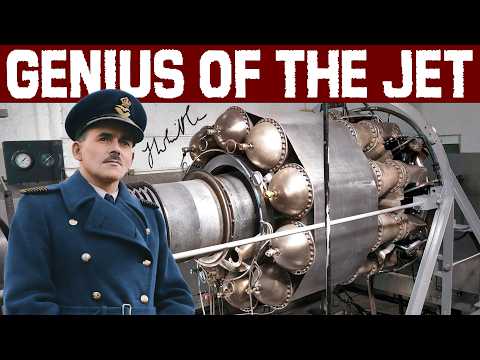
From a young age, Frank was captivated by flight. His favorite toy was a metal model of a Bleriot monoplane, and his heroes were the flying aces of World War I. He dreamed of soaring through the clouds, but the Royal Air Force initially rejected him for being too small. Determined, he followed a strict diet and exercise regimen, grew three inches, and tried again—this time, he was accepted.
At Cranwell, Whittle’s exceptional mathematical mind caught the attention of his superiors, and he was selected for officer training. “I was number six on the graduation list,” he remembered, “but when the top student failed the eye test, I got my chance.” It was here that he first conceived the idea that would change everything.
In 1928, as a student at Cranwell, Whittle wrote a thesis on future developments in aircraft design. In it, he proposed a radical concept: an engine that would use a gas turbine to generate thrust, eliminating the need for a propeller. “I thought, why not get rid of the piston engine and replace it with a turbine?” he said. “It seemed so obvious then.” His professor didn’t fully understand it but gave him a perfect score.
Whittle’s idea was met with skepticism. The British Air Ministry showed little interest, and when he approached industry experts, they dismissed it as impractical. “According to the theories of the time, gas turbines were inefficient and materials couldn’t withstand the heat,” Whittle explained. But he was confident that technology would catch up.
In 1930, he patented the jet engine, but the Air Ministry refused to keep it secret. The patent was published, and soon, it reached Germany, where it would be studied by engineers who would later build the world’s first jet aircraft. “I was told to become an engineer,” Whittle said, “because I was bothering the Ministry with my inventions.” He was sent to Cambridge to study mechanical sciences, where he continued to refine his idea.
Despite the lack of official support, Whittle’s persistence caught the eye of a few key individuals. In 1936, with the help of former RAF colleagues, he founded Power Jets Ltd. and secured funding to build a prototype. “The probability of success was 1 in 30,” he told his backers. But he was determined to prove them wrong.
On April 12, 1937, the first jet engine, the W.U., roared to life in a test cell in Rugby. “It accelerated out of control, and everyone ran for their lives,” Whittle recalled. “I was frozen with fear.” Despite the chaos, the engine worked, and the jet age had begun.
But the British government was slow to grasp what they had. In 1939, with war looming, Whittle’s team was still tiny—just six people—and their workshop was a crumbling foundry in Lutterworth. “We couldn’t even tell people what we were working on,” Whittle said. “The Official Secrets Act tied our hands.” Money was so tight that broken parts had to be patched up and reused.
Then, on June 30, 1939, a breakthrough came. The Ministry’s director of scientific research visited the Lutterworth works and watched the engine run for twenty minutes. He left convinced. “He agreed to order a flight engine and a aircraft to go with it,” Whittle recalled with a wry smile. “On the drive to the station, he explained to me all the advantages of my engine—as if I didn’t know.”
Across the North Sea, Germany was moving faster. Hans von Ohain, backed by Ernst Heinkel, had already flown the world’s first jet aircraft, the Heinkel He 178, just days before war broke out. “I was certain it would work,” von Ohain said of his engine, “but there was always a risk.” The Heinkel’s test pilot, Erich Warsitz, took off, circled, and landed with the fuel tanks still half full—a detail that stunned the ground crew. Heinkel called General Ernst Udet in triumph. Udet’s reply was less than enthusiastic: “Congratulations, but let me sleep—it’s an ungodly hour.”
In Britain, Whittle’s team pressed on. By May 1941, his engine was ready to be fitted to the Gloster E.28/39, a small experimental aircraft. The secret was so tightly guarded that when a young naval pilot named Eric Brown landed at Cranwell that same day, he had no idea what he was about to witness. “There was a strange hush over the place,” Brown remembered. “No one would tell me what was going on.”
That evening, the E.28/39 was towed to the runway. Brown watched, bewildered, as a aircraft with no propeller—“a structure I had never seen before”—trundled to the far end of the airfield. The pilot, Gerry Sayer, opened the throttle. The strange, high-pitched whine filled the air. Then, in just 600 yards, the aircraft lifted off.
“Frank, it flies!” shouted Pat Johnson, one of Whittle’s colleagues, clapping him on the back. Whittle, tense and exhausted, snapped back: “That’s exactly what it was designed to do, isn’t it?” But inside, he knew the moment was monumental.
The news reached Winston Churchill, who ordered a thousand Whittle engines. But the E.28 was only a test aircraft. The real fighter, the Gloster Meteor, was still on the drawing board—and Whittle’s company, Power Jets, was being squeezed out of its own creation. “Rover was making a mess of the engine,” Whittle said bitterly. “They had no idea what they were doing.” Eventually, Rolls-Royce took over, but by then, two precious years had been lost.
By 1944, the Meteor was finally in service, intercepting German V-1 flying bombs over Kent. But Germany had already deployed the Messerschmitt Me 262, a far more advanced jet fighter. “We could have had a jet fighter at the start of the war,” Whittle reflected. “Lives could have been saved. The war might have been shorter.”
When the war ended, the Allies discovered the wreckage of Germany’s jet program. Whittle was sent to interrogate von Ohain. “I wanted to know how he had used my patent,” Whittle said. “But he was evasive.” The two men, rivals in war, would later become close friends.
In 1948, Whittle was knighted and received a £100,000 award—worth about £3 million today. But it was too little, too late. “I paid a heavy price for the work I did,” he admitted. “The stress, the financial struggles, the political battles—it broke my health.” He suffered a series of nervous breakdowns and was declared unfit for flying, the love of his life.
He watched from the sidelines as Britain squandered its lead. The Comet, the world’s first jet airliner, was a triumph of his vision—but its square windows, which Whittle had warned against, led to catastrophic crashes. “I wrote to de Havilland about the window strength,” he said. “They ignored my advice.” America’s Boeing 707 would go on to dominate the skies.
By the 1960s, Britain had all but forgotten Frank Whittle. “In this country, they began to forget everything about me,” he said. “It was different in America. They were much more enthusiastic.” In 1976, he moved to the United States, where he felt appreciated. He reconnected with von Ohain, and the two engineers would spend hours discussing the future of flight.
In 1986, the Queen awarded him the Order of Merit. Recognition finally came—but the man who had shrunk the world was now in his late seventies, his health failing. “I think we’ll see much higher speeds in due course,” he said, still dreaming of a second-generation supersonic airliner. “It’s a very expensive project, unfortunately.”
Frank Whittle died in August 1996, confident of his place as the greatest aeronautical engineer of the twentieth century. “I wondered if he had gone flying,” his son Ian recalled, “and if he had, did he go alone? Or was there a companion?” His ashes were cremated in the United States, and the air attaché brought them home. Ian met the plane at Heathrow and placed the urn on his study shelf, beside the ashes of his mother, who had died just three weeks earlier.
They chose to bury them at the church in Cranwell, where it all began. Two Meteor and Vampire jets performed a flypast. “We flew the ashes to Cranwell and buried them there in a small ceremony,” Ian said. “It was a fitting tribute to a man who had given so much.”
But the story does not end there. Whittle’s legacy lives on in every jet that streaks across the sky. “Today, we make about one and a half billion flights a year,” one historian noted, “cheaply and safely, thanks to Frank Whittle.” He made the world seem smaller, yet his gift to Britain is undervalued. The famous aircraft manufacturers are gone, but Rolls-Royce remains a world leader in jet engines.
“Often I’m asked how I feel about this,” Whittle said in his later years, “and it’s a very difficult question to answer.” He paused, choosing his words carefully. “Things could have been much better. We could have had a greater influence on the war than we actually did.” Yet when he saw what had happened in civil and military aviation, especially the Concorde, he could not help but feel a deep satisfaction.
One memory stood out above all others. “Something else I never expected was to have a son who flies 747s as a captain with Cathay Pacific,” he said, his voice swelling with pride. Kai Tak Airport in Hong Kong had a fascinating approach—a right-hand turn that curved almost to the moment of touchdown. “When my father came with me in the cockpit of a Boeing 747, he was astonished to see his son flying at 1,000 feet straight toward the hills and then making a sharp final turn.”
Ian chuckled at the memory. “That was the way you had to do it. Unfortunately, I hadn’t briefed him beforehand. So he was gripping his seat very tightly until the moment we landed.” Even then, Frank Whittle kept theorizing about aerodynamic improvements and aircraft engines until the end of his life. He studied a second generation of supersonic transports and made recommendations, speaking publicly and privately in industrial circles to encourage manufacturers to take the risk.
“Concorde is a wonderful aircraft,” he said. “I’ve traveled on it many times, but I look forward to the next generation of supersonic transports, which I believe should be able to carry 300 passengers over distances of about 4,500 miles—like San Francisco to Tokyo—at speeds up to Mach 2.3. That’s 2,000 miles per hour, compared to Concorde’s 1,350.” He smiled. “But beyond that, I think we’ll see much higher speeds in due course. Unfortunately, those will be very expensive projects.”
Sir Frank Whittle died in August 1996, confident of his place in history. The Royal Air Force honored its distinguished son with a memorial service at Westminster Abbey. “He and I wanted to have a chance to fly together,” Ian said softly, “preferably in an open-cockpit biplane so we could do loops and rolls and climbs and dives together.” That modest ambition was never realized. The closest they came was when Ian flew his father to Hong Kong in a Boeing 747.
On the morning of his last day, Ian leaned over his father’s bed and said, “Dad, let’s get dressed and go flying.” Frank opened his eyes, looked at his son, and smiled. That evening, with Hazel holding his hand, he passed away. Ian wondered if he had gone flying—and if he had, whether he was alone or with a companion.
The jet age had begun with a young man’s dream, a professor’s perfect score, and a patent that reached the wrong hands. It had been forged in a crumbling foundry, tested in secret, and nearly lost to bureaucracy and doubt. “I was told to become an engineer,” Whittle once said, “because I was bothering the Ministry with my inventions.” That nuisance changed the world.
Frank Whittle’s ashes were laid to rest in the quiet churchyard at Cranwell, the very place where he had first learned to fly. Two Meteor and Vampire jets roared overhead in a final salute, their engines—his engines—thundering across the Lincolnshire sky. “It was a fitting tribute,” Ian said, “to a man who had given so much.”
Today, every time a jetliner lifts off, Whittle’s genius rides along. The boy who was rejected for being too small, who was dismissed by ministries and mocked by industry, had the last word. “I was told to become an engineer because I was bothering the Ministry with my inventions,” he once said with a wry smile. That nuisance gave us the world.
So the next time you settle into your seat at 35,000 feet, spare a thought for the quiet man from Coventry. He shrank the planet, yet his own country nearly forgot him. What would have happened if Britain had listened to Frank Whittle in 1929?
Report this article
Select a reason for reporting:






