At 3:00 AM on June 22, 1941, the world changed forever. Sleeping Red Army soldiers on the Soviet Union’s western frontier were jolted awake by the thunder of German artillery pounding the Polish city of Białystok. It was the opening salvo of Operation Barbarossa—the largest invasion in history—and the first battle would become one of the most one-sided massacres of World War II: the Battle of Białystok-Minsk.
Just hours earlier, a German communist defector had crossed the border to warn the Soviets of an imminent attack at 4:00 AM. He was interrogated, and the news reached Stalin himself. Stalin dismissed it as disinformation. The Red Army on the Western Front received orders at 1:00 AM to raise combat readiness—but avoid any provocative actions. The message took two hours to reach frontline units. By then, it was too late.
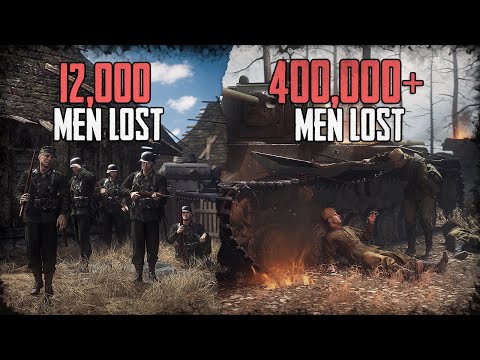
German bombers and artillery shattered Soviet airfields and communication lines before they could respond. The Battle of Białystok-Minsk had begun. The German objective was simple: seize Minsk, a strategic railway hub less than 100 kilometers from the frontier. Capturing it would give the Germans control of all rail lines to Moscow and a perfect defensive position. For Operation Barbarossa to succeed, Minsk had to fall fast.
The Germans were ready. The 3rd Panzer Group crossed the Neman River in the north, while the 2nd Panzer Group surged across the Bug River in the south, advancing 60 kilometers in a single day. Both panzer groups were now hooking around the Soviet armies from north and south, trapping them in a deadly pincer. To close the ring, the 4th and 9th German Armies smashed through the frontier from the west, hammering the Soviets at Białystok.
By June 23, the Soviets were nearly encircled. Stalin ordered general counterattacks to prevent the trap from closing, but the Red Army was too stunned to organize effectively. Before the invasion, Soviet doctrine emphasized counterattacking any aggressor to avoid a war of attrition—but that principle had never taken root in the ranks. The 10th Army attempted a more organized counterattack and failed quickly.
General Dmitry Pavlov, commander of the Western Front, was in a desperate position. He had received warning of the impending invasion on June 21 while watching a comedy show in Kiev—and chose to finish the show before acting. The Soviets considered this a fatal mistake. Now, Pavlov’s life was on the line if his new strategy failed. He decided to counterattack eastward, where the Soviets had more space and could prevent full encirclement. It slowed the German advance and allowed some units to escape toward Minsk, but it was a disastrous failure. With most of his transport destroyed in the initial air raids, Pavlov’s men had to flee on foot. Few succeeded.
Wherever Pavlov sent his men, the Germans were ready and repulsed them, forcing withdrawal every time. The Germans held every advantage—superior planning and a nearly complete encirclement. Soviet counterattacks had little effect on the German advance toward Minsk. On June 26, the panzer groups reached the city.
But the battle was not over. On June 28, the 4th and 9th German Armies split at Białystok, completely trapping the Soviet 10th Army and the 3rd, 4th, and 13th Armies. The 2nd and 3rd Panzer Groups met east of Minsk and advanced another 321 kilometers into Soviet territory—cutting a third of the way to Moscow in just the first week of the invasion.
The Soviet armies did not retreat. The 20th Mechanized Corps launched another counterattack from inside the pocket, and the 4th Airborne Corps tried to break through enemy fortifications, but both were quickly annihilated. On June 30, the Germans closed the final gaps, trapping 20 Soviet divisions. Then they unleashed a devastating assault, capturing or killing almost everyone in their path. Very few escaped.
In just 17 days, the Soviets had lost the majority of their forces and equipment on the Western Front. The Germans also suffered casualties, but nothing compared to the catastrophic losses of the Red Army. It was a massive German victory—but not perfect. The infantry took longer than expected to eliminate the trapped Soviet armies, delaying their link-up with the panzer groups. This gave Soviet commanders time to retreat east, regroup, and change strategy—a delay that would later contribute significantly to the failure of Operation Barbarossa after the German defeat at Stalingrad.
General Pavlov would not live to see the Red Army’s final victory. After his counterattack failed, he was relieved of command and arrested for “betraying the interests of the homeland, violating his military oath, and damaging the combat capability of the Red Army.” He was executed on July 22, 1941, alongside other commanders who had fought on the Western Front.
There was a kind of delayed justice for poor Pavlov. In 1956, it was determined that the Soviet defeat at Białystok-Minsk was not due to Pavlov alone, but to the entire Soviet military, which was utterly unprepared for the German onslaught. Fifteen years after his death, Pavlov was exonerated.
Despite the crushing defeat, the Soviets would eventually repel the German invasion and go on to conquer Germany itself. But the scars of Białystok-Minsk—and the question of whether it could have been different—would haunt history forever.
Yet the story of Białystok-Minsk is not merely a tale of German triumph and Soviet collapse. It is also a story of how a single week of catastrophe shaped the entire course of the war—and of the men who paid the price for decisions made far above their heads.
Consider the speed of the German advance. In just seven days, the Wehrmacht had destroyed or captured over 300,000 Soviet soldiers, thousands of tanks, and nearly 1,500 aircraft. The road to Moscow lay wide open, and the German high command knew it. Hitler himself reportedly believed the war in the East was already won. But that confidence would soon curdle into a fatal overconfidence.
For the Soviets, the disaster at Białystok-Minsk was a brutal awakening. It exposed every weakness in the Red Army: poor communication, outdated doctrine, inexperienced commanders, and a paralyzing fear of provoking the Germans. Stalin, who had ignored warnings for months, was said to have locked himself in his dacha for days after the invasion began. When he finally emerged, he addressed the nation for the first time—not with reassurance, but with a call to a ruthless, scorched-earth defense.
That call changed everything. The Soviets began to reorganize. They abandoned the rigid forward-defense strategy that had doomed them at Białystok-Minsk and adopted a deeper, more flexible defense. They moved factories east of the Urals, rebuilt shattered units, and promoted younger, more aggressive commanders. The Red Army that would later encircle Stalingrad and storm Berlin was born from the ashes of these early defeats.
But the human cost was staggering. The soldiers trapped in the Minsk pocket fought on for days with little food, ammunition, or hope. Many were killed in the German assault; others surrendered and faced brutal treatment in prisoner-of-war camps. Of the hundreds of thousands captured in the first weeks of Barbarossa, fewer than half would survive the war. The survivors carried the memory of Białystok-Minsk like a wound that never fully healed.
For the Germans, the victory brought a dangerous sense of invincibility. The infantry’s delay in closing the pocket—while costly for the Soviets—was dismissed as a minor setback. German commanders pushed their panzer groups ever faster toward Moscow, outrunning their supply lines and ignoring the warnings of their own logistics officers. The same arrogance that had made Barbarossa possible would soon bleed the Wehrmacht dry in the Russian winter.
And what of Pavlov? His execution, ordered by Stalin in a fit of rage and blame-shifting, was meant to serve as a warning to other commanders. Instead, it became a symbol of the Soviet system’s cruelty in the face of its own failures. Pavlov was not a traitor. He was a scapegoat—a man whose real crime was being unprepared for a war his country had refused to see coming.
When his name was finally cleared in 1956, it was too late for him, but not for history. The record now shows that Białystok-Minsk was not a failure of one man, but of a system: a system that ignored intelligence, stifled initiative, and punished its officers for the mistakes of its leaders. The battle remains a stark reminder that in war, the first casualty is often the truth—and the second is justice.
Today, the fields around Minsk are quiet. Forests have reclaimed the battlefields, and the mass graves are marked by simple monuments. But for historians and soldiers alike, Białystok-Minsk remains a case study in how not to fight a war—and how not to lead an army. It is a story of what happens when fear, denial, and arrogance collide with the brutal reality of modern warfare.
As the German panzers rolled east toward the Dnieper, the men who had survived the pocket trudged the other way, toward an uncertain future. They did not know it yet, but their suffering would become the foundation of a legend: the legend of the Red Army that bent but did not break. The road from Białystok-Minsk to Berlin was long, bloody, and paved with the bones of the fallen—but it was a road the Soviets would walk to the very end.
The Battle of Białystok-Minsk was over. In its wake, the Soviet Western Front was shattered beyond recognition. Within weeks, the Germans would stand at the gates of Smolensk, and the road to Moscow seemed unstoppable. Yet the seeds of their eventual undoing had already been sown in the very speed of their victory.
For the men in the pocket, the end came in different ways. Some died with rifles in hand, charging hopelessly at German machine guns. Others, starving and out of ammunition, surrendered in the thousands. Few would ever see their homes again. The prisoner-of-war camps of 1941 were not built to hold such multitudes—and the Wehrmacht had made no plans to feed them.
Pavlov’s execution sent a chill through the officer corps. Stalin had made it clear: failure would not be tolerated, no matter the circumstances. Yet in the months that followed, other commanders would fail too—at Smolensk, at Kiev, at Vyazma—and they too would pay with their lives. The pattern was set. The Red Army would learn to fight, but it would learn through blood.
And still, the Germans pushed on. Their generals studied the maps and saw only opportunity. They did not see the warning signs: the lengthening supply lines, the autumn mud, the first whispers of winter. The same arrogance that had delivered Białystok-Minsk would soon deliver them to the gates of Moscow—and then to their first great defeat.
For the Soviets, the lesson was brutal but clear. Never again would they allow their armies to be trapped in forward positions. Never again would they ignore intelligence. From the ashes of Białystok-Minsk rose a harder, colder, more ruthless Red Army—one that would eventually march all the way to Berlin.
But for the men who fell in those first seventeen days—and for the families who never learned their fate—history offered only silence. The battle was forgotten by many, overshadowed by Stalingrad and Kursk, by the great victories that came later. Yet without Białystok-Minsk, there would have been no Stalingrad. The defeat was the first step on the long road to victory.
So what do you think, dear readers? Could the Soviets have done anything differently at Białystok-Minsk—or was the disaster inevitable from the moment Stalin ignored the warnings? And was Pavlov’s execution a necessary act of wartime discipline, or a tragic miscarriage of justice? Tell us your thoughts in the comments below.
Report this article
Select a reason for reporting:






