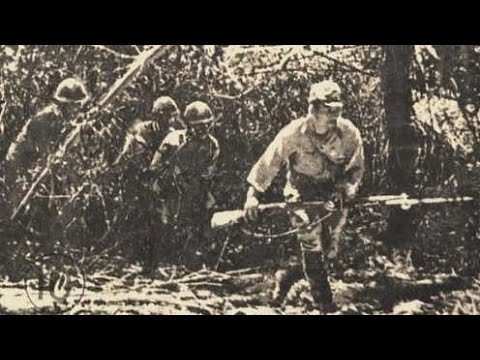
October 24, 1942. 2:30 AM. Guadalcanal. Sergeant John Basilone kneels in the mud behind a Browning M1917 machine gun. The barrel is so hot he can smell the oil burning off the metal. His hands are blistered. His uniform is soaked with rain, sweat, and something darker. He hasn’t slept in 36 hours. He hasn’t eaten in longer. Through the darkness, he hears them coming again.
The sound starts low—a rustle in the elephant grass, a snap of vegetation—and then the screaming begins. “Banzai! Banzai!” Three thousand Japanese soldiers from the Sendai Division charge straight at his position. They run over the bodies of their comrades who charged an hour ago, and the men who charged at midnight. They climb over their own dead like stepping stones across a river.
Basilone presses the trigger. The gun chatters. Red tracers slice through the rain. Men drop. More men take their place.
Somewhere behind the Japanese lines, Lieutenant General Harukichi Hyakutake listens to the gunfire and waits for the message that will announce the capture of Henderson Field. He has been promised this attack will succeed. He has 15,000 soldiers on Guadalcanal. He has artillery. He has tanks. He has the full backing of the Imperial Japanese Navy. He has Admiral Isoroku Yamamoto himself coordinating a massive fleet operation to support the ground assault.
And he has the most important advantage of all. The Americans, everyone in Tokyo agrees, are soft. They are weak. They do not know how to fight. They have no stomach for the kind of brutal close-quarters combat that is the specialty of the Japanese soldier. Hyakutake is certain that by sunrise the American flag over Henderson Field will be replaced by the Rising Sun.
He is wrong.
In the next 72 hours, the attack on Henderson Field will become one of the most lopsided defeats in the history of the Pacific War. The Sendai Division, one of Japan’s most experienced combat units, will be virtually annihilated. Bodies will stack so deep in the barbed wire that bulldozers will be required to bury them. The kill ratio will be so extreme that analysts in Washington will initially refuse to believe the reports. The Japanese are walking into a meat grinder calibrated with the precision of a Swiss watch—and they do not even know it.
To understand why the attack on Henderson Field was such a catastrophic mistake, you have to understand what that airfield meant. You have to understand why both sides were willing to throw everything they had at a single dirt runway carved out of the jungle on an island most Americans had never heard of.
Henderson Field was not just an airfield. It was the key to the entire South Pacific.
When the Japanese looked at a map in the summer of 1942, they saw an empire stretching from the home islands to the Dutch East Indies, from Burma to the Marshall Islands. They had conquered more territory in six months than any military force in history. They had humiliated the British at Singapore. They had driven the Americans out of the Philippines. They had destroyed the Pacific Fleet at Pearl Harbor.
But there was a problem. The Japanese war machine ran on oil, and the oil fields they had captured in the Dutch East Indies were thousands of miles from Japan. The tankers carrying that oil had to sail through waters increasingly vulnerable to American attack. The Japanese needed to push their defensive perimeter farther south. They needed to cut the supply lines between the United States and Australia. They needed to threaten the last major Allied base in the region. And to do that, they needed Guadalcanal.
The island sits at the southern end of the Solomon Islands chain—a lush, green nightmare of jungle, mountains, and disease. In May 1942, Japanese construction crews began building an airfield on the northern coastal plain. They worked around the clock. They cleared the kunai grass. They laid down coral and gravel. They imported heavy equipment from Rabaul. By early August, the runway was almost complete.
If that airfield became operational, Japanese bombers could reach Australia. Japanese fighters could intercept any Allied ship trying to resupply the South Pacific. The entire strategic balance of the war would shift.
The Americans could not let that happen.
On August 7, 1942, 11,000 Marines of the First Marine Division splashed ashore on Guadalcanal in the first American amphibious assault since the Spanish-American War. They caught the Japanese completely by surprise. The construction crews fled into the jungle. The Marines captured the half-finished airfield within 36 hours. They renamed it Henderson Field after Major Lofton Henderson, a Marine aviator killed at the Battle of Midway two months earlier.
And then the real fighting began.
The Japanese could not accept the loss of Guadalcanal. It was not just a strategic setback. It was an embarrassment. The Americans—who were supposed to be weak and decadent—had actually gone on the offensive. They had actually attacked.
Admiral Yamamoto understood immediately what this meant. He had spent years in America as a naval attaché. He had seen the automobile factories in Detroit. He had watched the shipyards on the West Coast. He knew that if the Americans were given time to build up their strength, Japan would be overwhelmed by sheer industrial might.
The Americans had to be stopped at Guadalcanal. They had to be thrown back into the sea. The airfield had to be recaptured before the tide of war turned against Japan forever.
And so began a desperate, months-long struggle for control of a single dirt runway in the middle of nowhere.
The first Japanese counterattack came just two weeks after the American landing. Colonel Kiyonao Ichiki led 900 men of the Ichiki Detachment in a night assault across the Tenaru River on August 21. The Japanese believed they would sweep the Marines aside. The Marines were waiting with machine guns and artillery. The Battle of the Tenaru lasted less than 12 hours. More than 800 Japanese soldiers were killed. Only a handful surrendered. The rest fought until they were dead. Colonel Ichiki burned his regimental colors to prevent their capture. Then he shot himself.
The Americans thought the battle was a clear victory. The Japanese thought it was a temporary setback. Neither side understood yet what Guadalcanal would become.
The second counterattack came in September at a place the Marines would call Bloody Ridge. Major General Kiyotake Kawaguchi led 3,100 men through the jungle in an attempt to take Henderson Field from the south. It was a brilliant plan on paper. The Japanese would avoid the Marine defenses on the coast and strike at the airfield’s vulnerable rear.
But the jungle was worse than anyone expected. It took Kawaguchi’s men four days to cover eight miles. They arrived exhausted, dehydrated, and disorganized. Their radios were dead. Their coordination was non-existent. Lieutenant Colonel Merritt Edson’s First Marine Raider Battalion was waiting for them on the ridge. For two nights, the Japanese threw themselves at the Marine lines. For two nights, the Marines held. When it was over, more than a thousand Japanese soldiers were dead. The ridge was renamed Edson’s Ridge in honor of the commander who held it.
But the Japanese were not done. In Tokyo, the Imperial General Staff was growing impatient. Two attacks had failed. The Americans were still holding Henderson Field. Something had to change.
The decision was made to send an entire division.
The Second Infantry Division—also known as the Sendai Division—was one of the most prestigious units in the Japanese Army. Its soldiers were recruited primarily from Miyagi Prefecture in northern Japan, men known for their endurance and discipline. The division had fought in Manchuria. It had participated in the conquest of Java. It was considered an elite formation.
In early October, the Tokyo Express began delivering the Sendai Division to Guadalcanal. The Tokyo Express was the nickname the Marines gave to the Japanese destroyers that ran down the Slot every night, bringing reinforcements and supplies under cover of darkness. The destroyers were too fast for the American patrol boats to catch. They unloaded their cargo, shelled the Marine positions, and were gone before dawn.
Night after night, the destroyers came. By mid-October, more than 15,000 Japanese soldiers were on Guadalcanal. Artillery pieces were dragged through the jungle. Tanks were landed on the beaches. Ammunition dumps were established in hidden positions. Lieutenant General Harukichi Hyakutake, commander of the 17th Army, arrived personally to take charge of the offensive.
This would not be another piecemeal attack. This would be a coordinated assault from multiple directions, supported by naval bombardment and air strikes.
Hyakutake set the attack for October 22. But first, the Japanese Navy had a surprise for Henderson Field.
The bombardment began at 1:33 AM on October 14. Two Japanese battleships, Kongo and Haruna, approached Guadalcanal under cover of darkness. They were escorted by a light cruiser and nine destroyers. Their mission was simple: destroy Henderson Field.
The battleships opened fire with their 14-inch guns. Each shell weighed more than 1,400 pounds. Each explosion could be heard for miles. For 83 minutes, the bombardment continued. 973 shells slammed into the Lunga Perimeter. Most of them landed in and around the airfield.
The Marines had never experienced anything like it. Pharmacist’s Mate First Class Lewis Ortega was in a pillbox when the first shells hit. He would later describe it this way: “A whistling noise and then boom. What the hell was that? And then another one. For the next four hours, we were bombarded. Let me tell you something. You can get a dozen air raids a day, but they come and they are gone. But when these battleship guns start lobbing shells into you, they come one after another.”
By the time the Japanese ships withdrew, Henderson Field was in ruins. Both runways were cratered. 48 of the 90 aircraft on the field were destroyed. Almost all of the aviation fuel had been burned. 41 men were dead, including six pilots. The Cactus Air Force—the motley collection of Marine, Navy, and Army aircraft that defended Guadalcanal—had been nearly wiped out.
The Marines called it simply “the Bombardment.” It was the worst naval shelling American forces had ever endured, and it was only the beginning.
In the days that followed, Japanese cruisers returned to shell the field again. Air raids came every day. The Tokyo Express delivered more troops every night. Everything was building toward the ground assault that would recapture the airfield and drive the Americans into the sea.
Hyakutake finalized his plan. The main attack would come from the south. Major General Masao Maruyama would lead 7,200 men of the Sendai Division through the jungle to strike at the airfield’s rear. It was essentially the same approach Kawaguchi had tried in September, but with more than twice as many troops. A secondary attack would come from the west. Colonel Nomasu Nakaguma would lead three battalions and nine tanks across the Matanikau River to hit the Marine flank. A third force under Colonel Akinosuke Oka would attack from the southwest. The three forces would strike simultaneously. The Americans would be overwhelmed from multiple directions. Henderson Field would fall.
“The time of the decisive battle between Japan and the United States has come,” Hyakutake announced on October 22. “This attack will determine the fate of the war.”
He set the assault for the night of October 23. But the jungle had other plans.
The route Maruyama chose looked reasonable on a map—barely fifteen miles to the American lines. But Guadalcanal was not normal terrain. The jungle was so thick you could not see ten feet ahead. Every step sank into mud. Men collapsed from heat exhaustion. Radios failed in the humidity. Units became separated.
By the afternoon of October 23, Maruyama’s force was nowhere near the American lines. The attack would have to be postponed—but the message never reached Nakaguma at the Matanikau.
At dusk, right on schedule, Nakaguma launched his attack. Nine tanks charged across the sandbar. The Marines were ready. 37mm anti-tank guns opened fire at point-blank range. One by one, all nine tanks were destroyed. Behind the burning wrecks, the infantry was caught in the open. Forty Marine howitzers fired 6,000 shells in less than an hour. The Matanikau ran red. By midnight, it was over: 600 Japanese dead, fewer than 50 American casualties.
The next night, Maruyama finally reached the lines. His men had spent two days struggling through the jungle—exhausted, dehydrated, their coordinated attack degenerated into a chaotic stumble through darkness. But he still had 7,000 soldiers facing a single American battalion under Lieutenant Colonel Lewis “Chesty” Puller.
At 9:30 PM, a listening post reported movement. Sergeant Ralph Briggs phoned in: “Colonel, there are about 3,000 Japs between you and me.” Puller asked if he was certain. “Positive. They’ve been all around us singing and smoking cigarettes, heading your way.” Puller hung up and looked at his officers. “Let them come,” he said.
At 1:15 AM, the first wave hit. The Japanese emerged from the jungle screaming, climbing over the barbed wire, throwing grenades. On the right of the line, Sergeant John Basilone’s machine gun section held a critical choke point. The first wave was cut down within fifty yards. The second made it closer. The third reached the wire. Bodies piled up in front of the guns. When one gun jammed, Basilone cleared it under fire. When another was destroyed by a grenade, he dragged a spare into position. When ammunition ran low, he fought through Japanese soldiers to reach the supply dump and carried belts back to his men. At one point he picked up the ninety-pound gun and moved it to a new position, the barrel so hot it burned through his gloves.
By dawn on October 25, the lines were still intact. In front of Basilone’s position, thirty-eight bodies were counted in a single heap. His section had fired more than 26,000 rounds. He had not slept in three days. For his actions that night, John Basilone would receive the Medal of Honor—the first enlisted Marine to earn the award in World War II.
But the battle was not over. On the night of October 25, the Japanese attacked again from multiple directions. At Puller’s command post, bullets cracked overhead as he coordinated fire missions. When a staff officer suggested they pull back, Puller’s response became legend: “We do not retreat. Marines do not retreat. We stay here and die if necessary.” They did not die. They held.
Army soldiers of the 164th National Guard—North Dakota boys who had never seen combat—were fed piecemeal into the Marine lines throughout the night. They fought anyway.
On October 26, Maruyama ordered one final desperate attack. Colonel Oka’s 2,000 men charged the positions held by the 2nd Battalion, 7th Marines. The Marines had been fighting for three straight nights. Their barrels were worn. Their hands were shaking. They held anyway. Oka’s attack disintegrated in the barbed wire.
On the morning of October 27, Maruyama admitted defeat. In three nights of fighting, the Japanese lost between 2,000 and 3,000 soldiers killed. The Americans lost fewer than 100. The kill ratio was at least twenty to one. The Sendai Division, which had arrived as an elite combat unit, was effectively destroyed. When burial details went out to count the bodies, they used bulldozers. The corpses were stacked so deep they had to be loaded into mass graves like cordwood. In Puller’s sector alone, one detail counted 1,462 bodies.
The Japanese had walked into a killing ground perfectly designed to destroy them—Marine artillery ranged on every approach, machine guns that could not be suppressed, barbed wire that channeled the attackers into predetermined kill zones. And they had men like John Basilone and Chesty Puller who refused to retreat.
The Japanese had been told the Americans were soft. They learned the truth in the mud and the wire and the blood of Henderson Field.
Henderson Field survived. Within days, aircraft were taking off from the cratered runway again. And that meant the Japanese plan for Guadalcanal was finished. The Cactus Air Force controlled the daylight hours. The Tokyo Express could only operate at night, and destroyers could not carry enough supplies to sustain a major ground force. The Japanese soldiers began to starve. They called the island “Starvation Island.” They boiled grass and ate it. They killed and ate the horses brought to carry artillery. Malaria and dysentery killed more men than American bullets.
In November, Yamamoto sent two more battleships to bombard the airfield. But this time the American Navy was waiting. In the brutal Naval Battle of Guadalcanal, both sides suffered terrible losses—but the Japanese lost the battleship Hiei to aircraft from Henderson Field, and the Kirishima to the guns of the USS Washington. Never again would the Japanese Navy attempt to knock out Henderson Field from the sea.
In late January 1943, Tokyo made the decision to evacuate. Over three nights in early February, Japanese destroyers crept down the Slot one final time—not delivering troops, but taking them away. More than 10,000 survivors were rescued. They left behind more than 20,000 dead.
The American victory was complete. Japan would never go on the offensive again in the Pacific. From that point forward, they would be retreating, defending, falling back. The tide of war had turned, and it turned at Henderson Field.
When Basilone received the Medal of Honor in Australia in May 1943, he said something that captured the spirit of the men who fought there: “Only part of this medal belongs to me. Pieces of it belong to the boys who are still on Guadalcanal.” The Marine Corps offered him a commission and a desk job. He refused. “I ain’t no officer, and I ain’t no museum piece. I belong back with my outfit.”
In February 1945, Sergeant John Basilone landed on Iwo Jima. On the first day of the assault, while leading his men off the beach under heavy fire, he was killed by a Japanese mortar round. He was twenty-eight years old. He received the Navy Cross posthumously—the only enlisted Marine to earn both the Medal of Honor and the Navy Cross in World War II.
The battle for Henderson Field ended more than eighty years ago. The jungle has reclaimed most of the battlefield. The runway where Basilone fought is now Honiara International Airport, serving the capital of the Solomon Islands. Tourists fly in on commercial jets and have no idea what happened there.
But the lesson of Henderson Field remains. The Japanese believed their spirit would overcome American machines. They believed their willingness to die would break American resolve. They were wrong. At Henderson Field, the Americans proved they could match Japanese courage with courage of their own—and that a defensive position, properly prepared and stubbornly held, could destroy an attacking force no matter how determined.
The Sendai Division learned this lesson in the barbed wire south of the airfield. They learned it in the mud in front of Basilone’s machine guns. They learned it in the craters left by Marine artillery. By the time they finished learning, most of them were dead.
In 1942, Japan attacked America’s Henderson Field. They threw their best division against a single Marine battalion. They expected to sweep the Americans aside and recapture the airfield that threatened their empire. It was a huge mistake—and it cost them the war.
What do you think was the single most decisive factor in the American victory at Henderson Field—the artillery, the machine gunners, the leadership, or something else entirely? Let us know in the comments.
Report this article
Select a reason for reporting:






