In the annals of war, the stories of women are often relegated to footnotes, their suffering overshadowed by the clamor of battle. Yet, in the shadows of World War II and the Vietnam War, countless women endured horrors that defy imagination. Their screams were drowned by gunfire, their tears washed away by blood. This is the untold story of their resilience and agony—a story that history has too often forgotten.
Imagine a village, emptied of men, where only women, children, and the elderly remain. The enemy arrives, and with them, a campaign of terror so brutal that it shakes the very foundations of humanity. This was the reality for millions of women caught in the crossfire of the 20th century’s deadliest conflicts.
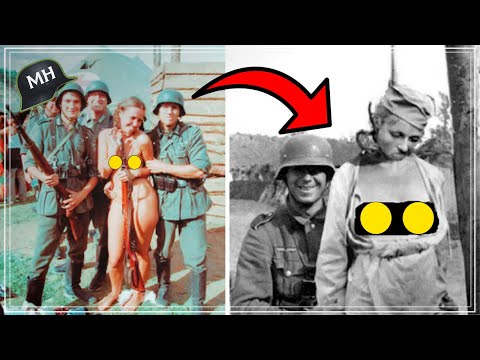
On the Eastern Front, Hitler’s forces unleashed a fury that knew no bounds. “The Slavic race was a mortal enemy of the Aryans and therefore could not continue to exist,” Hitler proclaimed, giving his soldiers a license to kill and violate at will. Women were raped, executed, and tortured—their bodies turned into battlefields. “Whenever they caught one of ours, she was either shot or paraded among the Germans as if she were a trophy,” recalled a Soviet veteran. “We used to hide a couple of extra ammunition rounds to commit suicide in case we were captured.”
The Japanese Empire mirrored this brutality across Asia. Women were lured with promises of work, only to be forced into “comfort houses”—military brothels where they endured daily rape and abuse. Pilar Frias, a Filipina survivor, recounted her ordeal: “They bound my hands behind me and tied me to a jack fruit tree and then they raped me.” Those who survived often faced infertility and social ostracism, their lives shattered by the horrors they endured.
But the Allies were not innocent. When the Red Army entered Berlin in 1945, German women were subjected to mass rape as revenge. Stalin himself encouraged his troops: “We repress our men too much. We need to give them a little more initiative.” In the chaos of victory, justice was rarely served.
Then came Vietnam. The war that divided America also brought untold suffering to Vietnamese women. The My Lai Massacre in 1968 saw American soldiers slaughter hundreds of unarmed civilians, including women and children. “Bodies began piling up on the dirt streets, and for a while all that could be heard were the screams of the victims,” described a survivor. Rape was rampant, and justice was fleeting—only one officer was convicted, later pardoned by President Nixon.
In another incident, five American soldiers kidnapped, raped, and murdered a young Vietnamese woman, Phan Thi Mao. “They stabbed her with a hunting knife, but she got up and ran through the jungle,” recalled one of the soldiers. “They caught her and shot her in the head.” The perpetrators received light sentences, and most walked free within years.
As we compare these two conflicts, one thing is clear: women have always been targets in war, their bodies used as weapons to terrorize communities. But which war was worse for women? The answer lies in the scale and systematic nature of the atrocities. Stay with us as we delve deeper into the harrowing experiences of women in WWII and Vietnam, and uncover the truth behind their forgotten suffering.
The numbers tell a story that words cannot. In World War II, the Eastern Front alone saw an estimated two million German women raped by Soviet soldiers, while Nazi forces subjected countless Soviet women to similar fates. The Japanese military’s comfort house system enslaved as many as 200,000 women across Asia. These were not isolated incidents—they were industrial-scale atrocities, sanctioned from the highest levels of command.
Vietnam, by contrast, was a war fought in villages rather than extermination camps. The brutality was intimate, chaotic, and often hidden. American soldiers, frustrated by an invisible enemy, turned their fury on civilians. “They opened fire on innocent civilians, unleashing a massacre,” one survivor recalled of My Lai. Yet the scale, while horrific, never approached the systematic slaughter of WWII.
But scale alone does not measure suffering. A woman raped by a South Korean soldier in Vietnam, her village burned to the ground, endured the same terror as a Soviet woman on the Eastern Front. “Most of these crimes were never reported,” a historian noted. “Commanders preferred to conceal them rather than admit they couldn’t control their men.” In both wars, the perpetrators often walked free.
What set WWII apart was the ideology behind the violence. Nazism sought to dehumanize entire races—Jews, Slavs, Roma—and women were targeted with particular cruelty. In concentration camps, they were stripped, shaved, and subjected to humiliating inspections. “They made them scrub the bathrooms in underwear, then forced their faces into the latrines,” recalled Zippora Goldstein, a survivor. For many, death was the only escape.
Vietnam had no such camps. There was no systematic plan to erase a people. But the war still left deep scars—hundreds of illegitimate children, shunned as social outcasts, and thousands of women haunted by memories they could never share. “The war ended, but for us, it never did,” one Vietnamese woman said, her voice barely a whisper.
So which war was worse for women? Perhaps the question itself is flawed. Both conflicts unleashed horrors that defy comparison. But if we must weigh them, WWII stands as the darkest chapter—a human catastrophe where cruelty was not an aberration but a policy, and women’s bodies became yet another battlefield in a war of annihilation.
Yet the story does not end there. For behind every statistic is a woman who survived, who rebuilt her life from the ashes. Their resilience is the true testament to the human spirit—a spirit that war can wound but never fully destroy.
It is tempting to close the ledger there, to declare a victor in the grim contest of suffering and move on. But history resists such tidy conclusions. The women of both wars left behind testimonies that continue to surface decades later, each one forcing us to reconsider what we think we know.
Consider the children. In Vietnam, tens of thousands of babies were born to Vietnamese mothers and American or South Korean fathers. They were called bui doi—the dust of life. “They were treated as social outcasts, abandoned by their families and shunned by their communities,” one aid worker recalled. These children carried the war in their faces, a daily reminder of the violence their mothers had endured.
World War II produced its own generation of forgotten children. In Norway, France, and the occupied territories, women who bore children fathered by German soldiers were publicly humiliated. Their heads were shaved, they were paraded through streets, and their children were branded Kriegskinder—war children. “My mother never spoke of my father,” one such child later wrote. “The shame silenced her for life.”
What emerges from these parallel tragedies is a pattern too consistent to ignore. In both wars, the suffering of women did not end when the guns fell silent. It continued in the form of stigma, poverty, and silence. The violence was physical, but the wounds were social—and they were passed down to the next generation.
There is another dimension that rarely makes it into the history books: the women who fought back. On the Eastern Front, Soviet women joined the Red Army in staggering numbers—snipers, pilots, medics, partisans. “They took up arms because waiting for death was not an option,” one veteran explained. The Night Witches, an all-female bomber regiment, flew thousands of missions against the Germans, their engines cut to idle as they glided silently toward their targets.
In Vietnam, women played a similarly vital role. The Viet Cong relied heavily on female fighters and couriers, many of them teenagers. They carried messages through tunnels, set booby traps, and nursed the wounded. “We were not just victims,” one former fighter insisted decades later. “We were soldiers too.” Their contributions were celebrated in propaganda, but after the war, many found themselves marginalized once again.
This raises a question that historians still debate: did these conflicts change anything for women? In some ways, yes. The sheer scale of WWII atrocities led to the Nuremberg Trials and, eventually, to international laws recognizing rape as a war crime. The comfort women system became a cause célèbre in the 1990s, forcing Japan to confront its past. Yet justice remained elusive for most survivors.
For the women of Vietnam, recognition came even more slowly. The My Lai Massacre was exposed by journalists, but the thousands of other rapes and murders never made headlines. “We were invisible,” one survivor said. “Our stories were not important enough to tell.”
Perhaps that is the most enduring tragedy of all—not the violence itself, but the silence that followed. In both wars, women were expected to endure, to rebuild, to forget. Their suffering was treated as collateral damage, an unfortunate byproduct of men’s wars. And yet, they endured. They rebuilt. They remembered.
And in remembering, they forced the world to confront uncomfortable truths. The tribunals that followed WWII established principles—however imperfectly applied—that rape and sexual slavery are crimes against humanity. The comfort women’s movement of the 1990s, led by elderly survivors who finally broke decades of silence, proved that shame belongs to the perpetrators, not the victims. “We speak now because we are dying,” one Korean survivor declared. “But our voices will outlive us.”
Vietnam’s women found their own forms of reckoning. Veterans returned to My Lai to rebuild, to plant rice where blood once soaked the earth. Some American soldiers, consumed by guilt, made pilgrimages back to apologize. “I have carried this weight for fifty years,” one veteran confessed to a survivor. “I needed her to know I was not the man I was then.”
History, in the end, does not offer clean verdicts. WWII was the greater catastrophe—systematic, ideological, industrial in its cruelty. Vietnam was a war of ambush and frustration, where atrocities were hidden rather than orchestrated. But for the woman in the photograph, her face frozen in despair, the distinction is meaningless. Her suffering was absolute.
What remains is the lesson: that war, whatever its scale, exacts its cruelest price from those least able to defend themselves. And that the silence that follows is not peace—it is merely the pause before the next story is told.
Which forgotten voice from these wars do you think history has treated most unfairly—and why?
Report this article
Select a reason for reporting:






