In the shadow of the F-16, a small, agile fighter quietly earned a reputation as one of the most lethal dogfighters of its era. The Northrop F-5, often overlooked and underestimated, was the aircraft that America’s top pilots trained against for years. It was the standard by which the US Air Force and Navy measured their best, a machine that starred in Top Gun, served in Vietnam, and even fell into Soviet hands for evaluation. Yet, its true combat prowess was misunderstood, hidden behind its role as an export fighter and aggressor. This is the story of how a simple, cheap, and reliable design became a giant killer in the skies.
At the height of the Cold War, the US faced a daunting challenge: equipping allies against a growing Soviet threat. The MiG-15 had proven a formidable opponent in Korea, and its successors, the MiG-17 and MiG-19, were spreading across the Eastern Bloc. The American solution was to build faster, larger platforms with advanced radar and missiles, but these were too sensitive and expensive for export. What was needed was a lightweight, agile fighter that could hold its own in a close-in fight. Northrop, led by Edgar Schmued, the mind behind the P-51 Mustang and F-86 Sabre, took on the challenge.
Schmued’s team envisioned a classic dogfighter, stripped of complex systems and built for simplicity. The arrival of the J85 engine made it possible: small, reliable, and with an excellent thrust-to-weight ratio. By 1956, the design had evolved into the N156, and in 1959, test pilot Lou Nelson took the first prototype into the air. The aircraft performed exceptionally well, validating the lightweight fighter concept. But despite its promise, the fighter version struggled to attract interest. It wasn’t until 1962, when the Kennedy administration selected it as the basis for a new export fighter, that the F-5 Freedom Fighter was born.
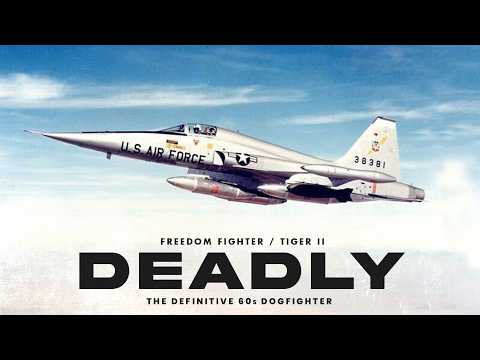
With afterburning J85 engines and a stripped-down airframe, the F-5 was cheap, deadly, and simple. It could deliver a payload with accuracy comparable to larger jets and outmaneuver anything in its class. In 1965, it was sent to Vietnam for combat evaluation under the Skoshi Tiger program. Over 2,600 sorties, the F-5 proved to be the most survivable strike aircraft of the war, with unmatched turnaround times and accuracy. Only two deficiencies were noted: payload and range. But in a dogfight, it was unrivaled.
The F-5’s agility was legendary. In 1975, a captured F-5E was evaluated by Soviet pilots against the MiG-21. At low speeds and high altitudes, the F-5 held a distinct advantage, and its clean cockpit and small size made it hard to spot. These traits were proven in combat during the 1977 Ogaden War, where Ethiopian F-5Es bested Somali MiG-21s. Even as an aggressor, the F-5 was almost unmatched in close-in fights until the arrival of fourth-generation fighters.
“The F-5 was probably the most survivable strike aircraft in the war,” noted the Skoshi Tiger evaluation. “In a close-in fight, it was basically unrivaled in agility.”
But the F-5’s legacy goes beyond its own exploits. Its design philosophy—high angle-of-attack performance, sustained energy, and affordability—directly influenced the F-16. Northrop’s own YF-17 Cobra, which evolved into the F/A-18 Hornet, was based on the F-5’s shaping. In many ways, the F-5 was the father of the fourth-generation fighters, proving that simple could be great.
As the sun set on its combat career, the F-5 remained a testament to a different era, when pilots relied on skill and agility rather than technology. But the story of the F-5 is far from over. Its legacy continues to shape the skies, and its title as the best dogfighter of its time is still debated. Yet, for those who flew it, there was no doubt: the F-5 was a fighter pilot’s fighter.
To understand why the F-5 mattered so much, you have to look at what it was up against. The MiG-21 was faster, could climb higher, and carried a more powerful radar in later variants. On paper, it was the superior interceptor. But war rarely happens on paper. The Soviet evaluation team that flew the captured F-5E against the Fishbed discovered something uncomfortable: in a turning fight, the American jet refused to give up energy the way the delta-winged MiG did. The F-5 could hold a corner speed that left MiG pilots struggling to keep the nose on target.
At low altitude and high speed, the Fishbed could outturn the Tiger. But slow it down, or drag it upstairs, and the advantage flipped entirely. Soviet test reports noted that MiG-21 pilots were advised to keep their speed up and fight in the vertical—the exact same dilemma American Phantom crews had faced against MiGs over Vietnam. The F-5 had turned the tables.
What made this remarkable was how unremarkable the F-5 was by design. No complex radar. No beyond-visual-range missiles in its early form. No fly-by-wire. Just a clean airframe, two reliable engines, and a pilot with good visibility and a gun. In an era obsessed with technology, the F-5 was a throwback—and it worked.
Its cockpit layout was a case study in thoughtful simplicity. Everything the pilot needed was pushed forward into direct or peripheral vision. The canopy had no thick frame to obstruct the optical gunsight. Compared to the MiG-21’s cluttered workspace, the F-5 felt like a sports car. And in a knife fight, where seconds matter, that visibility was worth more than any radar.
The Ogaden War of 1977 put these theories to the test. Ethiopian F-5Es, flown by pilots with American training and AIM-9B Sidewinders, clashed with Somali MiG-21s. The results were lopsided. The F-5’s sustained turn rate and better visibility allowed Ethiopian pilots to dictate the fight, even when the MiG held an energy advantage. Against the older MiG-19, the F-5’s advantages were even more pronounced.
But the F-5’s greatest contribution wasn’t in combat—it was in training. From 1975 onward, the F-5 became the aggressor of choice for the US Air Force and Navy. In mock dogfights over the Nevada desert, F-5 pilots flew against the best America had, and they won more often than anyone expected. The aircraft’s small size made it hard to spot, its turn rate made it hard to shake, and its simplicity made it hard to outthink.
“Until the fourth-generation fighters arrived, the F-5 was almost unmatched in a close-in fight,” one aggressor pilot recalled. “Even then, it was a close fight.”
That experience directly shaped the next generation. The F-16’s designers studied the F-5’s high angle-of-attack performance and sustained energy retention. The YF-17 Cobra, which became the F/A-18 Hornet, borrowed the F-5’s wing shape, leading-edge sweep, and even traces of its J85 engine lineage. The F-5 wasn’t just a fighter—it was a blueprint.
What Northrop built was something special, not because it was advanced, but because it was honest. It did exactly what it was designed to do, and it did it for decades. More than thirty nations flew it. Some still do. And in the annals of aviation history, the F-5 stands as proof that sometimes the simplest answer is the deadliest.
The title of best dogfighter passed from the F-5 to the F-16, but the principles remained the same. Energy, visibility, agility, and affordability. The F-5 validated them all. It was simple but great—so great that its legacy is still being felt in every fighter that followed.
Yet the F-5’s story did not end with its retirement from frontline service. In the decades that followed, the aircraft found new life in the most unexpected places. From the dusty runways of Yemen to the high-altitude valleys of the Himalayas, the Tiger continued to fight, often against its own descendants.
The Iranian experience proved particularly telling. When Iraq invaded in 1980, Iran’s F-5 fleet was aging and starved of spare parts. American sanctions had cut off the supply chain, and many of the aircraft sat idle. But Iranian maintainers, forced to improvise, kept a surprising number flying through cannibalization and reverse-engineered components. Against Iraqi MiG-21s and even the more advanced MiG-23s, Iranian F-5 pilots scored kills that American intelligence had not anticipated. The aircraft’s simplicity, once dismissed as a limitation, became its salvation—an F-5 could be repaired with hand tools and ingenuity in ways a Phantom never could.
Meanwhile, in the high mountains of Kashmir, the Indian Air Force had acquired its own F-5s under the designation Ajeet. The aircraft’s small size and agility proved ideal for the thin air and short runways of the region. Indian pilots, trained in close-in combat, found the Tiger’s turning ability nearly unmatched in the vertical. Against Pakistani F-16s, the F-5’s pilots learned to fight in the horizontal, where the lighter aircraft’s energy retention gave them a fighting chance.
But the most surprising chapter came from the F-5’s role as an aggressor. In the 1980s, the US Navy’s Top Gun school refined its curriculum around the F-5’s unique characteristics. Instructors discovered that the aircraft’s small radar cross-section and unpredictable turn rate made it the perfect stand-in for Soviet fighters. In mock engagements, F-5 pilots routinely defeated F-14s and F-15s when the fight was forced into a close-in merge. The lesson was uncomfortable: technology could not replace training, and a simple aircraft in skilled hands could humble the most advanced machines.
That lesson echoed through the halls of the Pentagon. When the F-16 entered service, its designers admitted that the F-5 had validated the lightweight fighter concept. When the F/A-18 took to the skies, its Northrop heritage was unmistakable. And when the US Air Force needed a cheap, reliable export fighter for allies in the 1980s, it turned once again to the Tiger—this time as the F-20 Tigershark, an upgraded F-5 with a modern radar and engine. The F-20 failed to sell, but its DNA was pure Tiger.
By the 1990s, the F-5 had become a fixture in the world’s smaller air forces. Switzerland, Brazil, Taiwan, and dozens of others kept their Tigers flying, often upgrading them with modern avionics and missiles. The aircraft’s airframe proved remarkably durable—many F-5s exceeded 8,000 flight hours, a testament to Northrop’s original emphasis on longevity. In some air forces, F-5s outlasted the pilots who first flew them, passing from father to son.
But the Tiger’s most enduring legacy was not in the aircraft itself, but in the philosophy it represented. The F-5 proved that a fighter did not need to be the most advanced or the most expensive to be effective. It needed to be reliable, agile, and honest. In an era of billion-dollar stealth fighters, that lesson remained relevant. The F-35, for all its technological marvels, still relied on the same principles the F-5 had validated: energy management, visibility, and the skill of the pilot.
As the 21st century dawned, the F-5 continued to serve in roles its designers never imagined. Some were converted into drones, serving as targets for live-fire training. Others became testbeds for new technologies. And a few, remarkably, remained in frontline service, patrolling the skies of nations that could not afford anything better.
The Tiger’s story was not one of glory or fame. It was a story of quiet competence, of an aircraft that did its job without complaint and without fanfare. It was the fighter that America’s best pilots trained against, the export that equipped allies, and the blueprint that shaped the future. And in the annals of aviation history, its name would endure—not as the most advanced, but as one of the most important.
For those who flew it, the F-5 was more than a machine. It was a partner, a teacher, and sometimes a savior. And as long as pilots value agility over technology and skill over systems, the spirit of the Tiger would live on.
Today, the F-5’s story has come full circle. In the hands of aggressor squadrons and smaller air forces, the Tiger still flies, still fights, and still teaches. Its descendants—the F-16 and F/A-18—now dominate the skies it once ruled, but they carry its DNA in every turn. The F-5 was never the fastest or the most advanced. It was simply the best at what mattered: close-in, knife-fighting agility.
Northrop’s team built something honest, reliable, and deadly. More than thirty nations flew it. Some still do. And in an age of stealth and sensors, the Tiger’s lesson endures: a simple aircraft in skilled hands can humble the most advanced machine.
So the next time you watch Top Gun and see that sleek black jet twisting through the sky, remember—it wasn’t just a movie prop. It was a fighter pilot’s fighter, a giant killer, and a blueprint for the future.
What do you think—could a simple, cheap fighter like the F-5 ever dominate modern skies again? Share your thoughts below.
Report this article
Select a reason for reporting:






