On the night of May 11, 1960, a bus pulled into the San Fernando district of Buenos Aires. A man stepped off, tired from another day at the Mercedes-Benz plant. He never made it home. Within seconds, Mossad agents had grabbed him, bundled him into a car, and vanished into the darkness. The man was Adolf Eichmann, the architect of the Holocaust, living under the alias Ricardo Clement. For a decade, he had hidden in plain sight, his family by his side. But his capture didn’t just end his freedom—it ignited a firestorm that would tear his family apart in ways no one could have predicted.
Eichmann’s wife, Vera, had known exactly who her husband was. A committed Nazi since before the war, she had packed up their four sons and crossed the Atlantic to join him in Argentina. Inside their modest suburban house, Eichmann never showed regret. He spoke openly about the Reich, framing himself as a soldier who had followed orders. His sons absorbed this worldview completely. But one of them, Horst, would inadvertently set the capture in motion by dating a Jewish girl whose suspicions led Mossad to their door.
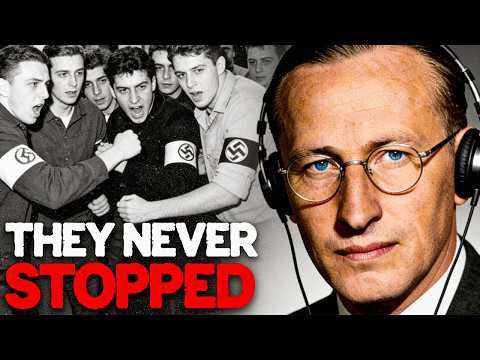
When the world learned the truth, the Clement family lie shattered overnight. Journalists camped outside. Neighbors stared. Most families would have retreated. But Horst responded by flying a swastika flag over the house. He wore a Nazi armband openly. His older brother Klaus echoed his defiance. This wasn’t grief—it was a declaration. The older sons didn’t crumble; they radicalized.
While the world debated Eichmann’s fate, Vera was planning something extraordinary. She petitioned Israeli authorities for permission to visit her husband in prison. The wife of the man who organized the murder of six million Jews, asking the Jewish state for a favor. And they granted it. On April 30, 1962, she flew to Israel under her maiden name, Vera Liebl, and was hustled through side gates at Ramle Prison. For roughly 80 minutes, she sat across from her husband, speaking through earphones. They talked about the family, about the boys. It was the last time she would ever see him.
Golda Meir herself had approved the visit with strict conditions: she comes, she sees him, she leaves immediately. No press, no statements. Israel calculated that a quiet humanitarian gesture would blunt international criticism before the execution. The visit remained classified for decades. When details surfaced, historians noted something telling: Vera showed no sign of moral reckoning. She hadn’t come to confront him. She had come to say goodbye to the man she still loved.
On the night between May 31 and June 1, 1962, Adolf Eichmann was hanged at Ramle Prison. It remains the only death sentence Israel has ever carried out. His body was cremated, and his ashes were scattered in the Mediterranean Sea beyond Israel’s territorial waters, so no grave could become a shrine. The three older sons had known it was coming. But knowing and accepting are two very different things. For Klaus, Horst, and Dieter, the execution didn’t close a chapter—it opened a wound that would never heal. They saw their father not as a war criminal, but as a martyr.
The execution didn’t end the Eichmann story. It split the family into two completely different narratives. And the direction those narratives took is something no one would have predicted.
Klaus, Horst, and Dieter didn’t distance themselves from their father’s legacy after the hanging. They weaponized it. In the months and years that followed, reports from Israeli and British investigators described the three brothers establishing a small neo-Nazi cell in Buenos Aires. They weren’t writing angry letters or attending quiet meetings in back rooms. They were harassing and physically attacking local Jews—targeting members of the very community their father had tried to erase from the earth.
They used the Eichmann surname not as a burden but as a badge of honor. In far-right Argentine circles, the name carried weight. It opened doors to networks of former SS officers, Nazi sympathizers, and the broader underground of unrepentant fascists who had found refuge in South America after the war. The brothers moved through these circles with a sense of entitlement, as though their father’s crimes had earned them status rather than shame.
Carmen Breton Lindemann, who knew the family during this period, later described Horst as a strong Nazi who considered himself closer to his father’s ideology than even his older brother Klaus. Horst wasn’t just sympathetic to National Socialism. He was devoted to it with a fervor that unsettled even some of the old guard. He saw himself as carrying on his father’s work—not in the bureaucratic sense of trains and deportation schedules, but in the raw, street-level sense of intimidation and violence.
Dieter followed a similar path, quieter but no less committed. Klaus, the eldest, served as the group’s informal leader, the one who connected the family to broader networks and gave their activities a sense of purpose beyond random aggression. Together, the three brothers represented something deeply disturbing: proof that the ideology hadn’t died with the regime. It had been passed down, absorbed, and put back into action by the next generation.
This wasn’t passive sympathy inherited through dinner-table conversations. This was active, violent continuation.
But while three sons were building a terror cell in Buenos Aires, the fourth was on a completely different trajectory. One that would eventually produce the most shocking statement any Eichmann ever made.
Ricardo Eichmann, the youngest of the four brothers, took the opposite path. At some point after the execution, he moved with Vera back to Germany. While his brothers were attacking Jews in Argentine streets, Ricardo was pursuing an academic career. He enrolled in university, studied archaeology, and eventually joined the German Archaeological Institute, where he specialized in the ancient civilizations of the Middle East. He published research. He earned the respect of his colleagues. He built a life defined not by his father’s name but by his own work.
But the real shock wasn’t his career change. It was what he said publicly. In interviews during the 1990s, Ricardo stated plainly that his father’s execution was justified. That Adolf Eichmann deserved to die for the enormity of his crimes. He didn’t hedge. He didn’t frame it in legal abstractions or offer qualified sympathy. He looked at the full weight of what his father had done—the trains, the camps, the millions of lives reduced to logistical problems—and he called the hanging justice.
Think about what that means for a moment. One household, one father, one ideology pumped into four sons from birth. The same bedtime stories about the glory of the Reich. The same casual hatred spoken over breakfast. The same worldview absorbed through years of daily exposure. Three of those sons became neo-Nazis who attacked Jews in the streets. The fourth said the hanging was deserved. Something broke the pattern in Ricardo. And historians still aren’t entirely sure what it was.
Some researchers point to age. Ricardo was the youngest, barely a teenager when Mossad agents seized his father on that Buenos Aires street. He had the least time under Eichmann’s direct influence before the capture shattered the family. His brothers were already formed—Klaus was in his twenties, Horst and Dieter not far behind—their identities hardened by years of dinner-table indoctrination. Ricardo was still malleable. Still, the age explanation only goes so far. Plenty of youngest children in extremist households grow up to be just as radical as their older siblings.
Others suggest something more specific: geography. Returning to Germany placed Ricardo in a country that, however imperfectly, was trying to confront its past. In the 1960s and 1970s, West German schools taught the Holocaust. Trials of former Nazis filled the newspapers. The Auschwitz trials in Frankfurt, the public reckoning with the crimes of the SS—these were the air Ricardo breathed as he studied archaeology and built his academic career. His brothers in Buenos Aires breathed a different air entirely. Their Argentina was a place where former Nazis lived openly, where the past was not confronted but celebrated in certain circles, where the Eichmann name still opened doors rather than closing them.
But there’s a third possibility that historians rarely discuss, and it may be the most unsettling of all. Perhaps Ricardo’s rejection wasn’t a matter of environment or age. Perhaps it was simply that he saw his father clearly, without the filter of ideology his brothers had wrapped around themselves. When the trial was broadcast around the world, when the details of the trains and the camps and the millions of murdered Jews were laid out in a Jerusalem courtroom, Ricardo watched. He was old enough to understand. And something in him refused to look away.
What the Eichmann family proves is that the Nazi legacy in South America wasn’t just a collection of old men hiding in suburban houses waiting to die. It was an active incubator, a place where ideology was maintained, transmitted, and put back into practice by sons who had never set foot in wartime Europe. Klaus, Horst, and Dieter weren’t relics. They were the future their father had envisioned—true believers raised from birth, untainted by direct participation in the original crimes but fully committed to the cause.
And yet the same household produced Ricardo. The same dinner table, the same father, the same last name. Completely different choices. That contradiction is what makes the story impossible to reduce to a simple lesson. Legacy doesn’t just haunt. It recruits. It reaches into the next generation and asks a question that every child of a monster eventually has to face: Do you carry this forward, or do you put it down?
Three Eichmann sons picked it up. One set it down.
But the story doesn’t end there. Because the sons who picked it up didn’t just fade into quiet obscurity. They left traces—scattered, fragmentary, but real. Investigators who tracked them through the 1960s and 1970s noted that the neo-Nazi cell they built in Buenos Aires didn’t operate in isolation. It was connected to a broader network, a shadowy infrastructure of former SS men and their sympathizers who had been smuggled into Argentina through the same ratlines that brought Eichmann himself. These were men who had organized the Holocaust, who had run the death camps, who had participated in mass shootings on the Eastern Front. And now they were mentoring the next generation.
Horst Eichmann, in particular, seemed to relish his role as heir to the cause. Witnesses described him as aggressive, confrontational, eager to prove himself. He wasn’t content to simply hold the ideology. He wanted to act on it. And act he did—harassing Jewish shopkeepers, painting swastikas on synagogue walls, participating in street brawls that left Jewish residents of Buenos Aires bruised and bleeding. The violence was small-scale compared to what his father had orchestrated, but it was real. It was a continuation, a statement that the ideology had survived the hanging at Ramle Prison.
But while Horst and his brothers were making themselves known in the streets, their mother Vera was navigating a different kind of survival. She had returned from Israel in 1962 with nothing but memories of those 80 minutes behind glass. She never spoke publicly about the visit. She never wrote about it. She simply resumed her life in Buenos Aires, raising her sons, maintaining the household, preserving the memory of the man she had loved. To the outside world, she was a widow. To her sons, she was the keeper of the flame.
What did Vera tell her boys after their father’s execution? That’s a question historians have never been able to answer with certainty. Did she tell them their father was a hero? A martyr? A victim of Jewish vengeance? Or did she say nothing at all, letting their own anger and grief shape their understanding of what had happened? The records don’t say. But the actions of Klaus, Horst, and Dieter in the years that followed suggest that whatever their mother told them, it didn’t include a call for reflection or remorse.
And what of Ricardo? When he moved with Vera to Germany, he left his brothers behind. The separation was physical, but it was also ideological. While Klaus and Horst and Dieter were building a terror cell in Buenos Aires, Ricardo was sitting in university lecture halls, learning about ancient civilizations, building a life that had nothing to do with his father’s crimes. Did he stay in touch with his brothers? Did they write letters? Did they argue about their father, about the war, about what it all meant? Again, the records are silent. But the fact that Ricardo eventually spoke so publicly and so clearly about his father’s guilt suggests that at some point, the break became permanent.
The Eichmann brothers never reconciled. They lived their lives on opposite sides of an ideological chasm that their father had dug for them. And as the decades passed, the world moved on. The Holocaust became history, then memory, then commemoration. The generation that had perpetrated the crimes died off, one by one. The generation that had inherited their ideology aged, faded, and in some cases, disappeared entirely.
But the questions remained. What creates the break? What makes one child of a monster reject everything their parent stood for while their siblings embrace it? The Eichmann family offers no easy answers. It offers only the stark fact of four brothers, raised in the same house, taught the same hatred, who made completely different choices. And it offers one more thing: the reminder that ideology is not destiny. It can be passed down, absorbed, and put into action. But it can also be seen clearly, confronted, and put down.
Ricardo Eichmann put it down. His brothers picked it up. And in that difference lies the whole terrible, complicated truth of what it means to be the child of a monster.
In the end, the Eichmann brothers scattered across the world they had tried to reshape. Klaus returned to southern Germany, fathered five children, and died in 2015 at seventy-nine—his memory erased by Alzheimer’s, reportedly unable even to recall his own name. Horst stayed in Buenos Aires, working manual jobs, dying of cancer that same year, anonymous and unrepentant.
Dieter, the quiet one, never left. As of 2018, a British investigation found him still living in Buenos Aires, a retired construction foreman, still within a few miles of the San Fernando bus stop where Mossad seized his father, still loyal to the ideology.
Ricardo alone lived a life of scholarship and moral clarity, insisting his father’s execution was just.
Same house. Same name. Different choices. If you were born into that legacy, which would you be—the one who picks it up, or the one who puts it down?
Report this article
Select a reason for reporting:






