You know the scene: Easy Company is pinned down at Foy, and Lieutenant Norman Dike freezes. He panics, gives incoherent orders, and is relieved of command. It’s one of the most infuriating moments in Band of Brothers—a moment that cements Dike’s reputation as a coward and an incompetent leader. But what if everything you just read was wrong? What if the man so many love to hate was actually a decorated hero who was shot in the line of duty?
According to a fellow soldier who was there, that’s exactly what happened. The real Norman Dike didn’t freeze up at Foy. He was shot.
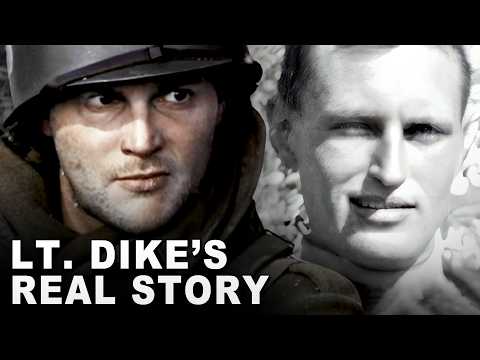
This is the story of a man whose legacy was rewritten by a bestselling book and a hit miniseries. A man who volunteered for the paratroopers, jumped into Normandy and Holland, and earned two Bronze Stars for valor and two Purple Hearts. A man who, according to eyewitnesses, was wounded in the shoulder during the attack on Foy—not paralyzed by fear.
Norman Staunton Dike Jr. was born in 1918 into a life of privilege. His father was a New York Supreme Court judge. He attended the prestigious St. Paul’s School, then Brown University, and was on his way to Yale Law School when Pearl Harbor changed everything. In January 1942, he enlisted.
He was commissioned a second lieutenant in under four months, married his socialite girlfriend Barbara, and soon volunteered for the paratroopers. By D-Day, he was the assistant regimental intelligence officer for the 506th Parachute Infantry Regiment, 101st Airborne Division.
In Normandy, Dike found himself separated from his unit, leading a group of 29 men with no radio contact. They fought for three days behind enemy lines, disrupting German positions and destroying equipment. “We never lost morale,” he later recalled. This was no coward.
A few months later, during Operation Market Garden, Dike was wounded twice in Holland. He earned his first Bronze Star for heroism at Uden, where he organized scattered paratroopers to defend a vital road junction against repeated attacks while completely surrounded. His second Bronze Star came at Bastogne, where he personally pulled three wounded men from an exposed position under intense small-arms fire.
Yet, in Band of Brothers, Dike is portrayed as a foxhole-hugging incompetent who abandons his men. The series shows him hiding during the shelling of Bastogne and then falling apart at Foy. But the real story is far different.
Easy Company veteran Clancy Lyall stated that he saw Dike get shot in the right shoulder near a haystack at Foy. That wound—not a nervous breakdown—is why he stopped fighting. The advance halted because Dike was incapacitated, possibly going into shock. A medic eventually helped him to the rear.
So why the discrepancy? Author Stephen Ambrose relied heavily on the accounts of a few veterans, including Dick Winters and Carwood Lipton, who disliked Dike and believed he had frozen. Ambrose never bothered to check Dike’s Bronze Star citations or Purple Hearts. The series amplified that biased portrayal.
Even some of Dike’s critics admit he wasn’t a coward. Babe Heffron said, “I don’t think he was a coward. I just think he was a bad leader.” But a bad leader doesn’t earn two Bronze Stars for valor. A bad leader doesn’t get shot and keep fighting.
Norman Dike survived the war, finished his law degree at Yale, served in the Korean War, and retired as a lieutenant colonel. He lived a full life, but his legacy was tarnished by a dramatization that needed a villain.
As we sit on our couches enjoying the freedoms his sacrifice afforded us, we should remember the real Norman Dike—not the caricature. He deserved better.
But the story of Norman Dike doesn’t end with his military career. After the war, he returned to Yale Law School and earned his degree in 1947. He stayed in the reserves, served during the Korean War, and retired as a lieutenant colonel in 1957. He worked for the CIA, served as a US Commissioner in Japan, and later became a uranium prospector in New Mexico.
In 1957, he married his second wife, Katherine Pousson, and they eventually settled in Switzerland, where Dike became president of a company that reconstructed the Grand Casino in Geneva. He lived out his days in quiet prosperity, far from the battlefields of Europe and the controversies that would later surround his name.
Interestingly, in the 1970s, Dike lived just five minutes away from Carwood Lipton—the very man whose account in Ambrose’s book helped cement Dike’s reputation as a coward. There’s no record that the two ever reconnected.
So here’s the question that haunts this story: how did a decorated hero become a punchline? The answer lies in the way history is written. Ambrose’s book relied on a handful of interviews, and those interviews were shaped by personal animosity, not objective fact. The men who disliked Dike had reasons—he was a staff officer thrust into a frontline command, he lacked the easy rapport of a Winters or a Speirs, and he may well have been indecisive under fire.
But indecisiveness is not cowardice. And a shoulder wound is not a nervous breakdown.
The controversy continues to this day. Some point to a 1945 newspaper article that lists Dike’s wounds as two in Holland and none in Belgium, suggesting he was never shot at Foy. Others counter that the article was written after the war and may have been incomplete. Winters himself, observing from a distance, believed Dike froze—but Winters wasn’t in the foxhole with him. Clancy Lyall was.
What’s certain is that Band of Brothers needed a villain in those episodes, and Dike fit the bill. He was a staff officer, not a beloved frontline leader. He was gone from the company by the time the war ended. He wasn’t alive to defend himself when the series aired.
And that’s the tragedy of Norman Dike. He volunteered, he jumped, he bled, and he earned his medals. But in the popular imagination, he’ll forever be the man who froze at Foy—a characterization that may be as fictional as the dialogue in the show.
As one commenter put it: we’re complaining that a man who jumped from a plane into combat twice and earned two Bronze Stars didn’t charge into machine-gun fire as efficiently as we would have liked—while we sit on our couches enjoying the freedom his sacrifice afforded us.
Norman Dike deserved better. Not because he was a perfect leader—he wasn’t—but because he was a brave man who served his country honorably, and his legacy deserves to be remembered in full.
But perhaps the most revealing detail is one that rarely makes it into the retellings. In the years after the war, Dike never publicly complained about his treatment, never wrote a letter to Ambrose, never sought to correct the record. Men who knew him in Switzerland described a reserved, thoughtful lawyer who preferred to speak about his family and his work rather than his wartime service.
That silence is telling. It’s the silence of a man who understood that memory is a fragile thing, and that those who shout loudest often write the history.
Consider the timing. Ambrose published Band of Brothers in 1992, three years after Dike’s death. The miniseries aired in 2001. By then, every veteran who might have defended Dike had either passed away or faded from the public eye. The narrative was sealed.
And yet, the documentary record refuses to cooperate. Dike’s Bronze Star citations still exist in the National Archives. His Purple Heart orders are still on file. The 1945 Brooklyn Citizen article still sits on microfilm, describing a man who was wounded twice in Holland and decorated for pulling wounded soldiers from exposed ground while bullets snapped overhead.
Those documents tell a different story than the one we’ve been sold. They tell of a man who, whatever his limitations as a company commander, repeatedly placed himself in harm’s way for the men around him.
Think about what it takes to earn a Bronze Star for valor. It isn’t given for showing up. It isn’t given for administrative competence. It’s given for acts of heroism under fire—for doing something that most men, in the same circumstances, would not do.
Dike did that at least twice. He may have done it a third time, if the Norwich Bulletin‘s mention of a Silver Star is accurate. The paperwork has never surfaced, but the obituary was written by people who knew him, and such claims are rarely invented from nothing.
What emerges, then, is not a coward and not a hero of legend, but something more human: a man of privilege who chose to jump out of airplanes, who led men in the dark hedgerows of Normandy, who bled in Holland, and who—when the moment came at Foy—may simply have been shot before he could prove the critics wrong.
The men of Easy Company were not villains for remembering him the way they did. Memory is selective. Winters and Lipton were exhausted, frightened, and watching their friends die. They saw a commander who didn’t inspire them, and they remembered that feeling long after the details faded.
But history should not be built on feeling alone. It should be built on evidence—on citations, on orders, on the testimony of eyewitnesses like Clancy Lyall, who had no reason to lie and every reason to stay silent.
Norman Dike’s story is a reminder that the men who fought in World War II were not characters in a drama. They were people—complicated, flawed, brave in some moments and hesitant in others. To reduce any of them to a single scene, a single failure, is to do them a disservice.
And so the question lingers, unanswered and perhaps unanswerable: when the cameras stopped rolling and the credits faded, did anyone think to ask what really happened to Foxhole Norman? Or had the story already become too convenient to question?
Maybe the answer lies in what we choose to do with stories like his. We can keep repeating the version that makes for better television—the coward who froze, the villain who needed replacing—or we can hold both truths at once: that Norman Dike may have been an uninspiring company commander and also a man who jumped into combat twice, bled for his country, and pulled wounded soldiers from exposed ground under fire.
Those two things are not contradictory. They are human.
The men who criticized Dike were not liars. They were soldiers who remembered fear and frustration through the fog of decades. But memory is not a court of law, and a miniseries is not a historical record. The documents remain—the Bronze Stars, the Purple Hearts, the citations that Ambrose never read.
Norman Dike died in Switzerland in 1989, five years before the book that would define him and twelve years before the series that would immortalize his worst moment. He never got to answer his critics. He never got to explain Foy.
But perhaps he didn’t need to. Perhaps the record speaks for itself, if only we bother to listen.
So the next time you watch that scene—Dike frozen, Speirs running through the smoke—ask yourself: whose story are you really watching? And what might the real man have said, if he’d been given the chance?
What do you think—does a dramatization owe the dead an accurate portrayal, or is artistic license simply the price of a good story? Let us know in the comments below.
Report this article
Select a reason for reporting:






