September 1967. Anderson Base, Phuoc Tuy Province, South Vietnam. Captain Richard Holloway of the US Army sat at his desk drafting something he had never expected to write in eight months of war: an official complaint. Not a field report. Not a casualty assessment. A grievance — the kind officers file when something threatens unit cohesion, command structure, and the dignity of the chain of command.
He had seen horrors that would follow him for the rest of his life. Ambushes. Body counts. Monsoon rains that turned jungle floor into rivers of mud and rot. But nothing — nothing — had prepared him for what he witnessed that morning at the joint briefing.
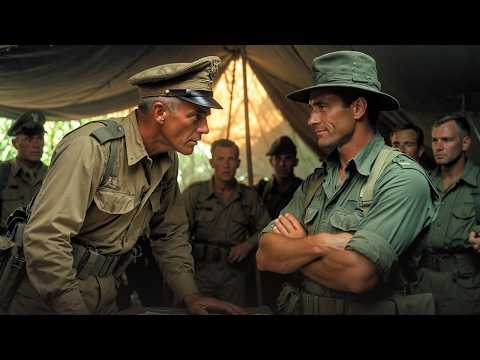
Five Australian SAS operators walked into the operations room. They ignored the seating arrangement clearly dictated by rank. They sat wherever they pleased. They interrupted the American briefer three times with corrections. And when the senior US commander suggested their proposed patrol route was too aggressive for a reconnaissance mission, the Australian patrol leader looked across the table and said — in the calm tone of a man ordering breakfast — that he appreciated the concern, but they would execute the mission differently.
Then they stood up and left. No salute. No request to be dismissed. They walked back into the jungle like smoke through a draft.
The captain’s complaint sat on a desk for four days before a senior officer quietly filed it away. No one wanted to pursue it because the patrol came back six days later with intelligence that saved 43 American soldiers. That was the problem, more than anything else.
The friction between American forces and Australian SAS in Vietnam was no secret. It wasn’t a footnote buried in declassified archives. It was a living, breathing friction that ran through joint operations like a crack in concrete — invisible on the surface, catastrophic when it moved.
American veterans who served in Phuoc Tuy between 1966 and 1971 speak of it with remarkable consistency decades later. The same words surface again and again in interviews, memoirs, and oral history projects. Arrogant. Difficult. Unprofessional. Disrespectful. Those were the polite versions. The less polite versions were never recorded for publication.
But here is what no one addressed directly — the question at the heart of everything, like unexploded ordnance no one wanted to approach: Were the Australians actually wrong?
Were they arrogant, or were they right? Were they disrespectful, or were they simply operating on a completely different frequency? A frequency tuned toward survival over protocol, results over rank, the jungle over headquarters.
To answer that question, you have to understand what the two forces were doing differently — and why those differences weren’t merely tactical disagreements between allies, but a collision between two entirely different theories of what war is.
The Americans arrived in Vietnam carrying enormous institutional confidence. Not vanity in the personal sense — methodological certainty instilled in every officer through years of training, doctrine, and the living memory of two world wars decided by firepower and industrial capacity. The US Army that deployed to Vietnam was the most powerful conventional military force in human history. It had more helicopters than most nations had aircraft of any kind. It had artillery networks capable of delivering fire on target within minutes of a radio call. It had complete air superiority. It had logistics infrastructure capable of supplying a small city.
And it had doctrine — revised, tested, written, refined, distributed across every level of command, telling every officer and NCO exactly how to handle every situation. Doctrine wasn’t optional. Doctrine was survival. Deviating from doctrine wasn’t initiative — it was dangerous independence that could get people killed.
Then the Australians arrived and treated doctrine like suggestions.
The first documented incident of what American officers called disrespect — and what Australian veterans called common sense — occurred within weeks of the initial deployment. A joint patrol briefing was scheduled. The American briefer, following standard procedure, laid out the patrol route, communication schedule, extraction timeline, and engagement protocols. Tested. Proven. Written for good reason.
The senior Australian listened to the entire briefing without expression. When it ended, he asked one question. He asked why the route followed the trail network for the first three kilometers.
The American officer explained it was the optimal path to the objective while maintaining navigation accuracy.
The Australian nodded slowly. Then he said, with complete neutrality, that the trail network was probably under observation, and that the patrol would reach a watching point within 90 minutes of entering it.
The American officer — the higher-ranking one — explained that intelligence assessment did not support that conclusion.
The Australian said, without any reaction, that the intelligence assessment had been wrong for six consecutive weeks, and that it would be wrong again.
The American officer filed a complaint. The patrol used the trail. The patrol was observed from a concealed position less than two hours after entering it, though contact was avoided. The Australian didn’t comment afterward. He didn’t need to.
This pattern repeated across dozens of joint operations. And it’s important to understand why this provoked such fury in the American chain of command. It wasn’t simply a difference of opinion. Disagreement existed at every level in every army. But the manner of disagreement was the problem.
American military culture, like most large armies, ran on specific social rules. Disagreement was expressed upward through official channels. Objections were carefully worded with respect for rank and acknowledgment of higher authority. You didn’t simply state that intelligence was wrong and that you would act differently. Those rules existed for good reason — they maintained cohesion in large organizations and prevented chaos when thousands of people needed to coordinate.
Australian SAS — especially veterans hardened in Malaya and Borneo — operated by rules the jungle itself had written. In the jungle, the rules were simpler and crueler. The correct procedure kept you alive. The wrong procedure killed you. Rank didn’t change that equation. A captain’s authority didn’t improve a bad route. A general’s confidence didn’t make a scent-tracked patrol invisible. The jungle didn’t care about institutional courtesies.
And the men who had spent years learning that truth — who had watched what happens when institutional courtesies override jungle reality — found it extraordinarily difficult to perform those courtesies again. Not because they were rude, but because it felt to them exactly like rehearsing a lie.
What made this friction truly complicated — what prevented it from being a simple story of reckless cowboys versus disciplined professionals — was that the Australians weren’t always right. They were right far more often than institutional logic justified. They were right enough to feel insulted, but they weren’t infallible, and they knew it.
The frustration wasn’t arrogance in the American sense — the swagger of a man who simply believes he’s better. It was closer to the impatience of someone who learned a lesson by surviving it, and who cannot watch that lesson be ignored without feeling almost physical pain.
One Australian SAS veteran, interviewed 40 years after his service, described the feeling with a precision no official report ever recorded. He said working with larger American units was like watching someone drive toward a cliff while insisting the map shows the road continues. You can shout. You can explain. You can show them the edge through the windshield. But if they outrank you, the vehicle keeps moving.
He didn’t say this with contempt. He said it with sadness. That’s a fundamental difference — and it changes the nature of what the Americans called disrespect.
To understand where the Australian approach came from, you cannot start in Vietnam. You have to go back more than a decade, to the jungle wars that preceded it — to the experiences that forged every SAS soldier who stepped off a transport plane at Phuoc Tuy. The Malayan Emergency. The Indonesian Confrontation in Borneo.
These were not large-scale conventional conflicts. They were grinding campaigns fought over years by small units in terrain that punished noise, rewarded patience, and killed anyone who confused institutional procedure with actual competence.
The Australians who fought in Malaya learned something that could not be transferred through briefings or field manuals. They learned that the jungle was not a backdrop to the war — it was a participant. It amplified sound, carried scent, recorded every movement in the vegetation, and reported it to anyone who knew how to read it.
They learned that the enemy who grew up in that environment held a biological advantage that could only be neutralized by merging with it as much as possible. They learned that rank meant absolutely nothing when a sniper was drawing a bead on you because your bootlace made a sound on wet leaves.
Then they arrived in Vietnam and discovered that their American allies — through no individual fault — had not learned these things. They hadn’t needed to. In two world wars, industrial firepower had ultimately overwhelmed any opponent. The problem had always been finding the enemy. It had always been finding the enemy — and the Australians knew how to do that.
The specific technical differences between Australian SAS doctrine and standard American infantry doctrine in Vietnam were not subtle. They were not matters of slight adjustment or simple preference. They were fundamental contradictions that touched almost every aspect of patrol work, from the moment of insertion to the moment of extraction.
American doctrine focused on unit size, firepower, communications, and mutual support. A larger force could break ambushes, call for and receive fire support, and possess redundancy — radio operators, leaders, multiple weapons systems. This was logical. It was based on experience in conflicts where the enemy moved in larger formations, which could be fixed and destroyed by superior firepower.
Australian SAS doctrine inverted these priorities — not out of philosophical preference, but as a result of specific lessons carved in blood in Malaya and Borneo. Smaller units were harder to detect. Five men made far less noise than fifty, needed less logistical support, and could operate farther from firebases. Five men moving at a slower, tracking pace — following the jungle’s own logic rather than a line drawn on a map — could achieve what a hundred men supported by artillery could not.
They could observe without being seen. Wait without being discovered. Understand the terrain with a precision that aerial photographs and electronic sensors could not simulate. And when they struck, they struck once, precisely, then vanished — leaving the enemy not merely with casualties, but with uncertainty. Unable to explain what had happened, where it came from, or whether it would happen again.
Communication protocols were a particularly sharp point of friction between the two forces. American doctrine mandated regular radio contact with command every four hours in most operational protocols, to confirm location and status. This had critical reasons: it allowed command to track unit positions, coordinate fire support, and launch search-and-rescue quickly if a patrol went silent. It saved lives in the scenarios it was designed for.
But it also produced an outcome that doctrine acknowledged and accepted as an unavoidable cost: it announced the patrol’s presence. Radio transmissions, even encrypted, even brief, were a signal. Enemy signals intelligence units — which the Viet Cong possessed — could detect any transmission activity and use direction-finding equipment to narrow down patrol locations. Practically, in the dense silence of the jungle at night, the click of a radio operator’s transmit button made a sound that carried farther than any briefing officer in an air-conditioned operations room could appreciate.
The Australian approach was different. Long periods of silence were not a failure to communicate — they were the communication. A patrol out of contact for three days was not a patrol in trouble. It was a patrol doing exactly what was required of it: becoming invisible.
When American commanders requested location reports from Australian patrols operating in their areas, the responses were sometimes so terse they seemed rude. Not because the Australians were rude, but because transmitting on schedule to satisfy administrative requirements felt, to a man lying motionless under jungle canopy thirty meters from an enemy supply route, like being asked to shout his address in a crowded room.
Even the ritual of cleaning weapons added a layer of friction that seemed almost absurd until you understood the logic behind it. American soldiers cleaned their rifles meticulously with standard-issue military solvents. The reason was obvious: a clean weapon doesn’t jam, and a jammed weapon ends lives.
The Australians cleaned their weapons too — but the solvents they used, or rather refused to use before long patrols, were different. Standard cleaning solvents had a chemical smell utterly alien to the jungle, and that smell lingered. An enemy tracker who had spent his life moving through those trees and rotting vegetation could detect the chemical signature of gun oil from distances American investigators considered unbelievable.
Perhaps the strangest point of cultural collision was food. Hot meals were a morale issue in the US Army — a genuine psychological and logistical priority. Australian SAS patrols on extended operations ate only cold rations. Not because they enjoyed hardship, but because heating food left aromatic traces that could compromise a patrol’s position across distances most people never anticipated.
When Australian patrols refused hot meals that American logistics units had worked tirelessly to organize, reactions ranged from confusion to deep resentment. They’re refusing what we built systems to provide. It looked like contempt. It wasn’t. It was five men trying to survive by disappearing from an enemy who had read the jungle’s signals for three generations.
The casualty ratio numbers were the deepest wound. Enemy-to-friendly loss ratios that made American statistics look like failure weren’t just a number — they were an argument. A daily, undeniable argument that something was being done differently, that the different way produced better results, and that those better results were being achieved by people who had been regarded with disdain when they stepped off transport planes.
American officers faced a choice when confronting those numbers. They could examine them, trace them to their logical conclusions, and begin asking uncomfortable questions about doctrine, training, and the foundational assumptions that had shaped American military thought for decades. Or they could question the numbers, find methodological problems in data collection, attribute results to luck or terrain, and move on.
The record shows clearly which choice was made most often. Not because American officers were stupid or dishonest, but because institutional survival, like biological survival, operates on mechanisms that protect the organism from information requiring complete restructuring to process.
The Australians watched this happen. Their capacity to observe without reaction, to see clearly without immediate utterance, served them no better here — because what they felt while watching wasn’t patience. It was something older and sharper. And it sometimes manifested in briefing rooms as dry, undiplomatic sentences that American officers complained about.
There were American units that understood. This must be said clearly and without reservation. There were US Special Forces officers who sat with Australian SAS veterans and listened intently, setting aside everything they believed to hear something new. Two groups of people changed by the same experience could communicate in a language of shared understanding without needing the social rules of institutional rank to keep the conversation coherent.
These interactions reveal that the problem was never fundamentally about nationality or personality. It was about experience — specifically, what happens to an individual, a unit, and a doctrine when tested in a specific reality long enough to change not only behavior, but perception itself. The Australians had undergone this test. So had some Americans. The rest were operating on a map that didn’t match the ground.
The psychological cost of the Australian approach was documented in ways both clinical and insufficient. Men who spent weeks in total operational silence, moving through enemy territory as creatures closer to predators than soldiers, returned changed in ways measurable but not fully classifiable. Hypervigilance was understood as a response to combat stress. What wasn’t fully understood was its particular nature — not general anxiety, but something more focused and professional. A continuous scan of the environment for threat indicators that the men themselves described not as fear, but as information-gathering that couldn’t be switched off.
One veteran described sitting in a Sydney restaurant six months after discharge, realizing he had mapped every exit, evaluated every patron for potential threat, and identified the only line of sight from the street that allowed observation of his table — all before the menu arrived. He didn’t describe this as disturbing. He described it as exhausting. The jungle doesn’t stay in the jungle. It moves home in the nervous system of the people who learn to become part of it, and it doesn’t leave when they do.
Formal relations between Australian and American forces improved as the war progressed — driven partly by genuine respect accumulated through joint operations, partly by practical necessity, and partly by the quiet influence of those American officers who listened. US Special Forces units began incorporating elements of the Australian approach into their doctrine, often without direct attribution, often described as independent tactical evolution rather than adoption of foreign practices.
The documentation language matters in these things. Citing allies suggests deficiency; independent evolution suggests institutional learning. The results were the same: quieter patrols, longer surveillance periods, more precise engagements, better intelligence, fewer friendly casualties. The evidence accumulated in the operational record with complete indifference to the facts, unconcerned by the institutional discomfort it represented.
Australian SAS soldiers who served in Vietnam, as a rule, did not speak at length about the conflict with American forces. Not in the years immediately after the war, not in the decades of silence that followed, not even later when oral history projects and documentary filmmakers began seeking them out. When they did speak about the American relationship, they spoke with a specific linguistic economy that conveyed more in what wasn’t said than in what was.
They didn’t claim superiority. They didn’t return to the complaints, the confrontations in briefing rooms, the reports filed. What they returned to, when they returned to anything, was the American soldiers they respected — the ones who learned the same things through different paths, the ones who sat in the jungle’s silence long enough to listen to what it was saying.
One veteran, asked about the tension in a 1998 interview, was silent for a long time before answering. He said he never hated working with Americans. He said he found it painful sometimes because he could see what was going to happen and couldn’t always prevent it. He said the ones who listened were the best soldiers he ever served with from any country. Then he said something that remained in that interview’s record as a kind of summary that no official history could provide.
He said the jungle isn’t complicated. It only requires that you stop arguing with it. Most people never manage that. The ones who do are the ones you want beside you.
The files of joint US-Australian operations in Vietnam were classified for reasons attributed to operational security, the sensitivity of interdependence, and the administrative caution that accompanies any documentation of formal complaints between alliance partners. When portions were released in the 1990s and early 2000s, researchers found exactly what the oral history records had indicated: a pattern of friction in the official records, documented disagreements, filed and dismissed complaints — in stark contradiction to the operational results that consistently supported the Australian approach.
The two sets of documents don’t agree with each other. One records an alliance that was professionally difficult; the other records an alliance that achieved brilliant results. Both are accurate, and neither is complete without the other — because that is reality. It was never a story of arrogant Australians ignoring American expertise, nor of rigid Americans unable to perceive superior method. It was a story of two groups of professional soldiers, each operating according to what their experience had taught them, colliding in a jungle that cared nothing for either’s lessons except what conformed to its own logic.
One group had learned that logic longer, and at greater cost. The friction wasn’t the alliance failing — it was the alliance working exactly as hard as it needed to, struggling with itself until the results emerged. The Australians weren’t reckless. They were somewhere else — deep in the jungle, waiting with the patience of men who had learned that the jungle always reveals the truth, if you’re willing to be quiet long enough to hear it.
Most people never quiet down enough. The ones who did changed military doctrine for an entire generation — and never asked for the credit.
So here’s the question that remains, buried like unexploded ordnance in the archive of alliance history: when two armies meet in a place that obeys no doctrine, whose silence speaks the truth — the one who follows the map, or the one who reads the ground?
Report this article
Select a reason for reporting:






