In the final, fading months of 1942, the western Mediterranean became a silent, churning graveyard of secrets. Two colossal armadas—one American, one British—sliced through the black waters, their engines humming a low, nervous hymn. Eighteen hours from departure. Destination unknown. A military secret. No one on those decks knew that the fate of the free world was about to be gambled on a single, audacious roll of the dice.
The convoys had been born four months earlier in the White House, where Roosevelt and Churchill sat late into the night, their faces drawn with the weight of a map that showed Axis spearheads driving east. “If these two prongs meet,” one planner whispered, “Europe and Asia become slaves.” The decision that emerged was bold and revolutionary: a joint invasion of North Africa, a second front before there was a first. They called it Operation Torch.
On board the USS Thomas Jefferson, Private Joe McAdams of Kansas leaned against the rail, watching the sea churn. He didn’t know where they were going. He only knew that the ship’s bulletin board had just posted the news: “You will perform your duty in North Africa as a soldier of the United States Army.” A cheer went up. Joe felt a strange mix of excitement and dread. North Africa? What was the plan called Torch?
Far to the south, a British convoy was splitting in two, one half turning back on itself in a delicate, 24-hour dance to confuse any spy. The men aboard—Scots, Londoners, Aussies, Kiwis—shared the same ignorance. “I’m a greengrocer from Surrey,” one soldier, George Metcalf, wrote to his girl. “But tonight I’m part of the greatest show on earth, and I don’t even know it.”
The plan was a masterpiece of deception. Three simultaneous landings—Casablanca, Oran, Algiers—to trap Rommel’s Afrika Korps between the Allied hammer and Montgomery’s anvil. But nothing went perfectly. Off Casablanca, French coastal batteries roared to life, and the battleship Jean Bart hurled shells at the American fleet. “Every resistance must be destroyed,” Patton told his men, “but if a French soldier seeks to surrender, treat him with respect. They are not Nazis.”
In Algiers, the French garrison wavered. Admiral Darlan, a man who had served Vichy, ordered a ceasefire after hours of confusion and blood. The city fell. But in Tunisia, the Germans were already pouring in—a thousand men a day, then more, under the ruthless Field Marshal Kesselring. The race was on.
Allied troops pushed east through mud and mountains, reaching within fifteen miles of Tunis before the winter rains turned the world to slime. “Our tanks couldn’t move,” a sergeant recalled. “Our planes couldn’t fly. Every hope of a quick victory drowned in a sea of mud.” The first gamble had failed. But it had not been in vain. The front lines froze along the Eastern Dorsal, a jagged spine of mountains where the Germans would have to come—and where the Allies would be waiting.
Through the long, cold months, patrols slipped through the hills at night, their faces caked in clay. “We look like moving lumps of mud,” George wrote. “But we’re still here.” And in the rear, the greatest supply chain the world had ever seen was grinding into gear. From Detroit to Algiers, from Manchester to Casablanca, trains, ships, and planes converged on a single point: Tunisia.
By mid-March, the trap was set. The cylinder strategy—a wall of Allied ground forces, a lid of air and sea power, and Montgomery’s Eighth Army as the piston—was ready to squeeze the Axis into oblivion. “The fuse is lit,” Alexander said. “Now we blow the charge.”
But before the final assault could begin, Rommel struck first at Kasserine, smashing through green American troops in a brutal, three-pronged offensive. For a moment, the Allied line buckled. Then it held. “They stopped us,” a German officer admitted. “And then they came back.” By March 17, the original line was restored. The initiative had passed—for good.
The final battle would be fought in the hills, in the mud, and in the air. And it would end, as all things must, with men raising their hands in surrender—or with men wondering what it had all been for.
The air war above Tunisia intensified as the spring sun dried the muddy runways. Every day, Allied fighters and bombers took off from hastily repaired airstrips, their engines coughing dust and exhaust. “We owned the sky,” one pilot said, “but the ground was still a butcher’s yard.” The tactical air force, under Cunningham’s command, pounded German supply columns relentlessly, turning the roads behind the front into smoking ribbons of wreckage.
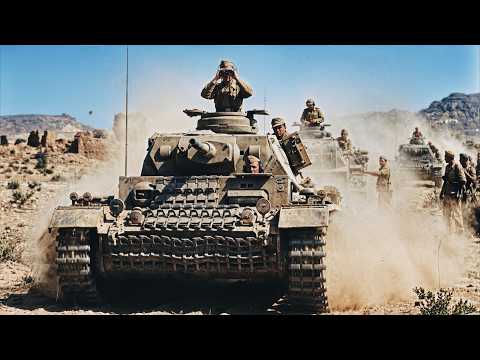
On the ground, the final assault began on April 19. The Eighth Army, battle-hardened and hungry, threw itself at the Enfidaville line while the First Army pushed from the west. “The whole horizon was on fire,” recalled a British artilleryman. “You couldn’t hear a single shell—just one continuous roar.” The Germans fought with the desperation of men who knew the end was near, but they were outnumbered, outgunned, and running out of fuel.
Hill 609 fell first. American infantry, many of them green only months before, clawed their way up the rocky slopes under murderous fire. “We took it,” Joe McAdams said, “but we left half our friends on that hill.” The capture of the high ground broke the German defensive shell. From there, it was a downhill race.
By May 6, British armor had punched through the center and was driving hard for Tunis. The 6th Armoured Division, with its Sherman tanks and Churchill Crocodiles, smashed through the last German reserves in the Medjerda valley. “There was no line anymore,” a German staff officer wrote. “Only chaos.” The Americans raced toward Bizerte, and the French, finally rearmed and eager, seized the hills on the right flank.
On May 7, Tunis fell. Bizerte followed hours later. The Axis forces, now split into four pockets, began to collapse. “Men came out of the hills in droves,” George Metcalf remembered. “Their hands were up, their eyes were empty. They looked like they hadn’t slept in weeks.” By May 13, the last organized resistance ended. More than 250,000 German and Italian soldiers surrendered—the largest mass capitulation of fully equipped troops in modern history.
In the aftermath, the battlefields fell silent. Joe and George stood on a ridge overlooking the sea, watching the endless columns of prisoners trudge toward the rear. “We won,” Joe said quietly. “But it doesn’t feel like winning.” George nodded. “It never does. But look at them—those villagers going home. That’s what it’s for.”
Below, an old Tunisian man approached them, his hands trembling as he shook theirs. “Shukran. Shukran,” he repeated, tears cutting tracks through the dust on his face. Joe thought of his friend who had died the day before. He thought of the mud, the cold, the fear. And he thought of the future—the dams, the ships, the roads they had promised each other they would build.
The war in Africa was over. But the road ahead was still long, still hard, still uncertain. And somewhere beyond the horizon, the liberation of Europe was waiting.
Yet even as the guns fell silent in Tunisia, the men of the First Army knew this was not an ending, but a turning. “Africa is free,” George wrote to his girl that night, “but Europe is still a long way off.” The same ships that had carried them to Casablanca and Oran now began to gather in the harbors of Algiers and Bizerte, their holds emptied of tanks and filled with the quiet anticipation of what came next.
In the weeks that followed, the Allied high command turned its gaze northward. Sicily lay just ninety miles across the Strait of Messina—a stepping stone to the Italian mainland, and from there, to the soft underbelly of Hitler’s fortress. “One down,” Eisenhower told his staff, tapping the map with his pointer. “Now we go for the throat.” The lessons of Tunisia—the coordination of air, land, and sea, the brutal arithmetic of supply lines, the necessity of unified command—were already being written into the plans for the next invasion.
Joe McAdams and George Metcalf found themselves camped near the ruins of Carthage, where Roman columns lay half-buried in the sand and the sea lapped at stones that had known Hannibal’s elephants. “Funny,” Joe said, staring at the ancient rubble. “They fought here too. Same ground, different century.” George laughed. “Let’s hope we leave it in better shape than they did.”
But the war was not done with them yet. Orders came down within days: the division was to begin training for amphibious operations, for beachheads and bunkers and the kind of fighting they had not yet seen. “Italy,” a sergeant muttered, and the word spread through the camp like wildfire. The men who had crossed the Atlantic and fought through the Tunisian hills would soon be asked to do it all again—only this time, the enemy would be waiting on his own soil.
On a warm evening in late May, Joe and George sat outside their tent, sharing a tin of captured German coffee. The sky over the Mediterranean was streaked with orange and violet, and for a moment, the world felt almost peaceful. “You remember what we talked about?” Joe asked. “After the war—the dams, the roads, all of it?” George nodded slowly. “I remember. I still mean it.”
Joe took a long sip of the bitter coffee and stared out at the sea. Somewhere beyond that horizon, men were already planning the next landing, the next battle, the next graveyard. But for now, there was only the quiet, and the promise they had made to each other. “Then we’d better survive Italy,” Joe said. “We’ve got work to do.”
The sun sank below the water, and the first stars appeared over North Africa—the same stars that would soon guide them to another shore, another fight, another step on the long road toward home.
The weeks turned into months, and the camp near Carthage became a revolving door of men and machines. Landing craft practiced their runs on the beaches, their ramps clanging down on sand that had once held Roman galleys. “Same sea,” George muttered, watching the drills. “Different invaders.” Joe just shook his head and cleaned his rifle.
Then, one morning in early July, the orders were finally posted. The division was to embark for Sicily. “We’re going to Italy,” the sergeant announced, and a strange quiet fell over the men—not fear, exactly, but a grim understanding. They had beaten the Axis in Africa. Now they would have to do it again, on the enemy’s own soil.
On the last night before embarkation, Joe and George sat on a low stone wall, the sea whispering against the ancient harbor. “You still mean it?” George asked. “The dams. The roads. The whole crazy idea?” Joe nodded, his face half-lit by the moon. “More than ever. If we don’t build something after this, what was any of it for?”
They shook hands—not as soldiers, but as men who had made a promise. Then they walked back to their tents, the stars wheeling overhead, the same stars that had watched them cross the Atlantic and would watch them cross the Mediterranean.
The war in Africa was over. The war for the world was not. And the men who had freed Tunisia would soon be asked to pay the price again—on the beaches of Sicily, in the mountains of Italy, on the long, bloody road to Berlin.
But that is another story. And somewhere, in the quiet of a Kansas evening or a Surrey garden, two old soldiers would one day sit and remember the mud, the hills, and the friends they left behind. What do you think—was it worth it?
Report this article
Select a reason for reporting:






