June 12th, 1982, Mount Longdon, East Falkland. Three Para is pinned down on a black rock ridge by Argentine machine gunners and snipers firing from caves. Behind them, six guns of 79 Battery, 29 Commando Regiment Royal Artillery, are working at charge super, the heaviest propellant setting the gun was ever designed to fire. In the next 12 hours, those six guns and their sister batteries will put roughly 6,000 rounds onto the ridge. Brigadier Julian Thompson, commanding Three Commando Brigade, later admitted he was on the point of pulling his Paras off the mountain. He didn’t. The artillery broke the Argentine defense first.
The gun firing those rounds was new then. The L118 light gun had been in British Army service for just seven years. Forty-four years later, that same Falklands-era gun—the same caliber, the same basic design—is in Ukrainian hands killing Russian artillery crews who are dying inside vehicles forty times its weight. This is the story of how a 105 mm towed howitzer from the 1970s is outlasting every modern Russian system on the battlefield, not by firepower, but by staying alive.
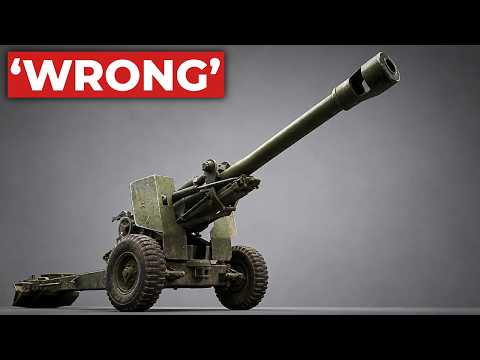
By 1965, the British Army had a problem. The Italian OTO Melara pack howitzer in British service as the L5 was failing the modern battlefield. Short barrel, unstable carriage at tow speed, poor sights. According to a 1965 general staff requirement, the gun lacked range and lethality. The Royal Armament Research and Development Establishment at Fort Halstead in Kent was handed the design brief. They were to produce a 105 mm gun light enough to be lifted under a helicopter, mobile enough for airborne and commando use, and accurate enough to replace heavier divisional artillery in expeditionary operations.
The team at Fort Halstead reused the L13 ordnance from the Abbot self-propelled gun, fitted a slightly shorter auto-frettaged L19 barrel, and mounted it on a new box trail carriage with a traversing platform. Prototypes were tested in 1968. Trials showed the carriage needed strengthening. Weight was added. The first production guns rolled out of the Royal Ordnance Factory in Nottingham in October 1974. The gun entered service with the Royal Artillery in 1975. The combat weight, 1,858 kg. Maximum range with the standard L31 high explosive shell, 17.2 km. Crew, six men. The L118 could be emplaced in roughly 30 seconds with the later automatic pointing system. A Chinook helicopter could carry it underslung. A Sea King could move a full battery of six guns with 500 rounds per gun in 85 sorties. That last figure mattered more than any other. It meant a battery could appear on a mountain, fire, and disappear before the enemy could find it.
Now, before we see how this gun performed in combat, if you’re enjoying this deep dive into British engineering, hit subscribe. It takes a second, costs nothing, and helps the channel grow. All right, let’s get into the war that made the L118’s reputation.
The Falklands War in 1982 committed 30 L118 guns to combat. Five batteries: 7, 8, and 79 Batteries of 29 Commando Regiment Royal Artillery; 29 and 97 Batteries of 4 Field Regiment Royal Artillery. According to Forecast International’s records, those 30 guns fired approximately 17,000 rounds during the campaign without a single malfunction. The Royal Artillery records that during the later stages of fighting around Port Stanley, each gun was firing up to 400 rounds per day at charge super.
To understand what that means, consider the conditions. South Atlantic winter, freezing rain, gale-force winds, peat ground so soft the gunners had to switch to air burst fuses because contact fuses were being absorbed by the bog before detonating. The guns fired anyway. Through Goose Green on May 28th, where 2 Para was supported by just three guns and 960 rounds. Through Mount Longdon and Two Sisters on June 11th, where six guns of 29 Commando supported 3 Para and 45 Commando through the night. Historian Hugh Bicheno, in his 2006 account Razor’s Edge, recorded that 1,500 shells were fired onto Two Sisters in a single night.
The Argentine artillery on the islands consisted largely of the Italian OTO Melara Model 56 pack howitzer—the same gun the British had replaced with the L118 because it lacked range and lethality. The Argentine guns were outranged. They were outpaced in rate of fire. They could not be repositioned by helicopter the way the British guns could. Brigadier Julian Thompson, writing in The Shibburnian in 1982 on 40 Commando, described his brigade as “5,000 men, five infantry units, and four batteries of 105-mm light guns plus helicopters and logistic support.” Four batteries, Sea Kings moving them between fire positions. That was the war-winning combination.
After the Falklands, the L118 became the standard British light field gun. It served in Sierra Leone in 2000, deployed off Royal Fleet Auxiliary Fort Austin during Operation Palliser. It served in Iraq from 2003 onwards. It served throughout the Afghanistan campaign from 2006 to 2014. In Helmand, the gun was stripped down and dragged by hand up rocky pinnacles to provide elevated fire positions no mechanized artillery could reach. The Americans took notice. In 1986, the United States Army announced acquisition of 583 M119s, a licensed copy of the British design. The first 147 were built at the Royal Ordnance Factory in Nottingham. The rest were produced in the United States. Britain didn’t buy an American gun. America bought a British one.
That brings us to 2022. Russia invades Ukraine. Ukrainian artillery brigades are equipped with a Soviet-era D-30, a 122-mm towed howitzer that entered service in 1963. The D-30 weighs 3,150 kg. It has a three-leg mount giving full 360° traverse. Maximum range with standard high explosive, 15.4 km. The Russians have the same gun in larger numbers plus heavier systems. The 2S19 Msta-S self-propelled howitzer, 42 tons, 152 mm, range up to 24.7 km with standard ammunition, 36 km with rocket-assisted projectiles, autoloader, crew of five. Per United24 Media, the unit cost is approximately $1.7 million.
On paper, the Russians have the firepower advantage. 152-mm shells carry roughly 6.8 kg of explosive. The British 105-mm L31 high explosive shell carries about 2.5 kg. A single Russian round is more destructive than a single British one. This is not a debate. What happened next was not on paper.
In July 2022, Defense Secretary Ben Wallace delivered written ministerial statement HCWS 259 to the House of Commons. He announced that the United Kingdom would supply Ukraine with 36 L119 guns. The L119 is the export variant of the L118, modified to fire United States standard M1 type ammunition. The United States added 72 more 105-mm howitzers. Australia and New Zealand contributed training and additional guns. By April 2024, BAE Systems announced a contract to maintain and repair the gifted L119s inside Ukraine. The British company had opened a legal entity in Kyiv. The supply chain was being built in country.
The guns went to the 95th Air Assault Brigade, the 67th Mechanized Brigade, the 77th and 46th Air Mobile Brigades, the 5th Assault Brigade. Ukrainian crews trained on them in Britain and New Zealand. According to Ukrainian crew accounts published by Defense Express, the L119 prepares to fire much faster than the D-30. The British gun has an elevation arc of 1,400 mils, roughly 79 degrees against the D-30’s 70, allowing steeper plunging fire into trenches and reverse slopes. Defense Express and Militarnyi both report that Ukrainian units have supplemented their D-30 fleet with the L119, and in some formations have replaced the Soviet gun entirely with the British one.
The reason has nothing to do with shell weight. It has everything to do with not dying. Russian artillery in Ukraine in 2024 and 2025 operates under a sensor-to-shooter cycle as fast as three minutes. That figure comes from Royal United Services Institute analysts Jack Watling and Nick Reynolds, who interviewed Ukrainian officers in November 2024 and January 2025 for their special report on the third year of the war.
The cycle works like this. A counter-battery radar detects an outgoing shell. Software triangulates the firing position. A Lancet loitering munition or a Russian artillery battery puts rounds on that position within three minutes. If your gun is still there, your crew is dead. If you can be hooked to a vehicle and gone in two minutes, you live.
The L119, at 1,858 kg combat weight, can be hooked to a Humvee in seconds. A 42-ton Msta-S takes between three and five minutes to displace from a prepared firing position. Its dozer blade spades have to be lifted out of the dirt. Its autoloader has to be safed. Its crew has to button up. In a three-minute counter-battery cycle, that is the difference between surviving and not.
The numbers prove it. According to the Oryx open-source database, as of April 22, 2025, Russia had lost at least 234 2S19 Msta-S and 52 2S33 Msta-SM2 systems, visually confirmed through photographic evidence. By August 9th, 2025, those figures had risen to 246 Msta-S and 54 Msta-SM2. 194 Msta-S confirmed destroyed outright. Per Army Recognition, Russia is now welding factory-installed cope cages onto new-build Msta-S turrets to defend against Ukrainian FPV drones. This is an admission. The 42-ton platform cannot survive the open battlefield without overhead protection.
According to Ukraine’s commander-in-chief, General Oleksandr Syrskyi, posting on Facebook in February 2025 and reported by Ukrainska Pravda, strike unmanned aerial vehicles accounted for 66 percent of Russian equipment losses in January 2025. FPV drones alone accounted for 49 percent. The Russian gunners are dying inside their vehicles, many before they ever fire a round.
The L119 survives because it has no engine, no exhaust plume, no thermal signature between fire missions. It can be netted. It can be hidden in a tree line. It can be lifted by helicopter to a position no tracked vehicle can reach. Sergeant Dmytro, an L119 gun commander in the 95th Polissia Air Assault Brigade, told his brigade in a Facebook post reported by Defense Express that his crew was positioned behind the lines of a friendly brigade for ten days. The Russians attempted to storm those positions ten to twelve times per day. The breaks were so brief, he said, that in the end it was one continuous assault. His crew held the enemy back with a single gun. He was personally decorated by General Syrskyi.
Reuters in June 2023 interviewed an M119 crew in the 67th Mechanized Brigade near Kreminna. The gunner, going by the call sign Cousin, said the gun was wonderful. What mattered most, he said, was having enough shells. The same Ukrainian crews told Reuters they valued the speed with which the gun could fire several rounds and be packed away.
Major Patrick Hinton of the Royal Artillery, serving as the Chief of the General Staff’s Visiting Fellow at RUSI Military Sciences Research Group, wrote in European Security and Defense in March 2024 that the static gun line is dead. In Ukraine, he wrote, there has been a disaggregation and federation of how fires are happening from previous static gun positions. Today, dispersal and mobility are absolutely key. He also noted that around a third of Ukrainian forces artillery, including M777s, is out of the line for repair at any one time. The L119, lighter, simpler, towed, takes less maintenance, and is faster to bring back into action.
The L119 is not better than a Msta-S at delivering destructive force per shell. The argument is not raw firepower. The argument is delivered lethality per surviving gun hour. Over a 1,000-day campaign, a gun that fires five rounds and lives is worth more than a gun that fires eight rounds and dies.
The Russian fleet has been bled white because its heavier systems cannot move fast enough between firing positions to survive Ukrainian counter-battery and drones. The British gun, designed in 1968 to be lifted under a helicopter and emplaced in 30 seconds, was almost accidentally optimized for exactly the battlefield Ukraine has become.
44 years separate Mount Longdon from the Donbas. The carriage is the same box trail. The ordnance is the same L19 barrel. The crew drill is the same. What changed is the battlefield around it. The Falklands rewarded a gun that could be moved by helicopter. Ukraine rewards a gun that can be moved by Humvee before a drone finds it. The same answer fits both questions.
The Mount Longdon ridge is quiet now. The guns from that night are in museums, in storage, or in Ukrainian gun positions on the Dnipro and the Donets. The Royal Armament Research and Development Establishment closed in 1991. Its work is still firing.
So here is the question for you: in an age of drones and three-minute kill chains, is the future of artillery lighter and towed—or heavier and armored? Tell us in the comments.
Report this article
Select a reason for reporting:






