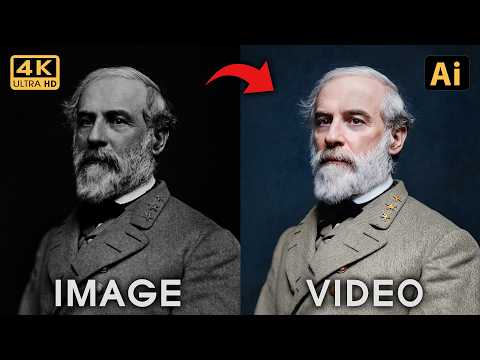
What if the dead could look you in the eye once more? Not as faded sepia ghosts trapped in old photographs, but as breathing, blinking, startlingly real faces—each one carrying the weight of a nation torn in two. That is the uncanny promise of this journey: twenty legendary figures from the American Civil War, resurrected through artificial intelligence, brought back from the silent archives to stare directly into our world.
This is not a history lesson. It is a séance of pixels and data, where the past refuses to stay buried.
Abraham Lincoln is the first to return. The sixteenth president, born in a log cabin and destined to hold the Union together through its bloodiest trial. His Gettysburg Address and Emancipation Proclamation still echo, but here, his weary eyes and hollow cheeks are rendered in unsettling detail—a face that carried the weight of over 600,000 dead. You almost expect him to speak.
Then comes Ulysses S. Grant, the general who refused to retreat, the man who accepted Robert E. Lee’s surrender at Appomattox and later led a fractured nation through Reconstruction. His stoic expression hides the scandals and battles that defined his presidency, but the lines on his face tell their own story.
And across the divide stands Lee himself—the Confederate commander whose military brilliance was matched only by the bitterness of his defeat. “It is well that war is so terrible, or we should grow too fond of it,” he once said. Brought back to life, his dignified bearing and sorrowful gaze make that sentiment feel terrifyingly immediate.
But these three are only the beginning. Stonewall Jackson, the eccentric genius of the South, whose accidental death by friendly fire shattered Confederate hopes. James Longstreet, Lee’s trusted lieutenant, later branded a traitor by his own people for embracing Reconstruction. And William T. Sherman, the Union general whose March to the Sea left a scar on the Southern psyche that still lingers.
Each face carries a story—of courage, of controversy, of convictions that split families and turned neighbors into enemies. David Farragut, the naval hero who thundered, “Damn the torpedoes, full speed ahead!” J.E.B. Stuart, the flamboyant cavalryman with his plumed hat and reckless daring. Braxton Bragg, the Confederate general so quarrelsome that even his own officers despised him.
Twenty figures. Twenty windows into a war that redefined America. The AI has done more than reconstruct faces—it has resurrected the tension, the tragedy, and the raw humanity of a conflict that still shapes the nation today.
As you look into these eyes, you may find yourself wondering: what would they say if they could see us now? And who among them will you recognize first?
Consider George B. McClellan, the young general who built the Army of the Potomac into a magnificent fighting machine—then seemed almost afraid to unleash it. His face in the reconstruction is smooth, almost boyish, a stark contrast to Lincoln’s weathered features. “He has the slows,” Lincoln once complained, and looking at McClellan’s cautious, calculating expression, you can almost understand why.
Next to him stands George Meade, the quiet victor of Gettysburg. There is no swagger in his eyes, only the weary composure of a man who held his ground under impossible pressure. History often forgets him, overshadowed by louder names—but the AI gives him his due.
Then the naval hero arrives. David Farragut, first admiral of the United States Navy, his jaw set with the stubbornness of a man who lashed himself to the rigging during battle rather than risk losing command. “Damn the torpedoes, full speed ahead!” The words still crackle with defiance.
Winfield Scott appears as an old man—but what an old man. The architect of the Anaconda Plan, the strategy that slowly strangled the Southern economy, he looks every inch the soldier who served under fourteen presidents. His face is a map of the early republic itself.
Andrew Johnson follows, the accidental president, his expression hard and unyielding. The first president to be impeached, he stares out with the stubbornness of a man who never forgot where he came from—and never quite learned how to compromise.
And then there is Jefferson Davis. The only president of the Confederacy, his gaunt face carries the ghost of a cause that was doomed from the start. Captured and imprisoned for two years, he never recanted, never apologized. In his reconstructed eyes, there is pride, and something else—perhaps the faintest shadow of regret.
But it is the generals who fought the war that unsettle us most. Ambrose Burnside, whose disastrous charge at Fredericksburg sent thousands to their deaths—his famous sideburns still framing a face marked by duty and defeat. Joseph Hooker, “Fighting Joe,” whose boldness collapsed at Chancellorsville. And J.E.B. Stuart, the cavalier with the plumed hat, whose reckless raids made him legendary—until a bullet at Yellow Tavern ended the music.
Each one returns, not as marble statues, but as men. Flawed. Fierce. Human.
Then the ranks open onto the western theater, where the war was won and lost in muddy rivers and burning cities. William Tecumseh Sherman stares back with eyes that seem to calculate distances and destruction in the same breath. The general who marched to the sea, who burned Atlanta and broke the Southern will, looks less like a monster and more like a man who understood—perhaps too well—that modern war is fought against populations, not just armies.
Beside him stands Braxton Bragg, the Confederate commander of the Army of Tennessee, his thin lips pressed into a line. Even in stillness, he radiates the quarrelsome temperament that made him despised by his own officers. Victory at Chickamauga meant little when every subordinate wanted him gone.
And here is Joseph E. Johnston, the master of the cautious retreat, forever clashing with Jefferson Davis over how the war should be fought. His face is calm, almost serene—the look of a man who valued preserving his army above winning glory.
Two more faces emerge from the Southern pantheon, both cut down before the war’s final act. A.P. Hill, the fiery commander of the Light Division, who reportedly fell ill before every major battle yet never failed to lead the charge. “I will never retreat if there is one man willing to stand by me,” he once vowed—and on April 2, 1865, one week before Appomattox, a bullet finally stopped him at thirty-nine.
Then John Bell Hood, the youngest and most reckless of them all. His eyes burn with the same ferocity that cost him an arm at Gettysburg and a leg at Chickamauga—and that later drove his army to ruin at Franklin and Nashville. Bravery and folly, it turns out, can wear the same face.
Finally, the first great loss of the war: Albert Sidney Johnston, the shining light of the South, killed at Shiloh before his promise could be fully realized. Robert E. Lee mourned him as irreplaceable. Looking at his reconstructed features, you sense the weight of what might have been.
Twenty faces. Twenty fates. Some died in glory, some in disgrace, some in bed decades later, still arguing about a war that never truly ended. The AI has given them back their eyes—and in those eyes, the whole terrible, magnificent drama of America’s bloodiest chapter flickers once more.
But resurrection has a price. The more real they become, the harder it is to look away—and the harder it is to remember that these are echoes, not ghosts. What happens when the line between remembrance and obsession begins to blur?
The screen flickers. One by one, the faces begin to move—not with the jerky artifice of early animation, but with the terrible smoothness of something almost alive. Lincoln blinks. Lee’s lips part as if to speak. Sherman’s eyes shift, tracking across the room.
“Who are you?” the silence seems to ask. “And what have you done with our war?”
You want to answer. You want to tell them about the world they helped build—the union preserved, the slavery abolished, the scars that healed and the ones that never did. But the words catch in your throat, because you realize they are not waiting for an answer. They are judging us.
The AI has done its work too well. These are not portraits anymore. They are mirrors.
And in that mirror, you see the truth: the Civil War never ended. It simply changed uniforms. The arguments that tore the nation apart in 1861—about freedom, about power, about who belongs—still echo in every headline, every protest, every divided family table.
“The past is never dead,” Faulkner wrote. “It’s not even past.” Looking into these twenty pairs of resurrected eyes, you finally understand what he meant.
So the question is not what they would say to us. The question is what we will say to them—and whether we have the courage to hear their answer.
Which of these faces will you carry with you when you close this video? And more importantly—what will you do with the history they left behind?
Report this article
Select a reason for reporting:






