Deep beneath the mountains of Germany, hidden from the eyes of the world, lie the remnants of a project so ambitious and so terrifying that it could have altered the course of history. These are the underground factories of the Third Reich—vast, bomb-proof complexes where Hitler’s scientists and slave laborers toiled to produce weapons of mass destruction. Today, only a few may set foot in these forgotten tunnels, where the air is thick with the ghosts of the past and the walls whisper secrets of unimaginable cruelty.
In the final years of World War II, as Allied bombs rained down on German cities, the Nazi leadership devised a desperate plan: to move their entire war production underground. Hundreds of millions of Reichsmarks were spent hollowing out mountains, creating a subterranean world of tunnels and halls where the latest weapons—jet fighters, ballistic missiles, and deadly chemical agents—would be built. “You will work until you drop dead,” a German officer told the slaves who were forced to excavate these tunnels. And many did.
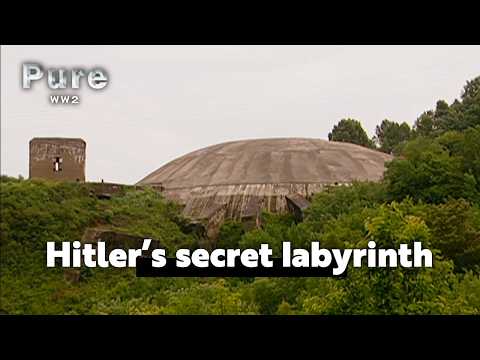
The scale of the project was staggering. Over 400 underground sites were given code names, and the Ministry of Armaments planned some 800. Yet, only about 20% were ever put into operation. The human cost was beyond comprehension. Hundreds of thousands of slave laborers from concentration camps were worked to death, their lives expendable in the race to complete Hitler’s wonder weapons. “We were considered the death commando,” recalled one survivor. “People called us that too.”
In the tunnels of Nordhausen, where V2 rockets were assembled, prisoners slept where they worked, surrounded by filth and death. “A lot of people died in there,” said another survivor, his voice trembling. “The brutality of the SS beyond description.” The air was humid and cold, and diseases spread like wildfire. Those who did not die from exhaustion or disease were often beaten to death.
But the Nazis’ ambitions went beyond rockets. In the forests of Brandenburg, at a place called Falkenhagen, scientists worked on a new chemical weapon: sarin. “With a month’s production of sarin, the Nazis would have been able to eradicate the population of a city as large as London,” experts believe. The Allies had no idea such a weapon existed. It was a purely German invention, and its potential for destruction was apocalyptic.
Yet, as the Red Army advanced, the Nazis fled, destroying what they could. The world would never know how close they came to unleashing this horror. Today, the tunnels stand as silent witnesses to a madness that almost consumed the world. But the story is far from over. What drove the Nazi leadership to such extremes? And what would have happened if their underground factories had succeeded? The answers lie buried deep within the earth, waiting to be uncovered.
To understand the madness, one must descend into the earth itself. Near the Bavarian town of Auerbach, a concrete seal blocks the only entrance to a tunnel system that once belonged to Messerschmitt. “Every few years, I have to make sure that everything inside is intact,” says Heinz, a state-appointed geologist responsible for some twenty such sites across southern and eastern Germany. His flashlight cuts through the darkness, revealing wooden lining rotted by six decades of damp. Stones loosen from the roof without warning. “The others were all blasted at the end of the war,” he explains, pointing to where a second portal once stood.
Here, two parallel tunnels run eighty to ninety meters, connected by cross-sections. They were meant for bomb-proof aircraft production. The Allies knew of 340 such sites before the war even ended. The Ministry of Armaments had plans for 800.
The decision to go underground came late. Only in the summer of 1943, as Allied bomber squadrons grew ever more destructive, did Albert Speer give the command to systematically transfer war production beneath the surface. Industry initially resisted. The costs were outrageous, the plans incomplete, the implementation chaotic. But the Führer’s will prevailed.
One of the first projects was realized on the banks of the Neckar River, code name Neckar. One hundred twenty meters beneath vineyard slopes, a gigantic tunnel system still lies out of sight. The gypsum mines there had operated for over 150 years. During World War I, they housed a dynamite factory. From 1937, they stored ammunition. Today, the iron gate opens into a subterranean town—a road network thirty-four kilometers long, carved from the mountainside.
A gigantic arms forge was to be built here on 130,000 square meters. It was partly operational by spring 1944. Two plants were transferred: ammunition casing production and a ball bearing factory from Schweinfurt. When the army expanded the installation in 1957, Europe was in the grip of the Cold War. Facilities were sought that would be nuclear bomb-proof, capable of storing high-grade materials and continuing repairs under the worst conditions.
“720 people work underground here,” says the facility’s commander, “providing supplies and repair parts for the army.” The maintenance costs the German Ministry of Defense 1.6 million euros annually. “The greatest advantage is the special climatic conditions—variable air temperature and humidity—so there is little effort involved in preserving and packaging. In addition, because of the few access points and ventilation shafts, the plant is very easy to guard.”
In the same tunnels where materials are stored today for German peace missions in Kosovo and Afghanistan, weapons of war were to be produced sixty years ago. The expansion would have cost at least fifty million Reichsmarks. Only half was completed by the end of the war.
The ball bearing factories in Schweinfurt were a particular target of Allied bomber raids. Despite heavy losses, the Americans succeeded in razing them to the ground. Yet their main goal—paralyzing production for Hitler’s Wehrmacht—was not achieved at that stage. Up to eighty percent of key war industries were to be moved underground, including aircraft engines, fuel tanks, and the secret missile program of the SS. Only about twenty percent of these projects were ever put into operation.
Installations deemed essential were well camouflaged, invisible to Allied reconnaissance planes. The gigantic fuel tanks of Nazi Germany, for instance, were bunkered underground from as early as the mid-1930s. One such tank near Bremen is still in operation over sixty years later. State-owned, it must be maintained regularly. Only trained personnel can descend into the tanks. Each of the eighty gigantic tanks holds 4,000 cubic meters of fuel, built from twelve-millimeter shipbuilding steel with a one-meter-thick concrete jacket.
Everywhere in the Third Reich, underground construction was given the highest priority. A propaganda film titled Weapons, Hands, Hearts contains rare footage of the subterranean sites. These scenes were shot in Kala, Thuringia, where an aircraft factory was to be built under the code name LAX. It was mostly foreign slave laborers who did the dirty work in the tunnels under inhuman conditions.
“On our first day, we were divided into groups,” recalls one survivor. “A German officer made his speech and told us, ‘You will work until you drop dead.’ Three people had to drill holes in the tunnels. Another three shoveled and one took out the full tippers. We stood on a scaffold and drilled huge holes into the roof, two and a half to three meters deep, which were filled with dynamite. Then they blasted it and we had to get back to work and start shoveling immediately afterwards. We could not even see one another in all the dust and gases, but they were merciless. We had to carry on.”
After their grueling twelve-hour shift, the tens of thousands of slave laborers received a frugal food ration. At the beginning of February 1945, even fourteen- and sixteen-year-olds were assigned to Kala to help with construction.
“From a technical viewpoint, the concept was rationally thought out and essential considering the air supremacy of the Allies over Germany,” a historian notes. “But the means to realize it were sheer madness, of course. The engine had to be kept running at full steam, although it was foreseeably speeding toward disaster—namely the end of the thousand-year Reich. And the cruelties that took place were beyond the understanding of a normal thinking and feeling human being.”
In Kala, one of the most closely guarded new weapons of the Luftwaffe was manufactured: the jet fighter Me 262. The first aircraft was ready for takeoff in mid-February 1945. “The jet fighter looked like a fish,” recalled a slave laborer. “It was ultramodern, very slim, and presumably very fast. We’d heard rumors that the plan was to build 1,200 fighters here every month. We just couldn’t believe that, but it happened before our eyes. We were all terrified because it was obvious that if the war lasted any longer, we would not survive.”
Aerial photos taken by the US Air Force in 1945 show the bunkered entrances and a freight lift at the side of the mountain. Inside, the Nazis planned thirty kilometers of passageways. At the end of the war, almost half had been blasted through the rock. The unlined tunnels led into the heart of the plant: four gigantic subterranean halls covering 27,000 square meters where manufacturing was to take place.
“We are in one of the huge halls which they were planning to use for the assembly of the jet fighters, the Me 262,” says a guide. “Here the fighter was put together and then transported above ground through this large cross-section of the tunnel. Then it was hoisted up the mountain by means of an elevator and from there it would take off. Above the totally excavated mountain ridge, the Germans had apparently laid out a runway.”
Serial production was only a question of time. As it happened, only a few ever took off from there. “I remember two takeoffs of Me 262s,” another survivor recalls. “We were working outside and were able to see the sloping elevator as well as what was happening above ground. We all looked up and some were already pointing at the horizon and then we saw this strange aircraft flying incredibly fast. One could really say that the Me 262 was another wonder weapon.”
The Nazi leadership placed great hopes on the new wonder weapon. Ultimately, however, even the state-of-the-art jet fighter was largely ineffective against the superiority of the Allied air forces. Up until the end of the war, hundreds of thousands of internees were transferred from concentration camps in the east to the Reich to build new aircraft factories within months.
Max Mannheimer came from Auschwitz to Mühldorf, a town by the Inn River, in February 1945. “We knew that a subterranean factory was to be built there,” he said. “And we also knew that the reason was because the armament plants above ground were all being bombed. They decided to transfer everything under the surface of the earth. Here, for example, there should have been three stories underground and three stories above. To me, it seemed like ancient Egypt and the building of the pyramids—a lot of people running back and forth, driven by overseers because it was a project that had to be finished very quickly.”
A five-meter-thick and 400-meter-long roof of reinforced concrete would form a vault over the production halls. Some 2,000 inmates lost their lives during its construction. “The main jobs were digging, carrying iron, and carrying cement,” Mannheimer recalled. “That was actually the worst command and also the most feared. SS doctors at the time calculated that an inmate who did this job, if he performed as expected, had a life expectancy of 60 to 80 days. And this calculation proved to be quite accurate.”
When the war ended, Max Mannheimer’s body weight was thirty-seven kilos. Many of his fellow laborers did not live to see liberation. Crammed into freight trains, they were evacuated from Mühldorf and other camps and taken to Dachau. The pictures of the dead, but also those of the survivors, shocked the free world.
In a forest northeast of Nuremberg, another hidden portal is sealed by a concrete wall. Mining engineers have opened it for maintenance. The Dogger sandstone tunnels near Hersbruck—code name Isaiah 1—are among the largest subterranean constructions built by the Nazis. “We’re now leaving the lined tunnel sections and entering the unlined ones,” says mining expert Heinz Rabber. “The greatest risk is that piles of sandstone come loose from the roof.”
Over 9,000 inmates from Flossenbürg were forced to work here. Some 3,500 died. “The bore holes were loaded, ready to be blasted,” Rabber notes, pointing to an original explosive cartridge still embedded in the stone. “It all stopped abruptly. They left everything behind just as it was.”
BMW aircraft engines were to be built here. They never were. By order of the American occupiers, the portals were walled up, and the plant fell into oblivion. Every now and again, former inmates return to commemorate their murdered companions.
Today, the tunnels stand empty—silent witnesses to a madness that almost consumed the world. The weapons were never fully built. The war was lost. But the question remains: what if they had succeeded? What if the underground factories had run at full capacity? Would Hitler’s war of annihilation have claimed millions more victims? The answers lie buried deep within the earth, waiting to be uncovered.
What do you think—was the Allies’ bombing campaign the true turning point that stopped this nightmare, or was it something else entirely? Share your thoughts below.
Report this article
Select a reason for reporting:






