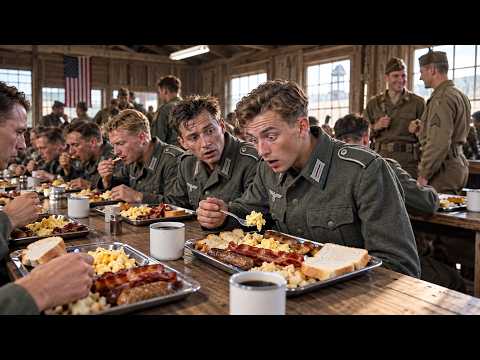
On the night of November 28, 1942, 68 German officers stepped onto a train platform in Crossville, Tennessee, 17 days out of North Africa. Their own commanders had told them the Americans shot prisoners. So when a mess sergeant set a breakfast tray in front of one of them the next morning, the lieutenant staring at it was sure it was a mistake.
Scrambled eggs, warm bacon, white bread—more than he had seen in a year. He ate it, waiting for someone to take the plate away. The next morning, it came again. And the morning after that.
He never asked the two questions that mattered most. Why were his enemies feeding him like this? And what would it finally take to make it stop?
Start with the first question, because it has the stranger answer. Why would a country at war feed its enemies at all? The answer begins in Geneva, Switzerland, in 1929, 13 years before that tray came down at Crossville. The major powers signed a convention on the treatment of prisoners of war. The United States ratified it. Germany signed it, too. One clause did the quiet work that would later feed a third of a million enemy soldiers. Article 11 required that a prisoner’s food be equal in quantity and quality to the rations of the capturing army’s own depot troops. Equal, not adequate, not humane—the same food the guards ate.
When the United States went to war, it chose to follow that clause to the letter, and it had a cold, practical reason to do so. By the end of the war, Germany held 93,941 American prisoners. Every egg a German ate in Kansas was, in a sense, insurance on an American boy in a stalag somewhere in Saxony. Feed theirs well, and maybe they feed ours. Starve theirs, and the telegram comes to a farmhouse in Ohio.
The first large group arrived straight out of the desert. In May of 1943, the Axis armies in Tunisia collapsed, and roughly 275,000 men went into the bag in a matter of days. The Afrika Korps veterans, sunburned and lean and still in their tropical khaki, were loaded onto ships that had carried American troops and supplies east and were now going home empty. Rather than cross the Atlantic with ballast, the ships crossed it with prisoners. They came at a rate of about 20,000 a month through that summer.
The United States had no real plan for them. The office that handled prisoners had been shut down since 1919. In the entire First World War, America had held barely more than a thousand German prisoners. Now, it was taking armies.
Those men stepped off the boats carrying a specific kind of fear. They had been told by their own propaganda ministry that capture meant death, that the Americans shot prisoners or worked them until they dropped. What they got instead, before any food at all, was a train ride that started to undo the lie. Not a boxcar—a passenger coach. Upholstered seats, windows they could see out of. One prisoner later remembered pressing his nose to the glass somewhere in Kentucky and seeing the thing that broke the propaganda first. Cars. Automobiles everywhere. In a country that was supposed to be on its knees.
The committed Nazis among them decided the route must have been chosen to hide the cities the Luftwaffe had bombed. There were no bombed cities. There was just America, intact, enormous, and about to feed them.
Then came the food. And the food is where the disbelief turned into something closer to shock. The army issued raw rations to each camp and let German mess sergeants cook them however they liked, which is part of why the plates looked so German and so good. A prisoner at Camp Crossville, a second lieutenant of the Afrika Korps named Gerhard Hennis, described his breakfasts in terms that read like a dream a hungry man would be ashamed to admit to. Scrambled eggs and crisp bacon, fresh juice, cereal of every kind, hotcakes soaked in maple syrup. Another prisoner wrote in his journal that he ate more in a single day in America than he had eaten in a whole week at home. And that supper brought cuts of meat up to a pound in weight with apricots and apples and plums most days of the week.
These were not officers being pampered while the enlisted men starved. In camp after camp, the menus ran the same. Breakfast of cereal and eggs and coffee with milk and sugar, lunch of roast pork and potato salad, supper of meatloaf and bread and more coffee. At a camp in Mississippi, the week’s menu listed scrambled eggs at supper as an afterthought because they had already had better at noon.
The bodies told the story the menus implied. One German prisoner, interviewed years later by the historian Lewis Carlson, laid it out plainly. He had weighed 128 pounds when the Americans took him. Two years later, he weighed 185. He said he had gotten so fat you could no longer see his eyes. He was not unusual. Afrika Korps men who had been living on short desert rations found, within a few months, that they could not button their own uniform trousers. Some of them actually got sick, their shrunken stomachs rebelling against the sheer richness of it.
And here is the detail that tells you everything about what the prisoners believed in those first weeks. They did not trust it. They were certain it was a mistake or a trick or a trap that would snap shut the moment the Americans noticed how much they were giving away. So they hid the evidence. At some camps, prisoners burned their own uneaten food rather than leave it in the garbage, afraid that if the Americans saw waste, the rations would be cut. At Camp Shelby in Mississippi, the prisoners left so little behind that the civilian contractor who had the garbage contract gave it up. There was nothing to haul.
Remember that. The men were so sure the abundance could not last that they were already rationing themselves against the day it ended. They were right that it would end. They were wrong about why.
The locals had a name for it before the prisoners did. They called the camps the Fritz Ritz, after the hotel, because that is what it looked like from the outside of the fence. Inside the fence, the prisoners earned real money for their work, paid in canteen coupons, and in the canteen they could buy beer—a bottle for about a dime. Gerhard Hennis, who had arrived at Crossville at 21 years old, put it simply. He was young, and there was plenty of beer.
Men who worked on the farms around the camps often ate at the farmers’ own table, and some farmers added cigarettes and a cold beer to the day as a matter of course. For a generation of young Germans who had known nothing but depression, dictatorship, and then the hunger of the front, rural America in wartime was the most comfortable place many of them had ever lived.
So they wrote home about it. And then they stopped writing home about it. Prisoners told their families not to send Red Cross parcels, because the men in Texas had more than they could eat while the families in Germany had almost nothing. One prisoner, Edwin Pelz, said the parcels from home made the men sad rather than happy—they knew how bad things were becoming in Germany, and they knew the food should have stayed there.
Some prisoners deliberately left the canteen and the full plates out of their letters for another reason entirely. They were afraid the Americans would photograph the letters and drop them over the German lines as propaganda leaflets. Eat well, surrender, come to America. The prisoners understood, even if their own government refused to, exactly how dangerous a full plate could be as a weapon—because that is what it was.
The comfort was not softness. It was strategy, and the men who ran the program said so out loud. The Provost Marshal General who oversaw the camps through the second half of the war, Major General Archer Lerch, defended the policy by pointing straight at the 94,000 Americans in German hands. Any failure by the United States to keep the convention, he warned, would probably bring instant retaliation against those men. That was the floor under everything.
But there was a second reason, and it was almost gleeful. A judge advocate officer named Lieutenant Newton Margulies spelled it out in a speech in the spring of 1945. It was more sensible, he said, and really more clever, to win the war with butter and beefsteaks instead of bullets and bombs. Feed a captured German like a king, and the letter he smuggles home, or the leaflet you drop on his comrades, does more to empty the enemy trenches than another artillery barrage.
The numbers suggested it worked. The assistant provost marshal, Brigadier General Blackshear Bryan, later told Congress that of the Germans captured in the months after the Normandy landings, nearly nine in ten expected to be treated according to the Geneva standard by the Americans. By the autumn of 1944, that figure was higher still. Word had traveled back across the lines, exactly as Margulies hoped it would.
A German prisoner named Fritz House at Camp Hearne in Texas once asked a camp chaplain, Gustav Zolock, why the Americans fed them so well. Zolock gave him three answers. Well-fed men are easier to control. It showed the world that democracy was the better system. And the most important reason, he said, was fear. Fear that if the Germans in Texas went hungry, the Americans in Germany would pay for it. The breakfast was mercy and leverage at the same time, and no one in charge pretended otherwise.
But do not mistake the full plate for a gentle place. That is the part the postcards never showed. The United States made a fateful decision early on. Short of guards, short of men who spoke German, the army let the prisoners run their own compounds internally through their own non-commissioned officers. In many camps, that handed quiet control to the most fanatical men behind the wire—the committed Nazis, the hardcore of the Afrika Korps who still believed Germany would win.
They set up their own courts, what they called courts of honor. They censored the other prisoners’ mail. They enforced the Hitler salute and marked Hitler’s birthday across the whole compound. And they punished anyone who looked too comfortable with America. Anyone who answered the re-education lectures honestly. Anyone suspected of cooperating.
The beatings had a nickname. The prisoners called a late-night visit from the camp enforcers the Holy Ghost. Sometimes the Holy Ghost killed.
At Papago Park in Arizona, where the Navy and U-boat prisoners were held, a sailor named Werner Drechsler was murdered by his own countrymen in March of 1944. He had informed for the Americans, and the camp hardliners knew it. They hanged him inside the compound within hours of his arrival. Seven Kriegsmarine men went to the gallows for it. At a camp in Oklahoma, prisoners beat a man named Johannes Kunze to death for the same crime—suspected cooperation. In the end, the United States executed 14 German prisoners for murders committed against other German prisoners inside American camps on American soil. One anti-Nazi at a camp in Kentucky was harassed so relentlessly, with ground glass worked into his food, that he lost 20 pounds and finally took his own life.
Here is the thing to hold on to. The food on that man’s tray was exactly the same as the food on his tormentor’s tray. The rations were identical in every compound. The fear was not. A man could eat scrambled eggs every morning and still be living inside a terror state the width of a baseball field.
And it was still a prison. In October of 1943 at Camp Concordia in Kansas, a man named Adolf Huebner chased a soccer ball toward the fence, and a guard in the tower shot him dead. He was, by one account, the first German prisoner killed on American soil. The guard was pulled from his post. Later, in July of 1945, at a camp near Salina, Utah, an American private named Clarence Bertucci climbed a guard tower in the middle of the night, swung the machine gun down onto the rows of prisoner tents, and opened fire on sleeping men. He killed nine and wounded 19 before anyone stopped him. He was later judged insane. The Fritz Ritz had towers, and the towers had guns, and the guns were loaded.
Now turn the camera around, because the cruelest contrast in this whole story was not between the prisoners and the guards. It was between the prisoners and the people watching them eat. In the American South and on army posts across the country, German prisoners of war were served in mess halls and lunch rooms that black American soldiers were barred from.
A black sergeant named Rupert Trimmingham wrote a letter to the army magazine Yank describing how he and his comrades, in uniform, serving their own country, could not be served at a Texas lunch counter while German prisoners of war were seated and fed inside. The singer Lena Horne, performing for the troops in Arkansas, walked out of a show when she realized the German prisoners had been seated in front of the black soldiers she had come to entertain. The leading black newspaper of the day put it in one sentence that should still sting. “Nothing,” it wrote, “so lowers the morale of black Americans as the constant preferential treatment of enemy prisoners of war.”
A man who had crossed an ocean to fight for a country watched that country feed its enemy at a table he was not allowed to touch. The Geneva Convention protected the German. Nothing protected the American.
Hold on to the question the lieutenant never asked. For almost two years, in camp after camp, the breakfast never missed a morning. What finally took it away was not a decision made in any of these camps, or even in Washington. It was something American soldiers were about to walk into 5,000 miles away that no menu and no policy could survive.
By 1944, the plates were becoming a scandal, and the scandal had a voice on the radio. The commentator Walter Winchell, heard by millions, hammered the government for coddling Nazis. A congressman from Arizona toured Papago Park and came out describing the prisoners as “pampered and well-fed and fat as hogs.” Letters poured into Washington by the hundreds every week.
Then, in April of 1945, American soldiers stopped reading about the enemy and started walking into his crimes. Eisenhower wrote to General Marshall that the things he had seen begged description. He ordered the footage shot and spread, because he knew that one day someone would say it had not happened.
Those films ran in American theaters in the same weeks that those same families were learning what Germany had done to their own captured sons. The question that had simmered for two years now boiled over, and it was no longer a question.
On the 18th of April, 1945, a week after Buchenwald, the Provost Marshal’s office sent a telegram to every service command in the country. Across the country, within a few weeks, the camps cut the rations hard. The meat shrank. The variety vanished. The prisoners, who had been gaining weight for two years, started losing it.
Gerhard Hennis watched the liberation films at Crossville and never forgot them. He said that was the day he changed, in one showing, from a man who had thought of himself as a soldier and a hero into a man who understood he had served something monstrous. He also noticed the food got worse and the guards got harder, and he understood the two were connected. He was right that they were connected. He was wrong about how.
It is tempting to tell this as a clean story of vengeance. The record does not quite allow it. The cut had already begun the summer before the first camp was ever liberated. There was a real food shortage across a wrecked world. The GI’s ration had been cut too. And the oldest reason of all had simply evaporated. For two years the United States had fed its prisoners well partly to protect the American boys in German hands. Now the war in Europe was over. The single strongest reason to keep the breakfast coming had vanished in the same weeks that the loudest reasons to take it away had appeared on every movie screen in the country.
The prisoners felt only the hunger and read into it the anger they could feel coming off their guards. The truth was quieter and larger than revenge. The reason to be generous was simply gone, and the reasons not to be had just walked out of Buchenwald on film.
Most of them wanted to go home, and most of them had to wait more than a year. The United States handed hundreds of thousands of them to France and Britain and Belgium first, to work on rebuilding the countries Germany had wrecked. Hennis finished his captivity at a camp in France called Attichy, on about 1,000 calories a day. The comfortable American years behind him for good.
And here is the strangest part of the whole strange story. Having been fed and then starved and then sent to clear rubble in France, a great many of them wanted to come back. Hennis returned to the United States in 1953 and became an American citizen in 1958. He spent his working life with a church relief agency, feeding other people.
A sergeant named Reinhold Pabel loved America so much the first time that he escaped his Illinois camp, lived quietly in Chicago under a false name, and ran a bookshop for years before the FBI caught up with him in 1953. He was deported, and then he came back legally for good.
And then there was Georg Gärtner, an Afrika Korps sergeant from a part of Germany that no longer existed after the war. He slipped under the wire of a camp in New Mexico in September of 1945 and simply disappeared into the country. He stayed hidden for 40 years under an American name, with an American wife who did not know who she had married. He finally turned himself in on national television in 1985. He said he was the last fugitive German prisoner of war, and he wanted to come in from the cold. He died an old man in Colorado.
Go back to the first breakfast. Go back to the young lieutenant staring at the eggs, certain they would be taken away, certain it was a mistake. He was not wrong to be certain. It did end. But he had the reason inside out, the way almost everyone in the story did. He thought the generosity was the error, a clerk’s slip that would be corrected the moment someone important noticed. It was never an error. It was a cold and deliberate bargain, kept for almost two years by a country that fed its enemies off the same scale it fed its own sons—partly out of principle, and partly to buy the lives of the sons it could not reach.
The bargain held exactly as long as the reasons for it held. It broke in the spring of 1945, not because a clerk finally noticed the eggs, but because American soldiers had opened the gates of the death camps and had found their own starving countrymen on the roads of a collapsing Reich. And a nation looked at what it had been putting on the enemy’s plate and could no longer stand the sight of it.
The men behind the wire never understood that the breakfast was never really about them. It was about the men they had left behind on the other side of the ocean, behind the other kind of wire. When those men came home, the breakfast was over. The eggs had kept a promise, and the promise had come due.
So here is the question I keep circling back to, and I want to hear what you think: if a nation’s mercy is really just arithmetic in disguise, does that make it any less merciful—or does it only make us honest about why we are ever kind to our enemies at all? Tell me in the comments.
Report this article
Select a reason for reporting:






