War is not won by courage alone. It is won by tools designed for one purpose: to kill. On the battlefields of the Second World War, three weapons rose above the rest, each shaping the course of history in its own brutal way. From the frozen forests of Finland to the bombed-out streets of Berlin, these machines of death left an indelible mark on the 20th century.
But what made them so deadly? And how did they come to be? The answers lie in a story of desperation, innovation, and the relentless pursuit of victory at any cost.
The submachine gun was born in the trenches of World War I. It was a weapon for close quarters, a way to clear a trench with a hail of bullets. But it was on the Eastern Front of World War II that the submachine gun truly came of age.
The Soviet PPSh-41 was a beast of a weapon. It was cheap, easy to produce, and could fire 900 rounds per minute. With its 71-round drum magazine, it was perfect for the brutal street fighting of Stalingrad and the tank-riding infantry assaults that broke the German lines. It was so effective that the Germans themselves captured and used it, even producing training manuals for their troops.
But the PPSh-41 had its flaws. It was prone to jamming, and its muzzle flash could give away a soldier’s position. Yet, despite these drawbacks, it remained a symbol of Soviet resilience and a key to their victory.
Meanwhile, the Germans were developing a weapon that would terrify Allied tank crews. The Panzerfaust was a single-shot, recoilless anti-tank weapon that could punch through armor with a shaped charge. It was cheap, simple, and deadly. A German soldier could hide in a building and destroy a tank with one shot, then disappear into the rubble.
The Panzerfaust’s range was short—just 30 meters in the early models—but in the close quarters of urban combat, that was enough. It was used to devastating effect during the Battle of Berlin, where Hitler Youth and Volkssturm members armed with Panzerfausts stalked Soviet tanks through the ruins.
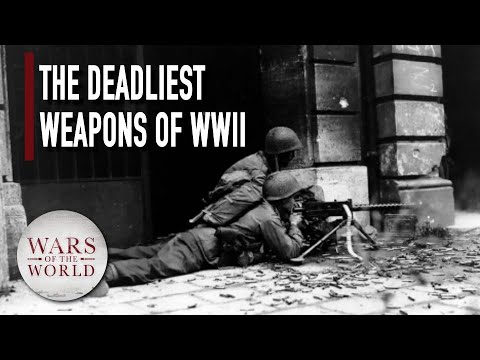
And then there was the M1919 Browning machine gun. It was not as flashy as the PPSh-41 or as revolutionary as the Panzerfaust, but it was the backbone of Allied firepower. It was reliable, accurate, and could lay down a wall of lead that stopped infantry cold. Mounted on tanks, jeeps, and aircraft, it was everywhere the Allies fought.
These three weapons—the PPSh-41, the Panzerfaust, and the M1919—could not have been more different. Yet together, they tell the story of World War II: a war of innovation, of desperation, and of the relentless human drive to find better ways to kill.
Yet the true measure of these weapons lies not in their specifications, but in the hands that wielded them. Consider the Soviet soldier crouched in the mud of Stalingrad, his PPSh-41 pressed to his shoulder. He is not a trained marksman. He is a factory worker or a farmer, given a weapon and told to hold the line. The PPSh-41 was built for him—simple, forgiving, and capable of spraying enough lead to make up for his lack of skill.
In the ruins of the city, the weapon’s short range was no disadvantage. Every fight was a close fight. Every room was a potential ambush. The drum magazine, prone to jamming in the open field, was less of a liability when the enemy was only twenty meters away. In Stalingrad, the PPSh-41 was not just a weapon; it was a way to survive.
On the other side of the line, the German infantryman faced a different problem. His MP40 was a fine weapon, but it could not match the sheer volume of fire the Soviets could produce. The Germans learned to respect the PPSh-41, and many carried captured versions into battle. It was a strange irony: German soldiers fighting with Soviet guns against Soviet soldiers.
But the Eastern Front was not the only place where these weapons left their mark. In the hedgerows of Normandy and the streets of Berlin, the Panzerfaust became a weapon of the desperate. It required no training, no special skill—only courage and a steady hand. A boy of sixteen could destroy a Sherman tank with a single shot, if he was close enough and lucky enough.
The Panzerfaust was not a weapon for soldiers who expected to live. Its short range meant that the user often had to expose himself to enemy fire. The backblast could kill a comrade standing behind him. And if he missed, he had no second shot. It was a weapon of last resort, a final gamble in a war that was already lost.
And yet, it was effective. In the final months of the war, Panzerfausts destroyed hundreds of Allied tanks. They were used by old men and young boys, by soldiers who had lost their units and civilians who had never held a weapon before. The Panzerfaust was not a symbol of German strength; it was a symbol of German desperation.
Meanwhile, the M1919 Browning told a different story. It was not a weapon of desperation. It was a weapon of industrial power. The United States produced over half a million of them during the war, and they served on every front. The Browning was not elegant or innovative; it was simply reliable. It did not jam. It did not fail. It kept firing, belt after belt, hour after hour.
For the Allied infantryman, the Browning was a source of confidence. When the machine gun opened up, the enemy went to ground. It did not win battles on its own, but it made victory possible. It was the sound of American industry, translated into lead.
But reliability alone does not win wars. The Browning’s true genius lay in its adaptability. The same weapon that defended a foxhole in the Ardennes could be mounted on a fighter plane over the Pacific or a landing craft approaching Omaha Beach. It was a weapon that bent to the will of the war, not the other way around.
This adaptability was no accident. The M1919 was the product of decades of refinement, of engineers who understood that a weapon must serve the soldier, not the other way around. Its air-cooled barrel was a breakthrough, allowing sustained fire without the cumbersome water jacket of its predecessor. Its belt-feed system meant it could keep firing long after a magazine-fed weapon would have fallen silent.
Yet even the Browning had its limits. In the dense jungles of the Pacific, the weapon’s weight was a burden. Soldiers struggled to haul it through mud and undergrowth, and its long barrel often snagged on vines and branches. It was a weapon built for the open battlefield, not the claustrophobic chaos of jungle warfare.
It was in these moments—when the tools of war met the reality of combat—that the true nature of these weapons was revealed. They were not perfect. They were not invincible. They were simply the best that could be made by the hands available, in the time available, for the war that was being fought.
The PPSh-41, for all its flaws, gave the Soviet soldier a fighting chance. The Panzerfaust, for all its desperation, gave the German defender a final word. The M1919, for all its weight, gave the Allied infantryman a wall of lead to hide behind.
And as the war entered its final, bloody chapter, these weapons would face their ultimate test. The battles to come would not be won by strategy or courage alone. They would be won by the cold, hard calculus of industrial production—by which side could put the most guns into the most hands and keep them firing longest.
In that calculus, the numbers told a story all their own. The Soviet Union produced over six million PPSh-41s. Germany produced fewer than half a million Panzerfausts. The United States produced over half a million M1919s, but each one was a masterpiece of precision manufacturing, built to last.
The war was not just a clash of armies. It was a clash of factories, of assembly lines, of workers who toiled through the night to feed the insatiable hunger of the front. Every weapon that left the factory was a promise: that the soldier who carried it would not be sent into battle empty-handed.
And yet, for all the millions of weapons produced, the war still came down to the individual. To the soldier in the trench, the tanker in his steel box, the pilot in his cockpit. They were the ones who would decide the fate of nations, armed with the tools that industry had given them.
The tools were deadly. But it was the hands that wielded them that made them lethal.
In the end, the war was decided not by any single weapon, but by the men and women who built them, carried them, and faced them across the shattered landscapes of Europe and the Pacific. The PPSh-41, the Panzerfaust, and the M1919 Browning were products of their nations’ genius and desperation—each a mirror reflecting the society that forged it.
The Soviet Union, bleeding and vast, chose quantity and simplicity. Germany, cornered and brilliant, chose ingenuity and terror. The United States, distant and industrial, chose reliability and precision. And when the smoke cleared, it was the nations that could arm their soldiers not just with weapons, but with hope, that stood victorious.
Today, these weapons sit in museums behind glass—cold, silent, and harmless. But look closely, and you can still see the scratches on the stocks, the wear on the barrels, the faint smell of oil and cordite. They are relics of a world that demanded the impossible and received it in return.
The soldiers who carried them are fading now, their stories slipping into memory. But the lessons remain: that war is not won by courage alone, nor by technology alone, but by the union of the two. That the tools of death are only as deadly as the hands that wield them. And that the true cost of victory is written not in production numbers, but in the lives of those who paid it.
So the next time you see a photograph of a soldier clutching a PPSh-41, or a tank crewman aiming a Panzerfaust, or a gunner feeding a belt into a Browning, ask yourself: What would I have carried? And what would it have cost me to pull the trigger?
Report this article
Select a reason for reporting:






