The hangar was silent except for the distant hum of ventilation, but in the mind of historian Dr. Emily Carter, the air roared with the ghost of Merlin engines. She stood before a weathered fighter plane, its camouflage paint faded but its silhouette unmistakable. This was it—the oldest Spitfire in the world, a Mark I believed to be the 16th ever built, now resting at the RAF Museum Midlands. As she ran her fingers along the cold metal, she felt the weight of ninety years of history.
Today marked the 90th anniversary of the Spitfire’s first flight, and Emily had been granted unprecedented access to document this legendary aircraft. But she knew that behind its celebrated status lay a complex, often overlooked story—one of survival, transformation, and the quiet heroism of those who flew it.
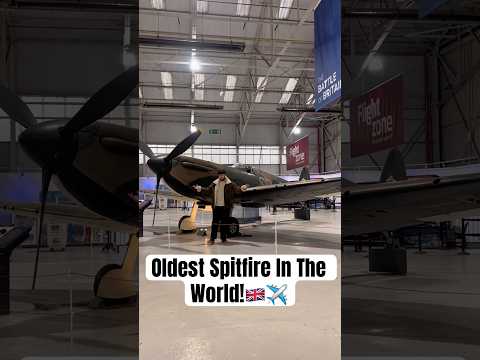
The plane had served during the Battle of Britain, the pivotal 1940 air campaign that saved Britain from invasion. Yet, unlike many of its brethren, it never had a confirmed kill. “It’s a strange kind of fame,” Emily mused, recalling the curator’s words. “This aircraft fought, but it never drew blood—at least not officially.” That paradox fascinated her. How could a machine so central to the war effort remain untouched by the violence it was built for?
She climbed a small ladder to inspect the cockpit, its leather seat cracked with age. Here, she knew, sat men who had stared death in the face. One of them was James Nicholson, the only Victoria Cross winner from the Battle of Britain. He had flown this very Spitfire a few times, though not during the action that earned him the medal. “Imagine,” Emily whispered, “sitting where a hero sat, your hands on the same controls.” The thought sent a shiver down her spine.
But the aircraft’s journey was not a straight line. After the war, it was converted into a Mark V—a faster, more powerful variant—before being restored back to its original Mark I configuration decades later. That transformation intrigued Emily. “It’s like the plane itself refused to be pinned down,” she said to the empty hangar. “It kept evolving, adapting, surviving.” In a way, it mirrored the spirit of the nation it defended.
As she stepped back to take a photograph, the sunlight caught the edge of the wing, and for a moment, Emily could almost hear the roar of the engine, the chatter of the radio, the distant thrum of enemy bombers. This was more than a museum piece; it was a witness to history.
She glanced at her notes, where a single question was scrawled in the margin: What stories could this plane tell if it could speak? Soon, she would delve into its archives, tracing its logbooks and the men who flew it. But for now, she simply stood in awe, knowing that the oldest Spitfire in the world was about to reveal its secrets—one layer at a time.
The museum’s archive was a different kind of quiet—fluorescent lights, acid-free boxes, and the faint smell of old paper. Emily had requested the aircraft’s logbooks, and the curator, a wiry man named Hollis, delivered them on a trolley with the reverence of a pallbearer. “Handle them gently,” he said. “Some of those pages haven’t seen daylight since the seventies.”
She opened the first ledger, its spine creaking like a joint stiff with age. The entries were terse, utilitarian—dates, pilot names, flight durations, engine hours. But between the lines, a rhythm emerged. Sorties logged in hurried pencil. A note about a rough landing at Duxford. A cryptic remark about a faulty magneto that kept recurring, as if the plane itself were stubbornly refusing to be fixed.
Then she found it. An entry dated September 1940, the height of the battle, with a name she recognized: Nicholson. J. B. — 20 mins — interception, no contact. No contact. The phrase appeared again and again in the logbook, a refrain of near-misses. The plane had scrambled, climbed, hunted—and found nothing. Emily turned the page, her pulse quickening. “It’s as if the war kept slipping through its fingers,” she murmured.
Hollis reappeared with a second trolley, this one carrying a battered cardboard file marked with a red stamp: CONVERSION — MK V — 1943. Inside were photographs Emily hadn’t expected—the same airframe, but altered. A new nose, a reinforced fuselage, the unmistakable bulge of a more powerful engine. In one grainy image, mechanics posed beside the plane, grinning, sleeves rolled up. On the back, someone had written in fountain pen: “She flies again—faster than ever.”
Emily laid the photograph beside the original Mark I blueprints. The differences were stark, almost surgical. “They didn’t just upgrade it,” she said, half to herself. “They rebuilt its whole identity.” Hollis nodded. “And then, decades later, someone decided to undo all of it. Put her back the way she was.” The question hung between them: why? What compels a museum to reverse history?
She flipped to the final pages of the file and found a memo from 1979, its typewritten text faded but legible. It mentioned a restoration team, a benefactor, and a single line that made her breath catch: “Original configuration prioritized—witness accounts suggest airframe saw action at Hornchurch, August 1940.” Hornchurch. The name tugged at her memory. Something about a crash. Something the official histories had glossed over.
Emily reached for her phone and began typing a message to a colleague at the Imperial War Museum. If anyone knew what had really happened at Hornchurch that summer, it was him. The oldest Spitfire in the world, it seemed, was not done telling its story.
She hit send and pocketed the phone, but the name Hornchurch refused to sit still in her mind. She pulled out her notebook and sketched a rough timeline: August 1940, No. 54 Squadron, heavy losses over the Channel. The logbook had been maddeningly vague about that month—long gaps between entries, then a sudden flurry of activity. Something had happened there, something worth burying in a footnote.
Hollis, sensing her agitation, cleared his throat. “There’s a box you haven’t asked for,” he said. “Personnel effects. Mostly letters that never got delivered. It came in with the airframe back in ’79, and nobody’s ever really gone through it.” He disappeared into the stacks before she could respond, returning with a shoebox-sized carton bound in twine.
Emily untied it carefully. Inside were envelopes, brittle as autumn leaves, and a small leather diary with a broken clasp. The first letter was addressed to a Mrs. E. Fairbanks of Ipswich, the handwriting looping and urgent. She read the first line and felt the archive’s fluorescent hum recede entirely.
“Dear Mum—I’ve done something they’ll either hang me for or give me a medal, and I can’t decide which.” The letter was dated 18 August 1940, signed by a Pilot Officer T. Fairbanks. Emily’s hands trembled. Fairbanks wasn’t in any of the official logbook entries she’d read. Yet here was his voice, insisting he’d flown this very aircraft—and that he’d brought it home when he shouldn’t have.
The diary was worse, or better. Page after page of cramped pencil: engine trouble over the Thames estuary, a forced diversion, a German fighter that appeared out of the sun and then simply… didn’t fire. Fairbanks had written the same word three times in the margin, underlined hard enough to tear the paper: WHY. WHY. WHY.
Emily looked up at Hollis, who was watching her with an expression she couldn’t read. “You knew,” she said quietly. “You knew there was a story in here.” He shrugged, but his eyes betrayed him. “I knew there were questions,” he said. “The museum’s job is to preserve them, not always to answer them.”
She turned back to the diary’s final entry, dated the day after the letter. The pencil strokes were shakier now, as if written in haste—or fear. “They’re transferring me. They say I imagined it. But I know what I saw. The Hun had me dead to rights and he let me go. Someone will want to know why. Someone has to.” The entry ended there. No signature. No resolution.
Emily’s phone buzzed. Her colleague at the Imperial War Museum had replied, and his message was short enough to make her stomach drop: “Hornchurch, August 1940—you’re not going to believe this. Call me. Now.”
She stood, the diary still open in her hands, and looked back toward the hangar where the Spitfire waited in its silent vigil. Ninety years old, and still keeping secrets. “All right,” she whispered to the empty archive. “Let’s find out what you’re hiding.”
She called him from the corridor outside the archive, her voice low even though no one was near. “Tell me about Hornchurch,” she said. Her colleague’s name was Pritchard, and he had the breathless tone of a man who’d been waiting years for someone to ask.
“August 18th, 1940. The hardest day of the battle,” he said. “Two hundred casualties in one afternoon. But there’s a gap in the squadron records—an hour nobody’s ever accounted for. And there’s a German pilot’s memoir, published in the fifties, that mentions a Spitfire he couldn’t bring himself to shoot. He wrote that the pilot waved at him. Waved.”
Emily felt the corridor tilt. Why. Why. Why. Fairbanks hadn’t been imagining things. He’d been spared—and the enemy had let him live for reasons no logbook could explain.
She returned to the hangar one last time before closing. The Spitfire sat bathed in the long amber light of evening, and Emily understood now what the restoration team in 1979 had been protecting. Not just an airframe, but a mystery—a war story without a kill, a pilot without a medal, an enemy who chose mercy in the middle of hell.
“You kept it,” she said softly, touching the wing. “All of it.” The plane offered no answer, but somehow that felt right. Some stories were meant to stay open, like a question passed from hand to hand across ninety years.
She locked the hangar and walked out into the cooling night, the diary tucked safely in her bag. Tomorrow she would write to Mrs. Fairbanks’s family, if any remained. Tomorrow she would ask the museum to display the letter. But tonight, she simply carried the secret home.
And she wondered, as the stars came out over the old airfield, how many other silent machines were waiting for someone to finally ask them the right question. What would you say—if the plane in your local museum could finally speak?
Report this article
Select a reason for reporting:






