Stalingrad, 1942. The city was a wasteland of twisted metal and shattered concrete, where death did not announce itself with the roar of artillery, but with the silent crack of a single rifle shot. In this apocalyptic landscape, two men would become legends—one a Siberian hunter turned Soviet hero, the other a mysterious German major whose very existence remains shrouded in mystery. This is the story of the most famous sniper duel in history, a confrontation that would capture the imagination of the world and become a symbol of the brutal struggle for Stalingrad.
But beyond the propaganda and the myth, what really happened? Who was the man they called Major König? And did the duel that inspired books and films actually take place as described? Through rare archival footage, eyewitness accounts, and cutting-edge technology, we will piece together the truth behind the legend.
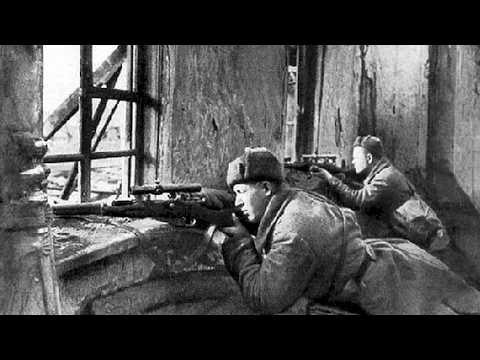
Vasily Zaitsev was born in 1915 in the Ural Mountains, where his grandfather taught him to hunt with a single-shot rifle. “Make every bullet count,” the old hunter would say, a lesson that would one day save Vasily’s life. When Germany invaded the Soviet Union in 1941, Zaitsev volunteered for the front, but it was not until the battle for Stalingrad that his skills would be put to the ultimate test.
Stalingrad, now Volgograd, stretched along the western bank of the Volga River, its factories and apartment blocks reduced to rubble by relentless German bombing. The city became a killing ground, where soldiers fought for every inch of blood-soaked earth. It was here, among the ruins, that snipers came into their own.
Zaitsev, a senior warrant officer in the 284th Rifle Division, quickly made a name for himself. With a standard Mosin-Nagant rifle, he silenced a German machine gun crew with three shots, each finding its mark. Colonel Nikolai Batyuk, the division commander, witnessed the feat and immediately ordered Zaitsev to be made a sniper. “That man is a born hunter,” Batyuk reportedly said.
But Zaitsev was not alone. The Germans, too, had their marksmen, and the ruined city became a deadly chessboard where the stakes were life and death.
By October, the Germans had reached the Volga, and the fighting was ferocious. Zaitsev, now armed with a scoped Mosin-Nagant, became a lethal hunter, racking up dozens of kills. “For us, there is no land beyond the Volga,” he famously told General Vasily Chuikov, a phrase that became the rallying cry of the 62nd Army.
Zaitsev’s reputation grew, and he was ordered to train other snipers—the “hares,” as they were called. Among his students was a young soldier named Nikolai Kulikov, who would become his trusted spotter.
But the Germans had their own ace: a sniper so skilled that he had allegedly been sent from Berlin with one mission—to hunt down the Russian rabbit. Major Erwin König, head of the Berlin Sniper School, was a name that struck fear into the hearts of Soviet soldiers.
On November 2, 1942, Zaitsev and Kulikov set out to find him. For days, they scoured the no man’s land, studying every crater and pile of rubble. “He’s out there,” Zaitsev muttered. “I can feel it.”
Then, on the third day, a helmet rose slowly above a German trench. “Don’t shoot,” Zaitsev whispered. “It’s a decoy.” He was right. The enemy was waiting for them to reveal their position.
Hours turned into days. The tension was unbearable. Then, a glimmer of light caught Zaitsev’s eye—a reflection off a scope, just for a split second. “There he is,” Zaitsev breathed. “Between the tank and the pillbox.”
But the German was cunning. He had not survived this long by being careless. Zaitsev knew he had to outsmart him.
On the morning of November 5, Zaitsev and Kulikov took up their positions. The sun was at their backs, blinding the enemy. “Raise your helmet,” Zaitsev ordered. Kulikov did as told, and a shot rang out. The helmet flew from his hand. “He’s taken the bait,” Zaitsev smiled. “Now, we wait.”
Minutes passed like hours. Then, ever so slowly, a head appeared above the metal sheet. Zaitsev held his breath, steadied his aim, and squeezed the trigger. The shot echoed across the ruins, and the German’s head disappeared.
That night, Zaitsev and Kulikov crawled to the spot and found the body of a German officer. His documents identified him as Major Erwin König. “We got him,” Kulikov whispered. But Zaitsev said nothing. He knew that in war, the truth was often the first casualty.
Years later, historians would question whether König ever existed. Some claimed he was a fabrication of Soviet propaganda, a convenient villain to boost morale. Others argued that the duel did happen, but the German’s identity was different. “The truth is somewhere in between,” one researcher noted.
What is certain is that the sniper duel at Stalingrad became a symbol of the brutal, personal nature of the fighting on the Eastern Front. “It was a war of rats,” one veteran recalled. “And the snipers were the deadliest rats of all.”
The morning of November 5, 1942, dawned cold and clear over the ruins of Stalingrad. Vasily Zaitsev and Nikolai Kulikov lay motionless in their hide, their breath misting in the chill air. They had been in position since before first light, their eyes fixed on the sheet of metal and pile of bricks that concealed their elusive prey.
“The sun will be in his eyes soon,” Zaitsev whispered. “He’ll have to adjust. That’s when we’ll see him.”
Kulikov nodded, his fingers tightening around his spotter’s scope. The two men had spent days studying the terrain, memorizing every shadow and every angle. They knew the German sniper was patient, methodical, and deadly. But they also knew he was human.
Hours passed. The sun climbed higher, casting long shadows across the wasteland. Then, a flicker of movement. “Something’s reflecting,” Kulikov breathed. “Right at the edge of the metal sheet.”
Zaitsev’s heart pounded. He adjusted his scope, his crosshairs settling on the spot. “He’s there,” he said. “Just the tip of his scope. He’s scanning.”
They waited. The German was cautious, never exposing himself for more than a second. Zaitsev knew he needed a distraction—something to draw the enemy’s eye and force him to reveal his position.
“Kulikov, your helmet. Raise it slowly, like you’re checking the line.”
Kulikov did as ordered, lifting his helmet on a wooden stick. The German fired instantly, the bullet punching through the steel and sending it spinning. Kulikov yelped and clutched his head, playing the part of a wounded man.
“He’s taking the bait,” Zaitsev murmured. “Now he’ll think he’s won.”
For a long moment, nothing happened. Then, ever so slowly, the metal sheet shifted. A head appeared, just for an instant—a flash of gray uniform and pale skin. Zaitsev’s finger tightened on the trigger. Bang!
The shot echoed across the ruins. The German’s head snapped back and vanished. “Did you get him?” Kulikov asked, his voice trembling.
“I don’t know,” Zaitsev replied. “We wait until dark.”
That night, under the cover of a moonless sky, the two men crawled toward the metal sheet. Their hearts raced as they approached, expecting at any moment to hear the crack of a rifle. But there was only silence.
They found the body slumped behind the sheet, a single bullet hole through the forehead. His sniper rifle—a Mauser 98K with a scope—lay beside him. Zaitsev picked up the weapon and examined it. “He was good,” he said quietly. “Very good.”
Kulikov searched the dead man’s pockets and pulled out a leather wallet. Inside were documents identifying him as Major Erwin König, head of the Berlin Sniper School. “It’s him,” Kulikov said. “We got the major.”
Zaitsev said nothing. He stared at the body, a strange unease settling in his stomach. Something didn’t add up. The man’s uniform was too clean, his boots too new. And the documents—they were almost too perfect, as if placed there for them to find.
Back at headquarters, Colonel Batyuk examined the captured rifle and documents. “Major König,” he said, a smile spreading across his face. “The Berlin sniper. You’ve done it, Zaitsev. You’ve killed the best they had.”
The news spread like wildfire. Within days, the story of Zaitsev’s duel with the German ace was printed in army newspapers and broadcast across the Soviet Union. “The Russian rabbit has killed the German wolf,” one headline read. Zaitsev was hailed as a hero, his name mentioned alongside the greatest marksmen of the war.
But Zaitsev remained uneasy. He had seen the body, examined the documents, and yet something nagged at him. “Comrade Colonel,” he said one evening, “what if it wasn’t König? What if it was just a decoy?”
Batyuk dismissed the concern with a wave of his hand. “Nonsense. The documents are clear. The rifle is German. Who else could it be?”
Zaitsev had no answer. But in the weeks that followed, he would hear rumors—whispers from prisoners and deserters—that the real König had never been in Stalingrad, that the man he had killed was just another sniper, a scapegoat sent to draw him out.
Years later, historians would dig into the archives and find no record of a Major Erwin König in the German army. The Berlin Sniper School, if it existed at all, had no such commander. The man Zaitsev killed may have been a skilled marksman, but he was not the legendary König.
Yet the duel itself was real. German reports from the time mention a sniper duel in the ruins of Stalingrad, and Soviet records confirm that Zaitsev engaged and killed an enemy marksman on November 5, 1942. The truth, as always, was more complicated than the myth.
Who was the man behind the scope that day? Some historians believe he was a German corporal named Heinz Thorwald, a sniper instructor from the 295th Infantry Division. Others suggest he was simply an unnamed marksman, sent to hunt Zaitsev as part of a broader German effort to counter the Soviet sniper threat.
Whatever his identity, the duel had a profound effect on the battle. “The death of their sniper broke the Germans’ spirit,” one Soviet officer recalled. “They became cautious, hesitant. They knew we had hunters among us.”
For Zaitsev, the duel was just one of many. He continued to fight, training new snipers and leading his men through the hell of Stalingrad. But the memory of that November morning stayed with him—the glint of sunlight on a scope, the crack of a single shot, and the silence that followed.
“In war, you never know who you’ve killed,” he later wrote. “You only know that you’re still alive.”
After the war, Zaitsev returned to the ruins he had once defended, not as a hero but as a man seeking answers. He walked the ground near the Dolgi ravine, now cleared of rubble, and stared at the spot where the metal sheet had lain. “I killed a man,” he told a young journalist decades later. “Whether he was König or not, he was a father, a husband, a son. War makes ghosts of us all.”
Historians would continue to debate the identity of the fallen sniper, but Zaitsev never wavered in his account. He kept the Mauser’s scope, a simple tube of glass and steel, as a reminder of that silent morning. “The rifle tells no lies,” he said. “Only men do.”
Today, a small monument stands near the Volga, marking the site of the duel. Visitors leave flowers and spent shell casings, a strange tribute to a strange war. The sniper’s craft—patience, precision, and a single breath—endures in military manuals and legends alike.
But the question remains: was the man in Zaitsev’s crosshairs truly Major König, or just another ghost of Stalingrad? What do you believe—was the duel a triumph of truth or the birth of a myth that outlived the men who fought it?
Report this article
Select a reason for reporting:






