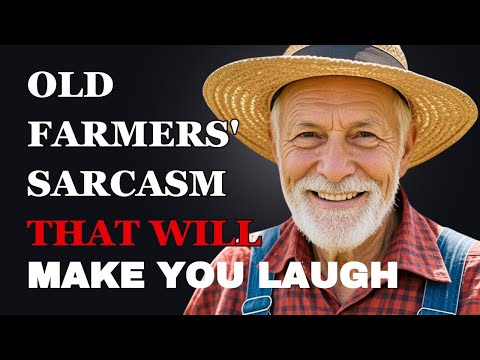
You think you know about life? You don’t know squat until you’ve heard an old farmer tell it like it is. Their wisdom isn’t wrapped in fancy words or delivered from a podium—it’s carved from decades of hard work, muddy boots, and plain common sense. And it’s hilarious.
Take, for instance, the early bird. Sure, it gets the worm. But as any old farmer will tell you with a sly grin, it’s the second mouse that gets the cheese. That’s the kind of twisted truth that makes you stop and think—and then laugh out loud.
Out here, life is simpler when you plow around the stump. Don’t corner something meaner than you. Always drink upstream from the herd. These aren’t just sayings; they’re survival tactics dressed up as humor.
And good judgment? Well, that comes from experience. And a lot of that experience comes from bad judgment. Most of the stuff people worry about never happens anyway. So why fret?
Don’t judge folks by their relatives. A bumblebee is faster than a John Deere tractor. Don’t skinny dip with snapping turtles. Each one is a gem, polished by years of watching, learning, and sometimes getting it wrong.
If you find yourself in a hole, the first thing to do is stop digging. If your horse is dead, dismount. Timing has a lot to do with the outcome of a rain dance. It don’t take a very big person to carry a grudge. Every path has a few puddles.
Meanness don’t just happen overnight. Forgive your enemies—it messes with their heads. When you wallow with pigs, expect to get dirty. These farmers don’t mince words, and they don’t suffer fools gladly.
If you’re riding ahead of the herd, take a look back every now and then to make sure it’s still there. Letting the cat out of the bag is a whole lot easier than putting it back in. Don’t interfere with something that ain’t bothering you none.
The best sermons are lived, not preached. Most times it just gets down to common sense. Letting the mule go wherever it wants ain’t going to plow the field. Never wrestle with a pig—you both get dirty, and the pig likes it.
Always hire a lazy man to do a hard job; he’ll find an easy way to do it. Don’t spread manure before a storm. You can lead a horse to water, but sometimes it’s too stubborn to drink. Don’t let yesterday use up too much of today.
Keep skunks and bankers at a distance. Sometimes you get, and sometimes you get got. The more you stir manure, the worse it stinks. Don’t trust a skinny cook. It’s not the falling in the manure that’s the problem—it’s staying in it.
Don’t name a pig you plan to eat. You can’t fix stupid, but you can sure watch it make a fool of itself. A wise man learns from others’ mistakes; a fool learns from his own. Don’t ask a barber if you need a haircut.
The squeaky wheel gets the grease, but the quiet one lasts longer. Don’t be mad if the rooster thinks he runs the barnyard—you know better. Life is like a barbed wire fence; it’ll tangle you up if you don’t watch where you’re going.
Cows don’t give milk; you got to work for it. You can’t plow a field by turning it over in your mind. Never slap a man chewing tobacco. Some folks are like clouds—when they’re gone, it’s a beautiful day.
Don’t try to teach a pig to sing; it wastes your time and annoys the pig. The trouble with retirement is you never get a day off. You can’t make a silk purse out of a sow’s ear. If the grass looks greener on the other side, it’s probably Astroturf.
Life’s a dance, but sometimes you just got to sit this one out. Don’t count your chickens before they hatch—or your goats before they escape. You don’t have to outrun the bear; just outrun the guy next to you. Even a broken clock is right twice a day.
A good neighbor is worth more than a distant relative. Don’t fence in a cow and expect it to move politely. It’s not about how fast you mow, but how well you mow fast. A gossiping tongue is the devil’s hand tool.
Don’t bite off more than you can chew—unless it’s beef jerky. If you think you’re too small to make a difference, you’ve never been in a tent with a mosquito. A tractor may start slow, but it gets the job done—unlike some folks. Rain’s always welcome, just not during hay season.
Life’s lessons don’t always come easy, but they sure can come funny. And these old farmers? They’ve got a lifetime of them.
Now, there’s a particular breed of farmer who’s been around so long he’s seen the same lesson taught a hundred different ways—and he still chuckles every time. He’ll lean against a fence post, push his hat back, and let one loose like he’s been saving it just for you.
“Some folks are like a wheelbarrow,” he’ll say, squinting off toward the treeline. “You can load ’em up with all the sense in the world, but they won’t move unless you push ’em—and even then, they’ll tip over first chance they get.”
Then he’ll spit, adjust his belt, and add, “But a good horse? You just point him at the barn and he’ll find the fastest way home. That’s the difference between being smart and being wise. Smart knows the way. Wise has already been there and knows where the mud is.”
He’ll tell you about the time he hired a fella who could talk a blue streak about farming. Knew every book, every theory, every newfangled method. “Couldn’t back a trailer to save his life,” the old farmer will say with a grin. “But boy, he could explain the physics of it. That’s like knowing all about the rain but never getting wet.”
There’s another one he’s fond of, usually saved for when someone’s complaining about the weather, the market, or the government. He’ll listen patient as a mule, nod slow, and then say, “You know, the rooster crows at dawn no matter what the almanac says. He don’t check the forecast first. He just does his job. Maybe that’s why he’s still around and the weatherman ain’t.”
And when it comes to folks who think they’re too important to get their hands dirty, he’s got a saying for that too. “A peacock struts around the barnyard like he owns the place,” he’ll say, “but it’s the old hen in the corner that’s been laying eggs every morning while he’s busy admiring his own tail feathers.”
He’s seen enough to know that a man who brags about his crop before harvest is usually the one who’s got the most weeds. And he’s quick to remind you that “the best fertilizer is the farmer’s footsteps”—meaning you got to walk your fields, check your fences, and pay attention. No amount of wishing will grow a single stalk of corn.
But here’s the thing about these old-timers: they don’t just hand out wisdom like candy at a parade. They wrap it in a story, a joke, or a question that makes you think. “You ever notice,” one will ask, “how a dog knows when it’s time to come in from the rain, but a grown man will stand out there arguing with the sky?”
And that’s when it hits you—the lesson wasn’t about the dog at all.
He’ll let that hang in the air a minute, watching you chew on it, then he’ll spit and move on to the next one like he didn’t just hand you a piece of his soul wrapped in a punchline.
“You know what the hardest thing about farming is?” he’ll ask, not waiting for an answer. “It’s the waiting. You plant a seed, and then you wait. You can’t hurry it. You can’t sweet-talk it. You can’t threaten it. You just got to trust the dirt and do your part.” He’ll pause, kick a clod of soil with his boot. “Same goes for raising kids, fixing fences, and getting over a grudge. Takes what it takes.”
He’s got a theory about hard work, too. “Some folks think working hard is the same as working smart,” he’ll say, wiping his hands on his overalls. “But I’ve seen a man chop wood all day with a dull axe and call himself a hard worker. Meanwhile, the fella next door sharpened his blade and finished by noon. Who’s the harder worker? The one who’s tired, or the one who’s done?”
Then there’s the matter of listening. He’ll tell you about the time he spent a whole afternoon arguing with a neighbor about the best way to fix a fence post. “Finally, my wife says to me, ‘You ain’t listening to him, you’re just waiting for your turn to talk.'” He’ll shake his head. “She was right. And that’s when I learned: a closed mouth gathers more knowledge than an open one ever will.”
He’s got a soft spot for the underdog, too—probably because he’s been one his whole life. “You ever see a old dog get pushed off his porch by a young pup?” he’ll ask. “He don’t fight back. He just waits. Waits till the pup gets tired of barking at shadows. Then he walks back up them steps and lays down like nothing happened. That’s not weakness—that’s patience with a plan.”
And when it comes to money, he’s got more sense in his little finger than most bankers got in their whole building. “A dollar borrowed is a dollar owned by somebody else,” he’ll say. “I’d rather own a beat-up truck outright than make payments on a shiny one that ain’t mine. Same with land. Same with a reputation. You can’t borrow either one and expect to keep ’em.”
He’ll tell you about the year the drought came and took half his crop. “I sat on the porch every evening watching that sky like it owed me something,” he’ll recall. “Then one day my boy says, ‘Dad, staring at it ain’t gonna make it rain.'” He’ll laugh, low and rumbly. “Out of the mouths of babes. I got up, checked the well, fixed the pump, and started hauling water by hand. Didn’t save everything, but I saved enough. The sky didn’t owe me a thing. I owed myself the effort.”
That’s the thing about these old farmers—they don’t dress up the truth. They hand it to you plain, like a glass of well water on a hot day. “You can’t control the weather, the market, or the neighbors,” he’ll say. “But you can control how you show up. And showing up is half the battle. The other half is knowing when to quit—and that’s a wisdom most folks never learn.”
He’ll lean back against that fence post, cross his boots, and give you that look—the one that says he’s got one more in him, but he’s deciding if you’re worth it.
Then he’ll nod, like he’s made up his mind about you. “You know what the good Lord gave us two ears and one mouth for?” he’ll ask. “So we’d listen twice as much as we talk. Most folks got that backwards, and it shows.”
He’ll tell you the best advice he ever got came from his own daddy, who never said much at all. “He told me, ‘Son, a man’s word is like a fence post—easy to set crooked, hard to straighten later.'” The old farmer will tap his chest. “I’ve set a few crooked in my day. Learned to dig ’em deep and set ’em true.”
And that’s the whole of it, really. Life’s lessons don’t come wrapped in ribbons—they come caked in mud, delivered with a grin, and usually at your own expense. So pull up a fence post, listen close, and laugh while you learn.
Which one of these old farmer sayings hit closest to home for you?
Report this article
Select a reason for reporting:






