June 1944. Three German soldiers stood in a Canadian processing camp, their faces frozen in confusion. A guard had just spoken to another prisoner in perfect High German—the kind you’d hear in Berlin or Munich. Not broken, not accented. Perfect.
They exchanged stunned glances. They had been told the Canadians were brutal colonials who barely spoke English, let alone German. Yet here was a guard speaking their mother tongue as naturally as breathing.
What these men could not know was that within weeks they would sit in Canadian farmhouses, speaking German with civilians who looked like enemies but sounded like neighbors from home. Their entire world was about to turn upside down.
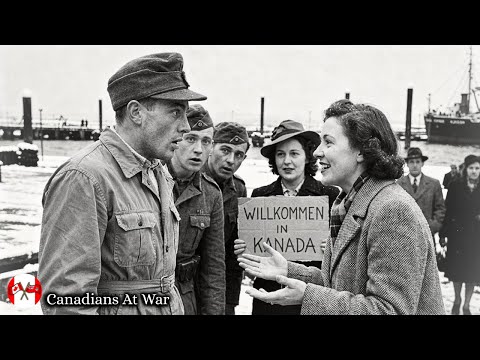
The war had reached a terrible point for Germany. Just weeks earlier, Allied forces had stormed the beaches of Normandy. Thousands of German soldiers were being captured every day as the front collapsed. By mid-June, over 35,000 German prisoners already sat in 26 camps scattered across Canada.
Most had no idea Canada even had prison camps. They knew nothing about this distant country except what Nazi propaganda had told them. And the propaganda had been clear: If you are captured, the enemy will torture you. They will execute you. Fight to the death rather than surrender.
The Canadians, they were told, were especially brutal—primitive people from a frozen wilderness, culturally inferior, driven by British imperialism to destroy the superior German race.
Feldwebel Ernst Hoffmann was 34 years old. Before the war, he had been a school teacher in Königsberg, a beautiful city in East Prussia. He taught history to children and loved his work. In 1940, the German army drafted him. He did not want to fight, but refusing meant prison or worse.
Ernst believed what his government told him. He thought Germany was defending itself. He thought the Führer was making Germany great again. He was not a fanatic, but he trusted his leaders.
The Canadians captured Ernst near the French city of Caen. His position was overrun on June 7th. He fought until his ammunition ran out, then raised his hands in surrender. He expected a bullet. Instead, the Canadian soldiers gave him water and bandaged a cut on his arm. They searched him roughly but did not beat him.
Ernst kept a small diary hidden in his boot. The Canadians never found it. In that diary, he would write things that would change his life.
Gefreiter Klaus Weber was only 22. He came from Stuttgart, where he had worked in a factory before the war. Klaus grew up on a small farm, the son of a practical man who taught him to fix things and work hard. Klaus joined the German army because his family pressured him. His father said it was his duty. His older brother had already died on the Eastern Front.
Klaus did not care much about Nazi ideas. He just wanted to survive and go home to his mother and younger sister.
Klaus was captured during the same Normandy fighting. A piece of shrapnel from a shell tore through his left leg. He lay in a ditch for six hours before Canadian medics found him. They carried him to an aid station, gave him morphine for the pain, and cleaned his wound. Klaus had expected to bleed to death in that ditch. Instead, an enemy doctor saved his leg.
He carried a photo of his mother and sister in his pocket. He looked at it every night and wondered if he would ever see them again.
Obergefreiter Friedrich Neumann was 28 and different from the others. Before the war, he had worked on merchant ships sailing to ports around the world. He had seen England, France, even America. Friedrich knew the Nazi propaganda was probably lies, but he kept quiet about it. Speaking against the government meant death.
His unit surrendered on June 8th after being surrounded for three days without food or supplies. Friedrich spoke some English from his sailing days. He listened carefully to what the Canadian soldiers said. They did not sound like monsters. They sounded tired and ready to go home, just like he was.
All three men were processed in British facilities in Normandy, then shipped to southern England. There they joined about 150 other German prisoners waiting for transport. Medical officers examined them. Klaus’s leg wound received proper treatment—stitches and clean bandages. The prisoners were given clean clothes and treated for lice. The treatment was thorough but not cruel.
This confused the men. Where was the torture they had been warned about?
They were put on a ship. The ship would cross the Atlantic Ocean to Canada. None of them had ever been across the ocean. None of them knew what waited on the other side.
Ernst wrote in his diary, “We face the unknown. Will we freeze in Arctic camps? Will we survive? I do not know.”
Klaus worried his wounded leg would make him useless for work. What happened to useless prisoners? Friedrich caught bits of English conversation. He heard guards mention Ontario and farms. But what did that mean?
The three men stood on the deck as the ship prepared to leave. They watched the English coast disappear behind them. The Atlantic Ocean stretched ahead, endless and gray. They were prisoners of war, heading to a country they knew nothing about, expecting the worst.
What came next would change everything they believed about the world.
Early July 1944, the ship left England and headed west across the Atlantic. The journey would take eight days. Ernst, Klaus, and Friedrich were packed below deck with about 850 other German prisoners. The space was cramped. Rows of bunks lined the walls, stacked three high. The air smelled like metal and unwashed men. The constant rumble of the engines shook everything. Ernst could taste salt on his lips from the ocean spray that came through the ventilation shafts.
But something was wrong. Or rather, something was not as terrible as they expected.
Each prisoner had his own bunk with a thin mattress. There were toilets that worked, sinks with running water. Organized meal times happened three times every single day. Three times. Ernst could not believe it. For breakfast, they received porridge, bread, and coffee. For lunch, soup with vegetables and sometimes chunks of meat. For dinner, more bread, more soup, sometimes beans or potatoes.
Ernst wrote in his hidden diary that night, “We are eating more in one day than our frontline troops received in three days in France.” He stared at the words after writing them. Was he exaggerating? No. He remembered the hunger in France, the supplies that never came, the thin soup that was mostly water. Here, on an enemy prison ship, he was eating better than he had eaten as a free German soldier.
Klaus noticed something else. The guards were not cruel. They did not beat the prisoners. They did not scream insults. Mostly they looked bored. They walked their patrols with tired faces, probably wishing they were home with their families. When prisoners got seasick from the ocean waves, the guards brought buckets and gave them water. One young guard even brought medicine for a prisoner who could not stop vomiting.
Klaus watched this happen and did not understand. These were the brutal colonials. They seemed like ordinary men doing a job they did not particularly enjoy.
The guards let prisoners come up on deck in small groups for fresh air. Ernst stood at the rail one afternoon watching the endless ocean. The water was gray and choppy. Seabirds followed the ship, crying their lonely calls. A Canadian guard stood nearby, smoking a cigarette. The guard looked at Ernst and shrugged.
“Long way from home, eh?” he said in English.
Ernst did not understand the words, but he understood the tone. It was not hateful. It was almost sympathetic.
Friedrich used his broken English to talk with some of the guards. One guard told him, “We’re taking you to work camps. Farms need workers because our men are overseas fighting.” The guard said it like he was describing the weather. Matter of fact, no anger, no threats. He even added, “You’ll be all right, boys. Better than the Eastern Front, I’d say.” Then he walked away.
Friedrich stood there trying to make sense of it. The guard had almost sounded kind.
At night, the prisoners whispered to each other in the darkness. Some said this good treatment was a trick. “They’re fattening us up before the real work begins,” said a former SS officer. “This is psychological warfare. They want us soft before they break us.” Many prisoners nodded. It made sense. Enemies did not feed you well unless they wanted something.
But Klaus lay in his bunk, his wounded leg throbbing slightly, and wondered, “If they treat prisoners this well, how do they treat their own people?” The thought troubled him because he did not want to know the answer.
Mid-July, the ship arrived in Halifax on Canada’s east coast. The prisoners were marched off the ship and through parts of the city to reach the train station. Ernst stared at everything. The harbor was full of ships, both military and commercial. Cranes loaded and unloaded cargo. Workers shouted to each other.
The city behind the docks looked normal—more than normal. It looked untouched by war. Buildings stood intact. Stores had goods in their windows. Civilians walked the streets in clean clothes. Children played on a corner, laughing. Ernst saw a man climb into an automobile and drive away. A civilian with his own car. In Germany, only the wealthy had cars before the war. Now almost no one had fuel to run them.
The prisoners were loaded onto trains—not cattle cars. Passenger trains with windows and padded seats. The journey west took several days, rolling through Quebec and into Ontario. Ernst pressed his face to the window. Endless forests stretched in every direction. Farmland appeared neat and organized. Small towns passed by, each with a church steeple, tidy houses, and paved streets. Everything looked prosperous. Everything looked peaceful.
Klaus counted automobiles. “I’ve seen forty cars today,” he whispered to Friedrich. “How can farmers afford automobiles?”
Friedrich had no answer. He was too busy staring at the landscape, comparing it in his mind to the bombed German cities he had left behind. Here, nothing was destroyed. Here, everything worked.
The train stopped several times for meals. Guards handed out sandwiches, fresh apples, and hot coffee. Canadian soldiers boarded at one stop, heading to their training bases. They were well equipped, well fed, and joking with each other. They looked confident. They looked like men who expected to win.
Ernst wrote in his diary as the train rolled on. “Everything we were told was a lie. But which lies? How many lies?”
Klaus slept fitfully, his leg treated twice by a medical officer who rode the train. Friedrich stared out the window into the growing darkness, thinking about the world he thought he knew and the world he was discovering.
The train began to slow. A guard announced they were approaching their final destination: Camp 20, near a town called Bowmanville in Ontario. The three men looked at each other. Whatever came next, they would face it together.
They climbed down onto the platform, and Ernst’s first thought startled him: This looks like a military base, not a punishment camp. Neat barracks, real glass in the windows, a heating stove in the corner. Klaus turned the hot water tap and watched steam rise. “We haven’t had hot water since basic training,” Friedrich whispered.
That night Ernst stared at a plate of pork, potatoes, and bread and could not finish it. He wrote in his diary, “I could not finish my plate. It was more than I had eaten at one sitting in two years.”
Weeks later, Jacob Rempel greeted the work crew in perfect German. “Good morning, men. Welcome to my farm.” Ernst froze. At the harvest feast, old Hinrich told him, “Canada gave us what Germany never would. True freedom.”
Something broke inside Ernst that day—and a new man began. “I came here as a German soldier. What am I now?” he wrote. He did not know. But he knew he could never go back.
So tell us—when truth shatters everything you were taught, what would you choose to become?
Report this article
Select a reason for reporting:






