Dr. Sarah Mitchell had spent years studying the past, but nothing prepared her for the moment she found evil staring back at her from a dusty antique shop shelf.
The photograph was ordinary—a formal 1920 studio portrait of the Ashford family, stiff and proper. But the daughter’s smile was wrong. Too knowing. Too cold. And Sarah, a Cambridge historian, felt a chill that had nothing to do with the shop’s drafty aisles.
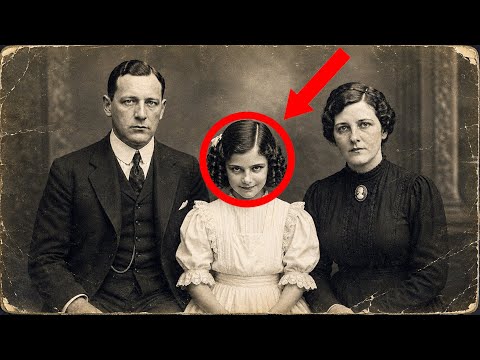
She bought it for a few pounds, intrigued. That night, under the lamplight of her office, she zoomed in on the girl’s face. The smile didn’t reach the eyes. It was the smile of someone who knew a secret—and enjoyed it.
Sarah’s research began innocently enough. A quick search revealed the family’s tragic fate: the father, Herbert, dead of a heart attack just days after the portrait was taken. The mother, Constance, institutionalized with delusions about her daughter’s “transformation.” And the girl, Millisent, vanished at age eleven, never to be seen again.
But the deeper Sarah dug, the more the pieces aligned. Medical reports described Herbert’s symptoms as consistent with poisoning—and noted that Millisent had taken a sudden interest in cooking. A constable’s journal detailed how the child had collected toxic plants and experimented on animals. Witnesses recalled her unsettling composure, her clinical detachment, her constant, predatory smile.
Sarah’s hands trembled as she uncovered a pattern of deaths stretching across decades. A series of mysterious fatalities in Yorkshire in the 1920s. The “Smiling Woman” murders of the 1930s and 40s. And finally, a nursing home in Surrey where dozens of elderly patients died under the care of a Dr. Margaret Ashworth—a woman with dark ringlets and a smile that never reached her eyes.
“It’s her,” Sarah whispered. “Millisent. She never stopped.”
The realization hit like a physical blow: the child in the photograph wasn’t just disturbed—she was a born predator, perfecting her craft over seven decades. And that smile, captured in a single unguarded moment, was the only confession she ever gave.
Now, Sarah stood in her office, the portrait propped against a stack of books. The girl’s eyes seemed to follow her. The smile seemed to widen.
She knew she should donate the photograph to a museum, let the experts take over. But something held her back—a historian’s obsession, or perhaps a deeper, more primal fear. Because Sarah had zoomed in on that smile, and she had seen what lay behind it: not innocence, but pure, calculating evil.
And she couldn’t shake the feeling that Millisent was still out there, somewhere, smiling.
She tried to sleep that night, but the face from the photograph kept surfacing behind her closed eyelids. Not the parents—never the parents—only the girl, patient and watchful, as though waiting for Sarah to make the next move.
By morning she had made a decision. She would not simply donate the portrait and walk away. She would write about Millisent Ashford properly—a full academic treatment, sourced and rigorous, the kind of study that could not be dismissed as morbid curiosity.
But the first thing she needed was proof that Millisent had actually died in 1995. Every account she had gathered rested on that single assumption, and assumptions, Sarah knew, were where historians went wrong.
She drove to Surrey the following Saturday. Sunset Manor had changed hands twice since the 1990s; it now operated as a private rehabilitation clinic, all clean lines and new signage. The administrator, a brisk woman named Diane Fowler, was polite but wary.
“Dr. Ashworth’s records?” She frowned. “We only hold patient files going back fifteen years. The old administrative archive was transferred to the county records office when the home was sold.”
Sarah thanked her and drove on to the records office, where she spent the better part of the afternoon in a windowless reading room. The Sunset Manor archive was incomplete—water damage, she was told, from a burst pipe in 2003—but among the surviving papers she found a staff roster from 1994 and, tucked inside it, an internal memo.
The memo was addressed to all senior staff and signed by the deputy administrator, a Mr. Alan Pryce. It concerned the recent death of the home’s founder and requested that no member of staff speak to the press regarding Dr. Ashworth’s “unorthodox methods.”
Sarah read it twice. Unorthodox methods. The phrase was carefully neutral, almost bureaucratic—and yet someone had thought it necessary to commit it to paper.
She requested the death register next. The entry for Margaret Ashworth was there, dated 3 March 1995, cause of death listed as bronchopneumonia. Beside the entry, a registrar’s note in faded ink: Body released to executor. Cremation at Woking, 11 March. No next of kin present.
No next of kin. Of course not. A woman who had spent her life erasing her past would hardly leave anyone behind to mourn her.
Sarah photographed the pages and was about to close the file when a second document slid loose from the folder—a single sheet of correspondence, unstapled and easy to miss. It was a letter from a Woking funeral director to the manor, confirming the cremation arrangements.
And at the bottom, in a firm, slanting hand, someone had added a postscript.
Please note: the deceased’s personal effects were collected by a Miss E. Harrow, who presented written authority from the estate. Miss Harrow gave a forwarding address in Cambridge.
Sarah stared at the word. Cambridge. Her own city.
She checked the date. The letter was dated 14 March 1995. For a long moment she sat perfectly still, the reading-room silence pressing in around her, and felt the old familiar chill return—the same chill she had felt in Peton’s antiques, staring at a child’s smile.
It might mean nothing. Executors, solicitors, distant acquaintances—there were a hundred innocent explanations. But the address nagged at her, and the name nagged at her more. E. Harrow. She had seen it somewhere before. She was certain of it.
She pulled out her notebook and began, methodically, to leaf back through the months of her research—the newspaper clippings, the constable’s journal, the Scotland Yard file—searching for a name she could not yet place.
It took her two hours to find it. In a photocopy of Detective Inspector Blackwood’s 1923 report, buried in a footnote about false identities, she found the line she had skimmed over months earlier: “The suspect is believed to have used the alias ‘Ellen Harrow’ while staying with a family in the village of Pickering.”
Sarah set down her pen very carefully, as though the motion might disturb something sleeping in the room.
Ellen Harrow. The same name that had collected a dead woman’s belongings in 1995. Either Millisent had chosen her aliases with a murderer’s sentimentality—recycling a name from her own youth—or the letter meant something far stranger: that someone else had been using the name all along.
She spent the next week in the university library, chasing the Harrow name through census returns, directories, and probate indexes. What she found was a ghost. An Ellen Harrow appeared in Cambridge city records in 1995 as a tenant at a lodging house on Mill Road, and then again in 1998 as the purchaser of a small cottage in the village of Grantchester, just outside the city. After 2001, the trail went cold entirely.
No death record. No marriage. No tax filings. The woman had simply stopped existing.
Sarah told herself it was a coincidence, an alias borrowed by chance, a clerical error compounded over decades. But the historian in her had learned to distrust coincidence, and the woman in her had begun to feel watched.
On a grey Thursday afternoon, she drove out to Grantchester. The cottage sat at the end of a narrow lane, half-hidden behind a wall of overgrown hawthorn. The garden was wild, the windows dark, and a faded notice on the gate read simply: No callers.
She was about to turn back when she noticed the flower bed beneath the front window. Foxglove. Nightshade, trellised and heavy with black berries. Monkshood, its hooded blue flowers nodding in the wind. Sarah had spent enough months reading Victorian toxicology to recognize the whole grim catalogue at a glance.
Someone had been cultivating poisons in that garden for years. And someone, she now saw, had been watching her from the shadow of the doorway.
The figure was small and stooped, wrapped in a grey shawl despite the mild air. Sarah’s heart hammered, but she forced herself to speak. “I’m looking for the estate of Margaret Ashworth,” she called. “My name is Dr. Sarah Mitchell. I’m a historian.”
The figure did not move for a long moment. Then the door creaked open, and a voice—thin, dry, and unmistakably amused—drifted across the garden.
“A historian,” it said. “How delightful. I do so love being studied.”
Sarah’s blood turned to ice. The woman stepped forward into the light, and Sarah saw the ringlets, gone white now, and the dark eyes, and the smile—that same smile, unchanged by eighty years, curving upward as though it had been waiting all this time for someone clever enough to come and find it.
She was not looking at a ghost. She was looking at Millisent Ashford, alive at a hundred and thirteen years old, and smiling still.
Sarah did not run. Her legs refused the command, and some stubborn academic reflex kept her standing her ground. “You’re Millisent,” she said, and was surprised at how steady her voice sounded.
The old woman tilted her head, the way a bird considers a worm. “I’ve been many people. But yes. I was her first.” She gestured at the garden, at the foxglove and the nightshade. “You’ve read about me, I expect. They always write me up so dramatically.”
Sarah’s mind raced through the files she had memorized—the deaths, the aliases, the decades of quiet, methodical cruelty. “How are you still alive?”
“Careful living,” Millisent said, and the smile widened. “And a very good knowledge of what to put in one’s tea. You’d be amazed what keeps a body going.”
She stepped closer, and Sarah caught the faint smell of dried herbs, camphor, something older underneath. “Now. You’ve come all this way. Shall I tell you the truth, or would you prefer to keep your version? It’s tidier.”
Sarah thought of Herbert Ashford, sweating in a photography studio, begging for one last portrait. “Tell me.”
Millisent laughed—a dry, papery sound. “They were all so certain I was wicked. But I was only curious. There’s a difference, you know, though no one ever believes it. I wanted to understand how things worked. How people worked. What made them stop.” She shrugged beneath the shawl. “It was a long education. I was a very good student.”
Sarah’s throat was dry. “Hundreds of people.”
“Hundreds of experiments,” Millisent corrected gently. “And one historian, now, standing in my garden. So tell me, Dr. Mitchell—what will you do with what you’ve found?”
The question hung in the grey air. Sarah could see the headlines, the court case, the impossible spectacle of a centenarian on trial for crimes older than the century itself. She could see, too, the disbelief that would greet it—the same disbelief that had let Millisent walk free for seventy years.
“I’ll write it,” Sarah said at last. “All of it. Properly.”
Millisent nodded, almost approvingly. “Good. I should like to be remembered accurately.” She turned toward the door, then paused. “Do come again, Doctor. I’ll make tea.”
The door closed. Sarah stood a long time in the wild garden, the foxglove nodding at her shoulder, and understood at last that the smile in the photograph had never been a confession. It had been an invitation.
She drove back to Cambridge with trembling hands and a notebook full of questions, and she has not yet decided whether she will accept.
What would you do—publish the truth, or leave the monster to her garden and her tea?
Report this article
Select a reason for reporting:






