In January 1965, Indonesian President Sukarno stood before 40,000 cheering supporters in Jakarta and promised to crush Malaysia. “We will drive the British from Borneo and unite the island under Indonesian rule,” he declared. He had the army to do it: 300,000 regular troops, with 40,000 stationed along the Borneo border, backed by artillery, armor, and air support. It was the largest military force in Southeast Asia outside of China.
On the other side of that border, a thin line of British and Commonwealth defenders—Gurkhas, Royal Marines, and Malay Regiment troops—spread across 900 miles of jungle frontier. They were undermanned, under-resourced, and fighting a border war they were forbidden to publicly acknowledge. And they were losing.
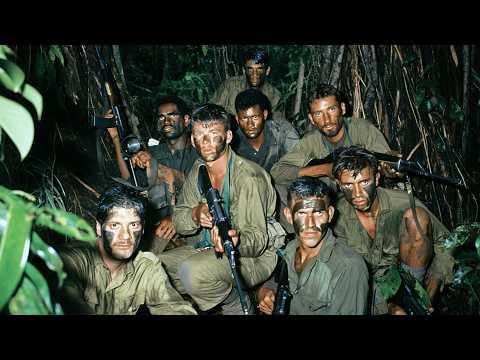
The raids were escalating. What had started as harassment was becoming invasion. Small units first, then platoon-strength incursions, then company-sized assaults on Commonwealth positions. The Indonesians were testing the border, probing for weakness, and they found it everywhere. 900 miles of frontier, dense primary jungle, no roads, no infrastructure, visibility measured in meters. A battalion could cross the border and disappear. A regiment could mass on the Indonesian side and no one would know until the shooting started.
The British commander in Borneo, Major General Walter Walker, understood the mathematics. He did not have enough troops to defend the border. He could not seal it. He could not patrol it. Every time Indonesian forces crossed, Commonwealth troops reacted, pursued, occasionally made contact—usually arriving too late. The jungle swallowed everything.
Walker needed a different answer. He needed someone who could operate in that jungle. Not react to incursions after they happened. Not chase shadows through terrain that defeated conventional pursuit. He needed forces that could cross the border themselves, go into Indonesian territory, find the staging areas, the supply routes, the assembly points where the next raid was being planned, and destroy them before they launched.
The problem was political. The Borneo confrontation was not a declared war. Officially, it was a series of border incidents. Indonesia denied involvement. Britain denied escalation. Both sides lied. Both sides knew the other was lying, but the fiction had to be maintained. If British or Commonwealth forces were caught inside Indonesian territory, the diplomatic consequences would be severe. Sukarno would have his justification for full-scale war. The Americans, already stretched thin in Vietnam, would be furious. The United Nations would intervene.
So, whatever crossed that border had to be invisible. Whatever went in had to leave no trace. Whatever operated on the Indonesian side had to be so quiet, so disciplined, so professional that the enemy would never know they had been there until they were already gone.
Walker did not reach for a battalion. He did not request a brigade. He reached for 30 men. 30 Australian commandos.
The Australian Special Air Service Regiment had arrived in Borneo without fanfare. No press coverage, no official announcement. Their deployment was classified from the moment they boarded the aircraft in Perth. Their destination was classified. Even their parent unit in Australia received only the vaguest notification of where they had gone.
They landed in Brunei and were driven to a compound near Kuching in Sarawak. The briefing was conducted by a British intelligence officer named Hale. He was precise. He was clinical. He was also visibly exhausted. The dark circles under his eyes said more than his briefing slides.
“Gentlemen, this is the situation along the first division border.” He pointed to a map covered in red markings. Each marking represented a confirmed Indonesian incursion in the previous 90 days. There were over 60. “We are reacting to every single one of these after the fact. By the time our patrols reach the incursion point, the enemy has withdrawn. We are finding burned longhouses, dead civilians, and abandoned equipment. We are not finding the enemy.” He paused. “You are going to change that.”
The Australian team leader was a captain named Darvall. 31 years old. Lean, quiet, the kind of officer who listened more than he spoke and remembered everything he heard. He had been selected for the SAS after three years with the Royal Australian Regiment and two years of additional training that included long-range reconnaissance, jungle warfare, survival, and demolitions.
He studied the map. He said nothing for a long time. Then he asked one question. “How far across the border are we authorized to operate?”
Hale looked at the senior British officer in the room. The officer nodded. “10,000 yards initially. Potentially further depending on results.”
10,000 yards. Roughly nine kilometers into Indonesian sovereign territory. Darvall nodded once. “We’ll need current aerial photography, river charts, every piece of signals intelligence you’ve collected in the last six months, and I want to talk to the border scouts.”
The border scouts were indigenous Iban trackers recruited by the British to monitor the frontier. They knew the jungle paths. They knew the river systems. They knew where the Indonesian patrols crossed and where they camped. Their intelligence was granular, local, and exactly what conventional forces had been too large and too loud to exploit.
Darvall spent three days talking to them. Not briefing, talking. Sitting in longhouses, drinking rice wine, listening to old men describe trail networks that appeared on no military map, watching young scouts draw river crossing points in the dirt with sticks, absorbing the texture of the border zone the way only a small unit operator could. By the fourth day, he had what he needed.
The first cross-border patrol launched on a Tuesday night. Four men. Darvall led it personally. They crossed the border at a river junction identified by the Iban scouts as a regular Indonesian transit point. They moved at night. They carried no identification, no unit patches, no documents that could link them to Australia or the Commonwealth. Their weapons were sterilized. Their equipment was unmarked. If they were captured, they did not exist.
The rules were absolute. No gruesome souvenirs, no prisoners, no firing unless fired upon or unless an ambush was initiated, no pursuit deeper than the authorized limit, no trace left behind—every shell casing collected, every boot print brushed, every sign of passage erased. They called them the golden rules. Break one and the entire program would be shut down. The political stakes were that high.
Darvall’s patrol moved six kilometers into Kalimantan on that first night. They found an Indonesian trail network within three hours. Fresh boot prints, hundreds of them. A well-used supply route running parallel to the border, connecting two Indonesian army camps that British intelligence had suspected but never confirmed. They marked the positions, counted the prints, estimated unit strength based on trail width and wear patterns, photographed everything they could in the darkness using infrared film. They did not fire a shot. They withdrew before dawn. They were back across the border by sunrise.
The intelligence they carried was more valuable than anything British forces had gathered in six months of conventional patrolling. Darvall’s report landed on Walker’s desk within 24 hours. Two confirmed Indonesian base camps, a supply route capable of supporting company-strength operations, evidence of recent reinforcement, estimated enemy strength 200 to 250 regular troops within striking distance of the border. Walker read the report. Then he authorized the next phase: ambush.
The Australians went back across the border 72 hours later. This time, eight men, two four-man patrols operating independently but within mutual support distance. Their target was the supply route Darvall had identified. Their mission was to interdict it.
They set up 200 meters apart on the trail, selected positions with clear fields of fire and multiple withdrawal routes, camouflaged their positions using techniques that took hours to execute properly. Cut vegetation was replaced. Disturbed earth was smoothed. Tripwires were laid not as weapons but as early warning systems. And they waited.
Patience is not a tactic taught in most military academies. It is not glamorous. It does not appear in recruitment videos. But in the jungle, patience is the most lethal weapon a soldier possesses—the ability to remain motionless for hours, to control breathing, to suppress the urge to swat the insects crawling across exposed skin, to watch a trail for an entire day without shifting position.
The Australians were trained for this. They had practiced it in the Queensland rainforest, in the mangrove swamps of North Australia, in conditions specifically chosen to replicate Borneo’s climate, terrain, and insect population. A soldier who could remain still for eight hours in a North Queensland swamp could remain still for twelve in Borneo.
They waited 19 hours. The Indonesian patrol appeared at dawn on the second day, twelve soldiers moving in single file along the trail, weapons slung, relaxed. They had walked this route dozens of times. They expected nothing.
The ambush was initiated by a single Claymore mine. The kill zone erupted. The Australians fired for exactly eleven seconds—controlled bursts, aimed shots, no panic, no sustained fire. Eleven seconds of precise, brutal violence. Then silence.
The Australians collected their Claymore wiring, collected their shell casings, checked for any equipment left behind. They withdrew. They left twelve dead Indonesian soldiers on the trail with no explanation of who had killed them. No shell casings, no boot prints, no physical evidence of any kind that could identify the attackers. The Indonesians found the bodies hours later. They had no idea what had happened.
Understand what this did. Twelve soldiers killed on a secure supply route deep inside Indonesian territory. No warning, no survivors, no evidence. The Indonesian local commander had to report the incident up the chain, had to explain how an entire patrol had been wiped out on a route that was supposed to be safe. Had to answer the question that every officer dreads: How did the enemy get here?
He did not have an answer. So, he did what frightened commanders always do. He increased patrols, doubled sentries, restricted movement along the supply route, requested reinforcements, and he reported that the border area was under attack by a significant enemy force. He estimated at least a company. There were eight Australians.
This was the beginning. Over the following weeks, Darvall’s teams expanded their operations, never more than four to eight men per patrol, never staying on the Indonesian side for more than 72 hours, never using the same crossing point twice, never operating in a pattern the Indonesians could predict. They hit supply routes, they ambushed patrols, they destroyed river crossings, they mined trails. Every operation was conducted with surgical precision and absolute discipline. Every shell casing collected, every trace erased, every patrol debriefed down to the smallest detail.
The intelligence they generated was extraordinary. Each patrol brought back information. Trail networks, base camp locations, unit identifications gleaned from shoulder patches observed through binoculars, supply chain patterns determined by monitoring river traffic, communication frequencies intercepted by signals equipment small enough for one man to carry. The Australians were building a picture of the Indonesian border deployment that was more detailed, more accurate, and more current than anything produced by any other intelligence source in the theater.
And the ambushes continued. A second patrol was hit on the same supply route eight days after the first. Seven killed. Again, no evidence. Again, no explanation. The Indonesian commander reinforced his assessment. He was facing a large enemy force. He requested battalion-strength reinforcements.
A third ambush struck a different trail network fifteen kilometers from the first two. Nine killed. The Indonesians now believed the enemy force was operating across a wide front. Multiple companies at minimum. Possibly a full battalion conducting deep penetration operations. There were still only 30 Australians in Borneo.
And they were rotating patrols. At any given time no more than twelve were across the border. Often fewer. Sometimes as few as four. Four men making an army believe it faced hundreds.
The secret was not firepower. The Australians carried the same weapons as any Commonwealth infantry patrol. Self-loading rifles. Bren guns. Grenades. Claymore mines. Nothing exotic. Nothing special. The secret was method. Every ambush was planned as a unique operation. Different location. Different approach route. Different withdrawal route. Different timing. Different formation. The Australians never repeated themselves because repetition creates patterns and patterns get soldiers killed.
Every ambush site was selected based on intelligence gathered by previous patrols. The Australians were not guessing. They were not hoping. They knew where the Indonesians would be because they had watched them for days or weeks before the ambush was set.
Every contact was brief. Eleven seconds. Fourteen seconds. Nine seconds. Never sustained engagement. Never pursuit. Never the kind of prolonged firefight that allowed the enemy to assess the attacking force’s size. The Indonesians heard Claymores and automatic weapons fire. They found their dead. They found nothing else.
What would you conclude? You would conclude what they concluded. A large, well-equipped, well-supplied force operating deep inside your territory with impunity. A force that knew your patrol routes. Knew your supply lines. Knew where you were and when you would be there. A force that struck without warning and vanished without a trace. You would be terrified.
The Indonesian response proved it. Within three months of the first Australian cross-border patrol, Indonesian forces along the Sarawak border had tripled their defensive deployments. Troops that had been staging for offensive operations into Malaysian territory were pulled back to defend against the phantom army in their own jungle. Patrol schedules were randomized. Supply routes were changed. New base camps were established further from the border. The raids into Sarawak dropped by 60%.
60%. 30 men did that. The irony was staggering. Indonesia had 300,000 troops. The Australians had 30. And those 30 had forced Indonesia to divert thousands of soldiers from offensive operations to defensive ones. The strategic mathematics were almost absurd. Every Australian commando was tying down roughly 100 Indonesian soldiers.
But the Australians were not finished. As the program expanded, the authorized penetration depth increased. 10,000 yards became 20,000. Then further still. The patrols pushed deeper into Kalimantan, mapping Indonesian positions that no Commonwealth force had ever observed. They found things the British had only guessed at. Major supply depots hidden under triple canopy. Training camps where the next generation of border raiders was being prepared. Communication centers linking the border forces to Jakarta. They documented everything.
One patrol led by a sergeant named Cray spent four days observing an Indonesian battalion headquarters from a concealed position less than 300 meters from the perimeter. Four days without moving, without cooking, without speaking above a whisper. They recorded every vehicle movement, every radio antenna, every officer who entered or left the compound. They counted weapons. They counted troops. They identified the battalion commander by his vehicle and his routine. They withdrew with more intelligence about that single Indonesian unit than the entire Commonwealth signals intelligence apparatus had produced in six months. Cray’s report ran to 47 pages.
Not all operations were observation missions. The ambushes escalated in sophistication. The Australians began targeting river traffic. Small boats carrying supplies and reinforcements along the Kalimantan river systems were the lifeline of the Indonesian border deployments. Without them, forward positions could not be sustained. A four-man team positioned on a riverbank could destroy a supply boat with a single burst of fire and disappear before any response force arrived. The rivers were long. The jungle pressed close to the banks. There were thousands of potential ambush sites. The Indonesians could not protect them all.
They tried. They assigned escort boats to supply convoys. They stationed sentries at regular intervals along the most critical river routes. They cleared vegetation from the banks near their positions. The Australians simply moved upstream, found new positions, hit the convoys where they were not protected.
A corporal named Madigan executed what became the program’s most celebrated river ambush. His four-man team identified a supply convoy of three boats approaching a bend in the river where the current forced the boats to slow. They positioned two Claymores on the bank aimed at the waterline and set up interlocking fields of fire from elevated positions.
The lead boat rounded the bend. Madigan detonated the Claymores. The blast shattered the lead boat’s hull. The second boat, unable to stop, collided with the wreckage. The third boat attempted to reverse. The Australians engaged it with aimed rifle fire. The engagement lasted seventeen seconds. All three boats were destroyed or disabled. The supply convoy ceased to exist.
Madigan’s team collected their equipment and withdrew. They crossed back into Sarawak before the Indonesian reaction force reached the ambush site. The Indonesians found burning wreckage, dead soldiers, and sinking supplies. They found nothing else. No shell casings, no boot prints, no equipment, no evidence. The convoy attack was attributed to a large enemy force. The river route was shut down for two weeks while the Indonesians reorganized their supply chain. Four men had done it.
There is a moment in every covert operation when the human cost becomes real. The Borneo jungle was not a backdrop. It was an adversary. Temperatures exceeded 35 degrees in the canopy, humidity was absolute, and clothing rotted on the body within days. Leeches were constant. The Australians patrolled through this for 72 hours at a stretch, moving at night, lying motionless during the day, eating cold rations because cooking fires produced smoke that could be detected from kilometers away.
They could not afford mistakes. A single cough, a dropped piece of equipment, a broken branch could compromise the entire patrol. And a compromised patrol deep inside Indonesian territory had no rescue option. If they were discovered they fought their way out or they did not come back. Every man knew this. Every man crossed the border anyway.
By mid-1965, Operation Claret had reshaped the entire confrontation. Indonesian offensive operations along the Sarawak border had collapsed to a fraction of their previous intensity. Captured intelligence assessments later revealed the extent of the deception: Indonesian commanders had estimated the cross-border force at between 500 and 2,000 troops, some reports suggesting an entire brigade. There were no forward operating bases. There was nothing inside Kalimantan except small groups of Australian soldiers who came, did their work, and left.
In August 1966, the confrontation officially ended. The Australians went home and said nothing. Operation Claret remained classified for decades. The men who had conducted the cross-border raids could not discuss them, could not claim them, could not receive public recognition. Some waited 30 years before they were allowed to speak.
When the files were finally declassified, the scope of the achievement became clear. Over the course of the program, Australian SAS patrols had inflicted confirmed casualties in the hundreds, gathered intelligence that fundamentally reshaped Commonwealth understanding of Indonesian border deployments, and forced the redeployment of thousands of Indonesian troops. They had done it without losing a single soldier killed in action on the Indonesian side of the border. Not one.
The military analysts who studied Operation Claret struggled with the numbers. 30 men tying down 10,000. Four-man patrols defeating company-strength positions. A single squadron achieving strategic effects normally associated with division-level operations. The answers were not complicated. They were simply uncommon. In the jungle, size is a liability. Numbers create noise. Noise creates detection. Detection creates casualties. The smallest possible force that can achieve the mission is not a compromise. It is the optimal solution.
The survivors are old men now. A retired sergeant, interviewed after declassification, was asked what it felt like to operate inside Indonesian territory knowing no one would come for him if things went wrong. He thought about it for a while. “You just got on with it,” he said. Five words. That is the Australian way of describing the most effective unconventional warfare campaign in the nation’s history.
The jungle along the Kalimantan border has reclaimed the trails. The ambush sites are gone, buried under decades of tropical growth. If you walked those trails today, you would find nothing. No shell casings, no equipment, no markers, no memorial. That was the point. The Australians were never there, officially. 30 men, 900 miles of frontier, 300,000 enemy troops, and not a single trace left behind.
But here is the question that lingers: if a war is fought in total silence, its heroes unnamed and its victories unclaimed—does it still count as courage, or does it become something else entirely? What do you think—was the silence the price of victory, or the truest measure of it?
Report this article
Select a reason for reporting:






