On the morning of March 4th, 2002, 24 American soldiers were about to die in an Afghan valley. They knew it. Their commander knew it. The enemy fighters pouring fire down from the ridgelines above them knew it, too. What the Rangers did not know was that two Australians were already up there watching. Two men, a sniper and a spotter. They had crawled into their hide before the sun came up, pressed themselves into the cold rock, and gone completely still while the valley below them filled with the sounds of a firefight going badly wrong. When the moment came, they did not call for permission. Nobody authored what happened next. They read the ground, read the fight, and made their call. They took their shots. They watched what happened. And when it was done, they picked up and moved on to their next task without writing a single word about any of it. The Americans wrote 40 pages. In the debrief room after the extraction, Rangers kept reaching for a word to describe what those two men had been in that fight. This is the story of how that word got earned and why it never turned up in a single Australian military document.
To understand what March 4th actually cost, you have to go back a few weeks and understand what Operation Anaconda was supposed to be. By early 2002, the Americans had been in Afghanistan for about five months. The opening campaign had gone faster than almost anyone expected. The Taliban collapsed in weeks. Al-Qaeda’s command structure took a serious hit. Bin Laden slipped out of Tora Bora in December 2001 and vanished. And that particular failure would haunt American commanders for years. But the broad picture in early 2002 looked, if you squinted at it from Washington, like things were going reasonably well. They were not. The enemy was still there, scattered, damaged, stripped of its government infrastructure, but still there, still watching, still waiting to see what came next.
What came next, as far as American intelligence could tell, was a concentration of remaining Al-Qaeda and Taliban fighters in the Shahi-Kot Valley in Paktia province. The estimate said 200 to 300 men had pulled back into the valley’s broken terrain to sit out the winter. American planners looked at that number and saw an opportunity they did not want to waste. Tora Bora had failed because the net had holes in it. Operation Anaconda was going to close every hole at the same time, caught in the valley on all sides simultaneously and finish what the opening campaign had started.
The planning ran for weeks. American conventional infantry, special operations units from several coalition countries, Afghan partner forces, layered air support. The planners had satellite imagery. They had intelligence networks. They believed they understood the ground. They were wrong about almost all of it.
When coalition forces began pushing into the Shahi-Kot on March 2nd, the picture that came back from the ground bore almost no resemblance to what headquarters had described. The valley was not holding two to 300 scattered fighters. It was holding somewhere between 500 and a thousand men who had spent months preparing for exactly this. They had mortars pre-sighted on the valley floor. They had heavy machine guns set up to cover the approach routes from multiple angles at the same time. They had rocket-propelled grenades and communications equipment and enough ammunition to make it clear this was not a ragged winter camp. This was a prepared defensive position held by a force that had been expecting company and had done a thorough job of getting ready.
The Americans had not walked into a mop-up. They had walked into one of the most dangerous engagements they would face during the entire Afghan war. The geography did not help. The Hindu Kush does not give a larger force the kind of advantages that larger forces usually rely on. There is no flat ground to maneuver across, no clear approach where weight of numbers translates into control of the fight. The valley floor sits below ridgelines that rise hard and steep on multiple sides. And the fighters who hold those ridgelines hold everything below them.
The Al-Qaeda and Taliban men defending the Shahi-Kot understood this better than the Americans did. They had placed themselves accordingly. The American units pushing in from below found themselves looking up at positions they could not easily suppress from terrain that offered them almost nowhere to hide.
On March 4th, a patrol from the 75th Ranger Regiment was put down by helicopter into a blocking position on the eastern edge of the valley. These were serious soldiers. The 75th Ranger Regiment traces its history back to the Second World War, and its men are trained specifically for the kind of fast, violent, close-in fighting that a blocking mission in rough terrain requires. They were not the kind of men who come apart under fire. But there is a limit to what training can do when you are sitting in open ground and an enemy that already holds the high ground on three sides opens up on you from every direction at once.
That limit arrived very quickly on March 4th. Within minutes of landing, the patrol was taking heavy accurate fire from ridgeline positions above them. There was almost no cover on the ground where they had been dropped. Wounded Rangers were lying in the open because the act of moving them meant exposing the men trying to move them. The patrol commander called for close air support, which was the right call and the only real option, but close air support in a landlocked mountain country is not something you can pull out of the air in the next five minutes. Radio networks, available assets, flight times, coordinates, every piece of that process takes time, and time was the one thing the patrol did not have in any useful quantity.
The situation was getting worse with every minute that passed. What the patrol commander did not know as he worked the radio and made decisions about his casualties was that something was about to change on the ridge line above the men trying to kill his soldiers. Something that had been there all morning and that nobody in that valley had seen.
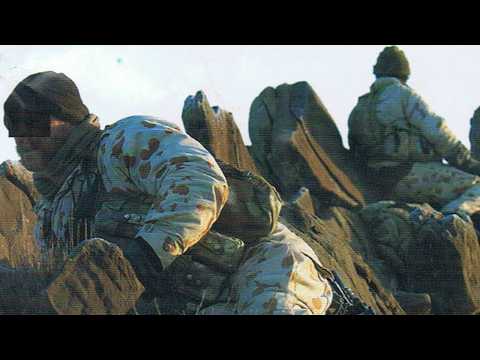
Up on the eastern ridge line, tucked into a fold of rock that broke their outline against the sky and made them part of the mountain rather than something sitting on top of it, a two-man SAS sniper team had been watching the valley since well before sunrise. They had moved into their hide in the dark, which is standard practice for a team that needs to be completely settled and invisible before the day starts below them. They had picked their ground the way years of training teaches you to pick it. The ridge line behind them killed their silhouette. The rock around them absorbed their outline from the valley floor. From the ridge lines the enemy was shooting from every angle that mattered, there was nothing on that piece of ground. There had been nothing there all morning. Two men still as the stone they were lying on, watching everything.
The SASR, the Special Air Service Regiment, sits at Campbell Barracks in Swanbourne, Western Australia. It was raised in 1957, built on the philosophy David Stirling put together when he created the British SAS in the North African desert back in 1941. Stirling’s argument was simple, and at the time it was considered almost heretical. Stop sending large formations to do things that small teams can do better. Find exceptional people. Train them beyond the point where most military organizations stop. Put them somewhere the enemy is not expecting and let them work.
The Australian military took that idea and made it its own over the decades that followed. The regiment went to the Malayan Emergency in the late 1950s and learned how to patrol in jungle terrain that punished any soldier who could not look after himself alone for days at a time. It ran operations into Indonesian-controlled territory during the Konfrontasi campaign of the mid-1960s on missions Australia did not publicly admit to for a very long time. Vietnam, Somalia, East Timor. Every deployment left something behind in the regiment’s institutional knowledge. And that knowledge got handed to the next generation of soldiers who came through selection.
By the time the SASR deployed to Afghanistan after September 11th, it had been doing this for 40 years. It did not arrive as a unit that was about to find out what hard operations felt like. It arrived as a unit that had already been in a lot of hard places and had a very clear idea of what it was doing.
Getting into the SAS starts with a selection course designed around one central idea. Most people cannot do this and the course exists to identify the ones who can. The dropout rate sits above 80% most years. The men who make it through are not just physically capable, though the physical standard is severe enough to end most people’s attempts before the week is out. They have shown something harder to quantify under sustained and extreme pressure. In situations where the right answer is not obvious and the wrong one has permanent consequences, they stay clear-headed and make good decisions. They work alone without losing their edge. They keep functioning when they are cold and hungry and exhausted and there is nobody coming to check on them. That last quality, the ability to perform when no one is watching, matters more for a two-man team operating alone on a hostile ridgeline than almost anything else.
The sniper qualification builds on top of all of that. A qualified SAS sniper can hit a target at 800 meters and further, adjusting for wind and elevation and temperature and the movement of what he is shooting at. The spotter beside him is running a parallel calculation the whole time, ranging the target, building the data the shooter needs, watching the ground around their position, and keeping the team security in his head while all of that is happening. The two roles lock together into a single system. And that system only works when both halves are operating at full capacity.
The two men on that ridge line on March 4th had spent years building that system between them. They had chosen their hide with the attention to detail that training at that level produces, and they had been lying in it, still and silent, watching the valley come apart below them.
When the Rangers’ helicopters came in and the shooting started, the SAS team could see the whole shape of the fight in a way that nobody on the valley floor could. From where they were sitting above and to the side of the contact, they could trace the lines of incoming fire and see which fighters were moving to press the attack harder. They could see how quickly the patrol’s options were running out. The decision in front of them was not complicated, but it had to be made fast. Engaging meant giving up their concealment, burning their ammunition, and ending the reconnaissance task that had put them on that ridge line in the first place. Not engaging meant watching 24 men below them reach a point from which there was no coming back from a position where two people had the ability to change that outcome. For the men the SASR produces, there is only one way that calculation goes.
The first shot came from ground nobody in the valley had identified, from a ridge line the enemy had been using with complete confidence all morning. Accurate fire arrived from something that had been invisible to everyone below since before the sun came up. The assault did not slow gradually. It stopped.
Fighters who had been moving forward started looking around for something they could not find. A second round came from a slightly different angle, because the team had shifted position after the first shot. Then a third. Precision fire from an unseen source does something specific to the men on the receiving end: it replaces certainty with doubt.
The momentum broke. The Rangers felt it before they knew why. They moved their wounded to better ground, sorted their ammunition, tightened the perimeter. Gunships arrived. Fast air behind them. The assault was called off. “Two men in, 24 men out.”
In the debrief, the Rangers kept reaching for the same word. Invisible. Not poetic — tactical. The Americans wrote 40 pages. The Australians wrote nothing. The regiment never put that word on paper. Do you think the absence of a record makes the deed more or less real?
Report this article
Select a reason for reporting:






