The desert sun had not yet reached its full fury, but the sand already burned like a furnace. A lean Australian soldier lay motionless in a shallow ditch, his face pressed against the hot ground, his eyes fixed through a rifle scope. He had been there since before dawn, watching, counting, calculating. Somewhere ahead, 25 American soldiers were completely surrounded by 400 German Africa Corps troops—the most feared desert fighters in the world. The Germans had closed the circle. No artillery. No tanks. No way out. The Americans were as good as dead. But nobody had told the Australian yet.
He had not moved for hours. Not a muscle. Not a breath out of place. He was waiting for the perfect moment to begin the killing. And when he finally pulled the trigger, the desert would never be the same.
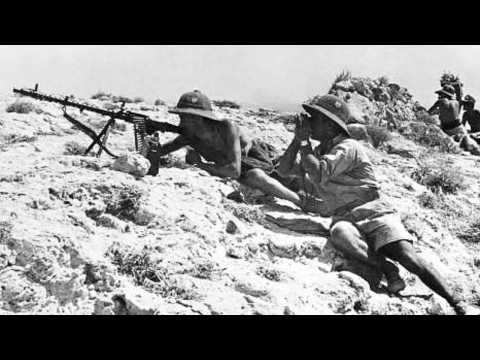
By 1942, World War II had swallowed the world whole. The fighting stretched from Europe to the Pacific and deep into the burning sands of North Africa. This desert campaign was unlike anything soldiers had ever faced. The Sahara killed men just as efficiently as bullets did. Temperatures soared past 120°F during the day and plunged near freezing at night. Water was more valuable than ammunition. The open ground offered almost no cover—no trees, no hills, nowhere to hide. Every movement could be seen for miles.
Germany’s Africa Corps, led by Field Marshal Erwin Rommel—the Desert Fox—had been tearing through Allied forces like a hot knife through butter. Rommel’s men were experienced, disciplined, and perfectly adapted to desert warfare. They had already pushed the British back hundreds of miles. Now American forces, fresh and eager but dangerously inexperienced, were entering the fight. The result was exactly what veteran soldiers feared most: brave men making deadly mistakes in terrain that punished every error without mercy.
The 25 Americans had pushed forward too fast. In the chaos of a morning advance, they had moved ahead of their own lines, lost contact with their flanking units, and suddenly found the desert closing around them like a fist. 400 German soldiers, professionals who had been fighting in this desert for over a year, recognized the opportunity immediately. They moved to encircle the Americans with calm, practiced efficiency. There was no hurry. The desert would help them. The sun would help them. Time would help them.
The Germans tightened their ring slowly through the early morning hours. Their machine gun crews set up in a wide circle. Their officers moved between positions, coordinating, pointing, giving orders. They had done this before. They knew exactly how it ended. What they did not know was that a single Australian had been watching them the entire time.
He had watched them set up their positions. He had watched their officers move. He had counted their machine guns. He had calculated the wind coming off the desert floor, measured the distance to each target, and decided the exact order in which the killing would happen. He picked up his rifle. The question is not whether one man could stop 400. The question is what happens to 400 men when they suddenly realize that the invisible thing haunting them in the desert has no intention of stopping at all.
To understand what happened in that desert in September 1942, you first have to understand where this story really begins. It does not begin in North Africa. It begins on a small, rocky peninsula in Turkey almost 30 years earlier, where a generation of Australian soldiers learned something about war that no textbook could ever teach them.
When Australia entered World War I, thousands of young men signed up and shipped out to a war that most of them had never imagined. Many had grown up in the Australian Outback, on cattle stations and sheep farms, where learning to shoot accurately was simply part of daily life. They could hit a rabbit at 200 yards before breakfast. What they could not do was survive a modern war. That education came fast, and it came brutal. And the place it happened was called Gallipoli.
The landing at Gallipoli in April 1915 was a disaster from the first hour. The smell of those first weeks was something every survivor described the same way without being asked: dust, salt water, and the specific sweetness of unburied men lying in the sun. The sound was worse. Turkish rifles cracked from the ridgelines above at a rate that seemed impossible to survive. And yet men survived because the ones who learned fastest—how to use the ground, how to read the light, how to move in ways that offered no clean target—lived long enough to teach what they had figured out to the men arriving behind them.
This was not a training program. There were no classrooms. The classroom was a hillside in Turkey where the tuition was paid in blood, and the lesson was always the same: Be still. Be patient. Be invisible. Or be dead.
From the survivors of that hillside, a new kind of soldier began to emerge. Men who learned that patience was not weakness. Men who learned that watching carefully before acting was not cowardice. Men who learned that one perfectly placed shot was worth more than 100 desperate ones. These men became snipers, and the most famous among them was a quiet, dark-eyed young man from Queensland named Billy Sing.
Billy Sing stood about 5’7″ tall. He was lean and dark-skinned, the son of a Chinese immigrant father and an English mother, which meant he faced prejudice even within his own army. None of that slowed him down. At Gallipoli, Sing recorded 150 official confirmed kills, with fellow soldiers believing the true number was closer to 200. The Turks feared him so deeply that they sent their own master sniper specifically to hunt him down and kill him. That Turkish sniper never came home. Sing did.
What made Sing extraordinary was not his eyesight or his trigger finger. It was his philosophy. He spent more time watching than shooting. He studied his targets the way a farmer studies weather, looking for patterns, habits, and routines. He selected his position before anything else because a perfect shot from the wrong place meant death. But an average shot from an invisible position could win everything. He moved constantly after firing because he understood that the second shot was always more dangerous than the first. The enemy was already searching for him by then.
This philosophy spread through the entire Australian military like water through dry ground. By the time World War II began, Australian soldiers carried this sniper tradition with them the way they carried their rifles. It was not written in a manual. It lived in the conversations between veterans and younger soldiers, in the hard-won lessons passed from man to man across two generations of warfare.
The Australian soldiers who arrived in North Africa in 1941 and 1942 brought all of this with them. They were entering a battlefield that actually rewarded the sniper’s core skills more than almost any other terrain on Earth. The open desert, which seemed to offer nowhere to hide, actually created extraordinary opportunities for a disciplined man who understood the ground. Heat shimmer distorted vision at long range. The rising sun blinded observers looking east in the morning. Sand dunes and rocky outcroppings, invisible on a flat map, provided perfect hides to a man who knew how to use them. Rommel’s Africa Corps was about to meet a philosophy they had never fully prepared for.
The morning the Americans got surrounded started like every other morning in the North African desert. Cold, gray light creeping over the sand before the sun turned everything white and merciless. The smell of dust and engine oil hanging in the still air. The distant sound of artillery rumbling somewhere to the west like far-off thunder that never quite arrived.
The 25 Americans were part of a larger advance that had been pushing into German-held territory since before dawn. They were young, most of them, and they were brave in the way that men are brave before they have seen enough war to fully understand what brave actually costs. Their unit had been moving fast, trying to exploit what looked like a gap in the German lines. In the confusion of the early morning advance, with dust clouds thrown up by vehicles obscuring visibility in every direction, they pushed forward beyond the point where any friendly unit could see them or support them. By the time the sun had fully risen, they were alone.
The realization did not come all at once. It came in pieces the way bad news always does. First, the radio contact with their parent unit became scratchy and unreliable. Then a scout sent back along their route of advance came running back with wide eyes and breathing hard. The Germans were behind them—not a small patrol, but a large force moving deliberately, cutting off the path back. Within the hour, reports from every direction confirmed what the men already felt in their chests before their minds accepted it. They were surrounded on all sides by approximately 400 German Africa Corps soldiers who were closing inward with the calm patience of men who had done this many times before.
The Germans held every advantage the desert could offer. They outnumbered the Americans sixteen to one. Machine gun teams ringed the perimeter, each capable of cutting down any breakout attempt in seconds. Experienced officers coordinated the encirclement with practiced signals. The ground between the Americans and any friendly force was flat and open—any rescue would be visible and vulnerable for the entire approach.
Inside the American perimeter, the situation was desperate in the specific way that is worse than simple danger. The men knew their position. They knew the numbers. They had enough ammunition for a fight, but not enough for a long one. The sun was climbing now, turning the sand into an oven. Men drank from their canteens carefully, knowing water out here was a clock counting down. A wounded man lying in that sun without shade could be in serious trouble within the hour.
Their commander sent what messages he could. The replies offered little comfort. Relief forces were being organized, but the open ground between friendly lines and the American position was covered by German fire. Any direct rescue attempt would be walking into the same trap. The Americans were told to hold, to conserve ammunition, to wait. Waiting in a circle of 400 men who wanted you dead, with the temperature climbing past 100° and your water shrinking every hour, is one of the hardest things a soldier can be ordered to do.
The Germans were in no hurry. They had the numbers. They had the ground. They tightened their circle slowly and steadily like a fist closing, and they fully expected that by afternoon this would be finished. Nobody had seen the Australian yet.
He had been watching for nearly two hours before he fired a single shot. This is the part that is hardest to understand about the Australian philosophy, because everything about combat pushes a soldier toward action. Noise, fear, urgency, the desperate need to do something when men are dying. The Australian sniper felt all of those things. He was not made of stone. But he had been shaped by the hardest school in the world—a tradition built on the bones of men who had acted too quickly—and he understood something those 400 Germans did not yet know he understood.
The first shot would not just kill one man. The first shot would begin something that, if done correctly, could not be stopped.
So he watched. He memorized the German positions the way a man memorizes the layout of his own home. He identified the machine gun nests first—counting four of them spaced around the perimeter, each one capable of cutting down any rescue attempt in seconds. He found the officers next, identifying them not by rank insignia he could not read at that distance, but by behavior. Officers are always the men others look at. The men who point. The men who move between positions and make other men move in response. He found three of them. He noted where each one stood, how often they moved, and the paths they used to travel between positions.
Then he studied the ground between himself and the German lines. The desert here was not flat in the way that people who have never seen it imagine. It rolled in long shallow waves, with rocky outcroppings and dried brush that a disciplined man could use as cover if he planned his movements carefully and moved only when the heat shimmer rising off the sand was thick enough to make distant observation difficult. He had already planned four separate positions he could move to after firing—each one offering a different angle, each one making it appear to any searching German eye that there were multiple shooters working the desert around them.
He took one slow breath and fired.
The first shot killed the German officer coordinating the eastern side of the encirclement. The man was in the middle of pointing toward the American position, giving an instruction to the soldiers around him, when he simply dropped. There was no drama in it from the Australian’s perspective. There was a crack, a recoil against his shoulder, and then the man was gone from his scope. From the German perspective, it was something else entirely. An officer fell dead with no warning, no visible enemy, no sound of any approaching force. Just a rifle shot coming from the open desert, and then silence.
The Australian was already moving. He covered forty meters through a low depression in the sand, moving fast and low, before settling into his second position. He gave himself sixty seconds to steady his breathing and reacquire targets through his scope. The German force had reacted to the first shot with immediate alarm, but also with confusion. Men were crouching, looking outward in multiple directions, trying to determine where the shot had come from. Two soldiers moved to check on the fallen officer, clustering together over his body without thinking. The Australian noted this, calculated the distance from his new position, adjusted slightly for the morning wind coming in from the northwest, and fired twice. He moved again before the echo died.
This is what the German soldiers began to experience, and it is important to understand it not just as a military event, but as a human one. Fear in combat is manageable when you know where it is coming from. A man can face a machine gun nest because he can see it, assess it, and make a decision about it. What the Australian was creating was something different. The shots were coming from different directions. No position could be identified with certainty. Every time German soldiers raised their heads to look, another man went down. The feeling that spread through the German encirclement was not ordinary combat fear. It was the specific, paralyzing terror of being hunted by something you cannot see.
He prioritized the machine gun crews with ruthless efficiency. A machine gun in the desert required a crew of at least two men to operate effectively. He worked each position in sequence—not firing randomly, but moving through his mental list with the calm focus of a man completing a task he has prepared for thoroughly. First the gunner, then the loader, then any man who moved to replace them. Within two hours, three of the four machine gun positions had fallen silent.
The German encirclement, which had been tightening with such professional confidence all morning, stopped moving. The ring did not break immediately, but it stopped tightening. And in the mathematics of this particular situation, stopped tightening was the difference between 25 men dying and 25 men living. The German soldiers were no longer thinking about advancing. They were thinking about where the next shot was coming from. They were pressing themselves into the sand. They were looking at the men beside them and seeing fear looking back.
The Australian moved to his third position, settled into the sand, and kept working.
By mid-afternoon, the desert around the American position had gone quiet in a way that felt nothing like peace. The 25 Americans had heard the rifle shots throughout the morning—single cracks coming from different directions across the open sand, never in rapid succession, never in the panicked bursts of a firefight, but steady and deliberate, like someone methodically completing a list of tasks. They did not know who was doing the shooting. They did not know where he was. What they knew was that the German pressure, which had been tightening around them all morning with terrible certainty, had stopped. The enemy soldiers, who had been moving closer with every passing hour, were no longer moving. The desert outside their small perimeter had gone still.
When the relief force finally broke through to the Americans in the late afternoon, pushing across the open ground that had been too dangerous to cross all morning, the scene they found was not what anyone had expected. 25 men alive, most of them unhurt, sitting in the sand with the particular hollow expression of people who have spent hours absolutely certain they were going to die and have not yet fully accepted that they were wrong. One American sergeant, when the first friendly face appeared over the ridge of sand he had been hiding behind, reportedly said nothing at all for almost a full minute. He just stared. Then he asked, very quietly, who had been doing the shooting. Nobody had a clean answer for him yet.
The German force that had encircled them told a different story through its casualties and its silence. Estimates from the aftermath placed the total German losses from the sniper’s work at somewhere approaching 100 men killed or wounded seriously enough to be out of the fight. Three of the four machine gun crews had been eliminated. Two of the three identified officers were dead. The soldiers who remained were found pressed into the sand in their positions, many of them having not moved for hours, afraid that movement meant death and having been proven right often enough throughout the day to believe it completely.
German accounts gathered from prisoners taken in the days following describe the experience in terms that went beyond normal combat reporting. One captured German sergeant, a veteran who had been fighting in North Africa for over a year, told Allied interrogators that he had never experienced anything like it. He said his men had stopped functioning as a unit—not because they had been defeated in a firefight, but because they had become convinced that the desert itself was killing them. They could not see the shooter. They could not locate his position. Every time they tried to organize a response, another man went down. After three hours of this, he said, his soldiers were not soldiers anymore. They were frightened men lying in the sand waiting for something they could not fight.
Among the Americans rescued that afternoon, the reactions split in a way that was deeply human. Some men were almost immediately loud with relief, laughing too hard at nothing, then talking rapidly about everything except what had just happened. Others went very quiet and stayed that way. A few wept without embarrassment—the kind of crying that comes not from sadness, but from the release of hours of compressed terror finally finding somewhere to go.
The Australian sniper was found by the relief force in a shallow depression in the sand, approximately 600 meters from the nearest German position. He was dehydrated, covered in sand from his hairline to his boots, and completely calm. He had fired methodically throughout the day from four different positions. He had moved each time after firing. He had done exactly what his training and tradition had taught him to do. He asked if there was any water. Someone handed him a canteen and he drank from it slowly, the way a man drinks when he has learned not to waste anything the desert offers. He did not celebrate. He did not speak about what he had done. He simply sat in the sand, put his rifle across his knees, and looked back out across the ground he had been working all day, as if checking one final time that the job was finished.
It was the most complete description of the Australian sniper that anyone who was there that afternoon ever recorded. Not a hero’s speech, not a dramatic gesture—just a man, a canteen, and the quiet certainty that the work had been done correctly.
What happened in that stretch of North African desert did not stay in that stretch of North African desert. The immediate military impact was significant enough on its own. 25 men returned to their unit instead of dying in the sand. Three machine gun positions that would have torn apart any rescue attempt were silenced before the relief force ever moved. A German encirclement that had been executed with professional precision was broken—not by a counterattack, not by artillery, not by tanks, but by one man with a rifle and a philosophy.
But the wider consequences ran much deeper than any single rescue. Allied commanders had been studying the desert war’s specific demands since the campaign began. North Africa punished conventional thinking. The open ground that seemed to make snipers irrelevant actually created conditions where a skilled sniper operating correctly could dominate enormous stretches of terrain. Heat shimmer made long-range observation unreliable for the enemy. The rising and setting sun created predictable windows where observers were temporarily blinded. Rocky ground and dry riverbeds offered concealment that only a disciplined man who studied the ground carefully would ever find and use.
Australian units operating across the Western Desert had been applying their sniper tradition to these conditions with growing effectiveness throughout 1941 and 1942. Intelligence reports noted a consistent pattern in sectors where Australian snipers were active. German and Italian infantry movement slowed dramatically. Supply runs that would normally be carried out in daylight were pushed to darkness. Officers became reluctant to observe from forward positions, which degraded the quality of German tactical decision-making at exactly the moments when clear decisions mattered most.
But the figure that Allied planners found most significant was not the kill count. It was the suppression ratio. For every German soldier an Australian sniper killed, military analysts estimated that between eight and twelve additional soldiers were effectively removed from offensive action for hours at a time—pressed into the sand, unwilling to move, consuming water and time and organizational energy that the German commanders needed desperately elsewhere. Multiply that across an entire campaign, across hundreds of miles of open desert, and the impact of a few dozen skilled men with rifles became something that no single afternoon’s count could fully capture. The Australian sniper did not just eliminate individuals. He consumed the German army’s capacity to function, one carefully chosen target at a time.
The German Africa Corps had its own snipers and respected the discipline deeply. But German after-action reports from this period reveal something striking. The Australians were not just outperforming other Allied snipers in results. They were achieving a psychological effect that went far beyond individual casualties. A German regimental report from late 1942 described Australian sniper activity as creating—and this is a direct translation of the language used—a feeling among troops that open ground was never truly safe regardless of distance from the front line. That feeling, the report noted with obvious frustration, was affecting the willingness of soldiers to perform basic duties without excessive caution.
For the Americans, the lessons of that September afternoon carried their own particular weight. The United States Army in 1942 was still developing its understanding of desert warfare and still learning, sometimes at terrible cost, what worked and what did not. The rescue at the encirclement, and others like it, began a conversation between American and Australian commanders about integrating sniper support more deliberately into American operations. American officers who had been skeptical of what one man with a rifle could accomplish had now seen the answer written clearly in the sand. The philosophy was no longer just an Australian tradition. It was becoming Allied doctrine.
Every war eventually comes back to the people inside it, because wars are not fought by strategies or doctrines. They are fought by men who had names and faces and lives waiting for them somewhere back home.
Billy Sing never fought in North Africa. He belonged to the First World War, not the Second. But the philosophy that saved 25 Americans in that desert in 1942 lived inside every Australian sniper who came after him—passed down through training and tradition and the hard conversations between veterans and younger soldiers who needed to understand not just how to shoot, but how to think. Sing himself came home from the First World War to Queensland, where he had grown up shooting rabbits before breakfast on dusty cattle stations. He did not come home to parades or official recognition anywhere near equal to what he had done. He came home to a country that had moved on, that was trying to forget the war rather than celebrate it. And he lived quietly and without much money until he died in Brisbane in 1943—the same year the desert campaign he had indirectly shaped was finally turning in the Allies’ favor. He never knew the full reach of what he had started.
The Australian sniper who performed the rescue that September afternoon was, in the way of most snipers, not a famous man. Snipers did not become famous the way generals did. Their work was specific, quiet, and documented in after-action reports that used careful military language to describe things that were actually extraordinary. His name may have passed through official records and then back into the anonymity that the desert itself seemed to demand of everyone who fought there. What is documented is the outcome. 25 men alive. Approximately 100 German casualties. A philosophy proven once again in the most demanding conditions imaginable.
Among the 25 Americans who came home from that circle of sand, there were ordinary men with ordinary lives waiting for them. A mechanic from Brooklyn who had been drafted in 1941 and who would go back to fixing engines in a garage on Flatbush Avenue if he survived long enough. A farmer’s son from Georgia who had never been further from home than Atlanta before the army put him on a ship. A schoolteacher from Ohio who had enlisted the week after Pearl Harbor because he believed it was the right thing to do, and who spent that afternoon in the desert wondering if right things were always supposed to feel this much like dying. Their names are in rosters. Their service records exist in archives. But their specific stories from that afternoon—what they thought about, what they promised themselves if they survived, what they dreamed about in the weeks afterward—those things went home with them and stayed private the way the most important experiences usually do.
What did not stay private was the fact of their survival. That traveled. It moved through letters sent home, through reports given to intelligence officers, through the quiet conversations between soldiers that carry real history forward when the official records are too formal to hold it. The 25 Americans went back to their unit. Most of them continued fighting. The North African campaign ground on through the rest of 1942 and into 1943, through the hard fighting at Kasserine Pass in February 1943 where American forces suffered a painful defeat against German forces, and through the slow, difficult rebuilding that followed. Some of the men who had lain in that desert circle waiting to die fought all the way through Tunisia, then Sicily, then Italy. Some of them did not survive those later battles. Some came home and never spoke about North Africa at all, carrying the memory of that afternoon inside them the way you carry something fragile—carefully and quietly, afraid that describing it might break it or make it feel less real.
The German soldiers who survived that day carried something different. The prisoners taken in subsequent operations were consistent in their descriptions of what Australian sniper activity did to the men around them. One German soldier captured near Tobruk several weeks after the encirclement was asked by an Allied intelligence officer what he feared most in the desert. He did not say tanks. He did not say artillery. He said he feared the shots that came from nowhere, because a man could prepare himself mentally for a fight he could see coming, but could not prepare himself for dying from a direction he never identified. That fear, multiplied across hundreds of German soldiers across hundreds of days, had a weight that never appeared in any official count, but shaped the desert war in ways that commanders on both sides understood and recorded.
The desert kept its secrets as deserts always do. But the men who were there remembered every burning, silent, terrifying hour of it until the day they died.
The North African desert does not hold memorials well. The sand shifts with every wind. The ground that men fought and died on in 1942 looks almost identical today to how it looked before anyone arrived to fight over it. The desert does not scar the way European battlefields do, where you can still find the shapes of old trenches in farmers’ fields and rust-colored soil that tells you something terrible happened here once. The desert simply continues—vast and indifferent, keeping its history beneath the surface where only the most careful searchers ever find it.
And yet the story of what happened there did not disappear with the sand. The Australian War Memorial in Canberra holds the records of what Australian soldiers did in North Africa with the same careful respect it gives to every theater of the war. The visitor who walks through its North African galleries today will find photographs of lean, sun-darkened men squinting into desert light, maps of campaigns fought across ground with names that meant everything to the men who fought there and almost nothing to the rest of the world now. Tobruk. El Alamein. The Western Desert. The memorial records what they did there. It does not always record how they felt about it, because that was never something most of them were willing to put into words.
In the United States, the men of the divisions that fought alongside Australians in the desert are commemorated in regimental histories and divisional records held in archives in Washington. The specific afternoon of the encirclement, like so many individual tactical moments in a war of enormous scale, exists in the spaces between the larger documented events. It is the kind of story that survived because men told it to other men. And those men told it to their children, and somewhere in that chain of telling it found its way into the historical record that researchers would later piece together with patient, careful work.
The Australian sniper tradition that saved those 25 men did not end with the desert war. It traveled forward through Korea, where Australian soldiers served again alongside Americans in brutal mountain fighting that demanded different skills but the same fundamental philosophy of stillness and precision. It traveled through Vietnam, where Australian snipers operating in jungle terrain applied the same core principles that Billy Sing had first demonstrated on a Turkish hillside decades earlier. It traveled into Afghanistan and Iraq, where Australian snipers continued to serve with a distinction that military historians have documented in detail—carrying forward a way of fighting that began not in any training school, but on a hillside above a small cove on the coast of Turkey in April 1915, where young men from the other side of the world learned the hardest lesson war ever teaches: that the most powerful weapon is not always the loudest one.
The deeper meaning of the story does not live in any distance or record or official report. It lives in something much simpler. 25 men went home because one man was disciplined enough to watch before he acted, composed enough to move when instinct said stay, and skilled enough to turn a hopeless mathematical equation into a different kind of outcome entirely. They went home to lives, to families, to children and grandchildren who exist today because of an afternoon in the desert that most of the world never heard about. The greatest victories are often the quietest ones—the ones where the only monument is the life that kept going when it had every reason to stop.
So here is the question that the desert still asks, decades later: if one disciplined man with a rifle and a philosophy could save 25 lives in a single afternoon, how many quiet, invisible acts of skill and patience are happening right now—unseen, uncelebrated—that the rest of us will never know about? And what would you do if you knew the shot that mattered most was the one nobody would ever hear? Tell us in the comments below.
Report this article
Select a reason for reporting:






