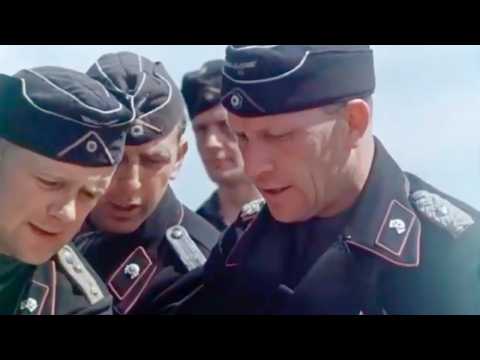
The sun-drenched steppe stretched endlessly, a deceptive calm settling over the German soldiers as they lounged on the outskirts of Stalingrad. They played cards, posed with their weapons, and laughed, their overconfidence palpable. The enemy seemed defeated, the road ahead clear. But this was merely the calm before the most devastating storm of the war.
Rare color footage, captured by German frontline cameramen like Hans Bastanier, reveals the chilling juxtaposition of leisure and impending doom. These men, unaware of the hell that awaited them, would soon be thrust into the Battle of Stalingrad—a turning point that would decide the fate of nations.
The German offensive strategy was one of maximum maneuver and minimal frontal engagement. Motorized units advanced swiftly, bypassing large Red Army formations to encircle and destroy them later. The Luftwaffe ruled the skies, obliterating anything that could slow the advance. Rivers like the Don and Volga became mere inconveniences, crossed on pontoon bridges assembled under near-resort-like conditions.
“The enemy appears defeated,” one soldier might have thought, as they marched hundreds of kilometers without resistance. But the open steppe, which facilitated their advance, also exposed them to the vastness of the Soviet Union—and the resilience of its people.
Contrary to popular myth, German tanks did not charge headlong. Instead, they executed precise flanking maneuvers, cutting off escape routes and striking from the rear. The Panzer III and IV, ideal for the steppe, spearheaded these attacks. Yet, the Red Army, though bloodied and retreating, used everything at their disposal—surviving tanks, lend-lease equipment, and sheer determination—to stem the tide.
Soviet air losses were catastrophic, with over 1,200 aircraft destroyed by July. German air supremacy turned minor rivers into mere geographical inconveniences. But despite the chaos, the Red Army constructed layered defenses, turning every ravine into a fortress and every hamlet into a strong point. Their elastic defense delayed the enemy, inflicting losses and buying precious time.
As German troops advanced easily toward the Don and Volga, they remained unaware of the trap being set. The crossings near Kalach would become a bloodbath, with the 62nd and 64th Armies waiting in camouflaged positions. During the July-August 1942 crossing attempts, the Germans suffered up to 20,000 casualties and lost significant armor.
Far from the front lines, Soviet factories roared to life. In Sverdlovsk, Chelyabinsk, and Moscow, workers forged the steel of future victory—new T-34 tanks, SU-76 self-propelled guns, and IL-2 ground attack aircraft. These machines would soon trap the Germans in the Stalingrad Cauldron and crush them at Kursk.
The USSR was not just retreating; it was evacuating hundreds of factories beyond the Urals, producing 3,000 tanks monthly, and mobilizing millions. On July 28, 1942, Order No. 227, “Not a Step Back,” was issued—a desperate measure born of existential necessity. Defeat here could have triggered Japan and Turkey to enter the war.
The Battle of Stalingrad became one of the costliest engagements in history. Germany spent an estimated 35 billion Reichsmarks, while the USSR expended at least $30 billion. By summer 1942, the USSR had received $2 billion in US lend-lease supplies, critical but not decisive. The war’s fate would be decided on the battlefield.
On July 17, 1942, forward elements of the 62nd and 64th Armies clashed with the Sixth Army’s vanguard near the Chir and Tsimla rivers. Soviet resistance briefly delayed the Germans, but by July 22, they breached the main defensive line. The Sixth Army, 250,000 strong and backed by 1,200 aircraft, pressed forward. By July 25, they broke through the 62nd Army’s right flank, reaching the Don at Kalach. Several Soviet divisions were partially encircled.
The situation grew critical. Reinforcements arrived when Hoth’s Fourth Panzer Army diverted from the Caucasus, reaching Kotelnikovo by August 2, intensifying pressure from the southwest. By mid-August, the 62nd Army was pushed beyond the Don, with some units fighting behind enemy lines until August 14. A counter-strike by the First Guards Army halted the Sixth Army’s advance. The German plan for a rapid breakthrough to the Volga had failed.
In three weeks, the Wehrmacht advanced just 100 km, meeting fierce resistance at the Don Bend. On August 23, the German 14th Panzer Corps crossed the Don and reached the Volga. The 16th Panzer Division seized Spartanovka, Stalingrad’s northern suburb, cutting off the 62nd Army. The siege of the city, lasting over five months, had begun.
The 16th Panzer Division’s dash to the Volga on August 23 was as audacious as it was reckless. That afternoon, German tanks rumbled into Spartanovka, a northern suburb of Stalingrad, and reached the riverbank. For a brief moment, the men of the 14th Panzer Corps stood on the heights above the Volga, watching the city sprawl below them like a prize waiting to be claimed. They believed the hardest part was over.
They were wrong. That same evening, the Luftwaffe launched one of the most devastating bombing raids of the war. Waves of Heinkel He 111s and Junkers Ju 88s pounded Stalingrad into rubble, turning entire districts into infernos. Thousands of civilians perished in the flames, and the city’s wooden buildings were reduced to ash. The Luftwaffe flew over 2,000 sorties in a single week, dropping thousands of tons of bombs.
But the bombing did not break the city’s defenders. Instead, it transformed Stalingrad into a nightmare battlefield—a labyrinth of ruined buildings, shattered streets, and twisted metal that favored the defender. The Germans had hoped to crush Soviet morale; instead, they created the perfect killing ground.
On August 25, the Soviet Supreme Command declared Stalingrad under siege. The 62nd Army, now cut off from the main Soviet forces, was ordered to hold the city at all costs. General Vasily Chuikov took command, a man who understood the brutal logic of urban warfare. His headquarters were barely a mile from the front lines, and his orders were simple: “We will fight in the streets, in the houses, on the stairs. Every building is a fortress.”
The Germans, meanwhile, pressed forward from the north and south, squeezing the city in a pincer movement. By early September, the Wehrmacht had reached the Volga in several places, cutting the 62nd Army into isolated pockets. The city’s main railway station changed hands fourteen times in a single week. Soldiers fought room to room, floor to floor, sometimes separated by nothing more than a wall.
The battle had become a meat grinder. German tanks, so effective on the open steppe, were useless in the rubble-strewn streets. Panzer crews found themselves vulnerable to Soviet infantry armed with anti-tank rifles, Molotov cocktails, and grenades. The average lifespan of a Soviet soldier arriving in Stalingrad was measured in hours, not days.
Chuikov’s tactics were brutally simple. He kept his troops as close to the Germans as possible—so close that the Luftwaffe could not bomb without risking its own men. The Soviet general famously quipped that his men were “hugging the Germans” to stay alive. Every building, every stairwell, every basement became a battleground.
By mid-September, the Germans had captured the Mamayev Kurgan, a strategic hill overlooking the city, and the main railway station. But the Red Army refused to break. Reinforcements were ferried across the Volga at night, under constant German artillery fire. The 13th Guards Rifle Division, commanded by General Alexander Rodimtsev, arrived in late September and immediately threw itself into the fight. Within twenty-four hours, the division had lost nearly half its men.
The fighting reached a level of savagery that defied comprehension. Soldiers fought with bayonets, shovels, and bare hands. The city’s sewers and cellars became communication trenches. Snipers on both sides stalked each other through the ruins, and the crack of rifles echoed endlessly through the rubble. The Germans, who had swept across Europe with ease, now found themselves locked in a battle of attrition they could not win.
Far to the south, the Red Army was quietly preparing a counteroffensive that would change the course of the war. Under the cover of darkness, Soviet forces were massing on the flanks of the German Sixth Army. The plan, codenamed Operation Uranus, was audacious: strike at the weak Romanian armies guarding the German flanks, encircle the entire Sixth Army, and trap it in Stalingrad. The Germans, fixated on the city, remained blind to the storm gathering behind them.
On November 19, the Soviet counteroffensive began. Thousands of guns opened fire, and Soviet tanks and infantry surged forward against the Romanian lines. The Romanians, poorly equipped and poorly led, crumbled under the assault. Within days, the Soviet pincers had closed, and the Sixth Army—over 300,000 men—was trapped in a cauldron of its own making.
Inside Stalingrad, the Germans continued to fight for every inch of ground, unaware that their supply lines had been severed and their escape routes cut off. Hitler, refusing to authorize a retreat, ordered the Sixth Army to hold its ground. “Stalingrad must be held at all costs,” he declared, sealing the fate of his men.
Inside the cauldron, the truth arrived slowly. Ammunition ran low. Bread was rationed to a few grams a day. Wounded men lay in cellars without morphine, without hope. “We are dying here for a city that no longer exists,” a German corporal wrote in his diary, his words buried with him beneath the rubble.
Göring promised an air bridge. It delivered a fraction of what was needed. The Luftwaffe, once masters of the sky, now lost transport planes by the dozen to Soviet fighters and flak. Fuel for the panzers froze in the tanks. Horses starved. Men ate them.
On January 10, 1943, the Red Army launched Operation Ring. Seven thousand guns and rocket launchers tore the pocket apart. The Germans retreated street by street, back toward the ruins they had already destroyed. The Mamayev Kurgan changed hands once more. The railway station fell for the last time.
On January 31, Field Marshal Friedrich Paulus surrendered in the basement of a department store. He had been promoted to Field Marshal only days earlier—a cynical hint from Hitler that no German Field Marshal had ever surrendered. Paulus chose life over legend. Two days later, the last organized resistance ended. Ninety-one thousand Germans marched east into captivity. Of those, fewer than six thousand would ever see home again.
The color footage of those cheerful, overconfident soldiers on the steppe became an epitaph. The cameramen who filmed them never imagined their frames would one day serve as a warning. The road they thought was clear led not to victory, but to the Volga’s frozen banks and a grave of ice and iron.
Stalingrad was not just a defeat. It was the moment the myth of German invincibility shattered forever. From that ruined city, the Red Army began its long march west—to Kursk, to Berlin, to the end.
And what of the men in those rare color frames, laughing over their cards and posing with their weapons? Did any of them survive to see the spring of 1943? Or did they, like so many, vanish into the snow and silence of the steppe? What do you think became of the smiling soldier who filmed the calm before the storm?
Report this article
Select a reason for reporting:






