Professor David Richardson had spent fifteen years decoding the silent language of old photographs, but nothing prepared him for the chill that ran down his spine as he examined the 1904 studio portrait of Adelaide Pemberton. At first glance, the image was a flawless relic of the Gilded Age: a twelve-year-old girl in a pristine white dress, her dark ringlets perfectly arranged, her expression serene and angelic. The photograph, donated from a dusty estate sale, seemed to whisper of privilege and innocence. Yet something about the girl’s hands, folded neatly in her lap, refused to let David look away.
Under the golden light of his office, David reached for his magnifying glass. The gloves Adelaide wore—white cotton, pearl buttons at the wrists—were appropriate for a wealthy child of the era. But the left glove was wrong. Subtly bulky around the palm, as if something beneath strained the fabric. And near the wrist, faint discoloration, darker spots that didn’t match the aging of the paper. “That’s odd,” he murmured. His trained eye had scanned thousands of Victorian portraits, but this distortion felt deliberate, almost staged. A cold intuition told him this was no ordinary photograph.
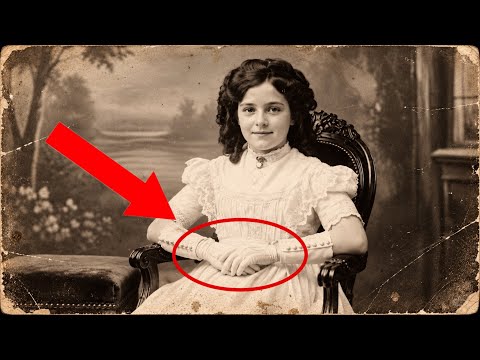
David photographed the image at high resolution, then enhanced the contrast on his screen. What emerged made his breath catch. The staining on the left glove formed a pattern consistent with blood—not fresh, but partially cleaned, leaving a ghostly residue. And the bulkiness? Under extreme magnification, it looked like bandaging. “She was hiding something,” he whispered. The date on the back read October 15th, 1904—exactly three weeks after the Pemberton family’s governess, Catherine Walsh, had died from a fall down the mansion’s marble staircase. A fall that was ruled accidental. A fall that now seemed anything but.
He turned to his assistant, Maria, who had been cataloging the collection. “Look at this,” he said, pointing to the enhanced image. “Blood on her glove. And her hand—it’s wrapped. A twelve-year-old girl doesn’t bandage her own hand for a portrait unless she’s hiding an injury.” Maria leaned closer, her face paling. “You think she…?” She didn’t finish the sentence. David didn’t need her to.
That evening, David dug into the archives. The Pemberton name was everywhere—textile money, Beacon Hill mansion, charity galas. Adelaide was their only child, described in society pages as a “precious angel.” But the newspapers from the autumn of 1904 told a different story. Three deaths in four months, all connected to the family. Catherine Walsh, the governess, dead on September 24th. A neighbor’s dog, poisoned in the Pemberton garden in November. A stable boy, Thomas, found drowned in the Charles River in December. “Three deaths,” Maria said, reading over his shoulder. “That’s not a coincidence.”
David found letters Catherine had written to her sister in New York. In one, dated September 18th, she described Adelaide breaking her mother’s favorite vase and blaming a maid. “When I told her lying was unacceptable, she looked at me with such coldness that I felt genuinely frightened. There is something in that child’s eyes that suggests she is capable of far worse than mere mischief.” The final letter, dated September 22nd, was more desperate: “Adelaide has threatened me in ways I dare not put into writing. I fear for my safety if I continue to oppose her will. I plan to speak with Mr. Pemberton tomorrow about my immediate resignation.” Two days later, Catherine was dead.
David sat back, the pieces clicking into place. The photograph was taken three weeks after the murder. Adelaide’s left hand—injured, bandaged, stained with blood—was concealed beneath a glove. She had posed with the composure of a child who had already learned to hide her sins in plain sight. “She killed her governess,” David said, his voice barely a whisper. “And then she sat for a portrait to prove to the world how innocent she was.”
But the story was far from over. As David delved deeper into the Pemberton family history, a pattern emerged—one that stretched back years before Catherine Walsh’s death. There were other accidents, other victims, all dismissed as misfortune. And at the center of every one, a girl with dark ringlets and a serene smile. The photograph on his desk was no longer a harmless relic. It was a confession, hidden for over a century, waiting for someone to notice the hands.
David pulled up the employment agency records first. Adelaide’s previous governess, Miss Emily Richardson, had left the Pemberton household abruptly when Adelaide was only eight. The agency file contained a warning letter, written in tight, anxious handwriting. “The child is of unusual and disturbing temperament. She should not be left alone with animals or smaller children.” The letter described how Adelaide had been found torturing insects, then small animals, watching their suffering with a calm curiosity that chilled her caretaker to the bone.
When Miss Richardson confronted her, the girl had shown no remorse. Instead, she had threatened the governess with vague but unmistakable menace. “She told me that people who interfere with her plans tend to have accidents,” the letter read. “She said it with such certainty that I believed her.” David set the paper down, his hands trembling slightly. The pattern was already forming, years before Catherine Walsh ever set foot in the Pemberton mansion.
He searched for records of Adelaide’s childhood social circle. Several society mothers had quietly stopped bringing their children to Pemberton parties after a string of incidents—a boy pushed down a flight of stairs, a girl’s hand deliberately crushed in a carriage door, all explained away as rough play. No one had ever accused Adelaide directly. The family’s wealth and influence smoothed every bruise, silenced every complaint.
The stable boy, Thomas, was the key. David found a coroner’s report that had been buried in a county archive, far from the polished accounts in the Boston papers. Thomas had been found in the Charles River with bruises on his ribs and a fractured wrist—injuries inconsistent with drowning. The report noted that the boy had been known for his kindness to the Pemberton horses. “If Thomas had seen Adelaide hurting an animal and threatened to tell,” David said to Maria, “he would have become a liability. Just like Catherine.”
Maria shivered. “She was twelve years old, David. Twelve.” He nodded grimly. “And she’d already learned that wealth could bury anything. Her parents made sure of that.” He pulled out Eleanor Pemberton’s diary, preserved in the family papers. The entries were damning in their quiet complicity. “Adelaide requires careful management,” Eleanor had written in September 1904. “We must ensure her special nature is channeled appropriately and that outsiders do not misunderstand her unique temperament.”
Another entry, from November of that same year, was even colder. “The girl’s governess was unsuitable and had to be replaced. Adelaide is happier now that she has more freedom to express herself. We must be more careful in our selection of household staff.” David felt a wave of disgust. The Pembertons had known. They had watched their daughter destroy lives and had chosen reputation over justice, donating generously to police funds and coroner’s offices to keep the whispers quiet.
The portrait itself had been their grandest deception—a public declaration of Adelaide’s innocence, staged just weeks after Catherine’s blood had dried on the marble stairs. White dress, angelic smile, gloved hands folded neatly to hide the bandages and the stains. “They commissioned a lie,” David said. “And it almost worked. For over a century, it worked.”
But the photographer’s private journal told another story. The man who had taken the portrait had been deeply unsettled. “The Pemberton child unnerved me greatly,” he had written. “While she maintained perfect stillness during the exposures, I had the distinct impression that she was studying me throughout the session, as if evaluating whether I posed any threat. There was an adult intelligence behind those young eyes.” Adelaide had asked detailed questions about photographic chemicals, about whether plates could capture details invisible to the naked eye. She had been worried, David realized, about what the camera might reveal.
Her worry had been justified—just not in her lifetime. The blood on her glove, the bandaged hand, the cold calculation behind her serene expression: all of it had waited patiently in sepia tones for someone to look closely enough. David stared at the photograph on his desk, at the girl who had killed and killed again, and felt the weight of a century of silence pressing down on him.
He reached for the phone to call Detective Kelly. There was more to uncover—Adelaide’s adult life, her two marriages, the mysterious deaths that had followed her into old age. The portrait was only the beginning of the story.
Detective Kelly arrived within the hour, his weathered face grim as David laid out the enhanced images, the letters, the diary entries. “You’re telling me this child murdered her governess and then posed for a portrait three weeks later?” He shook his head slowly. “I’ve worked cold cases for twenty years, Professor. This is the first time the killer left her confession in a photograph.” David nodded, sliding Catherine’s final diary entry across the desk. Kelly read it in silence, then set it down with a heavy breath.
“We can’t prosecute a ghost,” Kelly said. “But we can tell the truth.” He suggested contacting Catherine Walsh’s surviving relatives. David found them within a week—a great-niece named Patricia in New York, who had grown up hearing whispers that her great-aunt’s death was no accident. When David called her, the line was silent for a long moment. “Our family never believed the official story,” Patricia said, her voice thick. “But no one would listen. A governess’s life wasn’t worth a wealthy family’s reputation.”
The Boston Historical Society agreed to mount an exhibition. They titled it Hidden in Plain Sight, and Adelaide’s portrait hung at the center, flanked by Catherine’s letters and the photographer’s unsettling journal. Visitors stood before the image in silence, studying the gloved hands, the calculated serenity, the eyes that held no warmth. Patricia traveled to Boston for the opening and stood before the photograph for a long time. “She looks like an angel,” she said quietly. “That’s what makes it so terrifying.”
David’s research into Adelaide’s adult life revealed that the pattern had never broken. She had married twice, both husbands dying under suspicious circumstances. A business partner had vanished in 1932. A housekeeper had fallen from a window in 1957. Adelaide had lived to eighty-six, dying peacefully in 1978, never once suspected by the public. “She got away with it,” Maria said, staring at the records. “For her entire life.” David shook his head. “She got away with it then. She doesn’t get away with it now.”
He published his findings in the Journal of Forensic History, and the case became a landmark example of how modern techniques could solve historical crimes. Detective Kelly used it to train new investigators. “Adelaide Pemberton,” he told his students, “is proof that evil doesn’t always announce itself. Sometimes it wears a white dress and folds its hands neatly in its lap.”
On the final day of the exhibition, David stood alone before the portrait. The gallery was empty, the lights dimmed. Adelaide’s dark eyes seemed to follow him, still calculating, still cold. He thought of Catherine Walsh, who had died trying to protect others. He thought of Thomas, the stable boy, and the neighbor’s dog, and all the silent victims whose names had been buried by wealth and silence. “We see you now,” David whispered. The photograph offered no reply—only that perfect, chilling smile.
He turned off the lights and walked out into the Boston evening. The case was closed, but the question lingered, heavy and unsettling: How many other innocent faces are hiding in our archives, waiting for someone to look closely enough?
What do you think—should historical crimes like Adelaide’s be treated as evidence, or left in the past? Share your thoughts in the comments.
Report this article
Select a reason for reporting:






