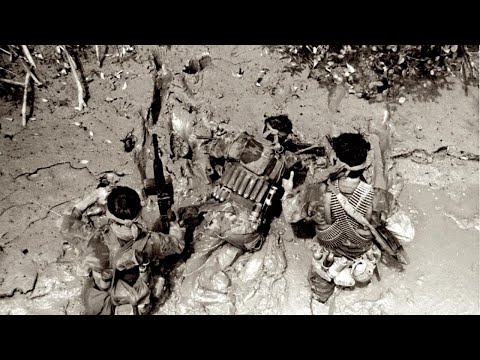
The year was 1968. Deep in the Mekong Delta, a six-man Navy SEAL patrol moved silently through waist-deep water. Their faces painted black, weapons at the ready. For three days, they had hunted a high-value Viet Cong target. Intelligence said he was in this village, meeting with North Vietnamese Army commanders. This was what SEALs did best: strike fast, strike hard, disappear into the night.
But tonight, something was different. The village was too quiet. The dogs that should have been barking were silent. The NVA knew they were coming.
Suddenly, the jungle exploded. Muzzle flashes erupted from three directions. Bullets tore through the vegetation, smacking into tree trunks and churning up the water around them. The team leader realized instantly: this was an ambush. They had been compromised.
For the next 40 minutes, these elite warriors fought for their lives, desperately trying to break contact and reach an extraction point. Two men were wounded. Ammunition was running low. The radio operator called for emergency extraction, but the NVA fire was too intense. Helicopters couldn’t land.
Three kilometers away, four men heard the firefight. They had been lying motionless in the jungle for 16 hours, watching an NVA supply route, not making a sound, barely breathing. These men didn’t wear the same uniform as the SEALs. They spoke with Australian accents. They were Special Air Service operators, and what they were about to do would save American lives and demonstrate why they were considered the most dangerous men in the jungle.
Without a word, using only hand signals, they moved toward the sound of the guns, but they didn’t rush. They glided through the jungle like smoke, using every bit of cover, reading the terrain, thinking three steps ahead.
The North Vietnamese Army thought they had finally figured out how to defeat American Special Operations Forces. They were about to learn they were very, very wrong.
This is the untold story of how Australian SAS operators changed the course of special operations in Vietnam. How they broke the silence when the enemy thought victory was within reach, and how a partnership forged in blood and jungle created a bond between warriors that endures to this day.
To understand what happened in that jungle in 1968, we need to go back to the beginning: to understand how this war became a nightmare, how the elite forces adapted, and how sometimes the quietest warriors make the loudest impact.
Vietnam in the early 1960s was a country tearing itself apart. The communist North, led by Ho Chi Minh and supported by the Soviet Union and China, was determined to reunify the country under their control. The South, backed by the United States and other Western powers, was fighting to remain independent. But this wasn’t going to be a conventional war with clear front lines and massive tank battles. This was going to be something America had never really experienced before: a guerrilla insurgency in terrain that gave every advantage to the enemy.
The jungles of Southeast Asia are unlike anything most American soldiers had ever seen. Triple-canopy rainforest where sunlight barely reaches the ground. Mangrove swamps filled with leeches and snakes. Mountains covered in thick vegetation where you could hide an entire battalion and never be spotted from the air. The Viet Cong, the communist insurgents in the south, knew this terrain intimately. They had been fighting there for years—first against the Japanese, then against the French. They knew every trail, every river crossing, every hiding spot. They could move through the jungle almost silently, set up ambushes, strike, and then disappear before conventional forces could respond.
By 1965, it became clear that conventional military tactics weren’t working. Large-scale search-and-destroy operations would sweep through an area, sometimes making contact with the enemy, often finding nothing but empty villages and abandoned tunnels. The Viet Cong would simply avoid the big American units, wait for them to leave, and then return. The frustration was enormous. American casualties were mounting. The enemy seemed to be everywhere and nowhere at the same time.
Military commanders realized they needed a different approach. They needed small units that could operate in the jungle, that could hunt the enemy on their own terms, that could gather intelligence and strike with precision rather than overwhelming force.
The United States Navy SEALs were born out of the legacy of World War II underwater demolition teams and the recognition that America needed elite maritime special operations forces. SEAL stands for Sea, Air, and Land, indicating these warriors were trained to operate in any environment.
The training to become a SEAL was brutal. It started with Basic Underwater Demolition/SEAL training, commonly known as BUD/S—a six-month crucible that pushed men to their absolute physical and mental limits. The most infamous part was Hell Week: 5½ days of continuous training with a maximum of four hours of sleep total. Candidates would run until their feet bled, swim in frigid ocean water until hypothermia set in, carry heavy boats on their heads for miles, and endure constant harassment from instructors designed to break their will. The failure rate was astronomical, often exceeding 80%. Those who made it through were among the toughest warriors America could produce.
But toughness alone wasn’t enough for Vietnam. After completing BUD/S, SEAL candidates went through advanced training in demolitions, weapons, close-quarters combat, parachuting, and small-unit tactics. They learned to insert by boat, helicopter, or parachute. They trained in jungle warfare, though nothing could truly prepare them for what Vietnam would be like.
The first SEAL teams arrived in Vietnam in 1962 as advisers to South Vietnamese forces. By 1966, SEAL Team 1, based on the West Coast, and SEAL Team 2, based on the East Coast, were deploying platoons for direct combat operations.
The SEALs quickly made a name for themselves in Vietnam. Operating primarily in the Mekong Delta and the Rung Sat Zone—a massive mangrove swamp near Saigon—they conducted nighttime raids on Viet Cong villages, ambushes along enemy supply routes, and prisoner-snatch operations to gather intelligence. A typical SEAL mission might involve a platoon of 14 men inserting by riverine craft at midnight, moving silently to a target village, capturing or killing Viet Cong leadership, and extracting before dawn. They were aggressive, well-trained, and heavily armed. They carried an impressive array of weapons: the Stoner 63 light machine gun, CAR-15 rifles, shotguns, grenade launchers, and an abundance of explosives. They painted their faces with camouflage, wore tiger-stripe uniforms, and developed a reputation for being absolutely ruthless in combat.
The psychological impact of SEAL operations was significant. The Viet Cong never knew when or where the SEALs would strike. A village leader could be sitting in his hut at night planning operations against American forces, and suddenly SEALs would be bursting through the door. The speed and violence of their actions was shocking. But more than that, it was the fact that the SEALs could operate in the darkness and in the waterways just as well as the Viet Cong themselves. The enemy’s safe havens weren’t safe anymore.
For the first two years of major SEAL operations, from 1966 through early 1968, the results were impressive. Body counts were high. Intelligence gathered from prisoners was valuable. SEAL casualties were relatively low. It seemed like they had found a winning formula. But war is a constantly evolving chess match. The North Vietnamese Army wasn’t stupid, and they weren’t going to keep making the same mistakes.
By late 1967, the NVA and Viet Cong began studying SEAL tactics. They learned the patterns. They noticed that SEALs often inserted from the waterways. They observed that SEAL operations typically happened at night. They realized that SEALs favored certain types of terrain for ambushes. Most importantly, they improved their intelligence networks in the villages. Informants, whether willing or coerced, began reporting when they saw Americans scouting areas during the day or asking questions about Viet Cong activity. The NVA started putting together a picture of how SEALs operated.
The enemy began adapting their tactics specifically to counter the SEALs. They set up counter-ambushes along known insertion points. They placed sentries with better fields of fire. They established early-warning systems using runners and signal fires. They created fallback positions and pre-planned fields of fire. When they suspected a SEAL operation was coming, they would prepare. Sometimes they would even deliberately leak information about a high-value target to lure a SEAL team into a kill zone. The hunted were becoming the hunters.
The first signs of trouble came in early 1968. SEAL operations that should have been straightforward were running into heavy resistance. Insertions were being met with immediate enemy fire. Ambushes were being reversed. Casualties started to increase. During one operation in February 1968, a SEAL platoon was nearly wiped out when what was supposed to be a simple raid on a Viet Cong supply cache turned into a running gunfight with a reinforced NVA company. The SEALs fought their way out, but they lost three men and several others were seriously wounded. It was becoming clear that the NVA had learned to predict SEAL movements and tactics.
The Tet Offensive in January and February 1968 changed everything about the war. The North Vietnamese and Viet Cong launched a massive coordinated attack on cities and military installations throughout South Vietnam. While the offensive was ultimately a military defeat for the communists, it was a psychological victory. It showed that despite years of American involvement and thousands of casualties, the enemy was still capable of striking anywhere, anytime. More importantly, it showed that the NVA was becoming more sophisticated, better coordinated, and more willing to engage in conventional military operations when it suited them.
For the special operations community, Tet was a wake-up call. The enemy was adapting faster than anticipated. Intelligence was improving on both sides. The relatively permissive operating environment that had allowed SEALs and other special operations units to operate with impunity was changing. The NVA was getting better at counter-intelligence, at operational security, at setting traps.
American commanders realized they needed to change their approach. They needed new tactics, new training, and frankly, they needed to learn from allies who had different experiences and different approaches to this type of warfare.
Enter the Australians.
Australia had committed to supporting South Vietnam with military forces starting in 1965. This wasn’t just a token gesture of solidarity. Australia sent combat troops, tanks, artillery, and critically, their elite Special Air Service Regiment.
To understand why the Australian SAS would prove so effective in Vietnam, you need to understand where they came from and what made them different from other special operations forces.
The Australian Special Air Service Regiment was formed in 1957, modeled after the British SAS but adapted to Australian conditions and culture. The British SAS had built a legendary reputation for long-range desert operations in North Africa, behind-the-lines raids, and unconventional warfare. After the war, they fought in Malaya, Borneo, and other colonial conflicts, specializing in jungle warfare and counterinsurgency.
The Australians studied the British model but made it their own. The selection process was deliberately designed to be one of the most challenging in the world. It typically lasted three weeks and took place in some of the harshest terrain Australia could offer—the rugged mountains and dense bush of the Snowy Mountains or the oppressive heat of the Northern Territory.
Candidates had to complete a series of increasingly difficult physical challenges, navigate long distances with heavy packs, demonstrate expert marksmanship, and most importantly, show the mental toughness to keep going when their bodies screamed at them to quit. Sleep deprivation, constant movement, minimal food, carrying loads that would break an ordinary soldier—this was the baseline.
But what really set SAS selection apart was the emphasis on individual initiative and thinking under pressure. Candidates would be given navigation problems with insufficient time and insufficient information. They would have to make decisions with incomplete data. They would be tested on their ability to stay calm when everything was going wrong. The instructors weren’t looking for robots who could follow orders mindlessly. They were looking for intelligent, adaptable soldiers who could think for themselves when they were alone behind enemy lines with no support.
The failure rate for SAS selection was typically over 90%. The men who made it through were truly exceptional.
Once selected, SAS troopers went through extensive continuation training. They learned advanced weapons handling with everything from pistols to heavy machine guns. They became experts in demolitions and sabotage. They trained in combat medicine far beyond what ordinary soldiers learned. They practiced parachuting, including high-altitude, low-opening jumps and water insertions. But most importantly for Vietnam, they became absolute masters of jungle warfare and fieldcraft.
The Australian military had extensive experience fighting in jungle environments. Australian soldiers had fought in the Pacific during World War II, battling the Japanese in New Guinea and Borneo in some of the most brutal jungle combat of the war. After World War II, Australian forces had participated in the Malayan Emergency, a 12-year counterinsurgency campaign against communist guerrillas in the jungles of Malaya.
The lessons learned from Malaya were invaluable. The British and Australian forces had developed tactics for long-range jungle patrols, for living in the jungle for extended periods, for tracking enemy movement through dense vegetation, and for setting up ambushes that were virtually impossible to detect.
These lessons were codified into SAS training. SAS troopers learned to move through the jungle with almost supernatural silence. They practiced a movement technique where each step was deliberate and controlled, where you check the ground before putting your weight down, where you used your peripheral vision to spot trip wires or disturbed vegetation that might indicate an ambush. They learned to read the jungle—to notice when birds suddenly went quiet, to recognize human trails versus animal trails, to identify which plants had been recently disturbed. They became so attuned to the environment that they could sense when something was wrong, when the jungle felt different, when danger was near.
One of the most distinctive aspects of SAS training was something called “hard routine.” This was a technique for remaining completely undetected while observing an enemy position. When an SAS patrol went into hard routine, it meant total silence and minimal movement. No talking, not even whispers. No smoking. No cooking, which meant eating cold rations. No unnecessary movement. Soldiers would remain in position for hours, sometimes for days, watching and listening. They would communicate only with hand signals. If they needed to relieve themselves, they did so in place, not moving from their position. It required immense discipline and mental toughness, but it made SAS patrols virtually invisible.
The Australian SAS arrived in Vietnam in 1966 and was initially based in Phuoc Tuy province in the southeast. Their mission was primarily long-range reconnaissance and intelligence gathering, though they were certainly capable of direct action when needed.
The SAS operated differently from most other units in Vietnam. While American units often operated in large formations—companies and battalions conducting sweep operations—the SAS preferred small patrols of four to six men. These patrols would insert into the jungle, usually by helicopter, and then spend days or even weeks operating independently, gathering intelligence on enemy movements, locations, and activities.
The typical SAS patrol consisted of a patrol commander, a patrol signaler who handled communications, a scout who took point and read the terrain, a medic who also served as a rifleman, and one or two additional riflemen depending on the mission. Every man was cross-trained in multiple roles. If the signaler was killed, someone else could operate the radio. If the medic went down, everyone knew advanced first aid. This redundancy was critical when you were operating days away from any friendly forces.
The SAS approach to operations was fundamentally different from the American approach in several key ways.
First, they prioritized stealth over speed. An American unit might move quickly to get to an objective, accepting that they might make some noise, but relying on their firepower if contacted by the enemy. An SAS patrol would move slowly and deliberately, sometimes covering only a few hundred meters in an hour, but moving with such care that they left virtually no trace and made almost no sound. They understood that in the jungle, the side that sees the enemy first usually wins. If you could observe the enemy without being observed, you could call in artillery or air strikes, or you could set up an ambush with all the advantages on your side.
Second, the SAS had enormous patience. American operations were often conducted on tight time frames: insert, conduct the mission, extract, move to the next operation. The SAS would insert, and then sometimes spend days just observing before taking any action. They would watch an enemy trail for three or four days, mapping out the patterns of enemy movement, identifying when the enemy was most vulnerable. Only then would they strike—or more often, they would simply report the information and let artillery or air power do the work while they remained hidden.
Third, the SAS had exceptional operational security. They trusted almost no one outside their immediate unit. They didn’t share their patrol routes or objectives with South Vietnamese forces if they could avoid it, knowing that the enemy had penetrated South Vietnamese units at all levels. They inserted and extracted at unexpected times and places. They had backup plans and emergency extraction points. They assumed the enemy was always watching and planned accordingly.
The SAS quickly proved their worth in Vietnam. Their intelligence reports were incredibly detailed and accurate. When they reported enemy locations, artillery could hit those locations with confidence that they weren’t firing at shadows or old information. When they reported enemy strength and movements, commanders could plan operations knowing the intelligence was solid.
The SAS also began conducting highly successful ambush operations along enemy supply routes. They would identify a trail used by the NVA to move supplies, set up an ambush with claymore mines and overlapping fields of fire, wait for days if necessary, and then strike with devastating effect before melting back into the jungle.
One aspect of SAS operations that made them particularly effective was their relationship with the indigenous population. While they were cautious about security, the SAS made efforts to build rapport with local villagers when appropriate. They understood that winning hearts and minds wasn’t just a slogan—it was practical intelligence gathering. By treating villagers with respect, by providing medical care when possible, by not treating every Vietnamese person as a potential enemy, they sometimes gained valuable information about Viet Cong and NVA activity. The SAS medics became particularly valued in remote areas where medical care was virtually non-existent.
The SAS also developed a fearsome reputation among the enemy. North Vietnamese prisoners sometimes spoke of phantoms in the jungle—soldiers who seemed to appear and disappear at will, who could observe without being seen, who struck and then vanished. The psychological impact of never knowing if you were being watched, of trails you thought were safe suddenly erupting in ambushes, of camps you thought were hidden being hit by perfectly targeted artillery—this was war on enemy morale.
The NVA was learning to counter American tactics. But the SAS presented a different challenge. They didn’t follow the patterns. They didn’t operate the way American units did. They were unpredictable and patient—a dangerous combination.
By early 1968, the Australian SAS had built an impressive combat record. They had conducted hundreds of patrols. They had provided critical intelligence for major operations. Their kill ratio was among the highest of any unit in Vietnam. They inflicted heavy casualties on the enemy while suffering very few casualties themselves. This wasn’t because they were reckless or aggressive. It was because they were smart, disciplined, and exceptionally well-trained. They fought on their own terms, engaging only when they had overwhelming tactical advantage.
Meanwhile, as we’ve discussed, the American SEALs were facing increasing challenges. The NVA was adapting to their tactics. Operations were becoming more dangerous. The predictability that came from following certain patterns was being exploited by the enemy.
American special operations commanders began looking for solutions. They needed to change their approach, to learn new techniques, to become less predictable. And they had allies who had already mastered the very skills they needed: the Australian SAS.
The collaboration between American special operations forces and the Australian SAS began informally. American officers would visit Australian units, ask questions, observe their operations. SAS officers would share their experiences and techniques. Some of this was formal exchange programs, but much of it was simply professional soldiers recognizing excellence and wanting to learn from it. SEAL team leaders began attending briefings on Australian operations and were impressed by the patience and precision they observed. The contrast was striking: where SEALs might conduct an aggressive raid with 14 men, helicopters, and heavy firepower, the SAS might achieve the same result with four men who had been lying in wait for three days.
The real breakthrough came when American and Australian special operations forces began conducting joint operations—shared area operations. This meant that in certain regions, both forces would be operating, sometimes in coordination, sometimes simply aware of each other’s presence and providing mutual support if needed. The geography of Vietnam made this practical. Certain provinces had both American and Australian conventional forces, and it made sense for their special operations units to coordinate as well.
What happened next would demonstrate the power of Allied cooperation and the incredible effectiveness of combining different approaches to special warfare.
Let’s return to that firefight we opened with. The SEAL team pinned down, taking casualties, unable to extract. Three kilometers away, the four-man SAS patrol had heard the gunfire. The patrol commander, a sergeant with four tours in Vietnam, made the decision instantly. They would move toward the firefight, but they would do it the SAS way.
The SAS patrol began moving through the jungle with purpose, but not panic. The scout, a corporal who could read terrain like most people read books, led them along a route that used every bit of available cover. They moved through dense vegetation where possible, skirted open areas, used creek beds and terrain features to mask their movement. They were heading toward a firefight, but they weren’t rushing blindly into it. They were thinking tactically, planning their approach, considering angles of fire and likely enemy positions.
As they got closer—perhaps 500 meters from the firefight—the patrol went to ground and listened. The pattern of fire told them a lot. The rapid cyclic fire of AK-47s and RPD machine guns—that was NVA. The intermittent, more controlled fire of American weapons—that was the SEALs trying to conserve ammunition and make every shot count.
The SAS patrol commander used hand signals to communicate with his men. He sent the scout forward alone to conduct a closer reconnaissance. The scout moved with incredible care, literally taking 15 minutes to move 30 meters, checking every step, every hand placement, making absolutely no sound. The scout returned 20 minutes later with critical information. He had located an NVA flanking position—approximately 8 to 10 soldiers positioned to cut off the SEAL team’s route to their extraction point. These soldiers were in prepared fighting positions, meaning they had been expecting an American operation. This confirmed what the SAS already suspected. The SEALs had been deliberately lured into an ambush. The NVA had set the trap well, with a blocking force that prevented the SEALs from withdrawing and fire superiority that prevented helicopter extraction.
The SAS patrol commander made his decision. They would hit the NVA flanking position. Four men against 10 sounds like poor odds, but the SAS had every advantage. They knew exactly where the enemy was. The enemy had no idea they were there. The NVA was focused on the SEALs, their attention and weapons oriented in that direction. Their backs were exposed.
The SAS moved into position with excruciating care, taking almost 30 minutes to cover the final 60 meters. They positioned themselves in a line, each man with a clear field of fire, each man knowing exactly what his sector was and what targets he would engage. The patrol commander checked his watch. The SEAL team radio operator had said they had maybe 20 minutes of ammunition left. The extraction helicopters were orbiting a few kilometers away, unable to approach because of the heavy anti-aircraft fire. It was now or never.
The patrol commander caught each of his men’s eyes, got a nod from each, and then gave the signal.
What happened next lasted perhaps 15 seconds, but it saved American lives. Four SAS soldiers opened fire almost simultaneously with precision and controlled aggression. They weren’t spraying bullets wildly. Each man engaged his assigned targets with aimed shots from their L1A1 SLR rifles. The initial burst of fire killed or wounded at least six NVA soldiers instantly. The survivors were caught completely by surprise. Unable to identify where the fire was coming from, unable to organize a response, the SAS threw grenades into the NVA positions and then shifted their fire, engaging any enemy soldiers who tried to return fire or flee.
The patrol commander was on his radio, speaking to the SEAL team leader. “American team, this is Australian patrol. Your right flank is clear. Move to your extraction point now.”
The SEAL team leader, who had been fighting for his life for the past hour, didn’t question, didn’t hesitate. He gathered his men and they moved toward the extraction point, carrying their wounded. The SAS patrol kept up suppressive fire for another 30 seconds, then executed a perfect break contact. They had drilled this maneuver countless times. On signal, two men laid down covering fire while two men moved back 20 meters. Then the roles reversed. In less than two minutes, they had disengaged and were moving away from the contact area. The remaining NVA soldiers, disorganized and shocked, didn’t pursue. They didn’t know how many soldiers had hit them. They didn’t know where they were or where they had gone. The SAS had struck like lightning and disappeared like ghosts.
Ten minutes later, the SEAL team was loading onto extraction helicopters. All six men made it out alive, though two required immediate medical evacuation for their wounds. The helicopter door gunner later said he saw the strangest thing as they lifted off: four soldiers in different uniforms, giving them a thumbs up from a tree line, and then fading back into the jungle.
The SAS patrol didn’t stick around. They moved to an alternate position, lay low for several hours to ensure they weren’t being tracked, and then continued their original mission—watching that NVA supply route.
When the SEAL team leader was debriefed the next day, he was effusive in his praise. “Those Australian SAS guys saved our lives. I don’t know how they moved through that jungle without making a sound, but they hit those NVA from a direction they never expected. It was the most professional thing I’ve ever seen.” He asked to be put in contact with the SAS unit to thank them personally. When he finally met the patrol commander, the Australian simply shrugged and said, “You would have done the same for us, mate. That’s what allies do.”
This incident, which occurred in March 1968, was not an isolated case. As American and Australian special operations forces began working more closely together, similar stories of mutual support and shared operations became more common. The relationship evolved from simple awareness of each other’s operations to active coordination and eventually to integrated planning. American commanders began to see the value in the Australian approach—the patience, the fieldcraft, the emphasis on intelligence gathering before action. Australian commanders appreciated the American willingness to learn and adapt.
The SEALs began incorporating Australian techniques into their operations. They started conducting longer reconnaissance missions, spending more time observing before acting. They improved their camouflage and noise discipline. They learned the hard routine techniques that made SAS patrols so difficult to detect. Most importantly, they learned that patience was often more effective than aggression. A SEAL platoon that might have previously conducted three raids in a week might now spend five days on reconnaissance, gather detailed intelligence, and then conduct a single precisely planned strike that achieved better results with less risk.
The cross-training went both ways. The Australians learned from American techniques as well, particularly regarding communications equipment and integration with air support. American units had more resources—more helicopters, more artillery support, and more advanced communications gear. The SAS learned how to leverage these American capabilities to enhance their own operations. They also appreciated the American can-do attitude and willingness to take calculated risks when the situation warranted it.
One of the most effective forms of cooperation was what became informally known as “hammer and anvil” operations. Though this wasn’t an official term at the time, the concept was simple but devastatingly effective. An SAS patrol would conduct long-range reconnaissance, spending days or even weeks observing an area, identifying enemy positions, mapping out their routines and patterns. They would gather detailed intelligence on enemy strength, fortifications, supply routes, and command and control. This intelligence would then be provided to American units who would plan a strike operation.
Here’s how a typical hammer-and-anvil operation would work. An SAS patrol would identify a significant NVA logistics base in a remote area. They would observe it for perhaps a week, noting that supply trucks arrived every other night, that the base had approximately 30 to 40 soldiers, that they had anti-aircraft weapons positioned on the eastern side, that their defensive positions were oriented toward expected approaches from the south. The SAS would note all of this, map it precisely, and report it. They would also identify the likely escape routes the NVA would use if the base came under attack.
Then the SEAL teams or other American special operations units would plan the strike, but with the SAS providing real-time intelligence and security. On the night of the raid, the SAS patrol would already be in position along the likely enemy escape routes, essentially acting as a blocking force. When the SEALs hit the base from an unexpected direction—perhaps from the north, where the defenses were weakest—the NVA would react predictably, trying to evacuate their command element and valuable supplies along their pre-planned escape routes. But those routes were now covered by SAS soldiers who had been in position for hours, waiting with the patience that was their trademark. The enemy would run straight into ambushes they never saw coming.
These joint operations had success rates that far exceeded previous missions. The combination was powerful: Australian patience and reconnaissance expertise combined with American firepower and aggressive action. The enemy couldn’t adapt because they couldn’t predict when or where these strikes would come. There was no pattern to exploit. An SAS patrol might observe an area for two weeks and never call in a strike. Or they might observe for two days and then coordinate a devastating raid. The unpredictability was psychologically devastating to the NVA.
There’s a particular operation that exemplifies this cooperation, though the exact details remain partially classified to this day. In late 1968, intelligence indicated that a senior NVA commander was operating in a border region, coordinating infiltration of forces and supplies from Cambodia into South Vietnam. This commander was responsible for significant American casualties and was considered a high-value target. Multiple attempts to locate and capture or kill him had failed. He was extremely careful about his security, moved frequently, and seemed to have good intelligence about American operations.
An SAS squadron was given the mission to locate this commander. They dedicated three patrols to the operation, with each patrol assigned to a different sector of the suspected area of operations. These patrols inserted covertly and began what would turn out to be a six-week reconnaissance mission. Six weeks of living in the jungle, of observing, of slowly piecing together the pattern of enemy movement in the region. They identified supply routes, base camps, and meeting locations. They tracked the movement of what they believed to be courier elements and command groups. They built a pattern-of-life analysis that would make any modern intelligence analyst proud.
Finally, one patrol identified what they believed was the commander’s current location: a well-hidden camp protected by at least two platoons of regular NVA soldiers and positioned in terrain that made direct assault extremely difficult. The camp was backed against a steep ridge with excellent fields of fire covering the approaches. There was no way to assault this position without taking heavy casualties. But the SAS patrol noticed something interesting. The commander would occasionally move to a smaller, less defended location for meetings. These movements followed a pattern, though not a rigid schedule. The patrol spent another week observing and confirmed their suspicion. Approximately every four to five days, the commander would travel to this meeting site, usually with a small security detail of four to six soldiers.
This information was passed to SEAL Team One. A joint operation was planned with extraordinary attention to detail. The SAS patrol would remain in position, monitoring the main camp and providing early warning if the enemy deviated from their pattern. A second SAS patrol would move into position along the likely route between the main camp and the meeting site, ready to intercept any reinforcements. The SEAL platoon would set up an ambush at the meeting site itself. The timing had to be perfect. If they hit too early, before the commander arrived, they would tip their hand and lose the opportunity. If they hit too late, the commander might escape or reinforcements might arrive.
The operation was executed on a moonless night in December 1968. The SAS patrol at the main camp reported movement: a small group leaving the camp, heading in the expected direction. This intelligence was relayed to the SEAL team, who went into final preparations. Fourteen SEALs were positioned in a horseshoe ambush around the meeting site. They had placed claymore mines to cover the kill zone and had overlapping fields of fire. They waited in absolute silence. The SAS blocking force was in position along the likely reinforcement route, ready to delay any enemy quick reaction force.
Forty minutes later, the target group arrived at the meeting site. The SEAL team commander waited, confirming the target, ensuring everyone was in the kill zone. Then he initiated the ambush. The claymores detonated simultaneously. The controlled bursts of rifle fire were devastatingly accurate. In less than 30 seconds, it was over. The NVA commander and his entire security detail were killed. The SEALs confirmed the kill, collected documents and intelligence materials, and began their withdrawal.
As expected, the main NVA camp reacted quickly, sending a reinforcement element. But that element ran straight into the SAS blocking position. The brief firefight that resulted inflicted casualties on the NVA and delayed them long enough for the SEALs to reach their extraction point. All American and Australian forces made it out without a single casualty.
This operation was considered such a success that it was studied in special operations schools for years afterward. The combination of long-term SAS reconnaissance, detailed intelligence gathering, patience, and then decisive American action had achieved what multiple previous operations had failed to accomplish. More importantly, it demonstrated that when elite forces from different nations work together, share their strengths, and support each other, they become far more effective than the sum of their parts.
The partnership between the SEALs and the Australian SAS continued to deepen throughout 1969 and into 1970. They conducted joint training exercises when out of the field, with each force teaching the other their specialized skills. SAS instructors would teach American operators about advanced fieldcraft, camouflage, and movement techniques. They would spend days in the jungle running stalking exercises where American operators would try to spot SAS soldiers who were concealed nearby—an incredibly humbling experience for many SEALs who thought they were already masters of concealment. The SAS soldiers could blend into the environment so completely that you could walk within three meters of them and never know they were there.
American instructors taught the Australians about their communications equipment, their procedures for coordinating with helicopter support, and their techniques for room clearing and close-quarters combat. While the SAS was skilled at jungle warfare and long-range reconnaissance, the SEALs had developed extremely effective techniques for raiding buildings and bunker complexes. This exchange of knowledge benefited both forces. The Australians incorporated better communications procedures and became more comfortable with helicopter operations. The Americans dramatically improved their fieldcraft and reconnaissance capabilities.
Perhaps most importantly, the mutual respect that developed between these warriors created bonds that went beyond professional courtesy. They were different in many ways—different accents, different uniforms, different national cultures—but they shared the same core values: courage, discipline, mission focus, and an unwavering commitment to their brothers-in-arms.
When the SEAL team leader who had been saved by the SAS patrol in March 1968 returned to the United States, he carried with him a profound appreciation for the Australian operators. He would tell the story of that night to anyone who would listen—not to glorify himself or his team, but to honor the men who had come to their rescue. “We were dead men,” he would say. “The NVA had us cold. And then four Australians appeared out of nowhere and changed everything. I owe them my life, and I’ll never forget it.”
The Australian SAS’s contribution to the Vietnam War is often overlooked in American accounts of the conflict. But those who served alongside them never forgot. The SEALs and the SAS had forged a bond in blood and jungle that transcended nationality. They had learned from each other, fought beside each other, and saved each other’s lives. In the annals of special operations, the partnership between these two elite forces stands as a testament to the power of allied cooperation and the extraordinary impact that a small group of highly trained, highly motivated warriors can have on the course of a war.
Years later, long after the war had ended, veterans of both units would gather at reunions and memorial services. They would share stories, raise glasses, and remember the men who didn’t come home. And they would speak of that night in March 1968 when four Australian SAS operators broke the silence and saved six American SEALs. It was a moment that encapsulated everything special operations should be: quiet, precise, deadly, and above all, loyal.
The jungles of Vietnam have long since reclaimed the battlefields. The trails the SAS patrolled are now overgrown. The ambush sites are silent. But the legacy of what they did—the lives they saved, the example they set, the bond they forged—endures. In the long history of special operations, there are few stories as powerful as the partnership between the Australian SAS and the American SEALs in Vietnam. It is a story of quiet professionals who made a loud impact, and of warriors who understood that the strongest weapon in war is not firepower or technology, but trust.
What do you think made the Australian SAS so effective in Vietnam—their training, their patience, or their partnership with American forces?
Report this article
Select a reason for reporting:






