In the autumn of 1904, deep beneath the Oquirrh Mountains of Utah, a copper miner’s pick struck something that was not ore. Not rock. Not copper. It was a dark, octagonal metal body, tapering at both ends, standing perfectly upright on its lower tip—without swaying at all. It measured seven feet four inches tall, taller than a man. A thin line encircled its middle. The shift supervisor measured it, wrote it down in his notebook, and added one more line: when he pressed his palm hard against its eastern face for a long moment, the upper half rotated in silence.
Five years later, on the other side of the mountain, an elderly man of the Ute tribe described this same object to a university researcher. He had never seen it, but he knew where it stood. He knew how it stood. The Ute said it was left there, and what is left there should not be touched. This is where the story begins.
Before we can understand what was found at the end of that tunnel, we need to understand the mountain itself. Bingham Canyon was no ordinary mining gulch. The Oquirrh range is a rugged, barren chain running north to south along the western edge of the Salt Lake Valley. The canyon is a narrow cut carved into the eastern slope. Two brothers, Thomas and Sanford Bingham, first settled the area in 1848—they logged timber, then raised cattle. The ore came later. Silver and lead were discovered in the 1860s, copper in the 1890s. Wooden houses, saloons, churches, and stores lined the canyon floor. The town was so narrow that two horse-drawn wagons could not pass side by side on some streets.
In 1903, two men—Daniel Jackling and Enos Wall—founded the Utah Copper Company. Jackling was a 34-year-old mining engineer who believed in something others considered worthless: the low-grade copper scattered throughout the entire mountain mass. Two percent copper. Just forty pounds of metal per ton of rock. But the mountain was so vast that, if mined the right way, that small percentage could become a fortune. In 1904, he chose his method: not from the inside, but from the outside, as an open-pit mine. But before the pit could be opened, the company had to understand what was inside the mountain. So they drove exploratory tunnels—long horizontal passages pushed into the rock to test the ore.
The lower development tunnel of the Utah Copper Company was one of those tunnels. In 1904, a few thousand people lived in Bingham Canyon, the town stretched along the valley floor like one long street. A branch of the Denver & Rio Grande Railroad reached the mouth of the canyon. From there, ore cars descended into the valley. The workers had come from all over the world—Swedes, Finns, Welsh, Irish, Greeks, Italians, Japanese. Each group had its own boarding house, its own saloon, its own neighborhood. Some neighborhoods on the canyon slopes were reachable only by stairs. The men who worked the mine came from this diverse crowd. Most did not speak each other’s languages fluently, but they all knew one rule: anything a man sees inside the mountain, he reports to the shift boss, and the rest is the shift boss’s responsibility.
But this mountain had an older history, too. The name “Oquirrh” does not come from miners—it comes from the language of the Goshute people. These mountains mark the eastern boundary of Goshute territory, who lived in the desert valleys to the west. Directly east of the mountains, along the shores of Utah Lake, lived the Timpanogos Ute. The lake provided them fish, the reeds on the shore provided shelter, and the surrounding mountains provided game. The two peoples knew each other. They knew each other’s mountains and streams, and the stories that described what lay inside those mountains. In the 1860s, most of the Ute were removed from the lake and relocated to a reservation in the Uinta Valley to the east. Their descendants still live there today, and the stories did not stay at the lake. They went with them.
The company records do not mention these stories. And the Ute accounts do not mention the Utah Copper Company. This is the story of an ancient machine found in a Utah copper mine in 1904, and what the Ute people said about it. They said this: It was left there. This is not a campfire tale, not a newspaper hoax. The first record of this story is a gray notebook that was in the pocket of the shift boss. His name was Evan Pritchard. He was forty-four years old, born among the coal mines of Carmarthenshire, Wales. He went underground at age twelve and came to America at twenty-six. He had been in Bingham since 1893. In town, they called him “Evan the Bookkeeper.” Because he carried a small, cloth-bound gray notebook in his inside jacket pocket every shift, bought for ten cents from a local store. Over eleven years, he filled twenty-six of them with details like the number of cars that came out, the ore grade, which support timber had cracked, and who was on the sick list. According to Pritchard, a supervisor who doesn’t take notes is ultimately a supervisor who remembers things wrong. And remembering things wrong costs money.
The page dated October 10, 1904, looks ordinary. The lower development tunnel had reached a depth of 900 feet. The ore contained two and a half percent copper—better than the previous week. The timber crew was two hours late. One miner’s wrist had swollen. The page dated October 11 is different. It is longer, and it contains words Pritchard never used in any of his twenty-six notebooks. The page begins as usual—the date, the shift, the temperature at the shaft head. Then comes a short sentence: “Miner Olaf Lindquist, Swedish, twenty-nine years old, returned from the end of the tunnel at a speed that was impossible under normal conditions.” Pritchard describes his face as that of a man who could not decide whether to drop what he was carrying or not. Pritchard took a second lantern and walked with Lindquist, and in his notebook he wrote one sentence about what he saw at the end of the tunnel. Not ore. Two words in a notebook full of talk about ore.
Lindquist also wrote down what he saw that morning in his own words. Four years later, in 1908, he left Bingham and returned to Sweden, and sent a letter to his brother from his village in Värmland. The letter remained with the family. In one paragraph, he describes the strangest thing he saw underground in America. He sums it up in one phrase: “Iron standing upright inside the mountain.”
Pritchard knew every form copper took in this mountain. Oxidized green surfaces, dark blue crusts, glittering veins of raw copper inside the rock. He had spent twenty years examining ore, and he knew what was ore and what was not. And at the end of the tunnel, four feet above the floor, what was visible through the freshly broken rock was not ore. At first, only a corner showed—a sharp, flat, dark surface, and a perfectly straight edge where two faces met. Pritchard traced the edge with his lantern. It ran downward into the rock in one straight line. He told Lindquist to set the pick aside, then waited. The first opening was nine by fourteen inches, and Pritchard wrote that down too. A surface inside the broken rock, surrounded by ore on three sides, with a fourth side exposed where the pick had struck. Its color was not like copper. It was not like any ore he knew. Pritchard tried to describe it several times, crossed out two attempts, and finally wrote: “Dark as wet slate, but it does not absorb light the way slate does.”
There were four men in the tunnel that morning: Pritchard, Lindquist, a loader, and a boy of fifteen. Pritchard sent the boy with a short message from the tunnel mouth to the company office. The message contained only one sentence. We know what that sentence was from the reply that came from the office the next day. Until the reply arrived, no one touched that surface again. Pritchard set the lamp aside, called his men back, and stood before the surface for forty minutes in a silence that those who measure time underground by work cannot measure. He wrote this in his notebook. The more he looked at it, the less ordinary it seemed.
In the margin of the notebook, there is another small note written that day, but it looks as if it was added later. Pritchard writes that he touched the edge with his bare hand, and that the surface he touched was not cold, the way everything inside the mountain is. Nor was it very cold. He did not dwell on that detail then, but a few pages later he returned to it. The reply from the office arrived the next morning, carried by the same boy. Pritchard had placed it inside the back cover of his notebook. The paper was folded, its edges worn, and it contained three short sentences and three initials. Do not touch it. Do not blast it. I will come down tomorrow. D.C.J. Daniel Cowan Jackling.
The second entry in this story does not come from a supervisor. It comes from the general manager of the company himself. Daniel Jackling descended into the mine on the morning of the next day, October 12, 1904. He was thirty-five years old. He was a man who had graduated from a mining school in Missouri, built mills in Colorado and Utah, and founded the Utah Copper Company from nothing. General managers rarely went underground, but the note Pritchard sent consisted of a single sentence, and as soon as Jackling read it, he went down himself carrying his lamp. He stood before the object for a long time without uttering a word. Pritchard writes this about him. He was the type who did not speak until he had decided what he was going to say. Finally, Jackling said one thing. The object must be removed carefully, and there will be no blasting. Pritchard had underlined the word carefully. This is the only place in his notebooks where he underlined a word. Not using explosives would prolong the work for weeks, but it was Jackling’s decision.
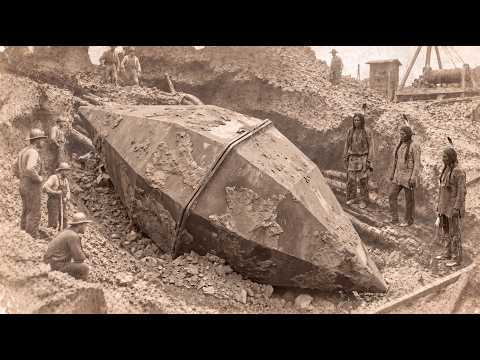
The men worked with hand tools. They crumbled the ore piece by piece, widening the area around the object. And as the opening grew, something appeared that none of the engineers could explain. The object was embedded entirely within the ore. There was no fissure above it or below it. On both sides, there were no cracks, no water channels, no sign of a collapse through which it could have entered later. The ore had wrapped around its surfaces, just as it had wrapped around everything inside the mountain. Without seams, without interruption. There were 600 feet of solid rock above it. Jackling wrote a two-page inspection report in his own hand. The report was written in the precise language an engineer uses when documenting something he cannot explain. He wrote that there were no traces in the ore touching the object indicating it had been inserted later. And he recorded his professional opinion in one sentence. The object settled into its place at the same time the surrounding ore formed, as part of the same event. Of the same age.
According to geologists, Bingham’s copper formed millions of years ago when hot, mineral-laden fluids seeped through the mountain’s rocks and cooled there. Millions of years. It took three days to remove the object because it would not fit in the vertical shaft. Carpenters built a cradle of heavy timbers around it inside the tunnel. It was secured there in an upright position, wedged tightly with planks and pegs. Then the men rolled it, still standing, onto a rail platform all the way to the tunnel mouth. According to Pritchard’s notebook, none of the men suggested laying it flat. And no one explained why they did not. And only there, in daylight, was it seen in full for the first time. It had eight faces, and both ends terminated in a pointed tip. Its widest point was exactly in the middle, three feet and one inch. Its length, measured with Pritchard’s steel ruler, was seven feet four inches. A single thin line wrapped around its center, fine as a hair, yet deep enough to catch a fingernail. Its surface was covered with a rough, flaking crust, as if it were an artifact extracted from the depths. Where the crust had flaked away, a dark, lusterless metal showed beneath. Not all of it. The hoist scale read 3,900 pounds.
Jackling measured the seam with a feeler gauge from his bag—thin steel strips engineers use to measure gaps between two surfaces. A blade 2/1000 of an inch thick slid into the seam. A blade 3/1000 of an inch thick did not, and this gap was identical on all eight faces he measured around the object’s circumference. A casting mold does not leave such a seam. Not even a blacksmith’s weld. The faces were measured too, and each was fourteen inches wide at the seam. Eight faces, eight equal widths, and each face tapered toward the pointed tips at both ends without any curvature. Then Pritchard wrote that sentence, which he had scribbled and rewritten several times in his notebook. When he pressed his palm against the eastern face with a long, deliberate pressure, the upper half of the object rotated along the seam in silence by one-eighth of a turn. And in the gap that opened along the seam, in the lantern light, something appeared inside. Thin, toothed, interlocking rings, like the inner workings of a pocket watch, but finer than any watch he had ever opened. When Pritchard withdrew his hand, the upper half slowly returned to its place and the seam closed.
Jackling tried the same experiment himself. According to his notes, the upper half did not budge with a single touch. Only when he threw his full weight onto his palm deliberately for several seconds did it rotate. It rotated without sound, without creaking. In the gap, by lantern light, he could count at least five interlocking rings, each thinner than the one before. Each ring rotated around its axis, and when he withdrew his hand, it took forty seconds, as measured by his pocket watch, for the upper half to return to its original position. Jackling added one sentence to his note. On any of the rings, where the teeth met, his lens could not find any trace of wear. In a mechanism that came out of rock millions of years old. There was no wear.
There is an official explanation for this story, and it deserves a fair hearing first. An internal memorandum from the Utah Copper Company, dated November 3, 1904, exists in the company records. According to the correspondence, the mass found in the tunnel was assessed as a discarded cast piece that had fallen from an old operation dating back to the 1870s. Mining had been going on in Bingham Canyon since the 1860s. The canyon once had small smelters, broken machinery, and abandoned boilers. Such a piece could have fallen from an old tunnel and later been covered with ore dust. The memo notes that the matter was closed from the company’s point of view. From their perspective, this is a perfectly reasonable explanation, but it does not explain Jackling’s own note. The general manager had written in his own hand that there were no traces in the surrounding ore indicating later entry. There was no old tunnel and no fissure. And a cast piece does not rotate along a seam, nor contain rings finer than a watch movement, nor stand on its lower tip without toppling. And the correspondence does not address these two points.
There is also a third piece of evidence. During those years, the United States Geological Survey (USGS) was conducting a detailed survey of the Bingham area. The geologist in charge was John Mason Boutwell. Throughout 1903 and 1904, he entered the mines in the canyon, mapped the rocks, and measured the ore bodies. His work was published in 1905 as USGS Professional Paper No. 38, and it remains one of the primary sources on Bingham’s geology to this day. There is not a single word about the object in the published report. But at the bottom of a page in Boutwell’s field notebooks, dated October 1904, there is one line: “An unusual metal mass was reported. The lower tunnel. The company refused access.” The government geologist was there, and he wanted to see the mass. He was not allowed to see it.
Nevertheless, the analysis was conducted within the company. Martin Oldroyd, the assayer at the Pilot Mill in Copper Cliff, took scraped samples from the object’s crust and the raw metal beneath it. The first two pages of his three-page report describe his methodology. Acids, flame tests, comparison samples. The third page is filled with the most honest sentence an assayer can write. There were traces of copper in the crust, as expected from a surface that had lain for a time in a copper-rich environment. Inside, there was a component resembling tin, but not actually tin. Oldroyd described the majority of the mass in one phrase: an unknown alloy with no commercial counterpart. The mass did not react to any of the standard acids. It responded partially to a magnet, but in a way that did not match any metal in the iron group he knew. Oldroyd performed another calculation. He calculated the object’s volume based on Pritchard’s measurements and divided it by the weight recorded on the hoist scale. The resulting density was greater than copper’s, but less than lead’s. So the bulk of the object was made of a material heavier than copper but lighter than lead. Oldroyd was a Lancashire man who had been in the field since 1896 and had weighed hundreds of samples. He did not know any metal that fell within that range and looked like this. Nothing. Oldroyd sealed his report with the following sentence: “Further analysis would require instruments not available at this station or, to his knowledge, at any assay office in the region.”
The explanation was reasonable. The report was honest. And the two did not describe the same thing. The third account in this story does not come from a mine, nor from a company. It comes from a page in a notebook written in pencil by a university researcher on the porch of an Indian agency. The researcher’s name was Ralph Vary Chamberlin. He was born in Salt Lake City in 1879. He was a biologist, a meticulous scientist who classified plants and animals. But in his late twenties, he began recording the names Native peoples of Utah gave to plants, animals, and places. That work was real, and it was published. In 1909, an article on Ute plant names in the American Anthropologist. In 1911, an expanded study of Goshute plant knowledge. In 1913, Goshute place names and personal names. None of these publications mentioned a machine.
But one field notebook from the summer of 1909, kept at the White Rocks agency in the Uinta Valley, holds a page that never reached print. It is dated August 1909. Below the usual plant names, in the same pencil, Chamberlin recorded an old Timpanogos Ute—about seventy-five years old, raised on the shore of Utah Lake before the settlers’ farms took it. The old man spoke slowly, waiting after each sentence for the translator to catch up.
He spoke first of the lake, of childhood among the reeds, of fish that lived nowhere else. Then, according to Chamberlin, he fell silent for a while and told a story that had nothing to do with plants. In the mountains west of the lake, in the green stone, something stood upright. No one went there. It was left behind, and what is left is not touched.
Chamberlin asked who made it. The answer was brief: those who left it were not Ute or Goshute. They came before. Asked if anyone had ever touched it, the old man said that long ago, in his great-grandmother’s time, someone had—from the side where the sun rises. “When touched, it turns once.”
At the bottom of the page, Chamberlin tried to write the old man’s name for the thing, crossed it out, and left only his own translation: “The one that stands waiting.” He never knew that five years earlier, at the end of a tunnel in Bingham, a Welsh shift boss had pressed his palm to the eastern face and watched the upper half rotate once in silence.
So who do you believe the Ute were remembering when they said it was left behind—and what do you think it is still waiting for? Tell us in the comments.
Report this article
Select a reason for reporting:






