The tank stood silent in the museum hall, its steel hull a canvas of history’s contradictions. A Soviet T-34/76, the very machine that once spearheaded the Red Army’s charge against the Axis, now bore a symbol that made visitors stop and stare: a blue swastika painted boldly on its side. It was a mark that instantly evoked the horrors of Nazi Germany, yet here it sat on a Soviet tank, in a museum dedicated to the very forces that crushed the Third Reich. The irony was thick enough to cut with a knife.
Every day, the museum’s curators field the same question, sometimes whispered, sometimes demanded: “Why is there a German symbol on a Soviet tank?” The answer, they’d explain with a weary but patient smile, was far more nuanced than the shocked visitors expected. This wasn’t a German swastika at all. It was Finnish—a symbol with a history that predated the Nazis by centuries, and one that had been adopted by the Finnish military long before Hitler’s rise to power.
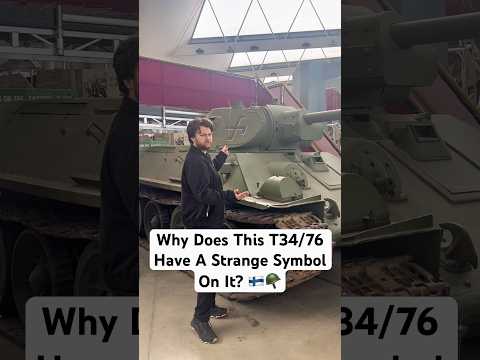
The tank itself was a relic of a forgotten front, a theater of World War II where allegiances were as shifting as the snows of the Arctic. Captured by Finnish forces during the Continuation War—the conflict that saw Finland align with Germany against the Soviet Union—this T-34 had been repurposed, repainted, and sent back into battle under a new flag. It was a trophy of war, a tool of vengeance, and a symbol of Finland’s desperate struggle to survive between two totalitarian giants.
But how did a Soviet tank end up fighting for Finland? And why did the Finns choose a symbol that would later be forever tainted by association? The answers lie in the frozen forests of Karelia, where the Winter War and its bloody sequel reshaped the fate of nations.
To understand the tank, you first have to understand the Finns. In 1939, the Soviet Union invaded Finland, expecting a quick victory. Instead, they met a ferocious defense that became legendary. Finnish soldiers on skis, outnumbered and outgunned, inflicted staggering losses on the Red Army. The Winter War was a humiliation for Moscow and a source of pride for Helsinki. But it was only the beginning.
When the Continuation War broke out in 1941, Finland seized the opportunity to reclaim lost territory. This time, they fought alongside Germany—not out of ideological kinship, but out of sheer necessity. Finland was a small nation caught in a geopolitical vice, and its survival depended on pragmatic, if uncomfortable, alliances.
Captured Soviet tanks like this T-34 became valuable assets. The Finns, with limited resources, refurbished and deployed them against their former owners. The swastika—a symbol of good luck and independence in Finnish culture since the 1918 Civil War—was painted on these vehicles to mark them as Finnish property. To the Finns, it meant nothing of Nazi ideology; it was simply their national insignia.
Yet, as the tank sits in the museum today, that distinction is lost on most visitors. The symbol’s dark twin overshadows its Finnish counterpart, forcing historians to explain the difference again and again. It’s a reminder that history is never black and white—and that symbols can be hijacked, misunderstood, and redeemed.
But the story of this T-34 doesn’t end with its capture. It went on to serve in battles that would determine the fate of Finland, and its journey from Soviet steel to Finnish symbol is a testament to the complexity of war. What happened to this tank after the war? And how did it end up in a museum, still bearing the mark of its strange and controversial service?
The answers begin with the tank’s capture, a story that unfolded in the mud and snow of the Karelian front. Finnish forces, advancing eastward in 1941, overran Soviet positions and seized dozens of T-34s, many of them abandoned or bogged down in the treacherous terrain. This particular tank, a 1942 model, was found near the Svir River, its crew dead or fled, its engine still warm.
It was towed back to a Finnish repair depot, where mechanics set to work. The Finns were masters of improvisation; they had to be. They stripped the tank, rebuilt its transmission, and repainted it in Finnish camouflage. Then came the swastika—the hakaristi—painted in blue on a white circle, the official insignia of the Finnish armored forces.
Renamed “Äiti” (Mother) by its new crew, the T-34 was pressed into service against its former masters. It fought in the battles of the Karelian Isthmus, where Finnish and Soviet forces clashed in some of the most brutal fighting of the Continuation War. The tank proved as deadly in Finnish hands as it had been in Soviet ones.
But the tide of war turned. By 1944, the Soviet Union had launched a massive offensive, and Finland, exhausted and outnumbered, sought an armistice. The terms were harsh: Finland had to expel German forces from its territory and surrender its captured tanks to the Soviets. Äiti, like many of its kind, was handed over—but not before its crew removed the hakaristi and scratched their initials into the hull.
For decades, the tank vanished into Soviet depots, its Finnish markings painted over, its history forgotten. It wasn’t until the 1990s, after the collapse of the Soviet Union, that a Finnish military historian stumbled upon a photograph of a T-34 with a faint blue cross visible beneath layers of Soviet green paint. The hunt was on.
The tank was eventually located in a scrap yard near St. Petersburg, rusting and incomplete. It was purchased by a Finnish museum foundation and restored to its wartime configuration—including the controversial hakaristi. The restoration team debated whether to include the symbol, knowing the confusion it would cause. In the end, they decided that history, however uncomfortable, must be told accurately.
Today, the tank stands as a monument to Finland’s impossible choices, a nation that fought both the Soviets and the Germans, that allied with one enemy to defeat another, and that survived against all odds. But the debate over the symbol continues.
Some visitors demand its removal, arguing that it offends Holocaust survivors and trivializes Nazi crimes. Others insist it must stay, a reminder that context matters and that history cannot be sanitized. The museum’s curators, caught in the crossfire, have added a detailed placard explaining the Finnish swastika’s origins—but the questions keep coming.
The placard helps, but it doesn’t satisfy everyone. On any given afternoon, you can watch the same scene play out: a visitor reads the sign, frowns, reads it again, and then turns to a curator with a look that says the explanation isn’t enough. The curators have learned to keep their answers short, calm, and rehearsed.
But the tank’s story has one more chapter that the placard barely mentions—the one that explains how a machine built in Nizhny Tagil ended up in a Finnish forest, and then in a scrap yard near St. Petersburg, and finally here. It’s a journey that spans three countries, two wars, and one very stubborn restoration team.
When the Finnish foundation bought the rusting hulk in the 1990s, they had no idea how much of the original Äiti remained. The hull was there, but the turret was a later Soviet replacement, and the engine was gone entirely. The team spent years tracking down period-correct parts, some from other wrecks, some from collectors who charged far more than the museum could comfortably afford.
Then came the discovery that changed everything. Beneath seventeen layers of paint—Soviet green over Finnish camouflage over factory primer—a restorer found the faint outline of the original hakaristi, painted by the crew who had renamed the tank Äiti. They also found something else: a small, hand-painted inscription in Finnish, almost illegible after decades of neglect.
It read: “For the home we could not save, we fight on.” The words were signed with three sets of initials—the initials of the crew who had scratched them into the hull before surrendering the tank in 1944.
The restoration team sat with those initials for weeks. They traced the crew through Finnish military archives and found that two of the three men had survived the war. One had emigrated to Sweden; the other had become a carpenter in a small town north of Helsinki. The third had been killed in the final weeks of the Continuation War, during the Soviet offensive that forced Finland to sue for peace.
When the museum contacted the surviving carpenter, now in his eighties, he agreed to visit the restoration workshop. He stood before the tank for a long time without speaking, then reached out and touched the hull where his initials were still faintly visible. “Äiti,” he said quietly. “I thought I would never see her again.”
The old man explained what the placard could never capture. The crew had loved that tank—not as a symbol, but as a machine that had kept them alive. They had painted the hakaristi because regulations demanded it, but they had named her Äiti because she was the closest thing to home they had.
He also settled a debate that had divided the restoration team for months. When asked whether the symbol should be painted back on, he shook his head. “Paint it as it was,” he said. “But paint the whole story, not just the mark. The mark alone means nothing. The story is everything.”
That story is now told in a small side gallery, away from the main hall where the tank sits. Visitors who want to understand the swastika must first walk past photographs of Finnish soldiers on skis, of burned villages in Karelia, of the armistice terms that forced Finland to turn on its former German allies. Only then do they reach the tank itself, standing silent and patient, waiting for the next question.
And the questions do keep coming—because the tank, for all its restoration, is still a puzzle. It is Soviet steel, Finnish paint, and a symbol that belongs to neither nation in the way most visitors assume. It is a machine that fought for three different flags without ever moving from the spot where it now sits.
But there is one part of the story that even the curators rarely discuss—the part that explains why the tank was found in a scrap yard in the first place. The answer lies not in Finland or Germany, but in the chaotic years after the Soviet collapse, when military hardware vanished from depots across Russia and reappeared in the hands of collectors, scrap dealers, and—occasionally—museums with more ambition than money.
The Finnish foundation’s purchase was, by all accounts, a minor miracle of persistence. They had spent years chasing rumors of a T-34 with Finnish markings, following leads that dead-ended in muddy fields and rusted-out barns. When they finally found Äiti, she was half-buried under scrap metal, her hull still bearing traces of the crew’s initials.
Transporting her back to Finland required permits, bribes, and a great deal of patience. The Russian authorities, suspicious of a foreign foundation buying military hardware, delayed the export for nearly a year. By the time the tank crossed the border, the restoration team had already assembled a full dossier on its history—every battle, every crew member, every layer of paint.
That dossier is now part of the museum’s archive, available to any visitor who asks. It includes the carpenter’s testimony, the photographs from the scrap yard, and a letter from the third crew member’s widow, who had kept his wartime diary for fifty years.
So the next time you see a swastika on a Soviet tank, remember: the symbol is not the story. The story is the men who painted it, the home they could not save, and the long journey that brought them all here.
But what if the symbol were removed tomorrow—would the story still be told, or would we lose the uncomfortable truth that gives it meaning?
Report this article
Select a reason for reporting:






