When Rowan Atkinson’s Edmund Blackadder charged into no man’s land in the final, gut-wrenching episode of Blackadder Goes Forth, millions of viewers assumed his fate was sealed. But what if I told you that a real Captain Blackadder not only fought on the Western Front but survived the war? And he wasn’t alone—a Lieutenant George, a Captain Darling, and a Private Baldrick also served. This is their story.
The surname Blackadder is not a invention of the writers; it belongs to a real Scottish clan from the border region, rewarded with lands for supporting Scottish kings against the English in the Middle Ages. A Blackadder fought and died at Flodden in 1513, and descendants included a Covenanter preacher and a Battle of Britain pilot. So when the fictional Edmund Blackadder first appeared in The Black Adder (set during the Wars of the Roses), his name already carried centuries of history.
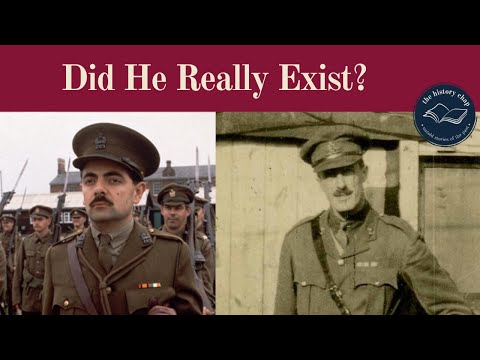
But the most striking parallel emerged in the series set during the First World War. Captain Robert Blackadder, born near Dundee in 1884, was a chartered accountant living in London when war broke out. He enlisted as a private in the Queen’s Westminster Rifles and was soon sent to the front. Like his fictional counterpart, he rose through the ranks, becoming an acting captain in the Royal Garrison Artillery. In March 1918, at Bons, near Arras, he commanded a unit under heavy fire and was awarded the Military Cross for withdrawing his guns and stores under bombardment. His citation praised his “energy, coolness and resource.” Unlike the sitcom character, he survived the war, finishing as an acting major, and later married and lived to 84.
Then there was Lieutenant Athon George—a real officer with the Dorset Regiment. Born in 1887, he was the son of a wealthy brewing family, educated at Cambridge, and a keen sportsman. He was commissioned in 1907 and described by his commanding officer as “the best subaltern he had ever commanded.” In 1914, he was sent to France and fought at Mons and Le Cateau. Just a month into the war, on 9 September 1914, he was shot in the head and killed, aged 27. A memorial to him stands in Romsey Abbey.
Captain John Clive Darling was another real-life counterpart to Tim McInnerny’s character. Born in 1888, he was the son of the first Baron Darling and educated at Eton and Sandhurst. Commissioned in the 20th Hussars, he served on the front line throughout the war—unlike the staff officer in the series. He fought at Mons, the Marne, and Ypres, was wounded, mentioned in dispatches, and awarded the Distinguished Service Order in 1916. He survived, married in 1918, and retired as a major.
And then there was Private James Baldrick, an illegitimate child from County Tyrone, Ireland, born in 1891. Like Tony Robinson’s character, he came from a humble background—his mother was just 17 when he was born, and there is no record of a father. By 1911, he was working as a shop porter in Omagh. He joined the Inniskilling Fusiliers in early 1914 and was called up when war was declared. His battalion was among the first British Expeditionary Force contingents to arrive in France, and he fought at Le Cateau during the retreat from Mons. On 20 October 1914, just over two months into the war, Private James Baldrick was killed in action, aged 23.
So from the central characters of Blackadder Goes Forth, there really was a Captain Blackadder, a Captain Darling, a Lieutenant George, and a Private Baldrick serving on the Western Front. Two were decorated for bravery, and two died for their country. The only one missing was General Melchett—but wait, there was a real General Blackadder too. Major General Charles Blackadder commanded troops on the Western Front and played a leading role in suppressing the Easter Rising in Dublin. His story, and how he came to condemn one of the rebellion’s leaders to death, is perhaps the most remarkable of all.
Charles Blackadder was born in Richmond, Surrey, in 1869—the son of a schoolmaster and a French mother from Alsace-Lorraine. Throughout his life he proudly declared himself half-French. He attended the Royal Military Academy at Sandhurst and was commissioned in the Leicestershire Regiment in 1888. His early career took him to Bermuda, Canada, and Jamaica, and by the late 1890s he had risen to captain.
In October 1899, a week after taking command of the 1st Battalion, the Second Anglo-Boer War erupted. Blackadder led his men at Talana Hill and through the gruelling Siege of Ladysmith. After the war, he served in India, and in 1912 returned there as commander of the 2nd Battalion.
When the First World War broke out, the 2nd Leicesters were mobilized as part of the 20th Indian Brigade. They landed in Marseilles and were rushed to the front line, going into action on 29 October 1914. By January 1915, Blackadder was a temporary Brigadier General, commanding the entire Garhwal Brigade—his own battalion plus two Indian battalions and a Gurkha battalion.
At the Battle of Neuve Chapelle in March 1915, three of his four attacking battalions achieved their objectives, earning two Victoria Crosses and nine Indian Orders of Merit. It was a remarkable feat of leadership.
But it was in Dublin, during the Easter Rising of 1916, that Blackadder faced his most painful duty. His brigade was rushed to Ireland to counter the rebellion, and due to his senior rank he chaired several courts-martial of the rebel leaders—including that of Patrick Pearse.
Blackadder seems to have felt deep sympathy for the rebels. After Pearse’s conviction, he wrote in his diary: “I’ve just done one of the hardest tasks I’ve ever had to do. I’ve had to condemn to death one of the finest characters I’ve ever come across. There must be something very wrong in the state of things that makes a man like that a rebel.”
He returned to the Western Front, commanding the 38th Welsh Division as a Major General and fighting at Passchendaele. In May 1918, deteriorating health forced him to leave the Army. He died of liver cancer and heart failure in April 1921, aged 51, and is buried in London. His regiment installed a memorial to him in Leicester Cathedral.
So the real Blackadder legacy stretches far beyond a sitcom. From a medieval Scottish clan to a decorated captain, a doomed lieutenant, a front-line cavalry officer, a fallen private, and a general who condemned a rebel leader to death—reality, it seems, was every bit as strange and compelling as fiction.
Yet the full story of the real men behind the surnames doesn’t end with their wartime service. Take Captain Robert Blackadder, the accountant who won the Military Cross. After returning to London, he didn’t simply fade into civilian life. In 1920 he married Margaret Scott, and the couple settled back in the Marylebone area where he had lived before the war. He resumed his accounting career and lived quietly until retiring to Surrey, where he died in 1968 at the age of 84. He had outlived the fictional Edmund by more than half a century.
Captain John Clive Darling, the cavalry officer who served on the front line rather than behind a desk, also built a life after the guns fell silent. He married Elena Powell in 1918, and the couple had two children. Retiring from the Army in 1923 with the rank of major, he turned to writing and produced a history of his regiment, the 20th Hussars. He died in the New Forest in 1933, aged just 45—a man who had survived Mons, the Marne, and Ypres only to be taken far too young by peacetime illness.
And what of the families left behind? Private James Baldrick’s mother, Martha, had given birth to him at just 17 and raised him and his siblings in the waterside dairy of County Tyrone. When news reached her that her son had been killed at Le Cateau in October 1914, she was still only in her early forties. The Baldrick name, so often a punchline in the sitcom, belonged to a real young man who never had the chance to marry, have children, or grow old.
There is one more layer to this story that deserves attention—the curious question of how these surnames came to cluster together in the same war. Was it pure coincidence, or did the writers of Blackadder Goes Forth somehow know? The answer, of course, is coincidence. Richard Curtis and Ben Elton created their characters in the 1980s with no knowledge of the real Captain Blackadder, Lieutenant George, Captain Darling, or Private Baldrick. The names were chosen for comic effect: Blackadder for its dark, snakelike sound; Darling for the irony of a man everyone despises; George for the blustering aristocratic type; Baldrick for its blunt, peasant-like ring.
Yet the coincidence runs deeper than mere surnames. The real Lieutenant George was, like his fictional counterpart, a public-school and Cambridge-educated young officer from a comfortable background. The real Private Baldrick was, like Tony Robinson’s character, an illegitimate child from a humble family who worked as a porter before enlisting. The real Captain Darling, though far braver than Tim McInnerny’s version, was still a career cavalry officer from an establishment family. It is as if the sitcom’s writers had somehow tuned into the social archaeology of the British Army.
Historians have long noted that the British Expeditionary Force of 1914 was a curiously stratified institution. Officers tended to come from public schools and old families; the ranks were filled with labourers, clerks, and porters. The real men who bore these names fit that pattern almost too neatly. Lieutenant Athon George, the son of a brewing family and a Cambridge man, was exactly the sort of young officer who led from the front and died early. Private James Baldrick, the shop porter from Omagh, was exactly the sort of soldier who filled the ranks and fell in the first months of the war.
In that sense, the characters of Blackadder Goes Forth were never based on specific individuals—but they were based on types. And those types were real. The tragedy of the series, its famous final scene where the men charge into the fog and the poppies bloom, resonates because it captures something true about the war: the waste of young lives across every rank and every background.
General Charles Blackadder, the half-French major general who condemned Patrick Pearse to death and later fought at Passchendaele, represents yet another layer of that truth. Here was a man of senior rank, far from the caricature of General Melchett, who agonized over the executions he was ordered to oversee. His diary entry about Pearse—“one of the finest characters I’ve ever come across”—reveals a commander who understood the human cost of his decisions. He was not a buffoon shouting orders from a château; he was a soldier doing a painful duty and questioning it privately.
When he died in 1921, at just 51, his regiment remembered him with a memorial in Leicester Cathedral. It is a quiet tribute to a man whose name now belongs as much to comedy as to history.
Perhaps that is the strangest part of this whole story. Millions of people around the world know the name Blackadder because of a sitcom. Far fewer know that real Blackadders fought and died at Flodden, at Blenheim, in the Boer War, and on the Western Front. The comedy has, in its own way, kept the name alive—even if the real men behind it have been largely forgotten.
So the next time you watch that final episode, and the men go over the top to the sound of the whistle, remember that somewhere in the archives there are real service records, real medals, and real graves. Captain Robert Blackadder, MC. Lieutenant Athon George, killed at 27. Captain John Clive Darling, DSO. Private James Baldrick, killed at 23. And Major General Charles Blackadder, who died too young after a war that took so much from so many.
Their stories remind us that behind every joke about the trenches lies a generation that actually bled there. The real Blackadder won his Military Cross under fire; the real Baldrick never came home. “Sometimes reality is even stranger and more fun than fiction,” as the historian Chris Green put it—but sometimes it is simply more heartbreaking.
So when the poppies bloom on screen and the whistle sounds, we are not only mourning Edmund, George, Baldrick, and Darling. We are mourning Robert, Athon, James, John, and Charles too—men whose names the comedy borrowed and whose sacrifices history must never let slip away.
Which of these real-life counterparts surprised you the most—the decorated Captain Blackadder, the doomed Lieutenant George, the front-line Captain Darling, the fallen Private Baldrick, or the conflicted General Blackadder? Share your thoughts below.
Report this article
Select a reason for reporting:






