The air was thick with smoke and the crack of machine-gun fire as Captain Dick Winters sprinted across the open field, his lungs burning, his legs pumping faster than they ever had before. He was ahead of his men—far ahead—and he knew it. But he couldn’t slow down. Not now. Not when the entire plan depended on speed and surprise.
He reached the elevated road, scrambled up the dyke, and there, just two steps away on the other side of the narrow dirt road, stood a young German soldier. Their eyes locked.
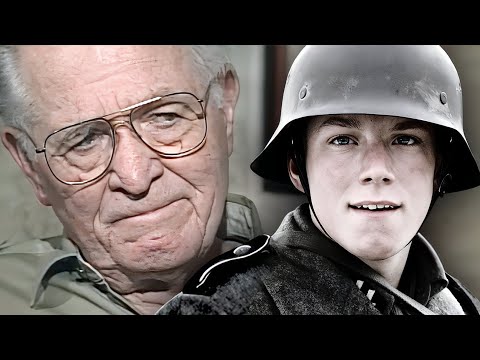
“He was just as shocked as could be,” Winters later recalled. “I leveled off at him and the thing that I can never forget was he smiled—and as he smiled, I shot him.”
That moment—the boy’s smile—would haunt Winters for the rest of his life. It was October 5, 1944, during the Battle of the Crossroads in Holland, and Easy Company had just pulled off one of its most daring assaults of the war. But for Winters, the victory came at a cost that no after-action report could capture.
In the decades that followed, Winters would recount the story many times, always with the same haunting detail: the young soldier, barely a teenager, smiling at him just before the trigger was pulled. “I don’t know why he smiled,” Winters said. “Was he happy my grenade didn’t go off? Was he acknowledging that I had won? Or did he think I might not fire?”
The truth was, Winters didn’t hesitate. He fired from the hip, the shot startling the entire company. Then he pivoted and kept firing into the mass of German troops, going through two clips before dropping back for cover. His men soon joined the fight, and the Germans—two companies, around 300 men—fled toward the river, outmatched by Winters’ group of just 35.
But the smile stayed with him. After the war, Winters tried to leave the killing behind. He went on a deer-hunting trip, hoping to find some peace in the mountains of Pennsylvania. But when four deer bounded down the mountainside and stopped barely 20 feet away, he couldn’t lift his rifle. “I was done,” he said. “I did not want any more killing.”
Yet the face of that young German soldier never faded. In interviews more than 50 years later, Winters admitted he still saw that smile. He never knew what it meant—and perhaps that was the hardest part. The not knowing. The question that would never be answered.
As Winters stood on that dyke in Holland, he couldn’t have known that this would be the last time he fired his weapon in combat. In just a few days, he would be promoted to executive officer of Second Battalion, and the war would carry him further from the front lines. But the memory of that smile would follow him home, a quiet ghost that no victory could silence.
What Winters also carried home was a more immediate, practical burden: the weight of what his men had just accomplished, and the cost of it. The assault at the crossroads had been a gamble—a frontal charge across open ground against an entrenched enemy, the kind of order that could have ended in disaster. Instead, it had ended in one of Easy Company’s most lopsided victories. Fifty Germans killed, eleven captured, and countless wounded, all at the cost of a handful of American casualties.
Yet Winters rarely spoke of the crossroads in terms of glory. When he did, he spoke of it as a job that had to be done. “There was no other way to do it,” he said flatly. “You had to make a frontal attack. It was the only approach.” The tone was matter-of-fact, almost clinical—the voice of a man who had long since learned to separate the soldier from the human being.
But the human being was still there, underneath. It surfaced in the small details. In the way he described the tape wrapped around his grenade handles, a precaution born of experience and fear of accident. In the way he remembered the German sentry hunched down, arms over his head, waiting for a grenade that never exploded. “He was only three or four yards away,” Winters wrote in his memoir. “After all these years, I can still see him smiling at me as I stood on top of the dyke.”
There was something else Winters wanted to set straight—a detail that the series had blurred in the retelling. The soldiers they had fought that day were not, as popular memory sometimes suggested, an elite SS unit through and through. They were the 369th Volksgrenadiers, a hard-nosed but ordinary infantry outfit, recently refitted after being mauled in Normandy. A small contingent of SS troops had been blended in among them, Winters explained, “to help keep the 369th boys on the ball.”
It was a distinction that mattered to Winters, though he could never quite articulate why. Perhaps it was because the young man he had shot deserved to be remembered accurately—not as a fanatic, but as a soldier, a boy in a uniform, doing a job he had likely been ordered to do. The SS patch on the collar in the series made for cleaner storytelling. The reality was messier, and messier still was what it left behind in the mind of the man who pulled the trigger.
In the years after the war, Winters would sometimes find himself thinking about the boy’s smile at the strangest moments—standing in a hardware store, driving to work, watching his children play in the yard. It would come and go like a flicker of light through a window, there and then gone. He never told anyone about those moments, not even his wife. Some things could not be explained, only carried.
And yet, Winters never once suggested that he regretted the shot. That, too, was part of the burden. He had done his duty. He had protected his men. He had survived. But survival, he was learning, was its own kind of wound—one that did not bleed, and did not heal, and could not be dressed by any medic in the company.
Winters’ promotion to executive officer of Second Battalion came on October 9th, just four days after the crossroads. The timing was not lost on him. He had led Easy Company through Normandy, through the hedgerows, through the charge across the Dutch field—and now the Army was moving him up and away from the men he had trained and bled with. He accepted the order the way he accepted everything: without complaint, without ceremony, and with his jaw set tight.
But leaving the line did not mean leaving the war behind. As executive officer, he now spent his days with maps and supply manifests and casualty reports, pushing paper instead of men. It was a different kind of combat, and in some ways a harder one. “I was never happy behind a desk,” he admitted years later. “But somebody had to do it, and I was the one they picked.”
The men of Easy Company noticed the change in him. He was still the same quiet, steady captain they would have followed into hell, but something had shifted. He laughed less. He lingered longer over his coffee. When the replacements arrived—new faces, new names, boys who had never heard a German machine gun—Winters would look at them the way a man looks at something he has already lost.
It was during those weeks that word came down about the island. The Germans had dug in along the south bank of the Rhine, and the fighting ahead promised to be brutal. Winters read the intelligence reports and felt the old, familiar tightening in his chest. He knew what those reports meant. He had written enough of them himself.
But the crossroads had changed something in him, and he could not quite name it. He found himself studying the faces of the young soldiers under his command—their smooth cheeks, their nervous jokes, their desperate attempts to look brave. “They were just kids,” he said. “Most of them were just kids. And I was supposed to send them out there and bring them back.”
One evening, not long after the promotion, Winters sat alone in his quarters with a pencil and a sheet of paper. He had started to write a letter home, but the words would not come. He set the pencil down and stared at the wall for a long time. In his mind, he was back on the dyke, the young German’s smile hovering in front of him like a ghost that refused to be dismissed.
He picked the pencil back up. He wrote two lines, crossed them out, and set it down again. Then he folded the paper, put it in his pocket, and stepped outside into the cold Dutch night. Somewhere in the distance, artillery rumbled. The war was not finished with him yet.
The weeks that followed blurred into a rhythm of duty and dread. Easy Company trained, refitted, and waited for the next order, while Winters watched the replacements stumble through drills and felt the old ache of command settle into his shoulders. He was no longer the man who charged across the field—he was the man who signed the papers that sent others to do it.
Then came the Ardennes. The Germans punched through the frozen forest in December, and Easy Company was rushed to Bastogne to hold the line. Winters, now a major, coordinated the defense from a command post, but the crossroads never left him. “I thought about that young soldier every day at Bastogne,” he later said. “The cold, the trees, the boys dying—it all came back.”
After the war, Winters returned to Pennsylvania and tried to build a quiet life. He married, raised a family, ran a business. But the smile on the dyke remained a shadow he could not shake. “I never forgot his face,” he admitted. “Fifty years later, I could still see it.”
He did not speak of the crossroads often, but when he did, his voice carried a weight that no medal could lift. “Killing never made me happy,” he said. “Satisfied, yes, because I knew I had done my job. But never happy.” The words were simple, but they carried the truth of a man who had carried the cost of duty long after the guns fell silent.
In his final years, Winters found a measure of peace in his family and in the legacy of Easy Company. But the young German soldier remained a silent companion—a reminder that war leaves marks no after-action report can capture. “I don’t know why he smiled,” Winters said one last time. “I guess I never will.”
And so the story ends not with a victory parade, but with a quiet question that echoes across the decades: What do we owe the enemy we kill—and what do we owe ourselves when the killing is done? What would you have done if you were standing on that dyke? Share your thoughts in the comments below.
Report this article
Select a reason for reporting:






