In August 1942, on a muddy track carved through the Owen Stanley Mountains of New Guinea, something happened that defied every law of military science. Japanese commanders stared at reports they could not explain. Australian militia units—starving, diseased, and wounded beyond what should have been fatal—refused to stop fighting. Men with shattered bones kept pulling triggers. Men with fevers so high their hands shook held their positions. Men who hadn’t eaten in days reloaded and fired.
The Japanese had crushed Singapore. They had smashed the Philippines. They had swept through Malaya like an unstoppable wave. But here, on a 60-mile jungle track, something stopped them. And they could not figure out what.
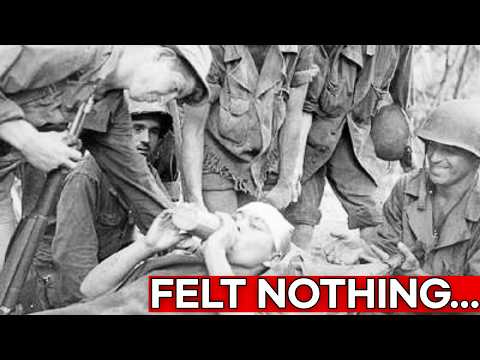
This is the story of that track—the Kokoda Trail—and the question that haunted Japanese field commanders all the way to the top: What secret allowed dying men to keep fighting?
To understand what happened on that trail, you first have to understand how bad things were for the Australians. The Kokoda Track wasn’t a paved road. It was barely a corridor. It climbed to 7,000 feet above sea level through jungle so dense that sunlight rarely touched the ground. The mud was deep enough to swallow a boot and keep it. Rain fell so hard and so often that soldiers stopped noticing it—the way you stop noticing a sound that never goes away.
Temperatures swung from blistering heat at the mountain base to near-freezing at the peaks, sometimes in the same afternoon. The area received over 200 inches of rain a year. The jungle itself was alive in ways that worked against human survival. Insects carried malaria. Water carried dysentery. Small cuts infected within hours, turning into tropical ulcers that ate through muscle down to bone.
Into this environment, the Japanese sent 13,500 of their best soldiers under Major General Tomitaro Horii. These were not ordinary men. They had fought across Asia and won. They were experienced, well-equipped, and fast-moving. They landed at Gona on the north coast of New Guinea in late July 1942 and were driving south toward Port Moresby—the last major Allied position standing between the Japanese Army and the Australian mainland. If Port Moresby fell, Australia would be exposed. Everyone understood the stakes could not be higher.
Standing in the way of those 13,500 men was the 39th Infantry Battalion. Most of them were teenagers. The average age was 18. They were militia soldiers—which meant they were not the polished, battle-hardened force their enemy was. They had less training, less equipment, and far less experience. By the time the Japanese attack began building in early August 1942, the 39th had fewer than 600 men who could be considered effective fighters. 600 against 13,500.
The math wasn’t complicated. Every available military estimate said this was over before it began.
Supply conditions made things worse. Food, ammunition, and medicine had to be carried by hand over the Kokoda Track because there was no other way. The carriers—many of them local Papuans who became legendary for their courage and loyalty—hauled loads on their backs over terrain that would challenge a healthy person carrying nothing. What reached the front was never enough. Soldiers fought on partial rations. They shared ammunition. They treated wounds with whatever cloth they could tear from their clothing because proper bandages had run out.
Military commanders in Brisbane and Melbourne looked at the reports coming from the trail and issued a judgment that would prove catastrophic and wrong. General Douglas MacArthur, Supreme Commander of Allied Forces in the South West Pacific, initially told his staff that a major Japanese offensive across the Owen Stanley Range was logistically impossible. His intelligence assessments in late July 1942 described the Japanese movement as a small raiding force. His planners believed the mountains could not be crossed by a large force. Port Moresby was defensible from the sea, not from above. They were wrong about all of it.
By the time they realized how wrong, the Australian boys on the trail were already dying.
This is where Ralph Honner enters the story. He was 37 years old. He was not a professional soldier in the way most people imagine. Before the war, he had been a teacher and a lawyer. He had served in the Middle East and in Greece. In Greece, he had experienced something most soldiers never recover from: a humiliating, organized defeat. But Honner did not break in Greece. He watched and learned. He learned what men look like when they truly reach the outer limits of their endurance. And he learned something few people in any army have the clarity to see—that those limits are rarely where the textbooks say they are.
When Honner reached the 39th Battalion at a place called Isurava on August 16, 1942, what he found would have ended the hopes of any reasonable man. His battalion consisted of only 77 men. 77 men, down from over 500 who had begun the campaign weeks earlier. Their faces were pale, their feet bare—boots had long since disintegrated in the mud and rain. Their weapons were held together with wire. Many of them were suffering from fevers that should have put them in a hospital bed anywhere else on earth. And yet, they had not run.
Against all odds, against an enemy that outnumbered them by a ratio that defied military logic, they had not broken. Honner stood among them and looked at what he saw the way a trained lawyer looks at evidence. And his first thought—the thought that would change everything that followed—was simple and extraordinary. The breaking point he had been told these men would reach did not exist. And if that was true, then everything the Japanese believed about the nature of their fighting might be wrong.
Honner did not waste time feeling sorry for what he had just found. He looked at those 77 men the way a lawyer looks at evidence that surprises him. He set aside what he had expected and worked with what was actually in front of him. And what was in front of him—under the fever, the wounds, and the hunger—was something he recognized from Greece. These men had already made a decision most soldiers never have to make. They had already looked at the worst possible situation and chosen to stay in it.
Honner realized that decision was not a small thing. It was the most important tactical resource he had, and he decided to build everything around it.
The first thing he did was study the ground. The Kokoda Track at Isurava ran through a narrow corridor with jungle walls on both sides rising almost vertically. Moving through that jungle was not like walking through an ordinary forest. It was like trying to push through a wall that pushed back. A machete might cut about 20 yards of progress through that brush in an hour. This meant the Japanese could not simply flank an Australian position the way they had in so many previous battles across Asia. Their preferred tactic—the one that had broken countless defensive lines—was to slip around the sides, sending soldiers wide of a position to hit it from behind and cause panic. On the Kokoda Track, that tactic cost them enormous time and heavy casualties.
Honner saw this clearly and built his defense entirely around it. He did not place his men in long straight lines that a larger force could simply overwhelm with numbers. Instead, he placed them in small pockets—sometimes as few as four to six men in a single position—distributed across the terrain in a pattern where each group protected the others. If the Japanese attacked one position, they exposed themselves to fire from two others. Taking any single point required attacking into a direction that was already covered by another Australian position. The positions overlapped like fish scales. No single position could be attacked without drawing fire from the others. With the numbers Honner had, a straight defensive line would have been thin enough to break with one strong push. His interlocking system meant the line had no single weak point for a strong push to find.
The second thing Honner built was about time and the human body. He had watched enough men fight in appalling conditions to understand something the military textbooks of the age had not fully absorbed. A man fighting malaria is not a broken soldier. He is a soldier running a damaged engine. And a damaged engine, if you manage it carefully, can keep running.
Honner set up a rotation system so simple it barely seemed worth mentioning. No man fought continuously for more than 90 minutes without a structured break. Forty-five minutes of lying down—even on wet ground, even under the sound of distant firing—gave the body enough recovery to function again. For men with fevers spiking past 103 degrees, for men whose legs shook when they stood, this was not rest in any comfortable sense. It was precision maintenance, the way you manage a machine you know is running dangerously hot. You don’t shut it off. You cool it just enough to keep it going.
The third thing Honner did was the strangest, and it was the one that confused Japanese commanders most deeply. He changed the way his men thought about their own wounds.
In standard military practice of the time, a soldier with visible injuries was pulled from the line. That was doctrine. It was also, on the Kokoda Track, a death sentence more often than not. The journey back along the trail for a badly wounded man took days through terrain that killed healthy men. Honner looked at this reality without flinching and realized that for many of his men, staying was safer than leaving. More than that, he noticed something in the men who stayed. They fought with a different quality of focus than those who still had the option to leave. They were not reckless. They were precise. They had narrowed their world down to the ground in front of them and the man beside them. And within that narrow world, they were completely committed.
Honner did not order the wounded to stay. He sat with them and asked. He explained the situation honestly, the way a lawyer explains the options in a difficult case, and he left the choice to them. The majority chose to hold their ground.
This created something that later Japanese battle reports had no category for. Defensive positions that took 40, 50, even 60 percent casualties were still delivering the same volume of accurate fire as before. The positions did not go quiet the way they were supposed to. They did not behave like positions that had lost half their men, because the men who remained had made a conscious, complete decision to be there—and that decision changed what they were capable of doing.
The first real test of everything Honner built came at the Battle of Isurava, which began on August 26, 1942, and lasted five straight days. Japanese forces—roughly 2,500 strong—launched coordinated attacks against Honner’s position, now reinforced to about 500 men with the arrival of the 2/14th Battalion. For five days the attacks kept coming, and for five days the interlocking positions held long enough to make a difference.
The Australians took over 50 percent casualties. Then they executed an orderly withdrawal. It was not a rout or a collapse—it was a calculated, disciplined movement that preserved the unit’s cohesion for the fighting still ahead.
But none of it would have been possible without one man who stood between Honner and the crushing pressure coming from above. Brigadier Arnold Potts commanded the 21st Brigade, had fought in the Middle East, and trusted what he saw in front of him more than what Brisbane told him. MacArthur’s headquarters wanted aggressive counterattacks. They wanted clean lines, bold maneuvers, and something they could put in an official communiqué. Potts absorbed that pressure and deflected it, giving Honner the room to fight the battle that was actually happening rather than the one that looked better on a map 600 miles away.
It was not the kind of support that gets celebrated. No one would write songs about it. But without it, the delicate system Honner had built would have been pulled apart by orders from men who could not see the mud.
Military analysts in Brisbane and Tokyo expected Port Moresby to fall by September 1942. They were wrong about almost everything, and the numbers were about to show exactly how wrong. The track looked open. The defenders were teenagers in rotting boots with shared ammunition. Every available calculation pointed to one outcome.
But calculations do not account for what Honner had built. And what Honner had built was about to show exactly what it could do across 60 miles of the hardest terrain on earth.
The 39th Battalion entered the Kokoda campaign with roughly 550 men. They came out with fewer than 100 still standing as an effective fighting force. By any military equation in 1942, a unit at 50 percent casualties was finished. The 39th went past 50. Then 60. Then kept fighting.
Malaria cases outnumbered battle wounds four to one. At the campaign’s peak, over 1,700 Australians fought while burning with acute malaria—not in hospitals, but in the line.
By November, the Japanese withdrawal was complete. Port Moresby never fell. Australia was never invaded. Horii drowned in the Kumusi River on November 2, his army broken not by a force of equal size, but by one that simply refused to stop.
Japanese field reports noted, with open frustration, that Australian positions never weakened in proportion to their losses. A captain’s diary, found after his death, confessed: “Perhaps these men had already died and did not know it.”
Honner went home, put on a suit, and practiced law. He lived to 89. Potts was relieved of command—a scapegoat for MacArthur’s politics—and carried a stain he never earned.
But the lesson endured: the line between what a person can endure and what they believe they can endure is not set by the body. It is set by the mind. And unlike bodies, minds can be led.
The Japanese could count wounds. They could not count the quiet, daily choice each man made in the dark and the rain to stay beside his mate. That choice was the secret. It always is.
So ask yourself: when your own breaking point arrives, what will you find on the other side of it?
Report this article
Select a reason for reporting:






