On the night of June 9th, 1980, neighbors in Northridge, California, watched in horror as a man ran down the street, his body engulfed in flames. It was Richard Pryor, the most famous comedian in America. For years, the public believed a cocaine freebasing accident had caused the fire. But Pryor later revealed the terrifying truth: after days awake on cocaine, gripped by drug psychosis, he poured rum over himself and lit the match. He suffered burns over half his body and spent six weeks in a burn unit, fighting for his life.
That night was the climax of a long battle with addiction—a battle that would define the lives of many beloved TV stars. Behind the laughter and the glamour, a darker story unfolded.
Pryor’s drug use began early. Born in 1940 in Peoria, Illinois, he grew up in a brothel run by his grandmother. By the 1970s, he was a superstar—winning Emmys, hosting Saturday Night Live, and headlining his own show. But cocaine was always there, and it brought violence. Around New Year’s Day 1978, he fired a gun into his wife’s car. His marriages crumbled—seven marriages to five women. Yet Pryor turned his darkest night into material, joking about the fire in his 1982 concert film Live on the Sunset Strip. In his memoir, he admitted it was a suicide attempt. He stopped freebasing after the fire, but the damage was done. In 1986, he was diagnosed with multiple sclerosis, and by the 1990s, he needed a wheelchair. He died in 2005 at 65.
Pryor’s story is just one of twelve. Take Bela Lugosi, the iconic Count Dracula. In 1955, at 72, he walked into a Los Angeles courtroom and begged a judge to lock him up. “I have been addicted to drugs for about 20 years,” he confessed. Lugosi’s addiction began with morphine prescribed for severe sciatica in the 1930s, later replaced by methadone. As his star faded, he took any role, including Ed Wood’s notoriously bad films. His public admission shocked the nation—no star of his magnitude had ever done such a thing. After three months in a state hospital, he emerged saying he was cured, but he died of a heart attack just a year later, buried in one of his Dracula capes.
Then there’s Robert Blake, who went from child star to Emmy-winning actor on Baretta. But behind the scenes, he battled heroin addiction in the 1950s. “I was angry, lost, and heading toward real trouble,” he later admitted. Therapy helped him claw his way back, but his life remained turbulent—culminating in a murder trial for his wife’s death, of which he was acquitted. Blake’s story is a stark reminder that addiction’s grip can last a lifetime.
Sid Caesar, the king of live TV in the 1950s, kept millions laughing while secretly依赖 alcohol and pills. “I couldn’t get through the show without them,” he confessed. His writers, including Mel Brooks and Woody Allen, witnessed his rages and his reliance on whiskey and barbiturates. It took a breakdown in 1978 to finally sober him up. He lived to 91, sober for over three decades.
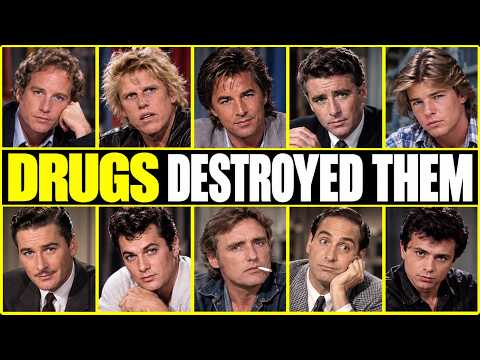
These stars, and others like Dennis Hopper, Tony Curtis, and Errol Flynn, all shared a common demon. Their stories are not just cautionary tales—they are human dramas of fall and redemption, played out under the glaring lights of fame.
Dennis Hopper told interviewers the numbers without flinching: in the early 1980s, he claimed a daily routine of half a gallon of rum, more than twenty beers, and several grams of cocaine just to get through the day. “I was lucky to be alive,” he said, and he meant it. Born in Dodge City, Kansas, in 1936, Hopper came to Hollywood young, working alongside James Dean in Rebel Without a Cause and Giant, then grinding through years of Westerns like Gunsmoke and The Rifleman. Studios found him difficult and stopped calling.
Then came Easy Rider in 1969—a small-budget film he directed and starred in with Peter Fonda that became a counterculture landmark. The drugs on that production were not acting. His follow-up, The Last Movie, shot in Peru, collapsed into a drug-fueled chaos that flopped in 1971, and Hollywood wrote him off as a burned-out wild man. Through the 1970s and early 1980s, it got worse. In 1983, while working in Mexico, cocaine paranoia sent him wandering into the countryside, convinced people were trying to kill him. He was brought back to Los Angeles and landed in a psychiatric ward.
That was the bottom. Hopper went into treatment and stayed sober for the rest of his life. The years that followed were the best of his career. In 1986 alone, he played the terrifying Frank Booth in Blue Velvet and earned an Oscar nomination as an alcoholic father in Hoosiers—a role about a drinker, played by a man who had just quit. He died of prostate cancer in 2010 at 74, having spent the second half of his life telling interviewers that the man from the 1970s should have been dead long before.
Tony Curtis’s troubles surfaced publicly in 1970, when customs officers at Heathrow found cannabis on him and fined him fifty pounds. It was a small story, but the drug use was far bigger than one airport arrest. Born Bernard Schwartz in the Bronx in 1925, Curtis had risen fast, earning an Oscar nomination for The Defiant Ones and starring in Some Like It Hot. As film roles thinned, television kept him busy—The Persuaders, McCoy, and a recurring role on Vega$—while, by his own account, he drank heavily and used cocaine.
Roger Moore later recalled Curtis smoking marijuana during The Persuaders. In his 2008 memoir, Curtis wrote about how deep the cocaine went and how close it came to killing him. In 1984, he checked into the Betty Ford Center. The family paid a terrible price: his son Nicholas died of a heroin overdose in 1994 at just 23. Curtis stayed clean afterward, took up painting seriously, and saw his work enter the collection of the Museum of Modern Art. He died of a heart attack in 2010 at 85.
Errol Flynn’s body told the story his press agents never did. When he died in Vancouver in October 1959 at only fifty, doctors were shocked—his liver was badly damaged, his heart worn out. Born in Hobart, Tasmania, in 1909, Flynn had lived like one of his own adventure films before Warner Brothers made him a star overnight with Captain Blood in 1935 and The Adventures of Robin Hood in 1938. The drugs began during those peak years. In his autobiography, My Wicked, Wicked Ways, published just after his death, he described using opium and morphine and injecting himself.
By the 1950s, he looked decades older than he was. He drifted to Europe and his yacht, hosted The Errol Flynn Theater in 1956 and 1957, and gave what critics called some of his best work in The Sun Also Rises in 1957—playing a drunk. Many noted he did not have to act. Friends reportedly slipped bottles of whiskey into his coffin at Forest Lawn.
Jan-Michael Vincent’s fall was just as steep. In the mid-1980s, he was one of the highest-paid actors on television, earning a reported $200,000 an episode for Airwolf. He played Stringfellow Hawke, a moody helicopter pilot, and the show was a hit for CBS starting in 1984. He had paid his dues in films like The Mechanic with Charles Bronson and Big Wednesday, and earned good reviews for the miniseries The Winds of War. Airwolf should have been the launch of a long run at the top.
Instead, the drinking and cocaine took over. Vincent admitted his problems in interviews, and people on the set said his condition was affecting production. He was arrested several times through the 1980s and 1990s for drunk driving and bar fights. After the third season, CBS dropped Airwolf, and when it moved to cable, the original cast was gone. In 1996, a serious car crash broke three vertebrae in his neck and permanently damaged his vocal cords. His voice grew rough, and acting jobs dried up to small roles in low-budget films. In 2012, an infection led doctors to amputate his right leg below the knee. He died of a heart attack in 2019 at 74, his death not made public for weeks.
Peter Lawford’s ending was perhaps the saddest of all. Born in London in 1923, the son of a British Army general, he came to Hollywood and became a polished leading man at MGM. In 1954, he married Patricia Kennedy, sister of John F. Kennedy, and by the early 1960s he was at the center of everything—close to Frank Sinatra and the Rat Pack, a link between the White House and Hollywood. On television, he played Nick Charles in The Thin Man from 1957 to 1959.
After the Kennedy assassination and his divorce from Patricia in 1966, his life came apart. Sinatra cut him off. Lawford drank heavily, then moved on to cocaine and other drugs. People who knew him described a man spending what money he had on drugs, going from party to party long after the invitations stopped. In late 1983, he checked into the Betty Ford Center, but it did not hold. He left and went back to using. His kidneys and liver were failing. He married Patricia Seaton in 1984, just months before he died of cardiac arrest on December 24th, 1984, at 61. Even his ashes could not rest in peace—four years later, the cemetery removed them because the bill had not been paid.
Don Johnson was the coolest man on television in the 1980s. Miami Vice ran from 1984 to 1989, with Johnson as detective Sonny Crockett in pastel suits and loafers with no socks, and it changed the look and sound of TV. He won a Golden Globe in 1986. But behind the style was a long road of drugs and alcohol. Born in Flat Creek, Missouri, in 1949, he started drinking very young. Through the 1970s, he made a string of films and TV pilots that went nowhere, while drinking heavily and using cocaine. He has described himself plainly as an addict and an alcoholic.
He got sober in the early 1980s, just before Miami Vice began. The irony was that he then spent five years playing a cop chasing cocaine smugglers through Miami on a show shaped by the cocaine culture of that city. Staying sober did not stay simple. In 1994, he went back into treatment and talked about it publicly. He came back with Nash Bridges, which ran from 1996 to 2001. His marriage to Melanie Griffith—twice—was loud, and she had her own public struggles. In later years, he became a respected character actor in films like Django Unchained and Knives Out. Johnson has said more than once that the way he was living, he did not expect to survive the 1970s.
Gary Busey’s story took a brutal turn. After his Oscar-nominated turn in The Buddy Holly Story, cocaine ran through the 1980s and into the 1990s. Then came December 4th, 1988—a motorcycle crash without a helmet that fractured his skull. “The head injury changed the way my mind works,” he said. In 1995, he overdosed on cocaine and nearly died. Faith pulled him out, but the public would come to know him as a wild reality-TV figure rather than the actor who once played Buddy Holly.
And then there was Richard Dreyfuss—the youngest man ever to win Best Actor, at 30, for The Goodbye Girl. By his own account, cocaine was already part of his life. In October 1982, he crashed his Mercedes into a palm tree in Beverly Hills. Police found cocaine and Percodan in the car. “The crash was one of the luckiest things that ever happened to me,” he later said, because it forced him to stop. He went into treatment, spoke openly about bipolar disorder, and came back with Down and Out in Beverly Hills and another Oscar nomination for Mr. Holland’s Opus.
Twelve stars. Twelve battles. Some found redemption; others never did. Which of these stories hit you hardest—and why?
Report this article
Select a reason for reporting:






