Autumn 1941. Spitfire pilots land in southern England, shaken, describing something that shouldn’t exist. A German fighter with a thick, radial nose that outruns, outclimbs, and outdives them—and turns tighter than anything they’ve ever chased. The men don’t come back. RAF Intelligence has a ready answer: “Calm down. Those are old Curtiss Hawks the Germans captured from the French in 1940.” The pilots are furious. They’ve just met the most lethal opponent the Spitfire will face all war.
Its true weapon wasn’t speed, armor, or firepower. To understand what it was, we need a different kind of scorecard—not just a spec sheet. Top speed and cannon caliber matter, but they don’t tell the whole truth.
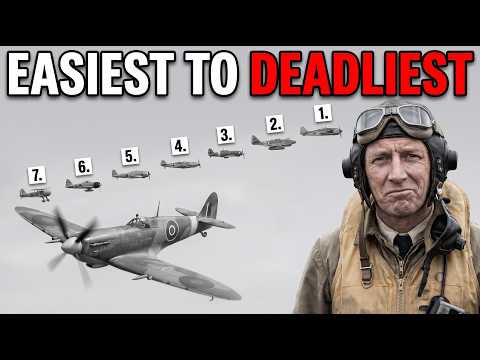
The Spitfire faced dozens of enemy types, from Italian biplanes to German jets. I’m ranking the seven that actually defined its combats, from easiest kill to deadliest. The rule is simple: in every fight, someone decides when it starts, where it starts, and when it ends. The easiest opponents were forced to fight on the Spitfire’s terms. The deadliest made the Spitfire fight on theirs.
So first, what are the Spitfire’s terms? Look at that wing. Thin, broad, elliptical, huge for the weight it carries. That meant the Spitfire could turn tighter than almost any fighter in Europe without losing balance in the air. If an enemy got behind a Spitfire and tried to follow, the Spitfire often turned inside, got behind his tail, and stayed there.
But turning is a strange weapon. It only works if the other side agrees to turn with you. Aerial combat in a circle is a contract between pilots. The Spitfire’s best fights were the ones where the enemy signed that contract. Every aircraft on this list is really an answer to one question: could it refuse to sign?
Our first opponent couldn’t. In the late 1930s, the Luftwaffe built an entire philosophy around a twin-engine heavy fighter called the Messerschmitt Bf 110. They called it the Zerstörer—the Destroyer. The idea looked brilliant on paper: a large twin-engine fighter that could fly long ranges, carry a second crewman to guard the tail, and pack a nose full of firepower—two 20mm cannons and four machine guns. It was supposed to escort bombers and sweep enemy fighters from the sky.
Here’s the hidden price. Everything that made the 110 strong also made it heavy. Two engines, two men, extra fuel, a big airframe—all of it made it slow to roll, slow to accelerate, and slow to turn. It handled like a bus compared to a single-seat fighter. And the man guarding the tail had only one rear machine gun to stop anything attacking him.
In the summer of 1940, over southern England, the Zerstörers met Spitfires and Hurricanes. A Spitfire attacking from the side or rear didn’t need extraordinary skill. It just had to stay in the turn. The 110 crews responded with a defensive circle, each plane guarding the tail of the one ahead. The fighter meant to protect bombers was now flying in a ring to protect itself. It wasn’t long before Bf 109s were ordered to escort the escorts.
That’s why the Bf 110 comes last. If it met a Spitfire head-on, its nose could shred it in a second—but it couldn’t escape or outturn, so it rarely had the freedom to choose. And here’s the irony: the same weight that made it a target in daylight made it valuable at night, where there was room for radar, a radar operator, and heavy cannons to hunt bombers in the dark. It wasn’t a bad machine. It was forced into the wrong job.
Now, let’s flip the equation entirely. What happens when the enemy can outturn a Spitfire with ease?
In Burma, the Japanese Army’s main fighter was the Nakajima Ki-43 Hayabusa. The Allies called it “Oscar.” Japanese designers pushed the limits of weight-saving to the extreme. The Ki-43 was so light and agile that it could turn inside a Spitfire’s circle with ease. If you followed an Oscar in a tight turn, you’d end up the one being chased.
So why is it near the bottom? Because lightness has a price, and Oscar paid it in full. It carried only two machine guns. Early versions flew without armor behind the pilot and with fuel tanks that didn’t self-seal if hit. A burst from a Spitfire that a German fighter might survive would set an Oscar ablaze.
When Spitfires finally reached the Burma front in late 1943, their pilots learned the solution quickly. Don’t get into a turning fight. Keep your speed, dive from above, fire, then use your speed to climb away before the Oscar can turn. Oscar could win the turning fight, but it couldn’t stop the Spitfire from refusing that kind of fight—and it couldn’t take a hit. If you broke the rule, it punished you. But the Spitfire still decided how the fight began.
So the heavy fighter loses because it can’t turn. The light fighter loses because it can’t take damage. What about an enemy right in the middle?
In March 1942, Spitfires took off from the deck of HMS Eagle to the besieged island of Malta, later joined by others from the American carrier USS Wasp. Malta was being bombed almost daily. Waiting for them was the Macchi C.202 Folgore—the Thunderbolt. The Folgore’s story is a clever example of adaptation. Its designer, Mario Castoldi, had an excellent airframe in the earlier C.200, but Italian engines weren’t powerful enough. So the C.202 took the Daimler-Benz inline engine, built under license in Italy, and fitted it into a sleek Italian airframe. The result was a fighter with superb handling, a strong dive, and the ability to match the Spitfire V in many situations. A skilled Folgore pilot could stay with a Spitfire.
Then what? Here’s the weak point behind the strength. The Folgore’s main armament was two 12.7mm machine guns in the nose, with smaller guns in the wings added later. The Spitfire V typically carried two 20mm cannons and four machine guns. Imagine two pilots each getting a three-second burst. One fires a handful of heavy bullets; the other fires explosive cannon shells. Spitfires over Malta returned to base with holes. The Folgore often caught its prey but couldn’t finish it.
So the Folgore ranks above the Oscar and the Bf 110. It could choose its fights. But what it couldn’t do was finish them.
Now we reach the opponent most people put first—and I think they’re wrong. The Messerschmitt Me 262 was the first jet fighter to enter combat in real numbers. It was about 100 mph faster than the piston-engine fighters around it and carried four 30mm cannons in the nose. A few shells could destroy a four-engine bomber. By our own rule, it should win. A jet that fast could refuse almost any fight. It could arrive when it wanted, fire, and leave. No Spitfire could chase it in a straight line.
But look at what the jet was actually doing. Its job was to destroy bombers, not to dogfight Spitfires. Its engines were made of rare materials and had a lifespan of only a few hours. Pilots had to move the throttle gently or risk the engine catching fire. At low speed, the jet accelerated slowly, which meant its most dangerous moments were takeoff and landing. Allied pilots learned to wait near airfields and catch them when they were slow and low. About 1,400 were built, but only a fraction were operational at any time. Most Spitfire pilots never fired at one. And sometimes the encounter ended the other way. On October 5, 1944, near Nijmegen in the Netherlands, five Canadian pilots from 401 Squadron jointly shot down an Me 262—the first jet credited to Spitfire pilots.
So the jet is the most terrifying machine on this list, but it’s not the deadliest opponent. For bombers, it was a nightmare. For Spitfires, it was mostly a fleeting frustration that rarely stayed to fight. Refusing combat is not the same as winning it.
And that leads us to an opponent that won one of the Spitfire’s worst days—and did it in a way nobody expected.
By early 1943, Darwin in northern Australia had been bombed repeatedly, so Britain sent Spitfires. In January 1943, three squadrons—No. 54 RAF and Nos. 452 and 457 RAAF—moved to the Darwin area. They flew Spitfire VCs shipped from Britain, led by Wing Commander Clive Caldwell, a prominent Australian pilot from North Africa. The expectations were simple: this was the fighter that had beaten the Luftwaffe. Surely it would dominate the Zero.
At first, that seemed true. In the first major clashes in March, Spitfires shot down several Japanese aircraft with limited losses. Then came the second of May, 1943.
About twenty Japanese bombers arrived, escorted by roughly twenty Zeros. They came from high altitude. To meet them, Caldwell wanted his wing properly formed so it could hit the raid as one force. Climbing an entire wing to the altitude the Japanese were using took time and fuel. By the time the Spitfires reached the enemy, the bombs had already fallen, and the Japanese were turning for home over the sea.
Now look at who chose the terms of the fight. The Japanese set the altitude, the timing, and the direction of combat out over the water, far from Spitfire bases. Every minute the Spitfires spent chasing the Zeros was a minute of fuel they would need to get home. The fight drifted out toward the sea.
The Spitfires claimed six Japanese aircraft destroyed and four more probable, but five Spitfires were shot down and two pilots killed. Then came the real losses. Eight more Spitfires had to force-land due to engine failure or because their fuel ran out. Some of the engine trouble came from propeller controls that failed in the cold at high altitude. Six of those eight were later recovered, but that day the famous Spitfires crashed without the enemy needing to shoot down most of them.
One pilot who ran out of fuel was Flight Sergeant Ross Stagg of No. 452 Squadron. He realized he didn’t have enough fuel to return, so he landed his Spitfire in the sea about 18 kilometers off the coast and rowed his dinghy toward land. Then he walked. For sixteen days he headed east toward Darwin without food or water until an Aboriginal man found him on the seventeenth of May.
The result caused real public anxiety in Australia. This is the part people forget. The Zero was not better than the Spitfire in a direct comparison. Like the Oscar, it was light, fragile, and unarmored, and it burned when hit. What it had at Darwin was the choice of combat conditions, flown by experienced naval pilots who used the Spitfire’s own fuel gauges against them.
Once the wing changed tactics—avoiding the turning fight and managing fuel instead of chasing far out to sea—those tactics worked against later raids. That’s why the Zero ranks third. Not for what it was, but for what it forced the Spitfire to do.
So who can beat that? Who could choose the conditions of battle more often, in more places, and for longer? The answer is the enemy the Spitfire was born to fight.
The Messerschmitt Bf 109 and the Spitfire are really two expressions of the same idea: the smallest airframe around the most powerful engine, a racehorse built for speed and climb. In the Battle of Britain in 1940, the Spitfire I and the Bf 109E were close enough that the pilot was often more important than the machine. The 109 tended to climb and dive better. The Spitfire turned harder, and the side that started with altitude usually won.
But the 109 had one trick RAF pilots hated. Its Daimler-Benz engine used fuel injection. The Spitfire’s Merlin used a float carburetor. When a 109 pilot pushed the stick forward to dive away, negative G didn’t affect his engine at all. When a Spitfire pilot did the same to follow, the fuel pulled away from where it was needed, and the Merlin coughed and cut out for a moment. In a dogfight, that moment was enough to lose the target—or worse.
The most famous fix was a small, simple restrictor in the fuel line. Designed in early 1941 by an engineer at the Royal Aircraft Establishment named Beatrice Shilling, pilots called it “Miss Shilling’s orifice.” It wasn’t a perfect solution, but it was a perfect example of combat complaints turning into engineering fixes.
The 109 had its own price. It was built for a short war over nearby skies. Over London in 1940, it had only minutes to fight before fuel forced it home. It was a fast racehorse. But it couldn’t stay in the race for long.
So why does it rank second? Because the 109 met the Spitfire everywhere—over the Channel, Malta, the desert, Italy, Normandy, and Germany. Every new Spitfire model answered a new 109 model, and every new 109 answered back. About 34,000 were built, more than any other fighter in history. And some of the most experienced fighter pilots ever flew it. When a 109 came out of the sun, it was the one choosing. And it chose thousands of times.
But the 109 remained a racehorse fighting another racehorse, and the race was usually close. What if the Germans built something that wasn’t a racehorse at all?
That brings us back to autumn 1941 and those angry pilots. At Focke-Wulf, designer Kurt Tank had a different philosophy. He later said he saw fighters like the 109 and Spitfire as racehorses, and he wanted something more like a cavalry horse—a tough fighter that could take punishment, operate from rough airfields, and be flown forcefully by ordinary pilots. The result was the FW 190.
Look at what Tank chose: a BMW radial engine, air-cooled, meaning no vulnerable radiator and cooling system that a single bullet could destroy; heavy armament with cannons in the wings and machine guns above the engine; and above all, controls that stayed light at high speed. That last choice is the key to this entire ranking, because the Spitfire’s controls did not stay light. At high speed, its ailerons stiffened. Rolling from one direction to another took more effort the faster you went. The FW 190 could roll sharply and instantly.
In combat, that meant the 190 could change direction, chase you, or roll and dive away before you could react. It wasn’t forced to follow your turn. It could simply leave the circle.
In August 1941, the first FW 190s reached II Gruppe of JG 26 in France. By September, they were in combat in growing numbers. RAF pilots returned describing a new radial-engine fighter, and for months the official explanation was that the Germans were using old Curtiss Hawks captured from the French. The pilots didn’t believe it. Johnny Johnson, who would become one of the RAF’s most famous aces, later wrote about how angry they were at Intelligence’s attempts to downplay the new fighter.
Here’s a strange detail. On September 18, 1941, the commander of II Gruppe, Hauptmann Walter Adolph, was killed in an air battle with Spitfires. Most likely a pilot from No. 41 Squadron, Cyril Babbage, shot him down, describing his victim in the combat report as a “Curtiss Hawk” or possibly an “FW 190.” So someone in the RAF was already writing down the right name. But the official picture hadn’t caught up yet.
Meanwhile, the numbers were becoming alarming. In September 1941 alone, FW 190 pilots claimed eighteen Spitfires shot down for the loss of only two of their own. Those were wartime claims, exaggerated on all sides, but the trend was clear.
Now the deeper problem. The Spitfire V, the RAF’s main fighter at the time, was essentially a 1940 airframe with a stronger engine and better weapons. Against the Bf 109F, it was competitive. Against the FW 190A, the German fighter was superior in almost everything that gives a pilot control of the fight: speed, climb, dive, and roll. The Spitfire still had one advantage. It could outturn the Focke-Wulf.
And here is exactly where the cruelty of our rule appears. Turning only matters if the enemy turns with you. FW 190 pilots simply didn’t. They would drop from above, fire, then use speed and roll to get away before the Spitfire could use its turning advantage. You could outturn a 190 all day. It simply wouldn’t stay in the circle with you.
Worse, the RAF didn’t fully grasp how bad things were. In the first six months of 1942, Fighter Command lost 259 Spitfires over France. Its pilots claimed 197 German aircraft in return, which looked like an acceptable exchange. But actual Luftwaffe losses in that period were only 59 aircraft. Nobody was lying. In fast combat, smoke and a falling enemy look exactly like a confirmed kill, and several pilots could claim the same victory. But it meant the RAF was losing about four Spitfires for every German aircraft—while believing the exchange was roughly even.
The RAF desperately wanted a 190. If they could fly one, they could reveal its weaknesses. Plans were drawn up for a bold commando raid into France to steal one and bring it home by air. And on the very day that proposal was submitted, the problem solved itself.
On June 23, 1942, Oberleutnant Armin Faber, an adjutant of III Gruppe of JG 2, got special permission for a combat mission. Over Devon, his formation clashed with Czech-manned Spitfire squadrons escorting a bombing raid. Faber shot down a Czech pilot, František Trejtnar, who bailed out wounded. That same midday, the Czechs lost their wing commander, Alois Vašátko, killed when his Spitfire collided with an FW 190 over the sea.
Faber came out of that fight disoriented. He flew north, thinking he was heading south. He mistook the Bristol Channel for the English Channel, saw land, decided south Wales was France, and headed for the nearest airfield. That airfield was RAF Pembrey. He reportedly celebrated with a victory roll, lowered his gear, and landed. Pembrey was a training base. The duty pilot, Sergeant Jeffreys, had nothing but a flare pistol within reach. He ran out, jumped onto the wing of the FW 190 as it taxied, and captured Faber with it.
For ten months, the RAF had been losing pilots to a machine it couldn’t study. Now it had one, intact, delivered by its own pilot.
The FW 190 A-3 was repainted in RAF colors and given the serial MP499. At Farnborough and then at the Air Fighting Development Unit at Duxford, British pilots flew it against their own fighters. The verdict confirmed what the squadrons had been saying all along. Against the Spitfire VB, the FW 190A was superior in everything except the turning circle. But the tests revealed something else too. The Focke-Wulf’s performance fell off at high altitude—and Britain already had a nearly ready answer for exactly that.
Rolls-Royce had developed a new Merlin with a two-stage supercharger, essentially a second compressor that kept the engine producing power in thin air. The RAF put that engine into the Spitfire V airframe and called it the Spitfire IX. It was meant to be a quick, temporary fix until better designs matured. It entered squadron service in July 1942, and at Duxford it was flown in mock combat against the captured Focke-Wulf. For the first time, the gap began to close.
But a solution on paper is not a solution in the sky. Only a handful of squadrons had the Mark IX, and two months later the RAF threw almost everything it had into the largest test yet.
On August 19, 1942, Allied troops—mostly Canadian—landed at the French port of Dieppe. Above them, Fighter Command wanted more than cover. They pushed for a raid on a French port specifically to force the Luftwaffe into a major battle where the RAF expected to have the advantage. About 2,500 sorties flew that day. Most squadrons flew Spitfire Mark Vs. Only six flew the Mark IX.
The FW 190s of JG 2 and JG 26 were waiting. The Germans chose their engagement positions from bases above their own coast. Focke-Wulfs hit the Spitfires, then the bombers and ships withdrew. The RAF lost 106 aircraft that day. At least 32 were lost to flak or accidents, but the rest fell in skies swarming with Focke-Wulfs. It was the RAF’s worst single-day loss of the entire war. The Luftwaffe lost 48 aircraft, many of them bombers attacking ships. JG 2 lost fourteen FW 190s; JG 26 lost six. RAF pilots claimed nearly double the real German losses.
So here is first place. The deadliest opponent the Spitfire faced was the FW 190A in 1941 and 1942. But beware the tempting conclusion that one German fighter simply beat one British fighter. Look at where these battles happened. Over France, the RAF was on the offensive. Its pilots flew across the Channel, fought over enemy territory, then had to return on damaged aircraft and dwindling fuel. A German pilot who bailed out over France could be flying again within days. An RAF pilot who bailed out was usually captured. German radar and ground observers could vector Focke-Wulfs into position with altitude and sun behind them. In other words, the FW 190 wasn’t just a better aircraft in that moment. It was a better aircraft fighting on terms the RAF had chosen to accept—and those terms didn’t last long.
Through the rest of 1942, the Allies kept losing two aircraft for every German one, but more Spitfire Mark IXs arrived. Then came Griffon-engine Spitfires and American pilots in huge numbers. Germany kept building Focke-Wulfs, and later versions like the long-nosed D-9 were superb, but the experienced pilots who made the 190 lethal in 1942 were being killed faster than they could be replaced. Training was cut and fuel ran out. By 1944, the magnificent Focke-Wulfs were mostly flown by young men with a fraction of the training of the pilots who had shot down Spitfires over Dieppe.
So look at the whole list. The Bf 110 had to fight any battle the Spitfire forced on it. The Oscar could outturn it but couldn’t survive a mistake. The Folgore could catch it but couldn’t finish the kill. The jet could refuse any fight but rarely initiated one. The Zero turned the Spitfire’s own fuel tanks into a weapon against it. Bf 109 pilots chose the moment of attack more often, in more places, than any other enemy. And the FW 190 made the Spitfire’s greatest strength—that magnificent turning ability—almost irrelevant. The more an enemy could refuse the Spitfire’s terms of engagement, the deadlier it became.
And here’s what that means for the Spitfire itself. The aircraft that turned so brilliantly in 1940 didn’t survive the war by learning to turn better. It survived because engineers kept giving it the ability to climb higher and fly faster so its pilots could choose the conditions of combat again. The Spitfire IX wasn’t a better dogfighter. It was a Spitfire that could refuse the 190’s terms.
Which brings us back to the beginning. Autumn 1941, a room full of furious pilots and an intelligence officer explaining that the new radial-engine fighter was just an old Curtiss Hawk. It was the wrong explanation, but it wasn’t a stupid one. It was what people believe when the alternative is admitting that the best fighter they have has just been outclassed. The FW 190 deserves the top spot not because it was fast or powerful or heavily armed—though it was all of those things—but because it imposed its terms in nearly every fight for about a year, so thoroughly that the RAF didn’t dare speak its name.
So what do you think—was the Spitfire truly outclassed in 1941, or was it the pilots and the terms of engagement that made the difference? And which of these seven opponents would you have feared most?
Report this article
Select a reason for reporting:






