The color film flickers to life, and for a moment, the war seems almost like a holiday. German soldiers lounge on the sun-scorched steppe, playing cards, posing with their rifles, their faces relaxed and confident. They assemble pontoon bridges with the casual ease of men who believe the enemy is already beaten. The road ahead looks clear—but this is merely the calm before the most devastating storm in human history.
These rare frames, captured by combat cinematographer Hans Bastanier on Agfacolor film, offer a chilling glimpse into the overconfidence that gripped the Wehrmacht in the summer of 1942. The soldiers laugh and smoke, utterly unaware that ahead lies Stalingrad, a name that will soon become synonymous with hell on earth.
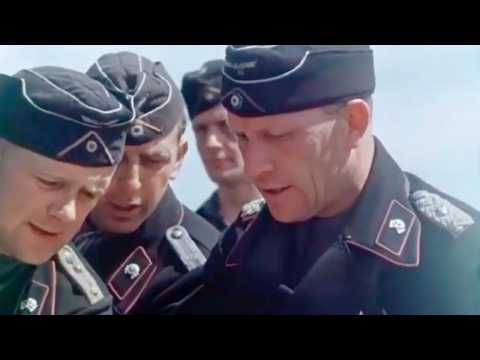
The German offensive strategy was a masterpiece of maneuver warfare: maximum speed, minimal frontal engagement. Motorized spearheads raced across the open steppe, bypassing strongpoints, while the Luftwaffe methodically pulverized anything that could slow the advance. “The enemy appears defeated,” one soldier might have thought. But the vast southern steppe, so ideal for rapid movement, also offered no cover from the growing storm.
Columns of Soviet prisoners trudged across the scorched earth, nameless and broken, many never reaching the camps. “Those who fell behind were executed,” the narrator notes, a grim reminder of the brutality that accompanied the German advance. Yet for the men in the color footage, the war still seemed winnable—even easy.
By mid-July 1942, the Sixth Army under Paulus, backed by Hoth’s Fourth Panzer Army, had pushed to the Don River. The 62nd and 64th Soviet Armies, bloodied but unbroken, fought desperate delaying actions. “The German plan for a rapid breakthrough to the Volga had failed,” and every day of delay bought precious time for the Red Army to fortify Stalingrad’s approaches.
On August 23, the 14th Panzer Corps crossed the Don and reached the Volga, cutting off the 62nd Army. The siege had begun—and the cheerful soldiers in the color film would soon discover that the easy victories were over. The storm they had ignored was about to break.
Within days, the color footage turns from postcard to prophecy. Bastanier’s lens catches the shift: fewer card games, more smoke on the horizon. The 16th Panzer Division’s dash to the Volga on August 23 was followed almost immediately by the war’s first great terror—the Luftwaffe’s massive bombing raid that reduced much of Stalingrad’s wooden districts to ash in a single afternoon. The same air power that had brushed aside rivers now turned a city into a furnace.
What the confident soldiers on the steppe had not understood was that Stalingrad was not a prize to be taken but a trap being set. “Not a step back” —Order 227, issued July 28, had transformed the city’s defense into an existential command. Every factory, every ruined apartment block, every cellar became a fortress. The 62nd Army, though cut off, dug in with a ferocity that stunned German commanders.
The German assault on the city itself began in earnest in early September. Chuikov’s troops fought from the rubble with a simple, brutal calculus: the closer the enemy, the less the Luftwaffe and artillery could help them. Fighting was reduced to grenades, bayonets, and basement-to-basement slaughter. The color film, if it captured this phase, would show no lounging soldiers—only dust, exhaustion, and the slow realization that the easy war was over.
Reinforcements kept arriving from both sides, but the Red Army had something the Germans lacked: an unbroken flow of fresh divisions from the Volga’s far bank, crossing at night under fire. The city was being fed even as it burned.
And far to the rear, in factories beyond the Urals, the machines of future victory—T-34s, IL-2s, Katyushas—rolled off the lines by the thousand, waiting for their moment.
The color reel jumps forward, and the steppe is gone. In its place: a moonscape of broken brick and twisted steel. Bastanier’s camera pans across the northern suburbs, where the 16th Panzer Division had raised a swastika over the Volga on that August afternoon. The flag is still there, but everything around it has changed. Smoke rises in columns so dense they blot out the sun, and the river itself seems to boil.
What the confident soldiers on the pontoon bridges could not have imagined was this: fighting not for kilometers, but for stairwells. For a single room. For a heap of rubble that had once been a living room. The Germans called it Rattenkrieg—the rat war—and it swallowed entire divisions whole.
Chuikov’s headquarters sat barely a few hundred meters from the German front line, dug into the bank of the Volga itself. From there, he issued a command that has echoed through military history: “We will defend the city or die in the attempt.” The 62nd Army was not merely cut off—it was fighting with its back to the water, supplied by night boats that ran a gauntlet of fire.
By mid-September, the fighting had shifted to the Mamayev Kurgan—the Tartar burial mound that dominated the city’s skyline. Whoever held the hill held the city. The Germans took it. The Soviets took it back. It changed hands fifteen times in a single week. Each assault left the slope littered with bodies frozen in the postures of their last moments.
Bastanier’s lens, if it survived this phase, would have caught the faces of men who no longer recognized the war they had trained for. The Panzer crews who had raced across the steppe now found themselves fighting dismounted, room by room, against an enemy who seemed to rise from the earth itself.
And still, from the far bank, fresh troops crossed the Volga at night. The city was burning, but it would not fall.
By November, the color film stock had grown scarce, and Bastanier’s footage becomes fragmented—grainy glimpses of exhausted infantry huddled in cellars, of tanks frozen white with frost. The first snows arrived early that year, and with them came a silence that unsettled the veterans. The soldiers who had once played cards on the sunny steppe now stared eastward at a horizon that seemed to hold nothing but ruin.
On November 19, the silence broke. Soviet artillery thundered from the north—Operation Uranus, the counteroffensive the Germans had never believed possible. “They came out of the fog and snow like ghosts,” one survivor later recalled. Romanian and Hungarian flanks collapsed within hours.
Within four days, the two Soviet pincers met at Kalach, sealing the Sixth Army in a cauldron 50 kilometers wide. The men who had marched so confidently toward the Volga now found themselves surrounded by it, starving in the frozen ruins they had fought so hard to take.
Göring promised an air bridge. It delivered a fraction of what was needed. “The Luftwaffe that once darkened the sky over Stalingrad could no longer keep a single airfield open,” and the cauldron shrank week by week. Bastanier’s color reels, if any survive from this period, would show only white—snow, frostbite, and the endless steppe where relief armies never came.
On February 2, 1943, the last German troops in Stalingrad surrendered. Field Marshal Paulus, promoted to that rank only days before to prevent him from surrendering as a lesser officer, was captured alive. Of the 91,000 men taken prisoner, fewer than 6,000 would ever see Germany again.
The cheerful soldiers on the pontoon bridges, the card players on the sunlit steppe—they had marched into a trap of their own making. The color film ends there, mid-frame, as if the cameraman simply stopped filming and walked away.
But history did not stop. The victory at Stalingrad turned the tide of the entire war. The Red Army, bloodied and nearly broken in the summer of 1942, would never again retreat as it had. From the Volga to the Elbe, the road now led west.
What do you think—was Stalingrad the true turning point of World War II, or had the tide already begun to turn months earlier? Share your thoughts in the comments below.
Report this article
Select a reason for reporting:






