The basement of the Boston Historical Society smelled of old paper and forgotten time. Laura Bennett had spent three years cataloging donations—stiff-backed gentlemen, Sunday-best children, porch gatherings—each photograph a small portal into the past. On a cold February morning in 2024, she opened a box labeled simply Estate Sale, Beacon Hill.
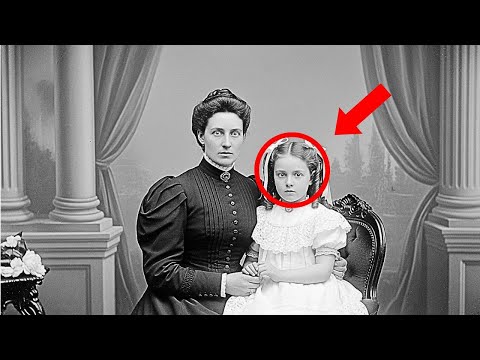
Beneath yellowed tissue paper lay dozens of late-19th-century portraits. Her hand paused on one: a professionally taken studio portrait marked Whitmore and Sons Studio, Boston, 1897. A woman in her early thirties, dressed in an elaborate dark gown with a high collar, sat in a velvet chair. On her lap, a girl of seven or eight in a white lace dress with ribbons in her curled hair. The backdrop showed painted columns and draped curtains. Everything spoke of prosperity and respectability.
But something was wrong.
Laura brought the photograph closer to the fluorescent light. The mother and daughter were smiling—or rather, their mouths were arranged into the semblance of smiles, the way photographers of that era demanded. Yet their eyes told a completely different story.
The mother’s eyes were wide, almost unnaturally so, with a fixed quality that suggested not serenity, but barely controlled panic. There was a tightness around them, a tension in the muscles of her face that contradicted the gentle curve of her lips. And the little girl—Laura felt a chill run down her spine—the little girl’s eyes held a look of pure, silent terror. Her small hands gripped her mother’s arm with desperate force, her tiny fingers white against the dark fabric.
Laura had examined thousands of Victorian photographs. She knew the conventions: long exposure times, uncomfortable formal clothing, the general unease before cameras. But this was different. This was not the stiffness of Victorian formality. This was fear captured and preserved for more than a century.
She turned the photograph over. On the back, in faded pencil, someone had written: Elizabeth and Clara, March 1897. May God forgive us.
Laura’s heart quickened. She took high-resolution photographs of the portrait, zooming in on the faces, the hands, every detail. Then she opened her laptop and began to search the historical society’s digital archives for any mention of Elizabeth and Clara from 1897 Boston.
The names were frustratingly common. Without a last name, she had little to work with. But the studio mark was her best lead. After an hour of digging through business directories and old newspaper advertisements, she found it: Whitmore and Sons had operated on Tremont Street from 1889 to 1902, catering to Boston’s wealthy elite. The clothing offered more clues—the mother’s dress with its leg-of-mutton sleeves was expensive and fashionable for 1897. The little girl’s white dress spoke of wealth; white clothing was impractical and required servants to maintain. These were not middle-class Bostonians. They were from the upper echelons of society, likely residents of Beacon Hill or the Back Bay.
If they were wealthy, there might be records. Laura opened the digitized archives of the Boston Globe and began searching editions from 1897, focusing on the social columns. For hours, she scrolled through microfilm scans—charity events, dinner parties, arrivals and departures. Then, in the March 15, 1897 edition, she found something that made her sit up straight. A small notice buried on page 7:
Mrs. Elizabeth Ashworth and daughter Clara have departed the city for an extended rest. Mrs. Ashworth’s health has been delicate of late, and the family seeks the restorative benefits of country air.
Ashworth. Finally, a last name.
Laura’s fingers flew across the keyboard. William Ashworth was listed in the 1895 city directory as a banker with a residence on Mount Vernon Street in the heart of Beacon Hill. He served on the boards of multiple charitable organizations and was frequently mentioned in connection with the city’s financial elite. But after that brief March 1897 notice about Elizabeth and Clara’s departure, the mentions of Elizabeth vanished from the society pages. William Ashworth continued to appear at bank meetings, charitable events, gentlemen’s clubs—but always alone. No wife accompanied him. No daughter was mentioned.
Laura pulled out a notepad and began to list what she knew. Elizabeth and Clara had their portrait taken in March 1897, possibly just before leaving the city. The photograph showed clear signs of distress. Elizabeth’s health was described as delicate—a Victorian euphemism that could mean anything from genuine illness to depression to something far darker. And then both mother and daughter seemed to disappear from Boston society entirely.
She glanced at the clock. Nearly six in the evening; the historical society would close soon. But she knew she wouldn’t be able to sleep without learning more. She gathered her notes, carefully placed the photograph in an archival sleeve, and made a decision. Tomorrow, she would visit the Massachusetts State Archives. If Elizabeth and Clara Ashworth had met with tragedy, there would be records—death certificates, asylum admissions, court proceedings. The story hidden in those terrified eyes was waiting to be uncovered, and Laura was determined to find it.
The Massachusetts State Archives occupied a modern building in Dorchester, its climate-controlled rooms a stark contrast to the dusty basement where Laura usually worked. She arrived early Wednesday morning, armed with her notebook, the photograph, and a list of record types: vital records, asylum admissions, and court documents from 1897 to 1900.
The archivist at the front desk, a middle-aged man named Robert, examined her research request with interest. “The Ashworth family from Beacon Hill,” he said, adjusting his glasses. “That’s a name I haven’t heard in years. What’s your angle?”
Laura showed him the photograph. “I’m trying to find out what happened to this woman and her daughter. They disappeared from public records in March 1897.”
Robert studied the image, his expression growing somber as he noticed the fear in their eyes. “Victorian Boston had ways of making inconvenient women disappear,” he said quietly. “Let me pull what we have.”
An hour later, Laura sat at a research table surrounded by document boxes. She started with death certificates, hoping she wouldn’t find what she was looking for. She scanned dozens of entries from March through December 1897, her finger tracing down columns of names. No Elizabeth Ashworth. No Clara Ashworth. Relief mixed with frustration—they hadn’t died, at least not in Massachusetts in 1897. But that meant they had gone somewhere else.
She moved to the asylum records. Massachusetts had several institutions in the late 19th century where wealthy families could quietly commit troublesome relatives: McLean Hospital in Belmont, the Boston Lunatic Hospital, the Taunton State Hospital. The admission ledgers were incomplete, many pages damaged or missing, but Laura worked through them methodically.
In the McLean Hospital ledger for April 1897, she found it.
Elizabeth Ashworth, age 32, admitted April 12, 1897. Committed by husband William Ashworth. Diagnosis: hysteria and melancholia. Patient displays agitation and makes unfounded accusations against family members.
Laura’s hands trembled as she photographed the page. Hysteria—the catch-all diagnosis Victorian doctors used to dismiss women’s inconvenient complaints. And unfounded accusations. What had Elizabeth tried to tell people? What had she accused her husband of?
She searched for any record of Elizabeth’s release or transfer, but found nothing. The ledger simply stopped mentioning her after June 1897. No discharge date. No death recorded. Elizabeth Ashworth had entered McLean Hospital and vanished from official records.
But what about Clara? Laura’s stomach tightened with dread as she turned to the juvenile records. If William Ashworth had committed his wife to an asylum, what had he done with their seven-year-old daughter?
The records for the Boston Female Asylum, an institution that housed orphaned and dependent children, provided the answer.
Clara Ashworth, age 7, admitted March 20, 1897. Father unable to care for child due to mother’s illness. Child is quiet and compliant, but suffers from nightmares.
March 20—just days after the photograph was taken, and weeks before Elizabeth was committed to McLean. William Ashworth had separated them almost immediately.
Laura sat back, piecing together the timeline. Something had happened in the Ashworth household in early March 1897. Elizabeth had taken Clara to Whitmore and Sons to have their portrait made—a portrait that captured their terror in a way words never could. Within days, Clara had been placed in an orphanage. Within weeks, Elizabeth had been committed to an asylum for making unfounded accusations.
The photograph hadn’t been a typical family portrait. It had been evidence. Elizabeth had known what was coming, and she had created a record of their fear—a silent testimony preserved in silver and paper.
Laura needed to find out what happened next. She needed court records, property transfers—anything that would tell her how William Ashworth had managed to erase his wife and daughter from his life so completely. And she needed to know if Clara had survived, if she’d ever been reunited with her mother, if anyone had ever believed them.
She spent the next two days buried in property records and legal documents at the Suffolk County Registry of Deeds. The trail of William Ashworth’s financial dealings painted a picture of a man who valued control above all else. In 1893, William had inherited his father’s banking firm, Ashworth and Company, along with the Mount Vernon Street mansion. The business had been prosperous, handling accounts for some of Boston’s wealthiest families.
But Laura found something odd in the ledgers. In early 1897, just weeks before Elizabeth and Clara’s photograph, several of the bank’s largest clients had quietly withdrawn their accounts. She cross-referenced the names with newspaper archives and found a small item in the Boston Herald from February 1897:
Several prominent families have elected to transfer their banking relationships following concerns about management practices at Ashworth and Company. Mr. William Ashworth declined to comment on the matter.
What kind of concerns? Laura searched for more details but found only vague references to irregularities and questions of propriety. In Victorian Boston, such euphemistic language could mean anything from minor accounting errors to serious fraud.
Then she found the court records. In June 1897, two months after Elizabeth was committed, three former clients had filed a civil suit against William Ashworth, alleging misappropriation of funds. The case had been quietly settled out of court, with all parties agreeing to seal the records. Whatever William had done, someone with power and money had helped him bury it.
Laura leaned back in her chair, the pieces beginning to fit together. William had been embezzling from his clients. Elizabeth had discovered it—and when she had threatened to expose him, when she had made what the asylum records called unfounded accusations, he had used the full weight of Victorian patriarchal law to silence her.
A husband in 1897 had near-absolute power over his wife. He could commit her to an asylum without proof of illness. He could control all her property. He could deny her access to her children. And society—especially wealthy Boston society—would support him, would assume the woman was the problem, that her mind was weak, that she was hysterical.
Laura felt a surge of anger for Elizabeth, trapped in an era that gave her no voice, no protection, no way to fight back except through a photograph that documented her terror. She needed to find out what happened next. The asylum records had stopped mentioning Elizabeth in June 1897. Had she died there? Had she been transferred elsewhere? And what about Clara? Had she remained in the orphanage, or had William eventually reclaimed her?
Laura returned to McLean Hospital’s records, this time requesting access to patient death records and transfer logs. The archivist brought her a leather-bound volume marked Deceased and Transferred, 1897–1900. She found Elizabeth’s name on a transfer record dated July 15, 1897:
Elizabeth Ashworth transferred to Taunton State Hospital. Patient remains agitated and resistant to treatment. Prognosis poor.
Taunton. Laura’s heart sank. Taunton State Hospital had been notorious in the late 19th century as a place where inconvenient family members were sent to disappear. Unlike McLean, which catered to wealthy families with some pretense of therapeutic care, Taunton was overcrowded, underfunded, and had a reputation for harsh treatment. William Ashworth had moved his wife from a relatively comfortable private institution to a state asylum where she would be forgotten—where her voice would be lost among hundreds of other institutionalized women, where no one from her former life would think to look for her.
Laura made copies of every document she had found, building a case file that would have made any prosecutor proud. But she wasn’t done. She needed to follow Elizabeth to Taunton, to find out if she had survived, if she had ever escaped, if she had ever seen her daughter again. And she needed to find out what had happened to Clara.
Laura found the Taunton death register: Elizabeth Ashworth, died March 3, 1909, of pneumonia. Eleven years institutionalized—silenced, erased. Clara had been discharged to her father in 1900, aged ten, and lived as his housekeeper until she married in 1912.
Clara’s daughter, Margaret Chen, now 83, met Laura in Newton. “She never spoke of her childhood,” Margaret whispered, staring at the portrait. “But she spent her life protecting children. Now I understand why.”
Laura published their story. The exhibition drew record crowds. Margaret stood before the photograph and said, “We see you now. Both of you.”
Elizabeth and Clara finally had witnesses. But how many other silent portraits are still waiting for someone to look?
Report this article
Select a reason for reporting:






