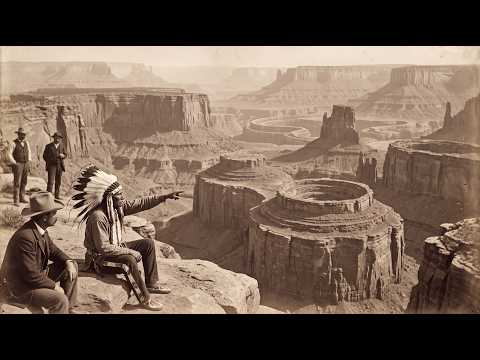
In the fall of 1873, a surveyor pressed his ear against a sealed opening in a remote canyon wall and heard something that made him write a single word: machines. That word, scrawled in a field notebook, would become the most haunting entry in the archive of John Wesley Powell—the one-armed Civil War veteran who mapped the Colorado River and ran the Smithsonian’s Bureau of Ethnology. But the story doesn’t start with Powell. It starts with a sound.
Owen Marsh, a methodical surveyor, was measuring side canyons in the Kanab Creek basin when he found a doorway-sized opening, sealed shut with a material that looked poured, not built. He didn’t interpret. He measured. And when he pressed his ear to the fill, he felt a low, rhythmic vibration—like a millstone turning far away. He wrote it down, walked back to camp, and never returned.
Weeks later, an elderly Paiute leader named Chu-ar-um-peak sat by a juniper fire with Powell and described seven chambers hidden in the northern canyons. Inside them, he said, were objects the height of a man that moved along grooves in the floor and made a sound like breathing. “They were already there,” he insisted. “When the Paiute came into this land, they were already built, already sealed.” The interpreter, Jacob Hamblin, could find only one English word for them: machines.
What makes this file so strange is that neither source knew the other existed. Marsh’s notebook and Powell’s commission notes were written independently, weeks apart. Yet they describe the same place: a smooth wall with no bedding lines, two parallel grooves that cut across the water’s flow, a sealed entrance 18 feet above the canyon floor. And the timing—Marsh pressed his ear to the stone in the last week of September, the exact season Chu-ar-um-peak said the breathing was loudest.
Powell published none of it. In the margin of Marsh’s notebook, he wrote a single word: wait. He never explained what he was waiting for. For 150 years, the file has sat in Box 41 of his papers, untouched. The wall still stands in the canyon. No one on record has ever pressed an ear to that stone again.
But there is a page in that same box that almost no one has written about, and it changes the shape of the question. It is not a notebook page. It is a single sheet of letterhead from the Hayden Survey, folded once, addressed to Powell in Washington and dated February 1874. The handwriting is cramped, hurried, and the signature at the bottom belongs to a man named Silas R. Kennard, a geologist who had spent that winter cataloguing specimens in the Hayden collection in Philadelphia.
Kennard was not part of Powell’s crew. He had no access to Marsh’s notebook. He had never met Chu-ar-um-peak. What he had was a crate.
According to the letter, a crate of unlabeled specimens had arrived at the Hayden warehouse in December 1873, shipped from a trading post near Kanab. The crate was not on any manifest. Inside were mineral samples, ordinary enough, and one object wrapped in burlap and tied with rawhide. Kennard describes it in a single paragraph, and then he apologizes for describing it at all.
The object was a curved plate, roughly the size of a man’s palm, made of a metal Kennard could not identify. It was not iron, not copper, not silver. It did not rust. It did not tarnish. And along its inner face, cut with a precision that Kennard called “beyond the reach of any tool I have seen in this country,” were grooves. Not decorative grooves. Grooves that matched, he wrote, the spacing of the parallel marks in a surveyor’s notebook he had been shown by a colleague—marks that had been described to him only in conversation, by a man who had heard them secondhand.
Kennard asked Powell one question at the end of the letter. “Is this the thing your man heard?”
There is no reply in the file. There is no record of the object being catalogued, photographed, or returned. The crate’s contents are listed in the Hayden accession book for that winter, item by item, except for one line that has been struck through so heavily that the ink has bitten through the paper. Under the strike, under a lamp held at the right angle, three words are still legible.
The words are not a description. They are a destination: “return to canyon.”
Who wrote them, and whether anyone ever did return, is not recorded. But the accession book is not the only place the object appears. In 1885, eleven years later, a clerk in the Bureau of Ethnology compiled an inventory of uncatalogued materials held in storage. The inventory is a dull document, columns and abbreviations, and in the middle of it, one entry stands out. It lists a single metal plate, “origin unverified, groove pattern noted,” and beside it, in the margin, a small check mark and two initials that match Powell’s own hand.
The initials are not a signature. They are a decision. He had seen it. He had marked it. And then, as with everything else in Box 41, he let it sit.
The question that remains is not whether the chamber exists. The question is what was in that crate, who sent it, and why a clerk in 1885 was still holding a piece of it in a storage room in Washington—while the wall in Kanab Creek, sealed and silent, waited for someone to press an ear to it again.
Here is where the file stops being a mystery and becomes something closer to a warning. The crate arrived from Kanab in December 1873, weeks after Marsh pressed his ear to the stone. Someone at that trading post knew what had been found. Someone wrapped a piece of it in burlap and sent it east without a manifest, without a name, without a word of explanation.
And Powell, who could have opened an investigation with a single letter, who commanded the two most powerful scientific institutions in America, did nothing. He marked the inventory with two initials and let the plate sit in a storage room for the rest of his life.
“Return to canyon,” the accession book said. But no one ever did.
Maybe the explanation is simple. Maybe the plate was a geological curiosity, a concretion, a shard of something ordinary that a clerk mislabeled and a geologist overdescribed. Maybe Powell was buried in budgets and reports and never gave it another thought.
But then there is the margin. The single word he wrote beside Marsh’s measurements. Wait.
Wait for what? For the breathing to stop? For the season to turn? For someone else to press an ear to that stone and hear what Marsh heard—or hear nothing at all?
The wall still stands in that unnamed side canyon, west of Kanab, where the narrow gorge bends south. The fill still looks poured. The grooves still hold their spacing. And somewhere in a storage room in Washington, if the inventory is to be believed, a curved plate of unidentifiable metal still waits for someone to ask the question Kennard asked in 1874 and no one answered.
Is this the thing your man heard?
So here is what I want to know: if you could stand in that canyon at the end of September, when the cottonwoods turn yellow and the air pressure swings and the stone is at its loudest—would you press your ear to the fill? Or would you do what Powell did, and wait?
Report this article
Select a reason for reporting:






