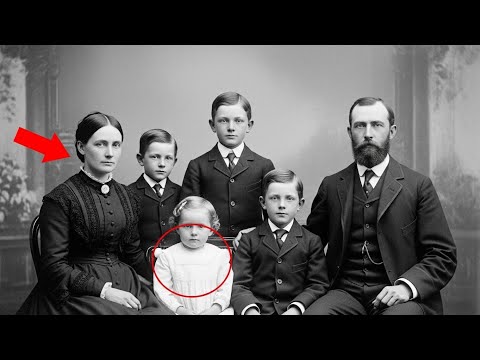
Dr. Rebecca Turner opened Archive Box 247B on a cold January morning in 2024, expecting nothing more than routine cataloging. The Massachusetts Historical Society had recently acquired the Whitman family collection—sixty photographs spanning 1870 to 1920. Standard Victorian portraits: stern faces, stiff poses, dark backgrounds. Then she reached photograph number 17.
An 8×10 print mounted on thick cardboard, labeled in faded ink: “Whitman family, October 14, 1893, Salem, Massachusetts. Hastings Studio, Essex Street.” Five figures arranged in a formal parlor. A man and woman seated, two boys standing between them, and a little girl—about six years old—in the woman’s lap. White dress, lace details, carefully styled hair with a white ribbon. Her eyes were closed.
Rebecca’s first thought: the child fell asleep during the long exposure. Common enough in 1890s photography. But something felt off. The mother’s hands weren’t cradling the child—they were positioned with surgical precision, supporting the torso, keeping it upright. The child’s skin had an unnatural texture, even for the era’s limited techniques.
This was a post-mortem photograph.
Post-mortem photography was widespread in America from 1840 to 1910. For many working- and middle-class families, it was often the only portrait they’d ever have of a deceased loved one—especially children. Rebecca cross-referenced the Thanatos Archive, a research database documenting American deathways. The evidence matched her initial assessment.
First, the child’s pose. The mother’s hands acted as a structural support, holding the body in a seated position. Photographers and families often arranged deceased children to look as if they were sleeping or resting peacefully—considered less disturbing than showing the body lying down.
Second, the date on the back. October 14, 1893 was almost certainly the date of the photograph, not the death. Families typically waited one to three days after death to arrange a post-mortem session, allowing time to notify the photographer, prepare the body, and dress the deceased.
Third, the white dress. While sometimes used for living children’s formal portraits, white was the standard color for post-mortem photographs of young girls in the 1890s. It symbolized innocence and purity—and the Victorian belief that dead children became angels.
Rebecca returned to the original print, examining it through a jeweler’s loupe at ten times magnification. Now she could see details invisible to the naked eye. No motion blur on the child’s face—unusual even for a sleeping child, who would typically shift during the 30- to 60-second exposure required by 1893 cameras. The complete absence of blur indicated absolute stillness, achievable only by the deceased.
The eyes were closed, but the eyelids appeared flat. Victorian burial practices sometimes involved placing cotton or small coins on the eyelids to keep them shut. The slight depression visible in the photograph suggested this technique had been used. Most tellingly, the child’s hands were folded on her stomach with fingers interlaced—a deliberate arrangement. A sleeping child’s hands would naturally fall to the sides or rest loosely in the lap. This formal positioning was a hallmark of corpse preparation.
Rebecca checked the studio notes again. Hastings Studio operated on Essex Street in Salem from 1889 to 1902. She cross-referenced the name with local business directories: Thomas Hastings advertised “memorial portraiture” as one of his specialties—a common euphemism for post-mortem photography.
She needed more information. Who were the Whitmans? What caused the child’s death? And why had this photograph survived for 131 years, preserved with such care until it reached the historical society’s collection?
Back at the archive box, Rebecca searched for additional materials. Beneath layers of tissue paper, she found a leather-bound book, about 5×7 inches, with a brass clasp. The cover was embossed with faded gold letters: Family Record.
She opened it carefully. The pages were fragile but intact. Inside was a genealogical record written in precise handwriting, documenting births, marriages, and deaths in the Whitman family from 1875 to 1918. Rebecca turned to 1893.
The entries were chronological, each dated and written in the same meticulous script—typical of educated women in the late nineteenth century: formal, precise, with ornate capitals and consistent spacing.
She found the entry she was looking for:
“October 11, 1893. Our beloved daughter Anna Louise Whitman passed into God’s mercy at the age of six years and four months, due to diphtheria. She died peacefully at home, surrounded by her mother, father, and brothers Thomas and William. Dr. Horace Fletcher attended. Burial at Harmony Grove Cemetery, Salem, on October 13. We ask God to have mercy on her soul.”
Three days between death and burial—typical for the period. The photograph was taken on October 14. One day after the burial.
Rebecca stared at the page, her mind racing. The child in the photograph—Anna Louise Whitman—had been buried the day before the image was made. But the body in the picture was clearly present, positioned, dressed. How was that possible?
She turned the page. Another entry, dated October 15, 1893:
“The photographer came yesterday. We could not bear to let her go without a likeness. Dr. Fletcher arranged everything. She looked so peaceful, like an angel. We will treasure this always.”
Rebecca’s hands trembled. Dr. Fletcher arranged everything. But Anna had been buried on October 13. Unless…
She flipped back to the burial entry. Something was wrong. The date of burial—October 13—was written in a different ink. Lighter. Almost as if it had been added later.
Rebecca pulled out her phone and searched for Harmony Grove Cemetery records. The database confirmed: Anna Louise Whitman, buried October 13, 1893. But there was a note in the margin: “Disinterred October 14, 1893, for photographic purposes. Reinterred October 15, 1893. Authorized by Dr. Horace Fletcher.”
Disinterred. They had dug up the child’s body for a photograph.
Rebecca sat back, her heart pounding. This wasn’t just a post-mortem portrait. This was something far more disturbing—a violation of the grave, sanctioned by a doctor, carried out by a family unwilling to let go. And the photograph had survived, hidden away for over a century.
But why? What was the secret that the Whitman family had protected for so long? And what had Dr. Fletcher really done?
Rebecca turned to the next page of the diary. The handwriting changed—no longer the mother’s neat script, but a shakier, more hurried hand. It was dated October 16, 1893:
“God forgive us. She moved.”
Rebecca read the line again. “God forgive us. She moved.” The words sat on the page like a confession, the ink pressed hard enough to score the paper. She turned to the following entry, her breath shallow.
The mother’s hand had returned, but the script was no longer neat. It was jagged, uneven. “Dr. Fletcher said it was only the gases. The body shifting. He said such things happen. But I saw her fingers curl. Thomas saw it too. He will not speak of it.”
Rebecca searched the next pages. A week passed in the diary with no entries. Then, on October 24, 1893: “The doctor has taken the plate and the prints. He says no one must ever see them. He says it is a mercy. I do not know what to believe.”
But the photograph in Rebecca’s hands proved the prints had survived. Someone had kept them. Hidden them. Passed them down through generations of Whitmans who never spoke of Anna Louise, who kept the leather book and the image sealed in the same box for 131 years.
Rebecca checked the final page. A single line, dated 1918, in a different hand—an older brother’s, perhaps:
“For Anna. Who came back for one photograph, and then was gone.”
Rebecca closed the book. Outside, the January wind rattled the archive windows. She looked once more at the little girl in the white dress, hands folded, eyes closed, held upright by a mother who could not let go—and wondered what the child had truly moved toward, or away from, in that parlor on October 14, 1893.
Was it grief that kept her still, or something that refused to stay buried?
Report this article
Select a reason for reporting:






