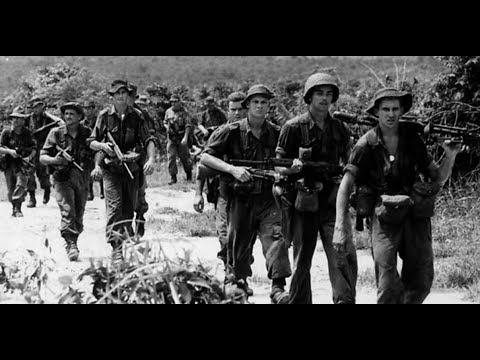
It sounds insane at first. Why would an elite soldier take a knife to his own boots and start slicing them open deep in enemy territory where every item of gear could mean the difference between life and death? But that’s exactly what many Australian SAS troopers did in the jungles of Vietnam. Before they fired their first shot, before they set up their ambushes, before they vanished into the triple canopy green, they sat down with their issued jungle boots, pulled out a blade, and cut.
They didn’t do it for comfort. They didn’t do it for fashion. They did it because they had to survive. Official issue boots—leather, high ankle, tough—looked great on parade grounds and training fields. But in Vietnam, they quickly turned into torture chambers. The jungle was wet. Not for hours, not for days, but for weeks. Constant monsoon rain soaked the ground, saturated every path, and flooded every low-lying position. And when water entered those boots, it didn’t leave.
The sealed leather and high ankle design trapped moisture inside. The soldiers’ feet stayed wet for days on end, and that’s when the jungle began to win. Wet feet meant trench foot—an infection that didn’t just hurt, it crippled. Flesh softened, skin peeled, toes swelled, blistered, cracked. And when you’re carrying 30 kg of gear through tangled undergrowth, and your feet are bleeding inside your boots, you slow down.
And in the SAS, slowing down meant the entire patrol slowed down. It meant leaving a trail. It meant risking the mission and your life. So, they adapted. Quietly, without asking permission, they began cutting their boots open. Slits on the sides, cuts around the ankle collar, small drainage holes punched into the soles. Some even removed the tongues or replaced the inner linings with rags that could dry faster.
These boots looked mangled—patched with tape, burned at the edges, held together by sheer necessity. But every cut had a reason. Every modification came from the ground truth of the jungle, not the desk of a quartermaster back home. And you know what happened? Their feet stayed drier. Not dry, but dry enough. Blisters came slower. Fungal infections were fewer. Patrols could stay out longer, move quieter, and fight harder because their boots were no longer betraying them.
In a war where rifles jammed, radios failed, and helicopters didn’t always arrive, sometimes the most important piece of gear was the one you’d already taken a knife to. From the outside, it looked like destruction, but in reality, it was innovation. From the inside, it wasn’t rebellion, it was survival. Because in the jungle, standard issue didn’t mean good enough. And for the SAS, good enough was never enough. The jungle didn’t care how your boots looked. It only cared whether you could still walk.
The Vietnamese jungle didn’t attack with bullets first—it attacked with water. Not the clean flowing kind you drink from a canteen, but the endless, creeping, rotting moisture that seeped into everything. Clothes, rucksacks, skin, and especially boots. The SAS quickly learned that in Vietnam, you don’t step into water. Water steps into you, climbing up your legs, saturating your socks, and settling into your boots like an unwanted passenger who refuses to leave.
Every patrol began with wet feet, and every patrol ended with wetter ones. Morning dew soaked boots before sunrise. Rainstorms erupted without warning, drenching everything in seconds. Rivers rose overnight, forcing patrols to wade chest deep through muddy water. Even when the sky was clear, humidity clung to the air so thickly that nothing truly dried. Not shirts, not gear, not skin, not spirits.
Inside those standard issue boots, this moisture became a slow, silent killer. Within hours, skin softened. Within a day, it wrinkled like paper soaked in oil. Within two days, it split open. And when cracks opened, the jungle filled them with bacteria, fungus, and anything else it could feed into human flesh.
This wasn’t a small inconvenience. It was a downward spiral. Soldiers didn’t just lose comfort—they lost mobility. They limped. They hesitated. Their gait changed. And in the SAS, even a subtle shift in how a man stepped could leave a detectable track or break the rhythm of the patrol. Trench foot wasn’t dramatic. It didn’t explode or scream. But it could end a mission just as effectively as an ambush.
One SAS veteran described the pain as walking on knives wrapped in fire. Another said he would rather face an NVA platoon head-on than hike one more day with soaked, rotting feet. But the war didn’t care about comfort. Missions had to be completed. Patrols had to continue. Extraction times were fixed. And if your feet gave up before you reached the LZ, no one was coming back for you.
This is why the SAS viewed moisture not as a condition, but as an enemy. An enemy that didn’t retreat, didn’t sleep, didn’t negotiate. And so they developed their own counterattack. Born not from manuals or orders, but from raw necessity. Boots had to drain, not trap. They had to breathe, not suffocate. They had to dry fast, even if that meant cutting away the very material meant to protect them.
The humidity also brought fungus. Ringworm, athlete’s foot. Infections that devoured flesh faster than any bullet. Foot powder became as essential as ammunition. Socks were rotated inside helmets to dry under the sun when rare light broke through. Men checked each other’s feet the way they checked weapons, because both could fail and both failures were fatal.
The jungle was not neutral. It was a living organism that wanted to slow you down, weaken you, digest you. And if you let it, it would take your feet first, then your life. That’s why the SAS cut their boots open—not out of defiance, but out of respect for an enemy that never fired a shot, yet claimed countless victims. In Vietnam, before you fought the NVA, before you fought the VC, you fought the jungle—and you fought it starting from the ground up.
The solution wasn’t elegant. It wasn’t regulation, but it worked. When standard issue gear failed, the Australian SAS didn’t complain. They adapted—and in the case of their boots, adaptation meant taking a knife and cutting the problem open.
Most SAS troopers didn’t do it dramatically. There was no ceremony, no show of rebellion. It was quiet, personal, practical. A small slit here, a punch hole there. Over time, the modifications became common across patrols—a shared language of survival whispered between veterans, passed down not in manuals, but in muddy firebases and hushed patrol briefings.
The first place to go was the ankle collar. Leather rubbed raw against wet skin, so they’d cut it lower to free movement and allow heat to escape. Then came the sides. Small incisions just above the sole to let water drain out instead of pooling inside. Some even drilled or burned tiny holes into the outsole with heated wire or field tools, creating makeshift drainage systems that released moisture with every step.
Others removed the boot’s tongue entirely, replacing it with softer cloth—or nothing at all—to speed drying and reduce pressure. The result? Their boots looked like junk. Ripped, burnt, wrapped in black tape, tied with fabric instead of standard laces. But every cut had a reason. Every change had a story. Every pair of destroyed boots was actually optimized for the only battlefield that mattered—the jungle.
And the jungle responded. SAS troopers who made these changes noticed it almost immediately. Their feet didn’t stay dry, but they dried faster. Less moisture meant fewer blisters, less infection, less swelling. They could patrol longer without pain, shift position without wincing, run if needed without feeling like the jungle was tearing their souls apart. And when the time came to ambush, withdraw, or crawl through creek beds, they moved faster than soldiers whose feet were screaming inside sealed boots.
One SAS operator later recalled, “We didn’t care what our gear looked like. We cared whether it kept us alive.”
That mentality bled into every aspect of how the SAS fought. Boots were just the beginning. If something chafed, made noise, absorbed too much water, or slowed them down, it was either modified or left behind. There was no room for sentimentality, no worship of gear—just brutal honesty with the battlefield.
A clean, polished pair of jungle boots might look good in a photo. But in the real jungle, where water rotted your skin from the toes up and every step could give you away, a hacked, scarred, field-altered boot wasn’t just footwear. It was armor. And if command didn’t like it, well—the jungle didn’t care what command thought. And neither did the men who had to walk through it.
Once the boots were cut, it didn’t stop there. For the Australian SAS in Vietnam, everything they carried was open to judgment, modification, or outright destruction if it meant better performance in the jungle. Their mindset wasn’t, “How do I make this gear last?” but, “How do I make this gear disappear?”
From boots to rifles, from rucksacks to camouflage, nothing was sacred. If it rattled, it was wrapped. If it reflected light, it was blackened. If it didn’t serve the mission, it was cut, burned, replaced, or left behind.
Their rifles—the legendary L1A1 self-loading rifle—were powerful but long and unwieldy in thick terrain. The standard version came with a full-length barrel, wooden furniture, and bipod mounts. Not ideal for crawling through bamboo or reacting in ambushes at ten meters. So SAS armorers and operators began customizing them. They sawed off barrels, often just past the gas block. They removed bipods. Some units even converted the rifles to full auto, though officially the L1A1 was semi-auto only.
These modified rifles, nicknamed the “bush carbines,” were short, loud, and terrifying up close. They weren’t pretty, but they did the job better than any issued variant.
Rucksacks received the same treatment. Issued packs were heavy, bulky, and full of unnecessary straps and flaps that snagged vines and made noise. SAS troopers stripped them down—cutting off excess webbing, replacing hard frames with softer alternatives, and sometimes switching entirely to locally made lightweight bags. Zippers were taped. Buckles were swapped for cloth ties. Silence came first. Function came second. Looks came dead last.
Even camouflage netting wasn’t spared. The standard net often came in dark green and black tones—fine in theory, but wrong for Vietnam’s layered jungle light. The SAS learned to customize their netting using local materials: mud, crushed leaves, bamboo fiber. They sometimes even sewed dried vegetation directly into the mesh. They knew that color alone wasn’t enough. The jungle moved. It swayed. It shimmered. And if you didn’t match its texture and rhythm, you might as well be waving a flag.
One particularly inventive patrol was known to carry small squares of mosquito net soaked in brown tea to cover reflective surfaces on binoculars and scopes. Others blackened their canteen cups with soot to avoid the glint of metal in sunlight. Radios were wrapped in canvas. Even cigarettes, if allowed, were smoked under ponchos with the cherry cupped in hands invisible from a distance.
To the untrained eye, their gear looked battered, unprofessional, even careless. But it wasn’t. It was perfectly tuned to the reality of jungle warfare, where the enemy was often just meters away, and the jungle itself punished noise, shine, and bulk with swift, silent death. This wasn’t rebellion. It wasn’t laziness. It was adaptation at its purest—because the jungle didn’t care what your gear looked like fresh out of the supply crate. It only cared if it got you killed.
At first, American special forces teams—like the Navy SEALs and long-range reconnaissance patrols, LRRP—looked at the Australian SAS with a mix of curiosity and skepticism. The Australians were quieter, less flashy, and often carried older, heavier gear. But after a few joint operations in the steaming jungles of Phuoc Tuy, skepticism turned into respect, and then quiet admiration.
It started with the way the Australians moved. They didn’t walk through the jungle—they melted into it. American operators were already trained to be stealthy, but the SAS took it further. They moved barefoot when necessary, especially near enemy camps, their boots slung over their shoulders. Their gear didn’t clank, didn’t shine, didn’t smell of oil or soap. They wore sweat-stained uniforms cut for silence, and when they stopped moving, they disappeared.
Not metaphorically. Literally.
One SEAL, after spending three days on patrol with an SAS unit, later said, “I turned around and thought they’d vanished. Then one of them whispered in my ear. I damn near jumped out of my skin. They were five feet away the whole time.”
That kind of invisibility came from more than just experience. It came from the way they modified everything—from their boots to their breath. They didn’t wear bug spray because the scent could carry. They used mud and ash to mask body odor. Their boots were cut open to drain water because wet socks meant trench foot. And a soldier who can’t walk is as good as dead. Even their food was chosen to avoid strong smells. One SAS team leader was known to forbid canned tuna on patrols because it “stinks like death.”
American LRRP teams, highly trained in their own right, started asking questions. Then they started copying tactics. Boots were modified. Face paint colors were reconsidered. Ambush setups were tweaked. LRRP teams, SEALs, and MACV-SOG began to quietly request joint missions with SAS units—not just to operate, but to observe. What they saw changed them.
They saw how the Australians watched—lying still for hours to study a trail before placing an ambush. They learned how the SAS used terrain, never silhouetting against a ridgeline, never crossing open ground unless absolutely necessary. They listened to how every movement was rehearsed, how gear was configured differently for lowland jungle, highlands, rivers, or rubber plantations.
In return, the Australians learned from their American counterparts. SEALs brought cutting-edge gear and fierce aggression in combat. LRRP teams had advanced communications and deep intel support. The respect went both ways, and in that fusion of stealth, strength, and strategy, a unique brotherhood in shadows was formed.
Out in the jungle, uniforms didn’t matter. What mattered was who could survive, who could fight, and who could vanish without leaving a sound. The Australians had mastered it—and the Americans listened.
Years later, veterans would look at modern combat boots and grin. Waterproof membranes, drainage ports, anti-fungal linings. They’d say, “We used to cut those things in with a bayonet.” Because long before design labs figured it out, the men on the ground had already hacked a solution.
Cutting your boots open wasn’t just a small field trick. It was a declaration: “I’m not here to look good. I’m here to survive. I’m here to win.” In the jungles of Vietnam, that mindset saved lives. It’s easy to underestimate such a small act—just a cut in a boot. But in truth, it captured the very essence of the Australian SAS. Silent, smart, unconventional, and deadly.
The jungle respected them for it. And so did everyone else.
So tell us—if you were dropped into that jungle tomorrow, what piece of your gear would you take a knife to first?
Report this article
Select a reason for reporting:






