The river barely moved. Thick brown water curled around the mangrove roots like cold tea left out in the sun. Above it, the canopy pressed down so low that even the birds had gone quiet. Four men lay in the mud of the bank, smeared head to boot in black river silt, breathing through their teeth. They had not spoken a word in nine days. They had not cooked a single meal. They had not stood upright since the previous Tuesday.
And now, drifting around the bend on the Sungai Koemba, came three long wooden boats packed with Indonesian regulars, rifles across their knees, laughing about something none of the Australians could understand. The patrol commander did not blink. He waited until the lead boat slid into a patch of dappled green light, counted to three inside his own skull, and squeezed the trigger of his Armalite. What happened in the next eleven seconds would echo through every jungle warfare manual written for the next sixty years. But the men who did it would never be allowed to speak about it. Not for decades. Not even to their wives. This is the story they buried.
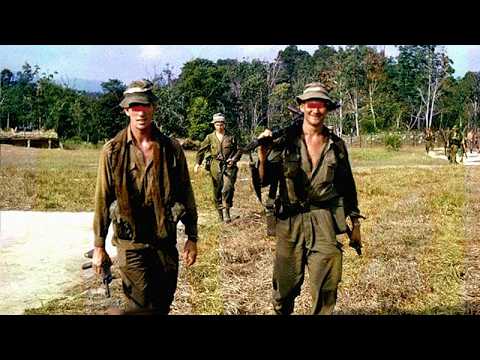
Welcome to the secret war that London denied, Canberra hid, and the jungle almost swallowed whole. A war fought by fewer than two hundred Australians against tens of thousands of Indonesian soldiers in a place so green and so wet that compasses lied and watches rusted shut. A war so classified that the men who fought it were ordered, on pain of court-martial, to never even mention the name of the country they had been inside.
And yet, by the time it ended in 1966, the reputation forged inside that dripping emerald hell would make the Australian Special Air Service Regiment one of the most feared small units on the planet. The Pommy generals who had laughed at them in 1964 would, by 1966, be quietly asking them how on earth they had done it. The Americans, still bleeding badly in Vietnam, would send observers to take notes. And the Indonesians, the proud heirs of a jungle fighting tradition that stretched back centuries, would begin whispering among themselves that the men hunting them were not men at all.
But to understand how a handful of sheep station boys from Western Australia ended up rewriting the rules of modern warfare, you have to go back to the beginning. You have to go back to the green lie.
Borneo in the middle of the 1960s was, by any honest measure, the worst piece of real estate on earth to fight a war. The island sat squarely on the equator, drenched in close to four metres of rainfall a year, blanketed in a primary rainforest so dense that sunlight reached the forest floor only in thin, trembling shafts. Visibility under that canopy was often no more than five or six metres. A man could pass within arm’s length of an enemy platoon and never know it. Rivers were the only highways, and the rivers belonged to whoever controlled the bends.
Leeches dropped from leaves in clusters. Hornets the size of a man’s thumb nested in the buttress roots. The mud was so deep in places that a fully laden soldier could sink to his thighs and have to be pulled out by his mates. And into this dripping green nightmare, in late 1963, Indonesian President Sukarno sent his best troops with orders to crush the newly formed Federation of Malaysia. He called it Konfrontasi—the confrontation.
The polite English translation hid a brutal reality. Sukarno’s men were not amateurs. The KKO Marines and the RPKAD paratroopers were genuinely elite, trained by Soviet and Chinese advisers, hardened on jungle exercises in Sumatra and Java, and absolutely convinced that the rainforest belonged to them. They crossed the long, almost invisible border into Sarawak and Sabah in small groups at first, then in larger raiding parties, ambushing police posts, burning longhouses, and slipping back across into Kalimantan before any conventional response could be mounted.
The British, who still held overall command in the region, threw Gurkhas and Royal Marines at the problem. The Gurkhas, magnificent as they were, could only react. They could not predict. And the brass in Singapore, sipping gin in air-conditioned offices, kept insisting that the war must remain officially deniable. There was to be no public acknowledgement that fighting was even taking place. Newspapers were censored. Casualty notices were vague. Families back home were told their boys had died in training accidents.
And then, in early 1965, somebody in London finally had an idea worth keeping.
That somebody was a quiet, pipe-smoking British general named Sir Walter Walker, the director of operations in Borneo. Walker had fought the Japanese in Burma. He understood the jungle in a way the carpet generals never would. He looked at the maps, looked at the casualty reports, and concluded that defending a border 1,100 miles long with conventional infantry was a fool’s errand. The only way to win, he decided, was to take the war across the border into Indonesian territory itself. Hit them in their own staging camps. Cut their supply lines before they ever reached Malaysia. Make the jungle so terrifying for them that they would stop coming.
He gave the operation a deliberately bland code name so that nothing on paper would ever betray its purpose. He called it Claret.
The orders that came down from Walker’s headquarters were extraordinary in their secrecy. Patrols were forbidden from carrying anything that could identify them as Australian or British. No name tags, no unit flashes, no personal letters, no cigarette packets with English writing. If a man fell, his mates were under standing orders to carry his body back across the border no matter what the cost—because a single Caucasian corpse on the wrong side of the line would have handed Sukarno a propaganda victory worth ten divisions. The patrols were not even allowed to leave spent cartridge cases behind. Every brass shell had to be picked up and carried out. Every footprint had to be brushed away.
The official position of the Australian government, repeated in Parliament whenever awkward questions were asked, was that no Australian soldier had ever crossed the border. It was a lie so complete that some of the men who carried it out went to their graves without ever telling their own children where they had really been.
And it was into this impossible mission that the Australian Special Air Service Regiment was thrown in February of 1965. They came from a base in the dust of Swanbourne on the outskirts of Perth. Most of them were country boys—shearers, fencers, jackaroos—kids who had grown up tracking kangaroos across the wheat belt and reading the bush the way a city accountant reads a balance sheet.
The British officers who first met them in Borneo were, to put it mildly, unimpressed. The Australians refused to salute properly. Their uniforms were a disgrace. They called their commanding officer the old man and addressed senior NCOs by their first names. One Coldstream Guards major, watching an Australian patrol come in from a job, reportedly muttered that they looked more like a band of bushrangers than soldiers of the Crown. He would, within six months, be eating those words with a side of crow.
Because what the polished pommy officer could not see, hidden under the stained jungle greens and the unshaven faces, was something the British Army had quietly stopped producing decades earlier. He could not see the patience of a man who had spent his boyhood waiting motionless in a hide for a fox to come within range. He could not see the ear of a kid who could tell a dingo from a wild dog by the rhythm of its paws on dry leaves. He could not see the hands of a fellow who had spent every summer of his life splicing fence wire, jury-rigging windmill pumps, and keeping a clapped-out Holden ute running on nothing but baling twine and stubbornness.
The Australians did not look like elite troops. They looked like the bloke who fixes your hot water service. And that, as the Indonesians were about to discover, was exactly why they were so dangerous.
The first cross-border patrols began in the autumn of 1965. The rules of engagement, hammered out in secret meetings in Singapore, were ferociously strict. No patrol was to penetrate more than 3,000 yards across the border at first, although that limit would later be quietly extended to 10,000 and eventually to 20,000. No prisoners were to be taken, because dragging a captive back through the jungle for days was considered impossible. Air support was forbidden inside Indonesian territory, because the sound of a British or Australian helicopter would have blown the entire deniability of the operation. If a patrol got into trouble, it was on its own. There was no cavalry coming over the hill. There was only the jungle, the enemy, and the four or five men you had walked in with.
A standard SAS patrol in Borneo numbered four men, sometimes five, never more. The thinking was simple enough. A larger group made too much noise, left too many tracks, ate too much food, and was harder to hide. Four men moving carefully could become almost invisible. Each patrol carried a signaller with a heavy A510 radio, a medic who doubled as a rifleman, a tracker, and a patrol commander who was usually a sergeant or a senior corporal. Officers were rare on the ground. Rank meant very little out there. What mattered was who could read the bush.
They went in light. Or rather, what passed for light in 1965, which was still about thirty kilograms of kit per man. Each operator carried roughly three hundred rounds of ammunition, six to eight grenades, a parang for cutting through vegetation, water purification tablets, a hammock, a poncho, and a hard ration pack designed to last between ten and fourteen days. The food was deliberately bland and dry because the smell of cooking curry could carry for hundreds of metres in the still air under the canopy. The men ate cold. They drank lukewarm water flavoured with iodine. They washed only when they crossed a river, and even then only with their bare hands because the perfumed scent of British Army soap had been known to give patrols away to enemy trackers.
They wore no underwear because in the constant wet, it caused infections that could cripple a man inside a week. They wore canvas jungle boots with drainage holes punched into the sides because leather rotted off the foot in a fortnight. And they carried, in a small waterproof pouch over the heart, a single morphine syrette and a folded square of silk printed with phrases in five languages asking for help and promising a reward.
But it was not the gear that made them ghosts. It was the discipline. Movement under the canopy was measured not in kilometres per hour, but in metres per hour. A good Australian patrol on a Claret mission would advance somewhere between one hundred and four hundred metres in an entire day. The lead scout, often called the point man, moved one painstaking step at a time, lifting each boot clear of the leaf litter, placing it down softly on the ball of the foot, scanning the green wall ahead before shifting his weight. Behind him, three metres back, came the patrol commander, eyes constantly flicking from the scout to the flanks. Behind him, the signaller. Behind him, the rear scout, walking backwards as often as forwards, brushing away any sign of their passage with a leafy branch.
Nobody spoke. Communication was done entirely with hand signals that the regiment had refined over hundreds of training hours back in Western Australia. A closed fist meant stop. A flat palm pressed downwards meant get down. Two fingers pointed at the eyes meant I see something. A thumb jerked over the shoulder meant fall back slowly. There were dozens more, and every man knew them in his sleep.
They never used the existing jungle paths, not once. The Indonesians watched the paths the way a fisherman watches a likely pool, and walking on one was considered a slow and embarrassing form of suicide. Instead, the Australians cut their own way through the bamboo and the thorn vines, choosing the worst, thickest, most miserable ground precisely because nobody else would think to look there. They crossed rivers at the deepest, most awkward bends. They climbed ridges through almost vertical tangles of root and rock. They slept in their hammocks slung low between trees, with one man always awake on stag, and they moved their layup position every single night so that no smell or sign would build up in one spot.
It was a level of bushcraft that simply did not exist in any other Western army of the period, and it was about to be tested against an enemy who thought he owned the place.
The Indonesians had been moving troops and supplies down the Sungai Koemba for months. The river was a brown, lazy artery curling through the southwest corner of Sarawak, and on the Indonesian side of the border, it linked a string of army camps to their forward staging areas. Boats moved up and down it constantly. Long wooden craft powered by single outboard motors ferrying rifles, mortar bombs, rice, and reinforcements.
The British command in Kuching had been desperate to interdict that river for the better part of a year, but every attempt to get close had failed. The mangrove swamps along the bank were considered impassable. The mud was waist-deep and stinking. The mosquitoes came in clouds so thick you could feel them on your eyelashes. And the Indonesians, knowing all this, had grown comfortable, lazy even. They sang on the boats. They smoked openly. They believed nobody could possibly be lying in that black, sucking mud watching them.
In June of 1965, an Australian patrol of four men commanded by a hard-nosed sergeant from Western Australia was given the job of proving them wrong. They crossed the border on foot carrying close to forty kilograms each because they expected to be out for at least three weeks. They moved at the now familiar crawl, three hundred metres on a good day, less when the going got thick. It took them six days to reach the river, six days of leeches and silent hand signals and ration packs eaten cold in the dark.
When they finally smelled the muddy stink of the Sungai Koemba, the sergeant did not allow them to rush forward. He made them lie up for another full day, listening, watching, and counting the boats that passed. He noted the times. He noted the spacing. He noted that the Indonesian crews, bored and confident, almost always congregated near the bow of each boat, leaving the stern lightly manned. He picked the killing ground himself. A bend in the river where the current pushed the boats in close to the southern bank, slowing them to little more than walking pace. And where a thicket of overhanging palms gave the patrol a perfect natural firing position only a dozen metres from the water.
Then, they moved into the mud. They lay there for almost twenty-four hours without moving. Twenty-four hours coated head-to-foot in the black slime of the riverbank. Faces blackened with cam cream. Weapons wrapped in strips of hessian to break up their outlines. They did not eat. They did not drink. They urinated where they lay rather than risk a movement that might be seen from the water. Sandflies bit them until their hands and necks were swollen. They did not so much as twitch.
This is the part that nobody who has not done it ever quite understands. The physical agony of complete stillness, hour after hour, with insects crawling into the corners of your eyes, and your back screaming, and your legs going numb beneath you, is a form of suffering that breaks ordinary men inside the first hour. The Australians simply endured it. Because endurance was the entire point.
At a quarter past nine on the second morning, the boats came. There were three of them, long and low in the water, packed with what the patrol later estimated to be somewhere between twenty and thirty Indonesian soldiers. They were laughing. One of them was singing. The lead boat slid into the killing ground exactly as the sergeant had predicted, the current pushing it gently in towards the southern bank, less than fifteen metres from the muzzles of four hidden rifles.
The sergeant let it come. He let the second boat enter the kill zone behind it. He let the third boat begin to drift in. And only when all three were perfectly aligned, with no possibility of escape and no overlap to spoil the field of fire, did he squeeze his trigger.
The opening volley was so synchronized that an Indonesian survivor, interrogated weeks later by Malaysian intelligence, would describe it as a single enormous explosion rather than four separate weapons. The lead boat disintegrated. The second one capsized within seconds. The third was shredded before its motorman could even reach for the throttle. The patrol fired for less than thirty seconds. They threw two grenades into the wreckage. And then, as suddenly as it had begun, the fight was over.
The sergeant gave a single hand signal. Within a minute, they had collected every spent shell case, smoothed the mud where they had lain, and were already moving back into the jungle along a route they had reconnoitred days earlier. They did not run. Running leaves tracks. They walked, fast and silent, and within an hour they were two ridges away from the river, listening to the distant, panicked stutter of Indonesian return fire being poured into empty jungle a kilometre from where they actually were.
They walked for another nine days to get home. When they finally crossed back into Sarawak, filthy, hollow-eyed, and stinking like something dragged out of a swamp, the British staff officer who debriefed them refused at first to believe the body count. He thought they were exaggerating, the way young soldiers sometimes do. Then the intelligence reports began to filter in from agents on the Indonesian side. Reports of a shocked, furious garrison commander who could not work out how an entire river convoy had been wiped out in his own backyard. Reports of Indonesian troops refusing to travel by boat after dark. Reports of patrols being doubled, then tripled, then cancelled altogether because nobody wanted to walk into the green wall anymore.
The Pommy major who had once called the Australians a band of bushrangers was, by all accounts, very quiet at the officers’ mess that week. Somebody said he bought a round of drinks for the patrol without saying a word.
But the Sungai Koemba ambush was only the most dramatic example of a method that the regiment was applying up and down the entire border. Patrol after patrol was crossing into Kalimantan, lying up for weeks at a time, watching enemy camps, mapping supply routes, and striking with surgical precision before vanishing back into the green. In one operation, a four-man team lay in the bush directly outside an Indonesian battalion headquarters for eleven days, counting men, photographing officers, and listening to radio traffic, and walked out without ever firing a shot. In another, a patrol led by a corporal from Queensland ambushed a column of forty Indonesian regulars on a jungle track and inflicted what the British later assessed as catastrophic casualties for the loss of not a single Australian. In yet another, an SAS team destroyed a key river crossing using nothing but plastic explosive carried in their packs, denying the enemy a vital supply route for the rest of the campaign.
And here is the part that would have made any Pommy carpet general choke on his afternoon tea. The Australians were achieving these results with equipment that by British or American standards was almost embarrassingly basic. Their boots were cheap. Their rations were dull. Their radios were heavy and temperamental. They had no helicopter extraction inside Indonesia. They had no air support. They had no artillery cover beyond the very edge of the border. They were doing all of this on foot with pack and rifle. The way Australian light horsemen had done it in Palestine in 1917 and the way the rats of Tobruk had done it in 1941. It was in the truest sense a bush mechanic war. They made do with what they had and what they had was patience, intelligence, and a bottomless capacity for discomfort.
The Americans across in Vietnam with all their helicopters and napalm and computerized body counts were losing. The Australians in Borneo with their canvas boots and their hand signals were winning so completely that the enemy began to invent ghost stories about them.
Because that is exactly what the Indonesians began to do. Captured documents recovered later in the campaign revealed an extraordinary thing. Indonesian officers were writing in their reports that they were no longer fighting British or Australian soldiers in the deep jungle. They were fighting haunted spirits—forest demons. The men who came out of the green wall without warning, killed with terrifying accuracy, and vanished without leaving so much as a footprint were, in the minds of the Indonesian rank and file, no longer human at all. Officers had to issue stern orders forbidding their men from talking about the ghosts. Patrols refused to enter certain areas after dusk. Whole units quietly stopped reporting for cross-border missions, claiming illness or equipment failure, rather than admit that they were simply too frightened to go.
One captured Indonesian sergeant, when interrogated, asked the Malaysian officer questioning him whether it was true that the men opposite him had been raised in the jungle by Aboriginal trackers. He had been told this by his own commanding officer as a way of explaining why the patrols never came back. The truth, of course, was both less mystical and far more impressive. The Australians were not ghosts. They were extremely well-trained men applying extremely old skills with extraordinary discipline. Many of them had, in fact, trained alongside Aboriginal trackers in the deserts of Western Australia and the top end of the Northern Territory. They had learned how to read a broken twig, how to age a footprint by the way the dew sat on it, how to follow a man across hard rock by reading the tiny scuff marks his heels left on the lichen. They had taken those skills, developed in the driest country on earth, and applied them in the wettest. And it had worked beyond anyone’s most optimistic prediction.
By early 1966, the confrontation was effectively over, even if the politicians had not yet caught up. Sukarno’s grip on power in Jakarta was crumbling. His army, bled white and humiliated by a war it could not win, had lost its appetite for cross-border adventures. A coup in October of 1965 had already shaken the regime to its foundations. And by August of 1966, a peace agreement was signed in Bangkok, ending the undeclared war that the world had barely been told about.
The Australian SAS had completed close to twenty cross-border Claret operations during their two tours in Borneo. They had killed or wounded a number of enemy combatants that the official histories still describe in carefully vague terms, but which insiders believe ran into the dozens and possibly the low hundreds. They had lost in return two men. Two. Both of those losses were, in the brutal arithmetic of special operations, considered freakish bad luck rather than tactical failure. One man drowned crossing a swollen river during a monsoon downpour. The other was lost to a tragic accident involving a booby trap. Not a single Australian SAS operator was killed in a stand-up fight with the enemy during the entire Borneo campaign. Not one.
In a war fought across thousands of square kilometres of the harshest terrain on the planet against a numerically superior and well-trained foe, that figure is so close to miraculous that historians still argue about what it really means. What it means is something the men themselves would never have said out loud, because saying it would have been bragging, and bragging was the one thing a digger never did. It means that a small group of country boys from the other side of the world, given a near impossible job and the freedom to do it their own way, had quietly become the most effective jungle fighters of the twentieth century.
The Pommy generals who had once dismissed them as undisciplined colonials were, by the end of the campaign, sending observers to study their methods. The Americans, struggling in the rice paddies of South Vietnam, would soon be asking the Australians to bring exactly the same techniques to a place called Phuoc Tuy Province. The lessons learned in the green silence of Borneo would be written into training manuals from Hereford to Fort Bragg. And the four-man patrol concept that the Australians had refined in those swamps would become the standard structure for special reconnaissance work in every Western army for the next half-century.
And yet the men who had done it came home to absolutely nothing. There were no parades. There were no medals presented in front of cheering crowds. There were no newspaper headlines celebrating the heroes of the secret war. The Australian government, bound by the same agreement of total deniability that had governed the operations themselves, would not officially acknowledge the cross-border missions for nearly thirty years. The men were forbidden from telling their families what they had done. Some of them were quietly given a mention in dispatches, in citations so deliberately vague that the words could have described almost any kind of soldiering. A handful received the Military Medal. Most received nothing at all beyond a quiet handshake from the old man and an unspoken understanding that this thing they had done would belong, for the rest of their lives, only to the men who had been there.
A few of them later said, in the rare interviews they gave decades afterwards, that it never bothered them. Bragging was for blokes who had not really done much. The men who had truly been in the green wall did not need a ribbon to know what they were worth. One veteran, asked many years later what the campaign had taught him, thought about it for a long while and finally said that it had taught him there were two kinds of soldiers in the world. The kind who needed a brass band to feel important and the kind who could lie in the mud for a day and a night without moving so much as a finger because somewhere up the river there were boats that should not arrive. He took a long pull of his beer when he said it. Then he looked out the window of the RSL and said nothing else for a while.
Outside, the sun was going down on suburban Perth and the men at the bar were arguing about the football. None of them knew that the quiet old fellow in the corner, the one with the faded hands and the watchful eyes, had once spent twenty-one days inside a country he was not allowed to name, in mud up to his ribs, killing men he had never met for reasons the politicians had never explained, and walking out again without leaving so much as a footprint. None of them knew that the legend of the Australian SAS, the legend that would later be invoked in every dusty corner from East Timor to Afghanistan, had been forged not in some glamorous desert raid or cinematic helicopter assault, but in the dripping silent green of a place called Borneo, by men who never asked for thanks and never expected any.
The general, somewhere far away, got his knighthood for the map he drew. The bloke in the corner of the RSL got a quiet beer and a memory he could not share. And if you had asked him which of the two had really won that war, he would have looked at you for a long moment over the rim of his glass, smiled the way old soldiers smile when they are deciding whether to bother answering, and finally said only this:
“The jungle remembers. That is enough.”
So the next time you hear the name Borneo and think only of rainforests and orangutans, remember the four men in the mud who never fired a shot in anger without first earning the silence—and ask yourself: what other quiet sacrifices have we been taught to forget?
Report this article
Select a reason for reporting:






