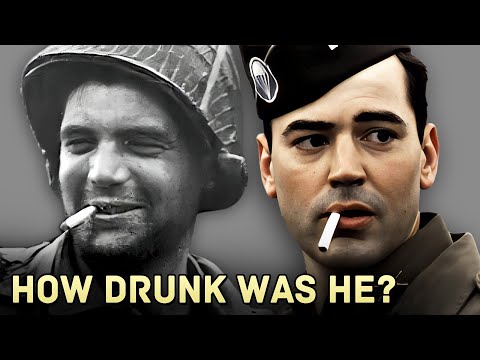
Captain Lewis Nixon of Easy Company is remembered as a brilliant intelligence officer, a Yale man, and the best friend of Major Richard Winters. But behind the polished exterior and the strategic mind, a darker truth lurked—one that Band of Brothers only hinted at. Nixon was an alcoholic. And not just any alcoholic: according to some veterans, he was “the worst drunk there’s ever been in the history of the United States military.”
While the series portrayed his drinking as a quirky flaw, a coping mechanism that never truly interfered with his duties, the reality was far more complex. Men who served with him described scenes that never made it to the screen: Nixon passed out on the floor, empty bottles strewn across his rented English home, and a reliance on alcohol so severe that it sometimes jeopardized his performance. How drunk was Lewis Nixon during World War II? The answer, as we’ll see, is more unsettling than the legend suggests.
To understand Nixon’s addiction, we must first look at his life before the war. Born into immense wealth—his family’s fortune came from shipbuilding and later Nixon Nitration Works—Lewis grew up with a silver spoon in his mouth. His father, Stanhope Nixon, was a heavy drinker with a violent past, including an assault charge that was conveniently swept under the rug. The apple didn’t fall far from the tree. By the time Lewis enlisted, he was already a hard drinker, a free spirit who partied with the best of them. The war only poured fuel on the fire.
As the fighting intensified, so did Nixon’s drinking. He turned to his beloved VAT 69 whiskey to numb the stress of battle, the loss of friends, and the collapse of his marriage. In episode 9, “Why We Fight,” we see him scavenging for alcohol after surviving a plane crash and receiving a Dear John letter—a portrayal that, while dramatic, barely scratched the surface of his real-life struggle.
Richard Winters, Nixon’s best friend and the series’ moral compass, watched with concern but rarely intervened. Their friendship was built on mutual respect and shared trauma, but Winters later admitted, “My only problem with Nixon was keeping him sober.” Yet even he buffered such statements with praise: “Captain Nixon was always my finest combat officer.” Others were less forgiving. Ed Shames, who briefly served as Nixon’s assistant, recalled having to “scrape him off the floor” multiple times and called him “absolutely worthless.” Colonel Robert Sink, frustrated by Nixon’s drinking, demoted him—a consequence that the series glosses over.
The truth is, Nixon’s alcoholism was both a personal demon and a wartime reality. Many soldiers turned to alcohol to cope, but Nixon’s addiction predated the war and followed him long after. After the war, Winters described visiting him as “sitting there and watching him get drunk.” It was a sad end for a man who, despite his flaws, volunteered to serve, earned a Bronze Star and Purple Heart, and gave up a lottery-winning furlough to stay with his men.
So how drunk was Lewis Nixon? Drunk enough to nearly derail his career, but not so drunk that he couldn’t contribute to the defeat of Nazi Germany. The full story is one of courage and addiction, of heroism and human frailty—a story that Band of Brothers only began to tell.
But the story of Nixon’s drinking didn’t end when the war did. If anything, the years that followed revealed just how deep the roots of his addiction had grown—and how much the war had accelerated a decline that began long before he ever put on a uniform.
After returning to civilian life, Nixon took over the family business, Nixon Nitration Works, and brought Winters along with him. On paper, it looked like a storybook ending: two war heroes, bound by brotherhood, building a future together. The reality was far messier. Winters, who never touched a drop, found himself managing layoffs and watching his best friend spiral. The bond that had carried them through Normandy and Bastogne was now being tested by something far less glamorous than combat.
Veterans who saw Nixon at reunions painted a similar picture. Don Malarkey recalled a gathering in Dallas where Nixon, deep in his cups, lashed out at Buck Compton, calling him a coward. Malarkey—who had witnessed Compton’s bravery firsthand—shut him down with a single question: “Is that right? And how many Silver Stars do you have?” The room went quiet. Nixon had no answer.
What makes Nixon’s story so compelling isn’t the drinking itself—it’s the contradiction. Here was a man born into staggering wealth, a man who could have easily secured a deferment and sat out the war in comfort. His family’s nitration works were deemed essential to the war effort. He didn’t have to jump out of airplanes. He didn’t have to earn three combat jump stars or a Bronze Star or a Purple Heart. Yet he did.
Clancy Lyall, who joined Easy Company later in the war, insisted that Nixon “drank a lot but not in combat” and was “a real fine intelligence officer.” Bill Guarnere called him one of the best. Even Ed Shames, his harshest critic, acknowledged Nixon’s tactical brilliance. The man who couldn’t stay upright in a rented English house could still read a map, anticipate enemy movements, and deliver intelligence that saved lives.
Perhaps that’s the real answer to the question. Nixon wasn’t a drunk who happened to be an officer. He was an officer who happened to be a drunk—and somehow, through sheer intellect and a stubborn sense of duty, he made it work. Most men couldn’t have. Most men wouldn’t have tried.
But the cost was real, and it followed him home. Winters admitted that their postwar relationship was “tough”—that visiting Nixon meant watching him drink himself into oblivion while Winters sat sober and helpless. The friendship survived, but it was never the same. The war had forged their bond; the bottle slowly eroded it.
There is one story from the war, however, that complicates the picture even further—and it comes from Winters himself. Near the end of the conflict, Winters arrived at Berchtesgaden and discovered something extraordinary in the basement of Hermann Göring’s officers club: roughly ten thousand bottles of the world’s finest liquor. A non-drinker, Winters had no use for any of it. His first thought was of Nixon. He planned to surprise his best friend with the ultimate gift—but only on one condition: Nixon had to sober up first.
Think about what that means. Winters knew that handing Nixon a basement full of premium alcohol would be like handing a match to a man soaked in gasoline. The fact that he insisted on sobriety as a precondition reveals just how much he understood the severity of his friend’s condition—even if he rarely said it aloud.
And yet, the men who served alongside Nixon didn’t universally condemn him. Clancy Lyall, who transferred into Easy Company in August 1944, pushed back hard against the popular image. “He wasn’t a drunk as they wanted to depict him,” Lyall insisted. “He was a real fine intelligence officer.” Lyall was known as a good-hearted Texan who tried to see the best in everyone—but his perspective matters. He joined when Nixon was already operating at the battalion level, meaning he saw the officer at work, not the man passed out on a floor in England.
That distinction is crucial. The veterans who knew Nixon best in a professional capacity—men like Lyall and Winters—tended to describe a functioning, even brilliant, officer. Those who encountered him in close quarters, like Ed Shames, saw the wreckage up close. Both accounts are true. Neither tells the whole story.
Perhaps the most revealing detail comes not from a dramatic anecdote, but from a quiet moment in the Netherlands. Winters recalled hunkering down among the trees, miserable and cold, when he noticed Nixon beside him, finishing off a bottle of schnapps. Winters could tell he was drunk. And in that moment, a thought crossed his mind that he later admitted in his memoir: he would never have tolerated that kind of behavior from any other man. He wasn’t sure why he tolerated it from Nixon.
That admission is more damning than any insult Ed Shames ever hurled. Winters—the disciplined, principled officer who demanded excellence from every soldier—made an exception for Nixon. Not because Nixon deserved it, but because Winters loved him like a brother. The war had bound them together in ways that defied logic or fairness.
In a letter to his friend Deetta Alman, Winters wrote with brutal honesty: “Captain Nixon is the biggest drunk I’ve ever seen, known, or hoped to see.” But in the very next breath, he added that Nixon was “absolutely the most reliable man I’ve ever known.” This was Winters’ signature move—praise buffered by concern, or concern buffered by praise. He could never quite bring himself to condemn his friend outright.
That same contradiction appeared again when Winters described Nixon as “absolutely the most undependable man you’d ever want to find.” The two statements seem irreconcilable. How could a man be both the most reliable and the most undependable? The answer lies in the gap between what Nixon could do when he was sober and what he became when he wasn’t. The war demanded both versions of the man, and Nixon delivered—just not always on schedule.
When Winters later accepted a job at Nixon Nitration Works, he did so despite his reservations. He had seen Nixon at his worst, yet he still believed in him. That belief would be tested in the years ahead, as the structure of military life gave way to the chaos of civilian existence—and as the bottle that had once been a wartime companion became something far more permanent.
Winters, ever the loyal friend, never publicly condemned Nixon. But in private letters and later memoirs, the truth slipped out. “Nixon and I always remained good friends, but our relationship after the war was tough,” he admitted. “To visit with Nixon was to sit there and watch him get drunk. That’s no fun when you’re sober.” The man who had once hidden whiskey in Winters’ foot locker now hid from nothing—his addiction was an open secret, tolerated because of who he had been in the war.
Yet even in decline, Nixon’s story refuses to be a simple cautionary tale. He volunteered when he could have deferred. He jumped when he could have stayed. He gave away a winning lottery furlough to remain with his men. He was, as Winters said, “the most reliable man I’ve ever known”—and also the most undependable. Both truths coexist, uncomfortable and inseparable.
So how drunk was Captain Lewis Nixon? Drunk enough to be scraped off floors, to be demoted, to watch his marriage dissolve. But not so drunk that he couldn’t outthink the enemy, earn a Bronze Star, or inspire the loyalty of men who saw him at his worst. He was a hero with a bottle in his hand—and somehow, he made it work.
What do you think? Does Nixon’s heroism excuse his alcoholism, or does it make the story more tragic? Share your thoughts in the comments below.
Report this article
Select a reason for reporting:






