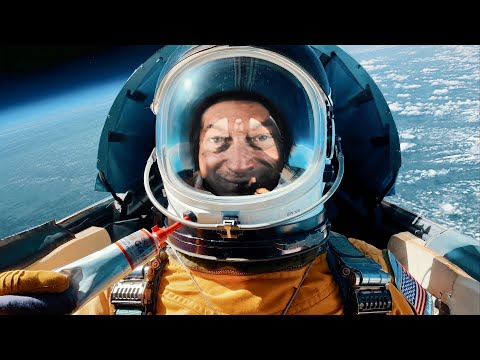
There was a day in 2011 when I was told I was the highest person on the face of the Earth—literally. That day, I traveled to space, equivalent to an altitude of 70,000 feet. It was a journey to the edge of infinity. For a few minutes I will remember for the rest of my life, I stared at the bubble that formed on the canopy of our aircraft with all my might. I’m Gary Sinise, and this was my high flight.
Over the years, I’ve had many opportunities to visit our soldiers and women in distant and often dangerous places where they live and work. In 2010, through a friend who worked with the USO, I was invited to take a flight aboard the legendary U-2 spy plane. As excited as I was, I didn’t fully realize all that a U-2 flight entails. By the time I boarded a plane to return home, I had met a group of people and traveled to a place I would carry with me for the rest of my life.
Beale Air Force Base is an 86,000-acre base that opened in October 1942 as an Army training site for armored and infantry divisions. It also served as a prisoner-of-war camp during World War II. It was transferred to the Air Force in 1948. The 9th Reconnaissance Wing is a highly specialized group of over 3,000 individuals in four groups: the 9th Mission Support Group, 9th Medical Group, 9th Maintenance Group, and 9th Operations Group. And Beale is the headquarters for our U-2 program.
The U-2 Dragon Lady is one of the most amazing defense systems the United States has ever developed. It’s a baby boomer. Born in the 1950s when we began to realize how little we knew about the newly emerging superpower, the Soviet Union. Once the Soviet Union became a nuclear power, it became a matter of national security to find a way to conduct reconnaissance. And doing so meant flying higher than any defensive aircraft or surface-to-air missile could reach. That meant flying to an altitude that is a true definition of space.
Designing such an aircraft became the top priority for Kelly Johnson’s legendary Skunk Works, Lockheed Martin’s advanced development programs. Johnson was an aviation genius, having developed over 40 aircraft, including the P-38 Lightning, P-80 Shooting Star, F-104 Starfighter, and SR-71 Blackbird. The U-2 program began, like many successful military programs, in a political environment. After World War II ended, political tension arose between the Soviet Union and the United States. There was little information about the interior of the Soviet Union. The United States secretly voted for a program to produce an aircraft that could fly above the suspected range of surface-to-air missiles at the time. And out came Clarence “Kelly” Johnson and his Skunks, saying, “I can take an F-104 fighter. I can take this fuselage, remove its wings, and marry it to highly efficient glider wings—high aspect ratio, long, thin wings that are extremely efficient at altitude.”
The target altitude was 66,000 feet. So the first U-2 flew in 1955. And in 1956, we used it operationally for the first time on a mission over the interior of the Soviet Union. On May 1, 1960, when Gary Powers was shot down, it did two things. First, it revealed the U-2 program. We should have made it so. The second thing it did, even with that specific aircraft lost, was confirm to us that the Soviets already had missiles that could reach that altitude. Through the ingenuity of its engineers and pilots, we took this Cold War system and changed how it was used so that it became suitable and effective at almost all levels of warfare.
In over 50 years of the U-2 Dragon Lady’s existence, only about 1,000 pilots have flown it. All our solo walls. Every pilot who flew the aircraft alone, he was alone and unafraid in the U-2, and his name and solo number were written on a plaque. On another wall in the Beale Officers’ Club are photos of those who lost their lives while serving in the U-2 program. This is truly sacred ground. I began to understand how rare an opportunity I had been given. The chance to join the High Flyers club. To go to the top of the Dragon Lady’s flight, at 70,000 feet. That’s twice what any commercial aircraft flies. It’s 40,000 feet higher than Mount Everest, the highest mountain in the world. If things go well, for a few incomparable minutes, I will be the highest human on the planet.
There you go, bud. Thank you for your service. Thank you. Click here. After all these years of traveling to support our troops, I’ve probably been on more military bases than many of those who actually serve in the armed forces. I am impressed by every visit. Our bases are special places, islands of efficiency, productivity, order, and courtesy. They are the places that stick with you, that inspire you to do a little better and be a little better when you return to your neighborhood. It was a great welcome at Beale.
The first steps you take to reach 70,000 feet are to go to the flight surgeon’s office. This whole adventure could end here. So, for a high-altitude or high-altitude flight, the things we look for include, first, making sure it will fit the ejection seat and can eject safely. So it’s unique to each airframe, and it has different parameters, and so we just have to make sure it meets the criteria for that type, and that’s the first thing we look at. The second reason has a lot to do with decompression sickness, the idea of going from a high-pressure state to a low-pressure area. When that happens, we have gases in our bodies that would bubble into the bloodstream, like opening a Coke bottle or a product like that, where you can then get a bunch of bubbles coming out. As a result, that can lead to some problems that we might later have to use hyperbaric treatment or a hyperbaric chamber to treat. And the things we also want to look at are that gas expands, or if there are problems with the ears or sinuses, or they couldn’t clear those areas, or if they have tooth pain, or tooth pressure, again, that gas could expand in those areas and create a lot of problems. So we don’t want them to fly if we have these issues in that combination.
Everything good? Yes. To be honest, I have some problems with my ears and sinuses, and I’ve never been to 70,000 feet before, so I’m eager to go, but also a bit apprehensive. Mr. Smith, this is your number 1042. This is your clearance to fly and go to altitude and board the aircraft. Great. I’m fine. You’re good to go, sir. Enjoy a pleasant flight at 70,000 feet. It’s a hostile environment for humans at that altitude, where a catastrophic loss of pressure would cause body fluids to start boiling within seconds. So there are some things you need to know and do before the Air Force takes you to the edge of space.
For our mission. Confident. Calm. Prepared. Unafraid. Funny. Ejection, so the ejection altitude we control, we want to be at least 2,000 feet above ground level. For some reason the aircraft went out of control today. We want to get out immediately. We don’t want to wait. But I’ll tell you if that happens. Please do. Physiological events, so if at any time during the flight you feel bad or funny, or have any questions about, why do I feel this way? Ask. Let me know. Bad news doesn’t get better with age, especially if it’s bubbles in your brain and spinal column. So we can do little to fix it. So tell me, and if you have any kind of gastrointestinal issues, let that gas out when it starts to build up. Don’t hold it in. Keep holding it in and keep holding it in, and then things can get messy. Yes. Thank you. Appreciate it. Peace, guys.
Join us. Do you want me in this? Absolutely. Okay. I mean, everyone who comes here is already a good pilot. So it’s just a matter of training. You like to be alone. I do. Because you’re up there alone. How long? 12 hours plus. 12 extra hours of flying just. But the altitude you’re at, which will be inside the aircraft, is about 28 or 29 thousand feet, so if you think about it, you’re sitting on top of Mount Everest because you know you’re descending and you’re going to feel like you’ve been run over by a truck sometimes, so then I’ll say yes. He goes out and leaves. How are you? I’m Gary. Thank you. Thank you. Hello. Hello, sir. My name is Heather. Heather. I’m going to teach you about the full pressure suit today. Awesome. Thank you.
The physiology brief was fascinating, to say the least. I began to learn what can happen to the body at altitude, and I met my new best friend—my spacesuit. “Basically, open this guy up. You should be able to feel that it’s open.” Heather walked me through every seal and valve, and I felt the suit pressurize around me like a second skin.
Loss of pressure in the aircraft would instantly make the suit my life-support system. There are a host of hazards at 70,000 feet that could turn into a very bad day: hypoxia, decompression sickness, altitude sickness. Heather knew them well—in February 2009, she had felt decompression sickness herself while flying over Afghanistan. “At that point, I realized it was decompression sickness and started heading toward my home base.” Four hours home. Probably the worst four hours of her life.
Then came the altitude chamber. 3, 2, 1. I watched what happens to a cup of water when the simulated altitude hit 60,000 feet—at that height, the pressure is so low that your body’s own 98.6 degrees would boil your fluids. Sobering stuff.
Next I learned the art of egress, of getting out of the U-2 if something went wrong on the ground or in the air. Of course, if you find yourself hanging from a parachute at 70,000 feet, you also need to know how to control it. That night, the command at Beale hosted a dinner for us. It’s an honor to be able to talk with these people. They are the best in the world at what they do.
Everything starts with feeling a little surreal. I’m definitely ready to sleep. I just wish I could. In many ways, it’s just another day at the office for my pilot, Jay Ford. Over a light breakfast, we reviewed the flight plan once more—a big flight over Northern California. The fear I took to bed last night had left me. Let’s go do this.
“You guys, we have a little tight meeting. We have someone to put on a suit. Two people, actually.” Then the moment came: “For his peak today, we want to tie it! Pinion! There you go. Have a great flight.” Thank you very much.
Yesterday I struggled with my gloves and visor. Today, honestly, I feel like I’ve been here before. I’m ready. This is very cool. I admit it. I’ve always been from the space group. When I was preparing to play astronaut Ken Mattingly in Ron Howard’s Apollo 13, I met Jim Lovell and a number of astronauts. I sat in NASA’s mission control where it all happened and let my imagination run wild.
As an actor, I’m used to playing roles. The spacesuit certainly brings back memories of the roles I’ve played. But this is no role. It’s about to get very real. First, they integrate you into your spacesuit, and they must be integrated into the aircraft. I had to test my ability to reach the levers and handles. I would have to eject if it became necessary to get out of the U-2 for any reason. There comes a moment when you have to arm your ejection seat. If you have to emergency egress, there’s an explosive charge that blows your entire seat out of the aircraft with you in it. I was fully aware that I was sitting on a bomb.
“Pinion 9-2, approved to start your engine, approved at Wheel Airport as submitted.” And so begins a journey I had never taken before. The traditional salute to the dedicated ground crew who keep this extraordinary bird flying. I know the camera crew is out there somewhere. Whatever happens, there will be pictures. And there are the chase cars.
The funny thing about the U-2 is that it’s flown by one pilot, but it can’t be flown by one pilot. When a U-2 tries to land, its high-aspect-ratio wings don’t want to stop flying. The only way to bring it back to Earth is to induce a full stall at just the right height above the runway. So other U-2 pilots and the chase cars—called mobiles—have to race and tell the pilot in the aircraft exactly where he is relative to the ground at every moment. Look at those amazing wings. They’re so long they must be supported by small wheels at the tips called pogo wheels.
“Wind 9-2, 15 at Bravo, altitude short, ready.” We’ve been cleared to go. I can’t believe how the U-2 exploded into the air. The aircraft needs 5,000 feet, or about a mile, to gain enough airspeed to take off. We covered less than a tenth of that—just four or five hundred feet. This U-2 is so smooth that I feel calm inside it. Yet the altimeter clearly shows it climbing as if it feels no homesickness.
“Starky, good morning, Gear 9-2 with you at 3,000 climbing 230.” “Gear 9-2, nothing for you, try to contact.” Are you looking outside? Oh yes, maybe you can read. If you like, you can open your T-blocks and do as you please at this point. Maybe it’ll only open a little. You can get a good amount of air through there.
It may sound strange to say, but so far the flight feels like a comfortable break from all the intensive training I did for it. The matter is above flight level 6-0-0. Jay has a mirror so he can see me. I didn’t even know until we got there that this was the only way we could have visual contact between me and Jay. The altimeter keeps spinning upward. Higher.
So we’re at about 29,000. Yes, we just passed 29, approaching 30. And we’ve been in the air for about five minutes. That’s fast. Yes. We’ve gone from below Mount Everest to the top in five minutes, and I don’t know—I think most people train for about four months to try to do that. Your perspective really changes quickly. Things made by humans look like sand dunes or snow piles. As Jay said, we’re above 29,000 feet on Everest at any time. My cockpit is about a foot higher than Jay’s. Because of that, at flight level, I will be the tallest person on the face of the Earth when we reach the top.
It’s a beautiful view here. Yes, it is. It’s getting better too. It’s very special. So I can see how I got a little addicted to this. Yes, it’s very special. Okay, here’s 45,000 feet. So we’ll keep setting new staff altitude records for you for the rest of the day. That didn’t take much. No, okay, there’s 50,000 feet. Our cabin altitude, where your body sits, is 24,000 feet, about 25. So we’ll gain over another 20,000 feet, but the cabin altitude will only go up another 5. Very comfortable now. Yes.
Yes, 59.2, passing 52,000 feet in the green zone. I’m copying in green. Mobile copying in green now. Good flight. Thank you. Where are you from, Jay? I’m from Georgia, originally. I grew up there, born in Albany, south, and moved north to Atlanta when I was two. When did you join the Air Force? 1998. So I went to the Air Force Academy in Colorado Springs, got my degree in computer science. Went to Mississippi for a year for pilot training at Columbus Air Force Base, then back to Georgia to Robins Air Force Base. I was a pilot for a year, then went to the Air Force Academy in Colorado Springs. Got my degree in computer science, then went to Mississippi for a year for pilot training at Columbus Air Force Base. Then back to Georgia to Robins Air Force Base near Macon, and stayed there for four and a half years before I came here.
Okay, well, apparently, yes, there’s 60. So we’re now well above the equivalent zone of space, because if we didn’t have the suit and we went out, you’d boil. That’s followed shortly thereafter by freezing to death because it’s nearly -60 degrees Celsius outside. Okay, let’s stay inside. Yes, I like that idea.
The U-2 is not an easy aircraft to fly. The thinner the atmosphere, the faster the aircraft must go so the wings can provide proper lift. To maintain the required airspeed at 70,000 feet, the U-2 must fly at the upper edge of its speed envelope. If it drops by 5 or 10 knots, the wing could stall. If that happens—coffin corner. This is incredible. Amazing. Yes, it really is. It never gets old. Best view in the world.
Getting a little darker there. Yes, it is. Yes, if you look up toward the sun, you’ll find the sky is completely black there. And then when you look near the Earth, where most of the atmosphere is, and since we’re above most of it now, you get that beautiful thin blue line, all the things that keep us alive. But stay hydrated. Okay, I’ll keep drinking. I’m making movies here. Amazing. We’re really here. Oh yes. Coming up on 66,000. Can you see that the Earth is actually round? Something amazing. Yes. Just—it almost leaves you speechless. Using words to describe what you feel and what your existence here looks like is not enough. It’s just so smooth. It seems like a glider. I’ve traveled by plane before. There’s a vastness I can feel deep in my being, but I can’t describe it in words.
I completely understand why some astronauts feel compelled to become writers and painters. At some point, even the prominent geographical features on Earth, like mountains and large lakes, become so small that you feel like you’re leaving them behind. When you travel to the outer edge of everything you’ve ever known, a feeling of isolation begins to emerge. I thought about the expression, Mother Earth, which we use spontaneously, and it suddenly seemed profound.
So 10, 19, 6, 5, 4, 3, 2, 1. We have one. One. Check. Mom, I’m home. Ha ha ha ha. Amazing. This is amazing. Okay. Amazing. Amazing. Look at this reception part. My people are here. I return to God’s good earth a different person. I left Beale Air Force Base a much richer man.
Emerson wrote that there is no history, only biography. There are hundreds, if not thousands, of biographies tied to the Dragon Lady U-2. From Kelly Johnson to Francis Gary Powers to Jay Ford, there have been thousands of dedicated pilots on the ground who kept her flying. There are countless brave soldiers still alive today because a U-2 was there to tell them what awaited them on the next sand dune.
I leave Beale, as I leave many military bases, with a deep and profound appreciation for those who serve our country in harm’s way. Remember that this is an all-volunteer force. These are the men and women who believe so strongly in the fundamental principles of America that they willingly sacrifice their lives to defend them. Greater love has no one than this: that a man or woman lay down his or her life for another.
I thought about that up there on the purple edge of space, with my life in Jay Ford’s hands. And I thought about it when I landed back on Earth, having seen the Earth in a way I had never seen it before, and most likely never will again. I’m Gary Sinise, and that was my high flight. I wish you were there. Now.
Hi, I’m Gary Sinise. I hope you enjoyed the high flight. For information about the Gary Sinise Foundation’s mission to serve and honor the needs of defenders, veterans, first responders, their families, and those in need, please visit our website at www.garysinisefoundation.org. Thank you. Thank you.
So here’s my question for you: if you were given the chance to stand at the edge of space—even for just a few minutes—what would you want to see when you looked back down at the world?
Report this article
Select a reason for reporting:






