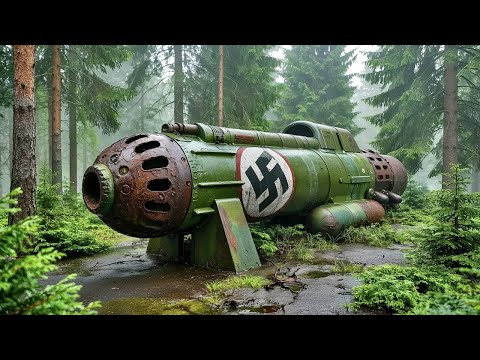
At the end of World War II, as the Third Reich crumbled, countless secrets were buried, hidden, or simply forgotten. Underground structures, secret laboratories, experimental weapons, and even trains loaded with gold and stolen treasures have been discovered over the years. These are the most chilling secrets of Nazi Germany, discoveries that reveal how far the darkness of the Third Reich extended.
In the dense forests of Gierłoż, Poland, lie the crumbling remains of the Wolf’s Lair, Adolf Hitler’s first military headquarters on the Eastern Front. This enormous bunker complex, camouflaged among the woods, was more than a simple command center. It was a fortress of terror composed of 80 buildings, surrounded by 50 bunkers, explosive traps, sniper nests, barbed wire, and a labyrinth of underground tunnels designed to fulfill the desires of a paranoid and megalomaniacal leader who distrusted every shadow and feared assassination at every step.
Even today, decades after the war, visitors to the Wolf’s Lair are unsettled by its eerie remains. Huge slabs of concrete lie scattered throughout the area, destroyed by German troops desperate to keep their secrets hidden. Still, one of the most important aspects of the discovery was its complex network of hidden corridors and extraordinary escape routes, which curiously were designed to destroy the complex in case the enemy managed to infiltrate or capture it.
The most famous event linked to this sinister complex occurred on July 20th, 1944, when Colonel Klaus von Stauffenberg attempted to kill Hitler with a briefcase bomb as part of Operation Valkyrie. Although the explosion ravaged the complex, Hitler survived. Despite its formidable defenses, Soviet forces eventually reached the site in early 1945, prompting retreating German troops to detonate hundreds of explosives, reducing the lair to ruins.
Today, only huge fragments of concrete and some collapsed shelters remain, reminding visitors of the terror and secrecy of a regime that once conspired within those walls to try to conquer the world.
Deep within the Owl Mountains of Poland lies one of the most enigmatic remnants of Nazi Germany: Project Riese, an extensive complex of tunnels built between 1943 and 1945. This underground network included corridors stretching for kilometers to connect underground chambers and was part of a massive project orchestrated by the SS, who used forced laborers to carry it out.
Some historians believe the plan was to create a secure command center for high-ranking officials, even a replica of the Führerbunker to house Hitler during his domination of the Eastern Front. Others argue it may have been intended for the development of advanced weapons or resource storage. Although its ultimate purpose was never confirmed since the project was left unfinished after the fall of Berlin, historians agree that the scale of the project was impressive.
Thousands of prisoners transferred from various concentration camps were forced to work under brutal conditions, excavating rock and pouring concrete in suffocating darkness. In some sections, ventilation systems, heavy armored doors, and railway lines appeared, indicating a large-scale design intended to withstand heavy bombings. Even today, the unfinished labyrinth seems eerily abandoned mid-construction, as if its creators disappeared overnight.
Today, Project Riese can be visited as a tourist site, and those who enter the tunnels experience intense chills thinking about the macabre nature of its construction.
Rising like monolithic fortresses above Berlin’s skyline, the Flak Towers were among the most formidable defense structures of Nazi Germany. These colossal elevated bunkers, crowned with brutalist stone platforms, were built to protect civilians from the devastating air raids of the British Royal Air Force. Constructed in the final years of the war, these massive concrete bastions housed anti-aircraft batteries and provided shelter to about 10,000 civilians. They were even used to safeguard ammunition, classified documents, and priceless cultural artifacts.
As Berlin prepared for imminent destruction, each tower complex rose proudly as a self-sufficient fortress packed with radar equipment, heavy artillery, and spotlights that could scan the skies for enemy bombers. In total, the Reich built eight anti-aircraft tower complexes: three in Berlin, two in Hamburg, and three in Vienna. The fortresses were divided into two types: G towers, designed for direct combat and bristling with weaponry, equipped with several 12.8 cm caliber Flak anti-aircraft guns; and L towers, or guide towers, which had radars and remote command equipment to coordinate defensive tactics.
Each complex consisted of one tower of each type, and although some measured around 43 meters high, those in Berlin reached up to 70 meters. During the final stages of the war, these enormous bunkers became critical vaults where museum artifacts and archives were stored. Despite intense bombing, the thick concrete walls withstood the Allied strikes with minimal structural damage, demonstrating unmatched structural superiority.
When Soviet forces pushed into Berlin in 1945, they found these fortresses had become the final frenzied refuge for desperate defenders. Today, some remains still stand as eroded ruins from a conflict that left Berlin reduced to ashes. Some towers, like those in Vienna, still remain standing, reminding us of the colossal scale of the Third Reich’s military engineering.
As Allied forces approached the territory occupied by the Third Reich, German officials rushed to safeguard looted cultural goods. While there were hundreds of hidden vaults, one of the largest and most spectacular treasure troves was the Altaussee salt mine in Austria, where the Nazis secretly hid thousands of paintings, sculptures, and other valuable artifacts. High-ranking Nazis oversaw the relocation of truly priceless works from across Europe, hoping to preserve them to form part of the cultural heritage of the postwar Nazi Empire.
Among the stolen works was the Ghent Altarpiece, a masterpiece of painting by Jan van Eyck, as well as works by Camille Pissarro, Michelangelo, and many others. We’re talking about pieces that today are worth hundreds of thousands, if not millions of euros individually, and form part of the most important private collections in the world. However, the harsh conditions inside the cold and labyrinthine mine threatened the integrity of these fragile artifacts, as moisture, cold, rockfalls, and other hostile conditions posed a serious risk.
To prevent this, the SS officers in charge of the project forced laborers to build huge wooden crates, wrap large waterproof tarpaulins, and erect protective walls. Finally, as Germany’s defeat loomed, the Nazi leadership chose the scorched earth option and gave the terrible order to destroy certain works of art to prevent them from falling into Allied hands. If they were not in Hitler’s hands, they would be in no one’s.
Fortunately, local miners who had organized into a small peaceful resistance managed to secretly sabotage the SS plan, using fake explosives or redirecting bombs so they would detonate far from critical areas. Once the region fell under Allied control, the Monuments, Fine Arts, and Archives program, later known as the Monuments Men, raced against time to recover and document the treasures hidden in the Altaussee mine. When President Franklin D. Roosevelt ordered a cultural sweep of the site, this treasure hunt became one of the greatest art recovery efforts in modern history.
The Second World War left behind many unsettling mysteries, but the vanishing of the Amber Room remains one of the most extraordinary. How could an entire room filled with gold and treasures disappear? Though it may sound like the plot of a crazy movie, this actually happened, and to this day, it continues to astonish even the most skeptical historians.
Originally, the room was designed as a dazzling spatial masterpiece of 55 square meters, with walls covered by amber panels totaling six tons of this expensive material and adorned with gold sculptures, mirrors, and other invaluable gemstone artifacts. Built in the early 1700s in Berlin, in 1716 the room was gifted to Tsar Peter the Great and installed in the Catherine Palace located in the Tsar’s Village near St. Petersburg, becoming the eighth wonder of the world. And there it remained until the Nazi invasion of the Soviet Union.
When Reich forces captured the Catherine Palace, they did the unthinkable: the Nazis stole the Amber Room. The entire room was dismantled and transported to Königsberg Castle, where it was last seen before vanishing without a trace. While its disappearance alone is chilling, what makes the Amber Room one of the greatest mysteries surrounding Nazi power are the dark legends that surround it.
Some historians propose that it was hidden in a secret Nazi bunker, equipped with traps to prevent it from being found. Others claim it was loaded aboard the ship Wilhelm Gustloff, which mysteriously disappeared in the Baltic Sea, allegedly torpedoed by a Soviet submarine, possibly transporting the room and other looted treasures. Unofficial sources claim that many treasure hunters died under mysterious circumstances while searching for the Amber Room, a myth that fed the belief in a curse surrounding the vanished wonder.
What is certain is that the pursuit of the Amber Room continued for decades, sweeping through secret tunnels, abandoned mines, and ruins devastated by war. Some parts were found in Königsberg Castle, which was brutally bombed by the British Royal Air Force in 1944, being reduced almost to ashes. Some claim that most of the room was destroyed along with the castle, although other parts such as certain mosaics and individual decorations were found in Germany, Italy, and strange locations, leading to the theory that the impressive room was torn apart and sent to hundreds of destinations throughout occupied Europe.
In 2003, a reconstructed Amber Room was inaugurated, which includes some of the parts that survived the Second World War and were recovered by the Allies. However, the fate of the original eighth wonder of the world was never discovered and continues to haunt historians and plague the dreams of treasure hunters around the world.
In late 1944, German physicists rushed to unlock atomic energy for military use, a capability that would have forever changed the outcome of the war. In the small town of Haigerloch in southwestern Germany, a select group of Nazi researchers moved into a brewery cellar which was converted into an impressive secret laboratory. There they began assembling a nuclear reactor based on heavy water, aiming to replicate the results of the American Manhattan Project and give Hitler the ultimate weapon.
Built underground and covered by a defensive bunker to protect it from bombings and aerial detection, the reactor began to be tested at the start of 1945 with the Allies already pressing at the borders of the Third Reich. The project, known as B8, was led by scientists like the legendary Werner Heisenberg, who headed a team feverishly trying to create a self-sustaining chain reaction—a step that could have changed the course of history.
But the war was nearing its end, and the evidence of Germany’s fall hindered the reactor’s development. The researchers faced resource limitations, disrupted supply chains, and constant Allied bombings that managed to stall the progress of Nazi nuclear technology. Heavy water shipments from Norway, a crucial resource for operating a reactor, were repeatedly sabotaged by Allied forces. As the enemies closed in on Germany, the team’s success drifted further away, though their final experiments continued under the watchful eyes of SS officers who were already utterly desperate to obtain some advantage.
In 1945, with the war practically lost, the Americans launched Operation Alsos, a coordinated effort by the Manhattan Project to infiltrate, recover, and redirect all Nazi research in the field of atomic energy. It didn’t take long for them to discover the secret site in Haigerloch. And when they raided the laboratory, they found a chilling discovery: the reactor was very close to completion and intact, with uranium cubes suspended from rods, suggesting just how dangerously close the Nazis had come to unlocking nuclear energy.
Fearing what might have been, Allied experts quickly dismantled the reactor and took its components for analysis. The underground site was later transformed into a museum where the remains of the reactor apparatus lie in the original cave—an unsettling relic of a terrifying possibility: a Nazi atomic bomb.
The final entry takes us beneath the ruined streets of Berlin to the Führerbunker, Hitler’s underground shelter during his last days. Built by Hochtief AG, this complex of 28 rooms was designed as an air raid shelter, not a true residence. By early 1945, as Soviet artillery pounded the city, Hitler and his inner circle withdrew into this concrete warren.
On April 29, 1945, Hitler and Eva Braun were married in a small ceremony just hours before ending their lives. Soldiers carried their bodies to the chancellery courtyard and burned them. Days later, other officials followed suit, destroying files and personal effects.
When Soviet troops secured the area, they found empty corridors littered with documents and evidence of frantic attempts to burn any record of Nazi activities. For decades after the war, authorities demolished parts of the bunker. Today, the remains lie beneath modern apartment buildings and parking areas, with only a discrete plaque marking the location.
These chilling discoveries reveal how far the darkness of the Third Reich extended—and how its secrets still haunt us. What do you think was the most disturbing secret of all?
Report this article
Select a reason for reporting:






