Dr. Amanda Chen stared at the oil painting on her computer screen, her breath catching in her throat. It was May 2024, and she had been analyzing 19th-century American portraits for months at the Smithsonian’s conservation lab in Washington, D.C. But this one—dated 1879—was different. Two young women, one white and one black, sat side by side on a stone bench, shoulders nearly touching, both smiling genuinely. It was an unusual display of intimacy and equality for a post–Civil War painting.
The work had been donated by the Whitfield family of Charleston, South Carolina. A brass plate read Margaret and Clara, 1879. The donation note explained that the portrait had been found in their grandmother’s attic in 1956 and hidden away for decades. “Hidden away?” That phrase nagged at Amanda. Why would such a peaceful scene be concealed?
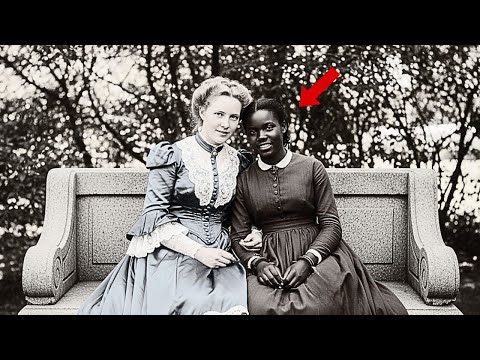
She began standard conservation analysis using X-radiography to examine the painting’s layers. When the X-ray image appeared, Amanda’s breath caught. There, invisible beneath layers of paint, were shapes around the black woman’s wrists and ankles—heavy, unmistakable shapes deliberately painted over. Iron shackles. Amanda sat back, heart pounding. This wasn’t just a portrait of two young women. Beneath the surface were symbols of bondage and enslavement, deliberately hidden by paint.
Why would an artist paint shackles and then cover them? What was the relationship between these women? And why had this portrait been hidden for decades? Amanda called Dr. Evelyn Washington, a historian specializing in slavery-era artifacts. “I found something extraordinary,” Amanda said. “A painting from 1879 showing two friends, but X-rays reveal shackles hidden beneath the paint. I need to know who these women were.” Evelyn was silent briefly. “Send me everything. If there’s a story here, we’ll find it.”
Two days later, Evelyn arrived at Amanda’s lab carrying folders about the Whitfield family. They met where the painting hung, looking deceptively peaceful. “Tell me what you found,” Evelyn said. Amanda displayed the X-ray images. “Look around Clara’s wrists and ankles. The artist painted heavy iron shackles, then deliberately covered them with layers of paint. It took significant effort to hide them this thoroughly.” Evelyn leaned closer, expression darkening. “So originally, Clara was shown in chains beside Margaret. Then someone painted over the shackles to make them look like equals.” “Exactly, but why?”
Evelyn opened her folder. “The Whitfields were wealthy Charleston plantation owners before the Civil War. They owned over 200 enslaved people. Margaret Whitfield was born in 1860, making her 19 in 1879. And Clara—the name doesn’t appear in official Whitfield records, but I found something in their plantation records from 1860. Girl child named Clara, born March 1860 to enslaved woman Ruth, assigned to house duties.” Amanda’s chest tightened. “So Clara was born the same year as Margaret on the same plantation.” “Yes, enslaved children were often assigned as companions to white children. They’d play together when young, though the relationship became unequal as they grew older,” Evelyn continued. “By 1879, Clara would have been legally free. But Reconstruction was failing, Jim Crow laws emerging. Many black women had little choice but to continue working for families that once enslaved them.”
Amanda studied the painting again. Two women who grew up together, one as master’s daughter, one as enslaved property. By 1879, slavery was over, but the shackles remained hidden beneath paint. “We need to find out what happened in 1879 specifically,” Evelyn said. “Why was this portrait commissioned?”
Over the next week, they researched. Margaret had married in 1881 and died in 1943. But Clara’s story was harder to trace—sporadic city directory mentions as a domestic worker, no marriage record, no clear trail after 1885. Then Amanda found a letter tucked in the frame’s back, dated June 1879. Dearest Clara, I know this is forbidden. My parents would be furious, but I cannot bear that we’ll soon be separated forever. You are my oldest friend. Though the world insists we are unequal, my heart knows otherwise. Let this painting preserve our friendship with deepest effect. They sat in silence. “They commissioned this secretly,” Amanda said. “To preserve their friendship.” “But the shackles,” Evelyn whispered. “Why paint Clara in shackles?”
Amanda examined every inch of the canvas, finding tiny letters in the painted tree bark: TWW1879. Evelyn searched Charleston records, finding Thomas Wright, a portrait painter with a studio on King Street, operating 1872–1884. More importantly, the 1870 census listed Wright as mulatto, a free person of color serving both black and white clients. “This changes everything,” Evelyn said. “As a black man, Wright understood the complexities. He understood what it meant for Margaret and Clara to sit together like this.” Amanda studied the X-rays again. “So Wright painted Clara in shackles deliberately. He was making a statement.” “Exactly. He was painting truth beneath appearance. On the surface, two friends; underneath, the reality that Clara was still bound—not by literal chains, but by social, economic, and legal constraints.”
They found Wright’s 1876 advertisement: T. Wright, Portrait Artist, all clients welcome. The phrase signaled he’d paint black subjects with dignity equal to white subjects. Then Evelyn found an August 1879 newspaper article: Local artist Thomas Wright has departed Charleston for Philadelphia, seeking greater opportunities in the North. Conditions have become untenable for Negro artists here. “He left right after painting this portrait,” Amanda said. “Not a coincidence.” Evelyn nodded. “Wright painted something dangerous. Margaret and Clara wanted a friendship memorial, but Wright made it more—a critique, a truth powerful people wouldn’t want revealed. And then he had to leave.”
They needed to understand why this painting had been hidden for decades. Who had hidden it and why? The answer would be more heartbreaking than either imagined. The portrait wasn’t just a friendship memorial; it was evidence of a tragedy the Whitfield family had worked hard to erase from history. Now, 145 years later, that tragedy was finally going to be revealed.
Evelyn knew that understanding this painting required finding Clara’s own words—letters, diary entries, anything documenting her perspective. She contacted the Avery Research Center in Charleston, which specialized in African-American history. Their archivist, Marcus, was intrigued and began searching their collections. Three weeks later, Marcus called with news. “We found something extraordinary. A collection of letters written by formerly enslaved women, donated in the 1930s by a black church. Among them are several letters written by someone named Clara, dated between 1877 and 1880.”
Evelyn flew to Charleston immediately. The letters were fragile, written in careful handwriting on cheap paper—the only kind Clara could afford. One letter, dated May 1879, was addressed to Margaret. Dear Margaret, I received your message about the portrait. I don’t know if this is wise. Your parents would be furious if they discovered we still meet in secret. But I confess my heart leaps at the thought of sitting beside you once more as we did as children before the world taught us we were meant to be separate. I will come. I will sit beside you one final time. Perhaps the painting will prove that what we felt was real, even if no one else understands. Your friend always, Clara.
Evelyn’s hands trembled reading it. This confirmed that Margaret and Clara had arranged the portrait secretly, against Margaret’s parents’ wishes. Another letter, dated July 1879—after the portrait was painted—revealed something darker. Dear Margaret, I cannot see you anymore. Your father discovered our portrait. He came to where I work, threatened me, said terrible things. He says if I ever approach you again, he will ensure I am arrested, that I will be sent to prison or worse. I know you tried to protect me, but we were foolish to think we could preserve our friendship. The world will not allow it. Please do not try to find me. It will only bring more trouble. I must disappear for both our sakes. Remember me kindly, Clara.
Evelyn felt sick. Richard Whitfield had discovered the portrait and threatened Clara to force her away from his daughter. She found one final letter, undated, but written in shakier handwriting. To whoever finds this, my name is Clara. I was born enslaved on the Whitfield plantation in 1860. Margaret Whitfield was my friend from childhood. We grew up together, played together, shared secrets. When slavery ended, I hoped things would be different. But freedom is not freedom when you’re still bound by poverty, by laws that deny you rights, by people who see you as property even without chains. Margaret tried to be my friend, tried to preserve our bond through a portrait. But her father destroyed that dream. I left Charleston because I had no choice. I write this so someone will know that I existed, that my friendship with Margaret was real, that I was more than what they tried to make me. Clara.
These letters changed everything. This wasn’t just about a hidden portrait; it was about two young women whose childhood friendship had been destroyed by racism and a father who couldn’t accept his daughter caring for a formerly enslaved woman. “The shackles in the painting,” Amanda said quietly. “Wright painted them because Clara was still shackled—by poverty, by Jim Crow, by men like Richard Whitfield who would threaten and intimidate to maintain racial hierarchy.” “And Margaret knew it,” Evelyn added. “That’s why she hid the painting after her father discovered it. She couldn’t show it publicly, but she couldn’t destroy it either. It was all she had left of Clara.”
Evelyn searched Richard Whitfield’s personal papers at the South Carolina Historical Society. In a July 1879 letter to his wife, Catherine, he raged: “I have dealt with the situation. I located Clara and made clear that any further contact with Margaret will result in severe consequences. I have also ensured the artist has left Charleston. The portrait will be destroyed.” But it wasn’t. Catherine’s diary revealed why. I cannot do it. I watched Margaret and Clara grow up together before the war. They were like sisters. This portrait is all she has left. I have hidden it in the attic instead.
Margaret married in 1881 and lived a melancholy life, but her granddaughter’s memoir revealed a locked drawer containing Clara’s letters and a small portrait—burned after her death. Clara, meanwhile, fled to Augusta, Georgia. Church records showed she joined Springfield Baptist in 1879, married a carpenter named Samuel in 1885, and raised four children. Her 1903 obituary noted her “quiet dignity and kindness to all.” Samuel later donated her letters to the church, writing: She never saw Margaret again, but thought of her often.
Amanda’s infrared reflectography uncovered Wright’s secret message beneath the paint: “Though the chains are hidden, they remain. 1879.” He had also painted tears on Clara’s face, then covered them. “He painted the truth first,” Amanda explained, “then created the version they could actually keep.”
They found Clara’s great-great-granddaughter, Michelle, a history teacher in Atlanta, and Margaret’s great-great-grandson, David, in Charleston. At the Smithsonian, Michelle told David, “Your family tried to erase this story.” David looked down. “I’m ashamed of what my ancestor did. But Margaret kept Clara’s letters her entire life.” Together they planned an exhibition: Hidden Chains: A Friendship That Survived on Canvas, Though It Could Not Survive in Life.
The exhibition opened in March 2025 to record crowds. Then a package arrived for Michelle from Patricia, age 92—Clara’s youngest daughter. Inside was a child’s pencil sketch: two little girls holding hands. Margaret and Clara, 1867. Patricia wrote: Mama told me, “The world said we couldn’t be friends, but we were. Remember that.”
Michelle showed the sketch to her students, then pointed to the formal portrait. “The chains were hidden. But so was the resistance. So was the love. And truth has a way of surviving.”
What hidden truths might still be waiting beneath the surfaces of the stories you’ve been told?
Report this article
Select a reason for reporting:






