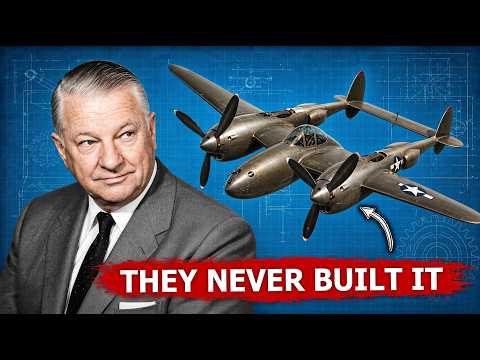
In the spring of 1943, at a dusty test field in Florida, a Lockheed Lightning lined up against the two newest fighters America had: the P-51 Mustang and the P-47 Thunderbolt. It beat them both—in climb, in speed, in altitude—in every category the engineers could measure. It reached 20,000 feet in five minutes flat. On paper, it was the best fighter in the country. And not a single one was ever built for combat.
To understand why—and the strange promise underneath it—you have to start with a rule every pilot in the Pacific knew by heart: if you meet a Japanese Zero, do not turn with it. Do not try to outfly it in a circle. If you do, you will die. That wasn’t cowardice. It was math learned in blood.
The Mitsubishi Zero could turn inside almost anything the Allies put in the air in 1942. It was light—brutally, deliberately light. Its designers had stripped out armor, stripped out self-sealing fuel tanks, stripped weight from anywhere they could find it. What they got in return was a fighter that could pull a tighter circle than any American pilot could follow. Get into a turning contest with a Zero, and it would simply rotate around behind you and put cannon shells through your cockpit.
So the Americans were told again and again: “Never dogfight a Zero. Use your speed. Dive on it, hit it, run, climb away, and come back. Whatever you do, don’t get pulled into a turn.”
Hold on to that rule, because the whole point of this story is that one American fighter learned to break it—and the version that could have broken it decisively was the one they threw away.
To see how any of this happened, we have to go back to 1937, to a requirement so demanding the men who wrote it half expected nobody could meet it. The US Army Air Corps wanted an interceptor—not just fast, very fast: 360 mph up high and able to climb to 20,000 feet in six minutes. In 1937, that was close to fantasy. The reason was the engine. There simply wasn’t an American engine powerful enough to push a single-engine fighter to those numbers.
At Lockheed, a young engineer named Clarence “Kelly” Johnson looked at the requirement with his boss, chief engineer Hall Hibbert, and came to a conclusion nobody else wanted to accept: if one engine can’t do it, use two. That sounds obvious now. It wasn’t. Twin-engine fighters were considered clumsy, heavy, doomed to lose to the nimble single-engine planes they’d meet. Nobody built a serious interceptor that way. And if Johnson was wrong, Lockheed had bet its shot at a major military contract on a layout the whole industry expected to fail.
But Johnson didn’t just bolt two engines onto a normal airframe. He built something that looked like nothing else in the sky: a central pod for the pilot and the guns, and two long booms stretching back behind the engines, joined at the tail. Two propellers spinning in opposite directions so the twist of one cancelled the twist of the other, and the plane didn’t try to wrench itself off the runway. And buried in the booms behind each engine sat turbo-superchargers—the trick that let it keep its power up high where other fighters ran out of air.
On January 27, 1939, a test pilot named Ben Kelsey took the prototype up for the first time. Almost immediately, this strange machine started causing the kind of problems that would haunt it for years. Because the first thing the Army wanted to do with it was show it off. Two weeks after that first flight, Kelsey was ordered to fly the prototype across the entire country, coast to coast, to prove what it could do. He did it in a little over seven hours with two stops to refuel—a stunning time for the era. And then on final approach near New York, with the whole point almost made, the engines iced up, lost power, and the prototype came down short into a golf course, wrecked, completely destroyed.
Here’s the strange part: it didn’t matter. The airplane had already flown fast enough for long enough that the Army had seen what it needed to see. Weeks later, they ordered 13 more. The prototype was scrap, but the program was alive. Lockheed had its fighter: the P-38.
And now, the plane carried a secret nobody had found yet—because nobody had flown it fast enough to trip it.
The P-38’s whole reason to exist was speed and height. Climb high, dive fast, hit hard. But when pilots started taking it into steep, high-speed dives, something terrifying happened. As the plane accelerated toward roughly three-quarters the speed of sound, the air flowing over the wing hit its own limit. Shock waves formed. The tail lost its grip. The nose tucked down harder. And the control column went stiff, then immovable. The pilot was locked into a screaming dive with a stick that would not move, watching the ground rise.
Nobody had a word for it that anyone understood yet. Today we call it compressibility. In 1941, it was just a thing that killed people.
On November 4, 1941, a Lockheed test pilot named Ralph Virden went up to try a fix for it—a set of spring-loaded tabs meant to give the pilot the muscle to haul the nose back up. Virden was no beginner. He had more than 15,000 hours in the air. He ran the test, and in the recovery, something went wrong. The forces were too much. The tail of the aircraft failed and tore off. The plane fell into a house in Glendale, California—into the kitchen. Virden was killed.
Think about what that did to the program. The airplane’s single greatest weapon, the dive, was killing its own test pilots and dropping them into people’s homes. And it wasn’t only test pilots. Out in the war, combat flyers who pushed a Lightning into a hard dive chasing an enemy could hit the same wall, feel the same stick freeze solid, and never come out of it. The plane had a speed it could reach but not survive.
But there was a clue, and it came from a man who lived. An Army major named Sigmund Gilkey got caught in one of these lockups and, instead of bailing out, rode it down. As the plane fell into thicker, denser air lower down, the controls slowly came back to life and he pulled out. That told the engineers something crucial: the plane wasn’t cursed. The effect was survivable if you understood it—and if you handed the pilot the right tool at the right instant. Finding that tool would take three more years.
While the engineers wrestled with it, the war arrived, and the P-38 was thrown into the one place it was almost perfectly built for: the Pacific. The Pacific was vast—mostly water and jungle—and the distances were enormous. Fighters with short legs were nearly useless out there. The P-38 had range no other American fighter of 1942 could match. It could escort bombers for hundreds of miles over open ocean and still get home. Two engines meant that if one was shot out over all that water, a pilot still had a chance. Missions ran nine, ten, twelve hours. Lightnings limped home on one engine again and again.
And it hit hard. Every gun—a cannon and four heavy machine guns—was packed into the nose right in front of the pilot. Most fighters carried their guns in the wings, angled inward to cross at one set distance downrange, which meant your fire only truly bit at that exact range. The Lightning’s nose guns fired straight ahead in one concentrated stream, deadly up close or far out. Point the nose, pull the trigger, everything went to the same place.
But here’s what happened. When those early P-38 pilots got into a real fight—low and slow against a Zero—they lost exactly the way the rule warned. They tried to turn with a plane built to outturn everything, and they came off second best. The Lightning was faster, climbed better, hit harder, and none of it helped if you let a Zero drag you into a circling fight down low. The plane had the tools to win. It did not yet have the tools to turn.
So the smart squadrons stopped trying. They built a whole way of fighting around the airplane’s real strengths and around that one rule. Stay high, where the turbo-superchargers gave the Lightning power the Zero couldn’t match. Pick your moment. Dive on the enemy in one fast pass. Hit him with that concentrated nose fire and keep going. Use the climb to zoom straight back up out of reach. Reset and come down again. One pass, no circling. If it went wrong, run—the P-38 could simply outrun what was chasing it. Flown like that in New Guinea and the Solomons, it started racking up results.
But it was winning by avoiding the turning fight, not by winning it. And that gap nagged at everyone. So the question became: could you make a big, heavy twin-engine fighter turn with the most agile dogfighter of the war?
And the honest answer the engineers reached was: not exactly. You couldn’t make it beat a Zero at the Zero’s own game. What you could do was change the game.
Here’s the thing about the Zero that its reputation leaves out. Its magic worked at low speed. Down low and slow, it was untouchable in a turn. But push the speed up, and the Zero developed a problem of its own. At high speed, its controls went heavy—the ailerons especially. Past roughly 250 mph, a Zero pilot hauling on the stick to roll into a hard turn found the airplane fighting back, stiffening up until rolling it felt like shoving against a wall. The little fighter that danced at low speed got clumsy when things got fast.
The late-model Lightnings attacked exactly that weakness with two changes. The first was a set of flaps the pilots called combat flaps. The P-38 used Fowler flaps—flaps that slide backward as they drop, adding real wing area, not just angle. A pilot could snap them to a special partial setting in the middle of a fight, and suddenly the wing was making more lift. More lift means a tighter turn at the same speed. It let the Lightning haul itself around a corner farther than a plane its size had any right to.
The second change mattered more, and it came late: hydraulically boosted ailerons, power assistance for the roll controls, so the pilot’s muscle was amplified. Now, at exactly the high speeds where the Zero’s controls froze up, the Lightning stayed light and quick. The P-38 could roll and change direction fast up on the high end of the speed scale—the one place the Zero simply couldn’t answer.
Put those together, and you get the fighter the title promises. Flown by a pilot who knew what he was doing at the right speeds, the late-model P-38 with its combat flaps, its boosted ailerons, and its dive brakes could actually hold its own against a Zero in a turning fight—and beat it. Not by being lighter, but by forcing the fight into the one place where the Zero got clumsy and the Lightning didn’t.
That’s the real answer to a question people still argue about. Yes, a P-38 could outturn a Zero—but only a very particular P-38 flown a very particular way. And it took until 1944 for all those pieces to reach the squadrons together.
Which raises the obvious, painful question: if the fix was that good, what took so long? And what would the Lightning have become if they’d pushed even harder?
They did push harder. That’s the part almost nobody knows.
While the combat models were still being refined, Lockheed had been watching what happened to another fighter—the P-47 Thunderbolt—when someone bolted a new kind of propeller onto it. Broad, paddle-shaped blades that took a much bigger bite of air. The Thunderbolt’s climb and acceleration jumped. So Lockheed tried the same idea on a Lightning: new paddle-blade propellers, plus revised gearing in the engines to spin them right. The result got a name—the P-38K.
To fit the fatter blades, they had to enlarge the spinners and reshape the engine cowling slightly, raising the thrust line. Remember that detail. It’s the whole tragedy in miniature.
But first, the numbers. They tested the K in early 1943, then flew it to Eglin Field in Florida to put it up against the newest fighters in the pipeline: the P-51B Mustang and the P-47D Thunderbolt. This is the moment from the opening. The Lightning beat both of them in every measured category.
At military power, it hit 432 mph. And Lockheed’s engineers projected that at full war emergency power, it would top 450. Its ceiling ran up around 46,000 feet. And the climb—the climb is what made the evaluation team sit up: 4,800 feet a minute. 20,000 feet in five minutes flat. And it did that carrying a heavy coat of camouflage paint that was slowing it down. Strip the paint, clean up the cowlings, and it would have been faster still.
This was, by the measured numbers, the best fighter America had in 1943. Better climb than the Mustang, better speed up high than the Thunderbolt, and with the more efficient propellers, its range would have stretched another 10 to 15 percent on top of the Lightning’s already enormous reach.
Lockheed thought they had a world-beater. They were right. So the government rushed it into production.
Except it didn’t.
The War Production Board said no. Not because the airplane wasn’t good enough—everyone agreed it was superior. They said no because of that detail about the cowlings. Changing the nacelles and spinners on the line would have meant stopping that line and retooling it for an estimated two to three weeks. And in 1943, with the Lightning being built flat out and demanded on every front, two to three weeks without Lightnings coming off the line was judged unacceptable. There were doubts, too, about whether the engine maker could deliver the new version in quantity. So the word came down: no interruption. Keep the current models flowing.
That decision only makes sense once you understand how the P-38 was built. Because unlike almost every other major American aircraft, the Lightning came from essentially one place: one main plant in Burbank, California. In a war where the American answer to everything was to build a second factory and a third and spread the work across the country, the Lightning stayed concentrated. By 1944, that single operation was pushing out more than 400 aircraft a month. Across the whole war, a little over 10,000 P-38s were built, and only 113 of them came from a second manufacturer, right near the end.
So there was no other line to absorb the change. No second plant to switch over while the first kept running. Stopping Burbank meant stopping the Lightning, full stop. The very success that flooded the war with P-38s is exactly what made improving them impossible. The best version of the airplane died to protect the schedule of the good-enough version.
One P-38K was built. That was all.
So the Lightning went to war as the airplane it already was, not the airplane it could have been. And even that airplane was about to do something no other American fighter could.
By April 1943, American codebreakers had cracked a Japanese message revealing that Admiral Isoroku Yamamoto—the man who had planned the attack on Pearl Harbor, the commander of the entire Japanese fleet—was going to fly to a forward base on a specific morning, on a schedule precise to the minute. The Americans decided to intercept him in the air and kill him.
There was only one fighter that could even attempt it. The target was hundreds of miles away, deep in Japanese-held airspace. The round trip came to around a thousand miles, most of it over water, and it had to be flown low and by an indirect route to avoid detection. Hung with an oversized drop tank under a wing, a P-38 could fly roughly 600 miles out, fight, and still make it home. No Navy or Marine fighter in the theater had that kind of reach. Only the P-38 did.
On April 18, 1943, 16 P-38s led by Major John Mitchell flew that route down on the deck over open ocean, navigating by compass and clock with no margin for error. They arrived almost exactly when the calculation said they would. Yamamoto’s aircraft was there. The Lightnings hit it, and it went down into the jungle of Bougainville. The architect of Pearl Harbor was dead—killed by the one quality of the P-38 no committee could ever design out of it: reach.
Reach won that mission. But reach is not the same as winning the air. For that, the Lightning needed something else: pilots who understood exactly what it was and what it wasn’t.
The two highest-scoring American fighter pilots in history both flew the P-38, and both flew it in the Pacific. The top ace was a quiet farm boy from Wisconsin named Richard Bong, who finished the war with 40 confirmed victories. Second was Thomas McGuire with 38, who flew with a P-38 outfit called the 475th Fighter Group—“Satan’s Angels”—which alone ran up more than 500 aerial victories. Both men received the Medal of Honor. Seven of the top eight American aces in the entire Pacific War flew Lightnings.
Bong is the perfect illustration of how you actually flew this airplane to win. He didn’t waste time trying to outdance anyone. He used the Lightning’s speed and its concentrated nose guns. And he flew straight at the enemy, closing the range until he almost couldn’t miss—sometimes flying through the debris of the plane he’d just blown apart. He wasn’t the smoothest pilot in the sky, by his own account. He just put a fast, heavily armed airplane where it needed to be and fired. That was the Lightning’s game: pick the fight, dictate the speed, hit hard, and refuse to be dragged into somebody else’s kind of battle.
And when a late-model Lightning was flown by someone with that judgment, it could finally do the thing the early pilots couldn’t. It could turn when it had to—and win. The airplane and the way to fly it had at last caught up to each other.
So in the Pacific, the P-38 was a killer. Which makes the next fact confusing: because over Europe, the same airplane struggled badly. And that contradiction tells you what the Lightning really was.
Over Europe, the Lightning hit problems the Pacific never really exposed. The escort war over Germany was fought high and bitterly cold, at altitudes and temperatures that punished the P-38’s engines. Cockpits froze. Engines that ran fine in the tropics threw fits in the deep cold of high-altitude Europe. And the compressibility trap—the tuck that locked the controls in a dive—was far more dangerous when you were chasing German fighters down from great height than it usually was in the Pacific. The fix, when it finally came, was almost modest: a set of small flaps under the wings that a pilot could pop out in a dive to restore some of the lift the shock waves had stolen, so the nose would come back and he could pull out alive.
Those dive-recovery flaps and the boosted ailerons that made the plane a dogfighter didn’t arrive in real numbers until 1944. And by then, another fighter had shown up that could fly all the way to Berlin more cheaply and simply: the P-51 Mustang. The Lightning was quietly pulled out of the escort role in Europe and shifted to other jobs.
Now look back at that canceled P-38K and feel the timing of it. The K model’s whole gift was climb and high-altitude performance—the exact things the Lightning was short of over Germany. It was tested and ready in early 1943. If it had gone into production then, the Lightning that reached Europe in force could have been a fundamentally better high-altitude fighter right when that mattered most. Instead, it was killed over a cowling change and a few weeks of tooling. The airplane never got the chance to answer its harshest critics, because the version built to answer them was never built at all.
And this is where you have to be honest about the whole legend. The P-38 was not a magic super-weapon. Its record in the Pacific rested on more than the airframe: on its range, on that concentrated firepower, on how much damage it could soak up and still fly home, and above all on pilots and tactics that learned to lean on its strengths and refuse its weaknesses. When it fought its way, it dominated. When it fought the enemy’s way, it died. That was true from the first year to the last.
So come back to where we started. A test field in Florida, 1943. The best fighter in the country by the numbers, flying against the Mustang and the Thunderbolt and beating them both—and never built. We can finally see what that airplane really was.
The Lightning did learn to outturn a Zero. Not by magic, and not everywhere, but truly—with combat flaps to tighten the corner and boosted ailerons to stay sharp at the speeds where the Zero went stiff, in the hands of a pilot who knew to keep the fight fast. That fighter was real. It flew, and it won. And the ultimate version of it—the one that would have made the Lightning untouchable over any front—was thrown away to keep an assembly line from pausing for three weeks.
The Lightning’s real enemy, in the end, was never the Zero. It was time, and its own production schedule. Every fix it needed arrived a little too late to change its own story: the dive flaps, the boosted ailerons, and most of all, the K sitting finished and superior in 1943, grounded by a decision about tooling.
And there’s a whole side of the Lightning most people never hear about. Strip out the guns, pack the nose with cameras, and you got the F-5—the version that flew unarmed, alone, and fast over enemy territory to bring back photographs. Lightnings in that role shot a huge share of the American aerial reconnaissance over Europe, the pictures that planned the invasions. One of the men flying those camera missions was Antoine de Saint-Exupéry. Yes—the French writer who wrote The Little Prince. He took off in an F-5 over the Mediterranean on the last day of July 1944 and never came back. The plane built to fight was also the plane that quietly went out to look, and it took some of those pilots with it, too.
The people moved on. Kelly Johnson, the young engineer who bet on two engines when everyone said it was clumsy, went on to run Lockheed’s secret project shop—the Skunk Works—and shaped American jets and spy planes for decades. Richard Bong, the top ace, survived the whole war in the Pacific, then died in August 1945 at home when the brand-new jet he was testing, the P-80, failed on takeoff. And the thousands of Lightnings that had crossed those oceans were rounded up after the war and scrapped by the thousands, sold for pennies, cut apart for their aluminum.
The airplane that could outturn a Zero got its wings eventually. The one that could have owned the sky never really left the ground. And the difference between them wasn’t the enemy, or the engineering, or the pilots. It was three weeks nobody was willing to spend.
So here’s the question that still hangs over that dusty Florida runway: if you were the one signing the order in 1943—knowing the P-38K was better, knowing the line would stop—would you have paused production to build the best fighter of the war, or kept the good-enough one rolling? Tell me in the comments which choice you’d have made.
Report this article
Select a reason for reporting:






