The hill had been burned black long before the first American boots touched its soil. Locals called it Suan Co Gen—Black Palm Ridge—because the palm trees that once stood tall along its slopes had been scorched by old napalm strikes, leaving behind twisted trunks like the charred ribs of some dead giant. Even in daylight, the place felt wrong. But now, with dusk bleeding out across the sky, it looked like the doorway to another world. A harder one. A crueler one.
Lieutenant Daniel Halloran crouched low behind a boulder half cracked by shrapnel and wiped soot-mud from his eyes. The ridge groaned with wind carrying the smell of old ash and the taste of iron. Three yards below him, the ground dropped into a steep slope littered with burnt palm husks and exposed roots sharp as claws. Farther down, beyond the haze of smoke drifting up from the valley, the jungle stirred restlessly—alive with shadows, shuffling boots, and voices speaking the clipped, disciplined cadence of North Vietnamese regulars.
His radio operator, PFC Jimenez, pressed a trembling hand to the set on his back. “Lieutenant, they’re tightening again. Left flank’s shot to hell. Right side’s nearly gone.”
Halloran didn’t need the update. He could see it, hear it, feel it in the ground. The entire ridge was closing around them like the jaws of a trap. Bravo Company second platoon had been fighting their way uphill all afternoon, pushed and hunted by NVA forces that seemed to replenish from the trees as fast as they could shoot them down. What was left of Halloran’s men—27 at the start—now barely 18. We’re stranded near the top of a position they never wanted. High ground that was far too exposed, hemmed by a cliff at their backs and three advancing enemy elements below.
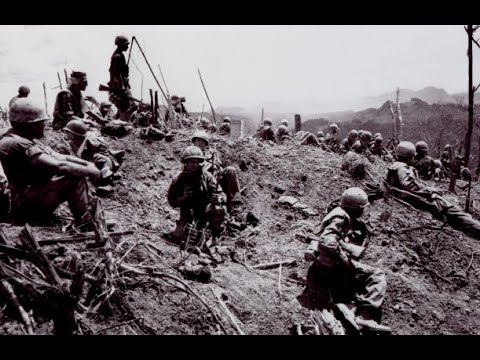
A burst of AK fire ripped across the slope, chewing bark off one of the few surviving stumps. Private Kovacs, one of the youngest in the platoon, ducked so fast he fell backward onto his pack. “They’re everywhere!” he gasped, rolling onto his elbows. “Sir, we—”
Halloran grabbed him by the webbing, dragging him behind cover as another burst tore through where the kid had been seconds earlier. “Keep your head down. They want us panicking. Don’t give it to them.”
But fear was already crawling through the platoon’s bones. The ridge was open, unforgiving. The NVA owned the jungle below. They were like shadows rising from the ground. And every minute they crept farther up the hill.
Halloran raised his binoculars. Movement. Figures shifting between the blackened palms, closing in from three directions. Left, right, center. A classic pincer. No drones, no artillery, no air support—just raw instinct and the smell of imminent death.
Jimenez twisted the radio knob again. “Still nothing. Storm’s messing everything up.”
Thunder rolled somewhere deep in the clouds. Lightning flickered across the sky, briefly illuminating the battlefield in stark white. Rain threatened, but hadn’t fallen yet. Like the sky was waiting for someone to die before it opened.
Halloran snatched the handset. “Bravo 2-6 to any unit in range, do you copy? We need immediate assistance. Immediate.”
Static. A long hiss, like the ridge itself mocking them. He tried again. “Any friendly unit, we are pinned and surrounded on Black Palm Ridge. Repeat, Black Palm Ridge. We’re—”
A single crackle cut through the static. Faint. Almost imaginary. “Receiving. Repeat your last.”
Halloran froze. The voice wasn’t American. Not Army, not Marines. The accent was sharper, rougher, stretched by a drawl he hadn’t heard since training exchanges months earlier.
“What the hell?” Jimenez muttered. “Is that Australian?”
Halloran keyed the mic again. “This is Bravo 2-6. We are surrounded, low on ammo, many wounded. We’re on the upper ridge. Any help you can spare.”
More static. Then again, clearer. “Dingo 3, copy that, Bravo 2-6. Hold position. Do not expose yourself. We’re coming from your rear. 20 minutes.”
Rear? Halloran blinked. The rear of the ridge wasn’t a path. It was a vertical drop. A slick, muddy wall of stone and roots that even his best climbers wouldn’t dare in daylight. Let alone under fire and storm clouds. “How the hell are they coming from the rear?” Kovacs whispered.
Halloran didn’t answer. Because he didn’t know. Because it shouldn’t be possible. Because 20 minutes might as well be 20 years with the NVA this close.
As if to emphasize the point, the jungle below erupted in another volley of fire. An RPG streaked through the twilight and detonated 10 yards to the left, throwing dirt and black palm shrapnel across the slope. Screams followed. Two more men hit.
Halloran clutched the radio handset with white knuckles. “Dingo 3, how many are you?”
A pause. “Six.”
Six? Six men against 60 NVA? But the voice on the radio wasn’t panicked. Wasn’t rushed. It sounded like someone stating the weather. Calm. Controlled. Almost unsettlingly sure.
Jimenez swallowed hard. “Sir, can they really get to us?”
Halloran stared at the black wall of jungle below and the blacker wall of cliff behind. The ridge was a coffin. The lid was closing. “I don’t know,” he said quietly. “But if they’re coming from the rear, then maybe they’re not regular infantry.” He looked up at the storm clouds gathering overhead. “Maybe they’re something else.”
As the NVA crept higher and the sky dimmed to bruised purple, Halloran gave the only order he could. “Hold the ridge. Hold until the Australians arrive.”
He didn’t know if they’d survive 20 minutes. But for the first time all day, he felt something like hope. Sharp, fragile, dangerous—and born from a single impossible promise. We’re coming from your rear.
Two kilometers south of Black Palm Ridge, in a strip of jungle the locals called the Broken Forest, six Australians were already moving long before Halloran finished his radio transmission.
Captain Roark, leader of SAS Patrol Dingo 3, snapped the handset back onto Rowe’s radio pack and spoke in a tone that carried the weight of experience rather than urgency. “Bravo 2-6 is about to be swallowed. We move.”
No drama, no speeches—just motion. The Australians shifted formation instantly. Silent, efficient, practiced. Where American patrols thundered through the bush in cautious packs, the SAS seemed to slide across the jungle floor. Their steps were whispers, their silhouettes low, their weapons carried not with tension, but with the calm ease of men who had walked into death enough times to understand its rhythm.
Mallory took point, fingers brushing leaves and mud, reading the terrain like a second language. Quinn ghosted behind him, SLR angled downward. Pierce checked the demolition charges strapped tight against his chest. Lawson carried the medic pack but moved like a hunter, not a healer. Rowe brought up the rear, antenna wrapped in canvas to hide its shine.
The jungle thickened as they approached the ridge’s rear escarpment. Rain spat from the sky in sporadic bursts, the storm building overhead like a lung drawing breath. Mallory slowed and lifted a fist. “Freeze.”
The team stopped mid-step. Not slowed—stopped. Like statues hidden beneath the dripping canopy. Above them, just 10 meters upslope, an NVA patrol walked the ridge’s lower perimeter, moving left to right with rifles at the ready. The soldiers scanned the forest leisurely but methodically. This side of the ridge was considered impossible to ascend. Their job was merely to listen for any stray movement.
Roark felt the tickle of rain running down his nose but didn’t wipe it. Didn’t blink. Didn’t shift weight. Freeze wasn’t simply stillness—it was erasure.
The NVA patrol paused. One soldier scraped mud off his sandal with a stick, looking downhill. His eyes passed straight over Mallory, passed right over Roark. Then the patrol moved on.
Ten seconds after their footsteps faded, Roark tapped Mallory’s boot. “Fade.”
Fade was movement without being seen. Movement that didn’t exist in the enemy’s brain. The SAS began a sideways drift across the slope. Each step no larger than the width of a leaf. They moved with the rain’s rhythm, stepping only when droplets pattered loudly enough to mask their sound. When thunder rumbled, they slid forward several more meters.
The ridge rose ahead of them like a black wall. Its rear face nearly vertical—a mix of mud-coated rock and tangled roots, slick from decades of monsoon seasons. Even veteran climbers would hesitate.
Roark didn’t. He pointed upward.
Mallory climbed first, using roots like rungs. Mud smeared down his sleeves. His boots held just enough friction to keep him from sliding back into the void. Quinn followed. Then Pierce and Lawson. Rowe came last, the radio pack adding weight that turned every foothold into a gamble.
Halfway up, thunder boomed—so close the entire cliff vibrated. For an instant, the rain intensified, turning the rock face into a living waterfall. Roark dug his fingers into a root and braced until the vibration subsided. Below them, another NVA patrol trudged past. This one closer. Pausing occasionally to listen.
Rowe froze in mid-climb, balancing on one toe and three fingertips. A single slip would cascade them all off the cliff. But they didn’t slip. They didn’t breathe. The patrol passed.
Five minutes later, they reached the ridge’s upper rear shelf—a narrow strip of ground just below the summit. Here, the forest thinned, replaced by charred palm trunks jutting like burnt spears out of the soil.
Mallory crouched and inspected the ground. “Blood,” he whispered. “American. Not fresh—maybe 30 minutes old.”
Roark nodded. “They’ve been pushed uphill hard.”
From the summit above came the distant rattle of gunfire. Short bursts, heavy breathing between shots—the unmistakable rhythm of men fighting for their lives. The Australians continued moving, their shapes weaving through the burnt palms. The scent of charred wood mixed with the metallic tang of gunpowder. Every few meters they found evidence of the battle: shell casings, torn webbing, footprints filled with rainwater.
A sudden crack echoed across the ridge—an RPG detonation. The explosion lit the entire summit in a brief flash of orange. Lawson exhaled sharply. “Christ, they’re getting chewed up.”
Roark didn’t need the confirmation. Bravo 2-6’s position was collapsing. The NVA were less than 10 minutes from overwhelming the hilltop. And yet Dingo 3 didn’t rush. They moved faster, yes, but never loudly. Never recklessly. Because if the NVA discovered them too early, the entire plateau would fill with fire.
Mallory raised his hand again and pointed through a gap in the scorched palms. There—silhouettes. American helmets. Bodies pressed low behind stones and dead trees. Men shaking, bleeding, firing blindly downslope. Halloran’s platoon.
Roark studied the angles, the slope, the positions of NVA muzzle flashes below. He counted three enemy elements. One on the left flank, one on the right, one moving directly up the middle. A classic closing triangle—and the Americans were the point.
Rowe whispered, “We’re cutting it close.”
Roark’s jaw tightened. “No, they’re cutting it close. We’re right on time.”
Lightning tore across the sky, illuminating six Australians in the burned forest. They had arrived behind the enemy—exactly where the NVA least expected ghosts to be.
Roark tapped Mallory’s shoulder. “Eyes on. No noise. We’re going in.”
And like that, Dingo 3 slipped closer—shadows in a dead forest, preparing to do the impossible.
The final stretch to the American position was the most dangerous—not because the enemy was closest there, but because panic was. Panic made men unpredictable. It made them shoot at shadows.
Mallory crawled first, then dropped into a shallow gully filled with wet ash. Twenty yards ahead, Halloran’s platoon clung to a half-collapsed ring of rocks and burnt stumps. One American spotted movement and nearly fired. Mallory surged forward, grabbed his wrist, and pressed a gloved hand over his mouth. “Friendly. SAS. Don’t shout.”
Roark knelt beside Halloran. “They’ll push in two waves. Left and right together. Main force up the gully. Be ready.”
Jimenez stared at the Australians like they’d stepped out of a legend. “Are you guys ghosts or something?”
Pierce smirked. “We pay taxes same as you. Now keep quiet.”
Down the hill, the jungle went still—an awful silence heavier than thunder. Then the NVA whistles shrieked, and the ridge erupted. Quinn fired once, twice, three times—each shot finding a target. Mallory materialized from the smoke behind two enemy soldiers, dropping both before the Americans could blink.
Pierce clicked the detonator. The rear face of the ridge tore open into a slanted chute of mud and roots. “Move!” Roark shouted.
They slid down in chaos, bullets hissing overhead, until the jungle swallowed them whole. At the creek, Roark checked his watch. “Three minutes.”
The Huey punched through the canopy, ropes dropping. Quinn covered the left, Pierce the right, and one by one the Americans climbed. Roark jumped last, catching the swaying rope as the helicopter clawed skyward.
On the landing pad, Halloran turned to him. “You saved my platoon.”
Roark shook his head. “No. We opened you a door. You decided to walk through it.”
Kovacs asked Mallory how they moved like that. Mallory shrugged. “We learned not to fight the jungle.”
Quinn grinned. “We just borrow its silence for a while.”
Roark spoke softly, rain washing the mud from his face. “Tonight the ridge wanted you dead. We just disagreed.”
And as the storm eased to a drizzle, Halloran understood: they hadn’t been rescued by ordinary soldiers, but by ghosts in green and black—the men of Dingo 3, who walked where no one else dared.
But what happens when the storm returns—and the ghosts are the ones who need saving?
Report this article
Select a reason for reporting:






