Major Dick Winters had faced death before. He had led men through fire and blood across France, Holland, and Belgium. But nothing—nothing—could have prepared him for what he saw on that April day in 1945.
As he stepped through the gates of the concentration camp near Lansburg, Germany, the world as he knew it shattered. “It just stops you,” he later recalled. “You’ve never seen anything like this. It’s a complete shock.”
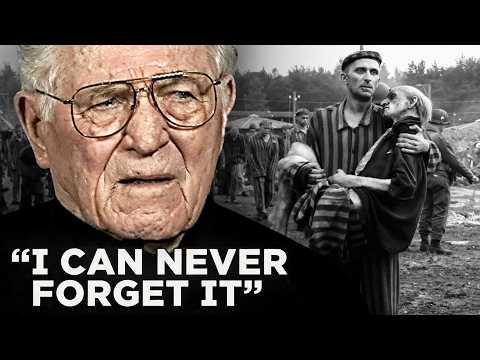
The camp was Kaufering IV, a subcamp of Dachau, where over 3,000 prisoners had been crammed into conditions of unimaginable cruelty. By the time Easy Company arrived, most had been marched away or murdered. Only a few hundred skeletal survivors remained, barely alive.
Winters walked among the dead and dying. The stench of death hung in the air. Barracks still smoldered from where the SS had tried to burn them—with prisoners locked inside. “The horror of it is you could never imagine anything like this before,” he said.
He had seen war. He had seen men killed. He had seen suffering in occupied countries. But this was different. This was systematic, industrial, inhuman. “How anybody could think like this, act like this, do something like this to fellow man…” His voice trailed off, the memory still too raw.
In that moment, Winters understood something with crystal clarity. He turned to those around him and said, “Now I know why I’m here.”
It was a phrase that would echo through history. The sacrifice, the blood, the loss—it all made sense now. “This is worse than death,” he later reflected. “This is worse than being shot at.”
But the story doesn’t end here. What Winters saw that day would haunt him forever—and drive him to ensure the world never forgot.
When Winters returned to Easy Company’s position that evening, he found Lewis Nixon already waiting. “You need to see it, Nix,” Winters said quietly. “Every man in this battalion needs to see it.”
Nixon didn’t argue. In the days that followed, word spread through the ranks. General Maxwell Taylor’s order was clear—every able-bodied German from the surrounding towns would be brought to the camps. They would dig graves. They would bury the dead. They would witness what had been done in their name.
Local farmers, shopkeepers, and townspeople arrived with shovels and rakes, many of them pale and trembling. Some claimed ignorance. Others simply wept. The men of Easy Company watched as the citizens of Lansburg came face to face with the truth.
“They knew,” Winters said flatly. “They had to know. Prisoners in striped uniforms had been marched through these towns for years. You can’t smell that stench and not know something terrible was happening.”
Private David Webster, who had always been one of the more observant men in the company, confronted a local baker who complained about soldiers taking food from his shop. Webster’s hand moved to his sidearm. “Are you going to tell me you never smelled the stench?” he demanded. The man stammered, denied everything, and hurried away.
Winters understood the anger. He felt it himself. But he also understood something deeper—this was why they had come. This was why they had crossed an ocean, jumped from planes into darkness, and fought through frozen forests and burning towns.
The survivors who remained at Kaufering IV were transferred to hospitals. Easy Company’s medics did what they could, but the damage was beyond repair. Some prisoners died in the days after liberation, their bodies too far gone to be saved. Others would carry the scars—physical and otherwise—for the rest of their lives.
Winters watched as one survivor, a man barely able to stand, reached out and touched his uniform. The man said nothing. He simply looked at Winters with eyes that held both gratitude and an unfathomable sorrow.
“That look,” Winters later said, “I still see it. I’ll always see it.”
In the weeks that followed, Easy Company would move on—to Berchtesgaden, to occupation duty, eventually home. But Winters carried Kaufering IV with him. He carried the images of the dead, the skeletal survivors, the smoking barracks. He carried the smell of death and the weight of what he had witnessed.
The war in Europe was ending, but for the men of Easy Company, a different kind of reckoning had begun. They had trained to fight soldiers, not to bear witness to the machinery of genocide. And yet, as the days passed, the scale of what they had uncovered only grew clearer.
“Dachau had over a hundred subcamps,” Winters later explained to those who would listen. “Kaufering was just one of eleven in that network alone. And Dachau itself was one of thousands.” The numbers were staggering—over 44,000 camps and detention sites established by the Nazi regime across occupied Europe.
He thought often of the prisoners who had been marched away before liberation. Thousands from the Kaufering camps had been forced onto death marches toward Dachau, collapsing from exhaustion or shot where they fell. The survivors Easy Company found were the ones too sick to move—the ones the SS had left behind to die.
What troubled Winters most was not just the cruelty, but the proximity of it. The camps were not hidden in remote wilderness. They sat beside towns, near farms, within sight of church steeples. “Some locals even rented prisoner labor for their businesses,” he noted with disgust. “They couldn’t claim they didn’t know.”
General Eisenhower had toured the Ohrdruf camp days earlier and was shaken to his core. He ordered that every soldier who could be spared be sent to witness the camps firsthand. Photographs were taken. Reports were filed. The evidence was meticulously documented so that no one could ever dismiss it as propaganda.
Winters understood the logic. “Ike wanted the world to see,” he said. “He wanted it on record. He wanted it undeniable.” It was a grim task, but a necessary one.
Years later, when the documentary series Band of Brothers brought Easy Company’s story to millions, Winters watched with a mixture of gratitude and unease. The filmmakers had drawn from historical photographs and newsreels, and the depiction was largely accurate. But some things, he felt, could never be fully captured.
“What I saw was worse than what they showed,” Winters admitted in an interview preserved by the Gettysburg Museum of History. “Much worse. You can’t put that on film. You can’t make people understand.”
The series had shown Easy Company discovering the camp, but in truth, it was the 12th Armored Division that had arrived first. Frank Perconte and his patrol, including Bull Randleman, had stumbled upon it a day later. Perconte had gotten word to Winters, though he hadn’t personally delivered the news as the series depicted.
These details mattered to Winters, not out of pride, but out of fidelity to the truth. The men who had been there deserved accuracy. The prisoners who had suffered deserved to have their story told correctly.
He thought of the survivor who had touched his uniform, the one with the eyes that held both gratitude and sorrow. “He didn’t say a word,” Winters recalled. “He didn’t have to. That look said everything.”
It was that look—and the memory of the dead, the skeletal living, the smoking barracks—that Winters carried home with him. He would carry it for the rest of his life.
And he would speak of it, whenever asked, so that the world would never forget.
In his later years, Winters rarely spoke of the war unless asked. But when he did, he always returned to that April day. “I can remember very distinctly saying, ‘Now I know why I’m here,'” he recalled. “This made any sacrifice that I’m giving of myself or the rest of us are giving—this is worth it.”
He kept a simple faith that the men who fought and died had done so for something that mattered. Kaufering IV was the proof. It was the answer to every question about why they had come.
Historians would later note that an estimated 50,000 to 100,000 American soldiers witnessed the camps firsthand. Winters was one of them—not a liberator in the strictest sense, but a witness. And witnesses, he believed, had a duty.
“You can never forget it,” he said. “And never understand it.” That paradox stayed with him: the memory that would not fade, and the understanding that would never come.
Of the 30,000 prisoners held across the eleven Kaufering camps, an estimated 14,500 died before liberation. They were a fraction of the six million Jews and millions of others murdered in the Holocaust—a number so vast it defies comprehension.
Winters understood that the men of Easy Company had been changed forever. They had trained to fight soldiers, not to bear witness to genocide. Yet they had done both. And in doing so, they had helped ensure that the truth could never be denied.
He returned to Pennsylvania, built a quiet life, raised a family, and rarely sought attention. But when filmmakers and historians came calling, he answered. He told the story plainly, without embellishment, because the truth was terrible enough.
“The horror of it is you could never imagine anything like this before,” he said. “You can never forget it. And never understand it.”
That was his final word on the matter—a soldier’s testimony, offered without bitterness, rooted in a simple conviction that the world must remember what happened at places like Kaufering IV.
What do you think—does remembering such horrors today still carry the same weight it did for Winters and his men, or have we grown too distant from the truth they witnessed?
Report this article
Select a reason for reporting:






