The mess hall fell silent the moment Technical Sergeant Martin O’Brien carried in the cake. It rose impossibly high, its surface pristine and cloudlike under the harsh fluorescent lights—a dessert that seemed to defy gravity itself. Twenty-eight German women prisoners stopped mid-sentence, their forks frozen in the air. None of them had seen anything like it in years. Some had never seen anything like it at all.
At the far table near the windows, twenty-four-year-old Rosemary Waldner stared, her heart pounding. The cake looked like something from a dream—or from the bakery windows of her childhood in Munich before the war had consumed everything beautiful. When Sergeant O’Brien began cutting into perfect triangular slices, handling each piece as though it were made of spun sugar, Rosie noticed how gently he moved, as if the dessert might dissolve at a rough touch.
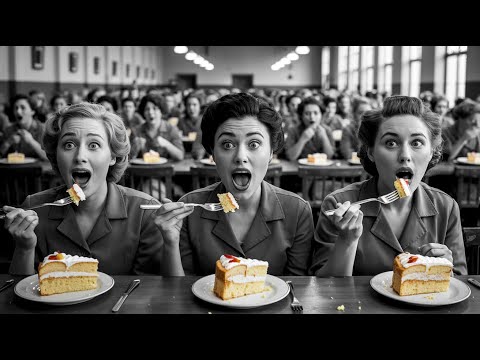
Nineteen-year-old L Reinhardt, the youngest among them, received her slice first. Her eyes widened as she leaned close to Rosie and whispered in German, her voice a mixture of wonder and confusion. “Rosie, what did Sergeant O’Brien call this?”
Rosie had been practicing her English diligently since arriving at Camp Crossville, serving as an informal translator between the German prisoners and their American captors. She had heard the sergeant’s announcement clearly, but even she found herself uncertain about the translation.
“He said it’s called angel food cake,” Rosie replied slowly, testing the English words on her tongue before translating. “Engelkuchen.”
L’s fork paused above her plate. She looked at the cake, then at Rosie, then back at the cake with an expression of genuine bewilderment. Around their table, other women were having similar quiet conversations, their faces reflecting the same confusion that would soon transform into something else entirely.
“But Rosie,” L said, her voice barely audible, “do the Americans have access to angels? Is that why they can make such things?”
The question hung in the air like the cake itself seemed to hang in defiance of weight and gravity. Rosie opened her mouth to explain, to clarify the metaphorical nature of the name, but found herself momentarily speechless. How could she explain that this was merely a name—a fanciful American description—when everything about their experience in this camp had already defied explanation?
They had arrived expecting cruelty and had found unexpected kindness. They had anticipated starvation rations and had received abundance. They had prepared for hatred and had encountered curiosity, even compassion. In a world where nothing made sense anymore, where enemies fed you better than your own country had in years, was it really so strange to wonder if angels might be involved?
November 8th, 1944. The transport truck rumbled through the gates of Camp Crossville just as the Tennessee sun was setting behind the Cumberland Mountains. Inside the covered vehicle, twenty-eight German women sat in tense silence, their hands gripping the wooden benches beneath them as the truck navigated the unpaved road leading into the compound. They wore the remnants of their gray auxiliary uniforms, some still bearing the insignia they had once worn with a pride that now felt like it belonged to a different lifetime entirely.
Rosemary Waldner pressed her face close to the small gap in the canvas cover, trying to catch glimpses of what awaited them. She had been captured three weeks earlier in Belgium, serving as a translator for a Wehrmacht communications unit that had been overrun during the Allied advance. The journey from Europe to America had been long and disorienting, filled with uncertainty about what treatment they would receive as female prisoners of war in enemy hands.
Beside her sat Freda Hartman, twenty-six years old, who had served as a medical auxiliary in field hospitals across France. Freda’s hands trembled slightly as she clutched a small metal tin containing the last photograph she had of her family in Hamburg. She had not heard from them in eight months. Across from them, twenty-two-year-old Clara Lindemann stared at her boots, her face carefully composed into an expression of stoic defiance that barely masked her fear.
The truck jerked to a stop and the canvas flap was pulled back by an American soldier. Bright lights flooded into the dim interior, causing several women to shield their eyes. A female voice called out in English, clear and authoritative, but not unkind. “Everyone out. Form two lines. Leave your belongings in the truck for now.”
Rosie understood enough English to translate for the others, though her voice wavered as she spoke. They climbed down from the truck one by one, their legs stiff from the long journey, and assembled in the courtyard of what appeared to be a converted Civilian Conservation Corps camp. Wooden barracks surrounded them on three sides, and in the fading light, they could see guard towers at each corner of the compound.
Major Francis Caldwell stood before them in her crisp uniform, her auburn hair pinned neatly beneath her service cap. She was in her mid-thirties, and her face carried the kind of weathered competence that came from years of military service. She studied the assembled prisoners with an expression that Rosie could not quite read. It was not hostile, but neither was it warm.
“I am Major Caldwell,” she said in English, speaking slowly and clearly. “You are now prisoners of war under the protection of the United States Army and the Geneva Convention. You will be treated fairly and humanely. Does anyone here speak English?”
Rosie hesitated for only a moment before raising her hand slightly. Her heart pounded as Major Caldwell’s gaze fixed on her.
“What is your name?” the major asked.
“Rosemary Waldner,” she replied in careful English. “I was translator. Auxiliary corps.”
Major Caldwell nodded. “You’ll be useful then. Welcome to Camp Crossville.”
The first morning at Camp Crossville brought a shock that none of the German women had prepared themselves for. When Technical Sergeant Martin O’Brien’s kitchen staff began serving breakfast, the prisoners stood in line, expecting the thin gruel and stale bread that had become standard fare in wartime Germany. What they received instead challenged everything they understood about imprisonment and scarcity.
Rosie held her metal tray as an American private placed two fried eggs on it, followed by three strips of bacon, a generous portion of fried potatoes, two slices of buttered toast, and a ladle of thick white gravy. She stared at the tray, certain there had been some mistake. Behind her, she heard L gasp audibly as she received a similar portion.
“Is this real?” Clara whispered in German as they found seats at one of the long tables. “Are they trying to poison us?”
Freda, who had medical training, examined her food carefully before speaking. “If they wanted to poison us, they wouldn’t waste this much food doing it. This is more than I’ve seen on a single plate in two years.”
Matilda Bergman, a twenty-eight-year-old who had worked in military kitchens before her capture, was nearly in tears. “Do you know how many people in Germany could be fed with what they’ve given just us? My sister wrote that they were eating turnips and potato peels. This is bacon. Real bacon.”
The other tables of German women were having similar conversations, their voices a mixture of disbelief, guilt, and hunger that had gone unsatisfied for so long. Some ate quickly, as if afraid the food might be taken away. Others ate slowly, savoring each bite as though it might be their last meal of such quality.
Technical Sergeant O’Brien moved through the mess hall with his staff, checking that everyone had been served. He was a stocky Irishman from Boston, somewhere in his early forties, with graying red hair and a face that seemed naturally inclined toward smiling. He paused near Rosie’s table and noticed that several of the women were crying quietly as they ate.
“Translator,” he called to Rosie, “ask them if something’s wrong with the food.”
Rosie wiped her own eyes and stood, embarrassed to be caught showing emotion. She explained in English, searching for the right words. “No, Sergeant, the food is very good. They cry because it is too good. In Germany now, there is very little food. We did not expect to eat like this as prisoners.”
O’Brien’s expression shifted to something resembling compassion. He cleared his throat and spoke more gently. “Well, you’re in America now. Nobody goes hungry here if I can help it. Tell them to eat up. There’s more if anyone wants seconds.”
The concept of seconds seemed almost fantastical. Johanna Steiner actually laughed at the absurdity. “More,” she repeated in German. “He says there’s more.”
That first breakfast set a pattern that would continue. Lunch brought thick sandwiches with real meat. Dinner included roasted chicken, mashed potatoes with butter, and for dessert, canned peaches that tasted like liquid sunshine. The third week of November brought the first cold snap to Tennessee—and with it, a gesture that would begin to crack the carefully maintained walls between captors and prisoners.
Corporal Samuel Levenson had been assigned to the evening guard rotation, walking the perimeter of the women’s barracks as temperatures dropped below freezing for the first time since their arrival. Sam was twenty-three years old, a Jewish soldier from Brooklyn whose grandmother had immigrated from Poland two decades earlier. He had grown up hearing Yiddish in his home, a language that shared certain Germanic roots, and he found himself understanding fragments of the prisoners’ conversations.
On this particular evening, he overheard L and Clara talking through the barracks window about the cold, about memories of winter celebrations, about the smell of fresh bread baking in their childhood homes. The next morning, Sam approached Technical Sergeant O’Brien in the kitchen before breakfast service began.
“Sergeant, I have a favor to ask,” Sam said. “My grandmother taught me how to make challah before she passed. It’s a braided bread we eat on Sabbath. With your permission, maybe I could use the kitchen during my off hours to bake some for the prisoners. They’ve been talking about missing fresh bread from home.”
O’Brien studied the young corporal for a long moment, wiping flour from his hands. “You want to bake bread for German prisoners? Bread from a Jewish recipe?”
“Yes, Sergeant. They’re just girls, really—scared and far from home. My grandmother always said bread was how you showed people they mattered.”
O’Brien nodded slowly. “You’re doing it on your own time, and you’re cleaning up after yourself.”
Two days later, on a Friday evening, Sam carried four golden loaves of braided challah into the mess hall during dinner service. The smell preceded him, filling the room with a warm, yeasty aroma that triggered something primal in the German women. Conversation stopped. Matilda stood up from her seat, her eyes fixed on the loaves.
Sam set the bread on the serving counter and began slicing it, the knife cutting through the soft interior to reveal its tender, slightly sweet crumb. He placed a slice on each prisoner’s tray as they came through the line. Rosie was among the first to taste it. The bread was still slightly warm, and when she bit into it, the flavor transported her instantly back to her mother’s kitchen in Munich—to Sunday mornings when the whole family would gather around fresh baked goods. The texture was different from what she remembered, slightly richer perhaps, but the essence was the same.
She looked across the mess hall and caught Sam’s eye. He was watching the women eat, his expression uncertain. Rosie stood and walked over to him, aware that every eye in the room was following her.
“Corporal,” she said in her careful English. “This bread is very good. Thank you for making it for us. It tastes like home.”
Sam nodded, his throat tight with emotion he hadn’t expected to feel. “You’re welcome, miss. Everyone deserves fresh bread.”
That evening, the women talked late into the night in their barracks. They spoke of the strange contradiction of their captivity—how an enemy soldier who had every reason to hate them had instead spent his free time baking bread to comfort them. It was a small gesture, but it planted a seed that would grow into something none of them had anticipated when they first arrived at Camp Crossville.
December 24th, 1944, arrived with unexpected snow covering the Tennessee hills. Inside the mess hall at Camp Crossville, Technical Sergeant O’Brien had been preparing for three days straight, transforming the utilitarian space into something that resembled a celebration rather than a prison dining facility. He had convinced Major Caldwell that maintaining morale during the holidays—even for prisoners—was sound military policy. What he didn’t tell her was that he had become personally invested in these young women who had arrived so broken and fearful just six weeks earlier.
The tables had been arranged differently, pushed together to form one long configuration instead of the usual separate groupings. Red and green paper chains made by the prisoners during their recreation time hung from the ceiling beams. Someone had fashioned a small tree from pine branches decorated with folded paper stars that Clara had taught the others to make using old newspaper.
When the women filed in for dinner that evening, they stopped at the doorway, stunned by the transformation. Major Caldwell stood near the head of the table, dressed in her formal uniform rather than her usual duty clothes. Beside her stood Corporal Levenson and several other guards who had volunteered to serve the meal rather than simply oversee it.
“Ladies,” Major Caldwell said, waiting for Rosie to translate. “Tonight we observe Christmas Eve together. You are far from your homes and families, but you are still human beings deserving of dignity—and on this night especially, of fellowship. Please be seated.”
What followed was a meal that none of the German women would ever forget. Sergeant O’Brien and his kitchen staff brought out roasted turkey with herb stuffing, mashed potatoes swimming in rich gravy, glazed carrots, fresh rolls with butter, cranberry sauce, and green beans almondine. The portions were generous, the presentation careful, the whole affair orchestrated with a level of attention that spoke of genuine care rather than mere obligation.
Freda wept openly as she ate, not bothering to hide her tears. Matilda kept shaking her head in disbelief, unable to reconcile this treatment with everything she had expected from enemy captivity. Young L, who had maintained a shell of adolescent bravado since their arrival, finally allowed herself to look her age, her face softening with each bite of food that tasted like the holidays she remembered from childhood.
Halfway through the meal, Johanna stood up suddenly. She looked at Major Caldwell and spoke in halting English that she had been practicing with Rosie for weeks. “Major Caldwell, we want—we wish to say thank you. This is—this is very kind. We do not deserve such treatment.”
The major’s expression remained composed, but Rosie noticed a slight shift in her eyes—a moment of human connection breaking through military professionalism. “Everyone deserves a decent Christmas dinner, Miss Steiner. Even in wartime, we must remember what we’re fighting to preserve. Decency, humanity, the belief that we can be better than our worst impulses.”
For dessert, Sergeant O’Brien brought out apple pie with vanilla ice cream. As the women tasted the combination of warm spiced apples and cold sweet cream, something fundamental shifted in the mess hall. The invisible wall that had separated prisoners from captors began to crumble, replaced by something more complex, more hopeful, and far more dangerous to the simple categories that war demanded.
January 1945 brought bitter cold to Tennessee—and an unexpected proposal from Mrs. Patricia Ashford, a local school teacher who had been visiting the camp as part of a church outreach program. She arrived one Thursday afternoon carrying a cardboard box filled with worn cookbooks, recipe cards, and handwritten collections that had been donated by women throughout the surrounding community.
Major Caldwell had been skeptical at first when Mrs. Ashford presented her idea. Teaching English to enemy prisoners seemed unnecessary, perhaps even dangerous. But Mrs. Ashford had argued persuasively that occupied time was peaceful time, and that language skills would ease communication and reduce tensions within the camp. Besides, she had said, what harm can come from teaching them to read recipes? If anything, it will help them understand Sergeant O’Brien’s kitchen instructions better.
The first lesson took place in the mess hall on a Saturday morning. Fifteen German women attended voluntarily, including all of Rosie’s closest companions. Mrs. Ashford spread recipe cards across the tables, each one featuring a different American dish with ingredients and instructions written in clear, simple English.
“We’ll start with something basic,” Mrs. Ashford announced, holding up a card. “Chocolate chip cookies.” She wrote the words on a makeshift chalkboard, pronouncing each syllable slowly. The women repeated after her, their accents heavy but their attention complete.
For Rosie, who already had a foundation in English, the lesson moved quickly. But she watched Freda struggle with the unfamiliar sounds, her medical training having included no language instruction. L, the youngest, approached the lesson with the same fearless enthusiasm she brought to everything. She sounded out words phonetically, mangling pronunciations in ways that made even Mrs. Ashford smile. When she attempted to say “tablespoon,” it came out as something that sounded more like “tablespoon,” her German accent refusing to cooperate with the English sounds.
Over the following weeks, the lessons became a fixture of camp routine. Mrs. Ashford visited three times weekly, each time bringing new recipes and new vocabulary. The women learned terms like simmer, fold, whisk, and cream. Together, they puzzled over measurements, trying to convert cups and teaspoons into the metric system they knew from home.
Clara discovered she had a talent for pronunciation. Her ear for the rhythms of Morse code translated surprisingly well to the cadences of English speech. Johanna approached the language with administrative precision, creating neat lists of vocabulary words organized by category. Matilda, with her kitchen experience, grasped cooking terminology immediately, often demonstrating techniques to help others understand the words.
The recipe cards became treasured possessions. The women kept them in their footlockers, studying them during evening hours, quizzing each other on ingredients and instructions. Some copied the recipes into notebooks, translating them into German in one column while keeping the English original in another.
Technical Sergeant O’Brien noticed the change during meal services. The women began asking questions about the food in halting English rather than relying solely on Rosie to translate. They wanted to know how dishes were prepared, what ingredients were used, why certain techniques produced specific results. His kitchen became an informal classroom where language learning happened through the universal medium of food.
By late February, most of the women could conduct basic conversations in English. More importantly, they had found a bridge between their world and the American one.
March 15th, 1945. The day began like any other at Camp Crossville, with morning formations and work assignments that had become routine over the past four months. But Technical Sergeant O’Brien had been planning something special—a dessert he had been perfecting in his off hours, waiting for the right moment to introduce it to the German women who had become far more than simple prisoners under his watch.
Angel food cake was a particular point of pride for O’Brien. His mother had taught him the technique years ago, explaining how the delicate balance of egg whites and sugar created something that seemed to defy the laws of baking. It required patience, precision, and a gentle hand. He had made three practice versions before feeling confident enough to serve it to the women.
That afternoon, he carried the tall white cake into the mess hall on its special pedestal plate. The cake rose nearly six inches high, its surface perfectly smooth and pale as fresh snow. Conversations quieted as women turned to look at what he was bringing to the serving counter. Even from across the room, they could see that this dessert was different from anything they had been served before.
Rosie stood in line with L, Freda, and Clara, watching as O’Brien began cutting the cake with a serrated knife. The blade moved through it easily, revealing an interior texture so light and airy it barely seemed substantial. When O’Brien placed the first slice on L’s tray, the young woman stared at it with undisguised wonder.
“What is this called, Sergeant?” Rosie asked in English, her vocabulary now strong enough for casual conversation.
“Angel food cake,” O’Brien replied with obvious satisfaction. “It’s made mostly from egg whites. Light as air, sweet as can be. My mother’s specialty.”
Rosie translated for the others, carefully pronouncing the English words first before rendering them in German. “Engelkuchen,” she said. “Food of angels.”
The translation rippled through the mess hall as women received their slices and carried them back to tables. L sat down and picked up her fork, but didn’t immediately eat. Instead, she examined the cake closely, turning her fork to view it from different angles. Her brow furrowed in concentration.
“Rosie,” she said slowly in German, her voice loud enough that nearby tables could hear. “If this is food of angels, does that mean the Americans have angels in their kitchens? Is that how they make such things?”
The question was asked with complete sincerity. L looked genuinely confused, as if trying to work out the logistics of celestial beings involved in American food preparation. Several women at neighboring tables had stopped eating to listen, their own expressions suggesting they had been wondering the same thing.
For a moment, the mess hall hung in suspended silence. Then Freda began to laugh—a genuine sound of mirth that startled everyone, including herself. The laughter spread like a wave through the room, touching even the American guards, who didn’t fully understand what had been said but recognized the breakthrough moment for what it was.
Rosie tried to explain through her own laughter that it was merely a name, that no actual angels were involved. But the absurdity of having to clarify this—combined with months of tension finally releasing—made the explanation nearly impossible.
Late March 1945 brought news from Europe that made the comfortable routines at Camp Crossville feel like a betrayal. Reports arrived of Allied forces advancing deeper into Germany, of cities reduced to rubble, of civilian populations fleeing westward with whatever possessions they could carry. The German women gathered around newspapers and radio broadcasts, trying to piece together what was happening to their homeland, to their families, to everything they had known before the war.
Freda sat in the recreation room with a piece of paper in front of her, a pen held motionless in her hand. She had been trying to write a letter to her mother in Hamburg for over an hour, but the words refused to come. How could she explain that she was eating three full meals a day while her family might be starving? How could she describe the kindness she had received from enemy soldiers while Allied bombs fell on German cities?
Major Caldwell had given permission for the women to write letters home, though she had been honest about the likelihood of them reaching their destinations. Mail service to Germany was virtually non-existent, and even if letters could be sent, there was no guarantee that the recipients were still alive or at their last known addresses. Still, she believed the act of writing might provide some comfort—some way to process the guilt and confusion that had been building in the prisoners since their capture.
Rosie wrote to her parents in Munich, describing her daily life in careful terms that omitted the abundance she had experienced. She mentioned learning English, helping with translation work, the kindness of some guards. She did not mention the angel food cake, the Christmas feast, or the fresh bread that had tasted like home. Those details felt obscene when she imagined her mother reading them while scavenging for turnips and potato peels.
L’s letter to her sister was more honest—perhaps because of her youth, or perhaps because she had not yet learned to filter her emotions through adult restraint. She wrote about the food, the warmth, the unexpected humanity of their captors. Then she crossed it all out and started again, trying to find words that would not sound like she had forgotten what side she was supposed to be on.
Clara didn’t write at all. She had received news through the Red Cross two weeks earlier that her family’s apartment building in Dresden had been destroyed in the February bombing raids. There was no information about survivors, no forwarding address, no one left to receive her words even if they could be delivered.
Matilda wrote recipe after recipe in her letter, filling pages with instructions for American dishes she had learned to prepare in Sergeant O’Brien’s kitchen. At the bottom of the final page, she added a single line: “I hope when you read this, there will be ingredients available to make these things. I hope you are alive to read this at all.”
That evening, Major Caldwell collected the letters. She promised to send them through military channels, to do whatever was possible to ensure their delivery. The women handed over their pages with expressions that suggested they understood the futility but appreciated the gesture nonetheless.
The letters were never sent. Within weeks, Germany would surrender, rendering the entire exercise moot.
May 8th, 1945. Victory in Europe Day arrived at Camp Crossville with church bells ringing in the distant town and American guards celebrating the end of the war on their continent. For the German women prisoners, the day brought no such clarity. They gathered in the mess hall that afternoon, summoned by Major Caldwell for an announcement that everyone knew was coming but no one felt prepared to hear.
Major Caldwell stood at the front of the room in her dress uniform, her expression neither celebratory nor severe. Behind her, Technical Sergeant O’Brien and Corporal Levenson stood at attention, their faces reflecting the complexity of the moment. The war was over, but what that meant for the twenty-eight women assembled before them remained uncertain.
“Ladies,” Major Caldwell began, waiting for Rosie to position herself for translation. “As you have likely heard, Germany has surrendered unconditionally to the Allied forces. The war in Europe is over. Under the terms of the Geneva Convention and orders from the War Department, arrangements will be made for your repatriation. Transportation back to Europe will be organized within the coming weeks.”
Rosie translated the words carefully, watching as understanding settled over her companions’ faces. Freda closed her eyes. L stared at her hands. Clara’s expression remained carefully neutral, but her fingers gripped the edge of the table until her knuckles went white.
“I want to be clear,” Major Caldwell continued, “that you are no longer enemy combatants. You are displaced persons awaiting return to your country of origin. You will be processed through camps in Europe and given assistance in locating your families or finding new accommodations if your homes have been destroyed.”
The words should have brought relief—freedom, the promise of going home. Instead, they settled over the room like a weight that pressed down on every woman present. Rosie found herself struggling to translate, not because she lacked the English vocabulary, but because putting the words into German made them feel more real, more final.
After the announcement, the women returned to their barracks in silence. That evening, they gathered in small groups, speaking in hushed voices about what awaited them in Germany. The reports they had been reading painted a picture of devastation beyond anything they had imagined. Cities in ruins. Millions displaced. Food shortages that made their pre-capture experiences seem mild by comparison. And over it all, the shame of what their country had done—the revelations about concentration camps and atrocities that had shattered any remaining illusions about the cause they had served.
Rosie sat on her bunk thinking about Munich, trying to remember what her neighborhood looked like before she left. She realized she couldn’t conjure the image clearly anymore. Five months at Camp Crossville had changed something fundamental in how she understood the world. She had learned to see Americans not as enemies but as individuals. She had experienced kindness from people who should have hated her. She had tasted angel food cake and learned to laugh again.
The question that haunted her as darkness fell was simple but impossible to answer: After everything that had happened here, after all the small transformations and unexpected moments of grace, could she simply return to being German again? Did that Germany even exist anymore?
June 20th, 1945. The morning of departure arrived with clear skies and a tension that had been building for weeks. The German women stood in the courtyard with their few belongings packed into small bags, waiting for the transport trucks that would take them to the port in Norfolk, then to ships bound for Europe. They wore civilian clothes now—donated by local churches—their auxiliary uniforms having been disposed of weeks earlier.
Technical Sergeant O’Brien appeared from the kitchen carrying a wooden box. He walked directly to Rosie and set it down at her feet. Inside were neatly organized stacks of recipe cards, each one handwritten in O’Brien’s careful script. Recipes for everything they had learned to make during their time at Camp Crossville: chocolate chip cookies, apple pie, pot roast, fried chicken. And there, on top of the stack, the recipe for angel food cake.
“Thought you might want these,” O’Brien said, his voice gruff with emotion he was trying to hide. “For when things get better over there. When you have kitchens again and ingredients to work with. So you can remember that even in the worst of times, people can still choose to be kind to each other.”
Rosie accepted the box with trembling hands. She wanted to say something profound—something that would adequately express what these months had meant, how completely they had changed her understanding of enemies and friendship and the possibility of redemption. Instead, she managed only two words in English: “Thank you.”
The other women gathered around, each taking a small stack of recipe cards to distribute the weight among their bags. L held the angel food cake recipe, reading it carefully as if memorizing every instruction. Freda tucked her cards into the metal tin where she kept her family photographs, the recipes becoming part of her most precious possessions.
Major Caldwell stood nearby watching the exchange. She had written letters of reference for each woman—documents that might help them find work or housing in occupied Germany. But she knew that the real value lay not in official papers but in the transformations these women had undergone, the lessons they would carry with them about the possibility of human connection even across the deepest divides.
Corporal Levenson approached the group, addressing them directly in his halting German. “Gute Reise,” he said. “Safe journey. Forge—forget—” He stumbled, then switched to English. “Don’t forget.”
As if they could forget. As if any of them could return to Germany and simply resume the lives they had lived before. As if angel food cake and fresh bread and Christmas dinners had not fundamentally altered their understanding of what America represented—and what they themselves were capable of becoming.
The trucks arrived. The women climbed aboard, clutching their bags and their recipe cards. As the vehicles pulled away from Camp Crossville, Rosie looked back at the compound that had been her home for seven months. It had been a prison, yes. But it had also been something else entirely: a place where enemies had learned to see each other as human beings, where kindness had proven more powerful than hatred, where a simple dessert called angel food cake had sparked laughter and questions about whether angels were real.
Years later, in kitchens across rebuilt Germany, women would pull out worn recipe cards and bake American desserts, teaching their children and grandchildren about the time when their enemies had shown them unexpected grace. And they would remember the young translator who had first put into German the words that had changed everything: “Engelkuchen—food of angels.”
But the story did not end there. For Rosie, the recipe cards became a bridge between two worlds—a reminder that even in the darkest of times, humanity could prevail. And as she watched the Tennessee hills fade in the distance, she wondered: Could the lessons learned at Camp Crossville ever truly be carried home, or would they remain forever confined to that small patch of American soil?
Report this article
Select a reason for reporting:






